


Control Line Aerobatics
Bob Hunt
A hot case of the intake chills
I had promised to have the newly re-refitted electric-powered Genesis Extreme test-flown by the time this column was due, and I almost made it. Apologies all around for not hitting my target date for this project; a back issue threw a painful monkey wrench into my schedule! Before being sidelined, I was able to do a bit more work on the retrofit.
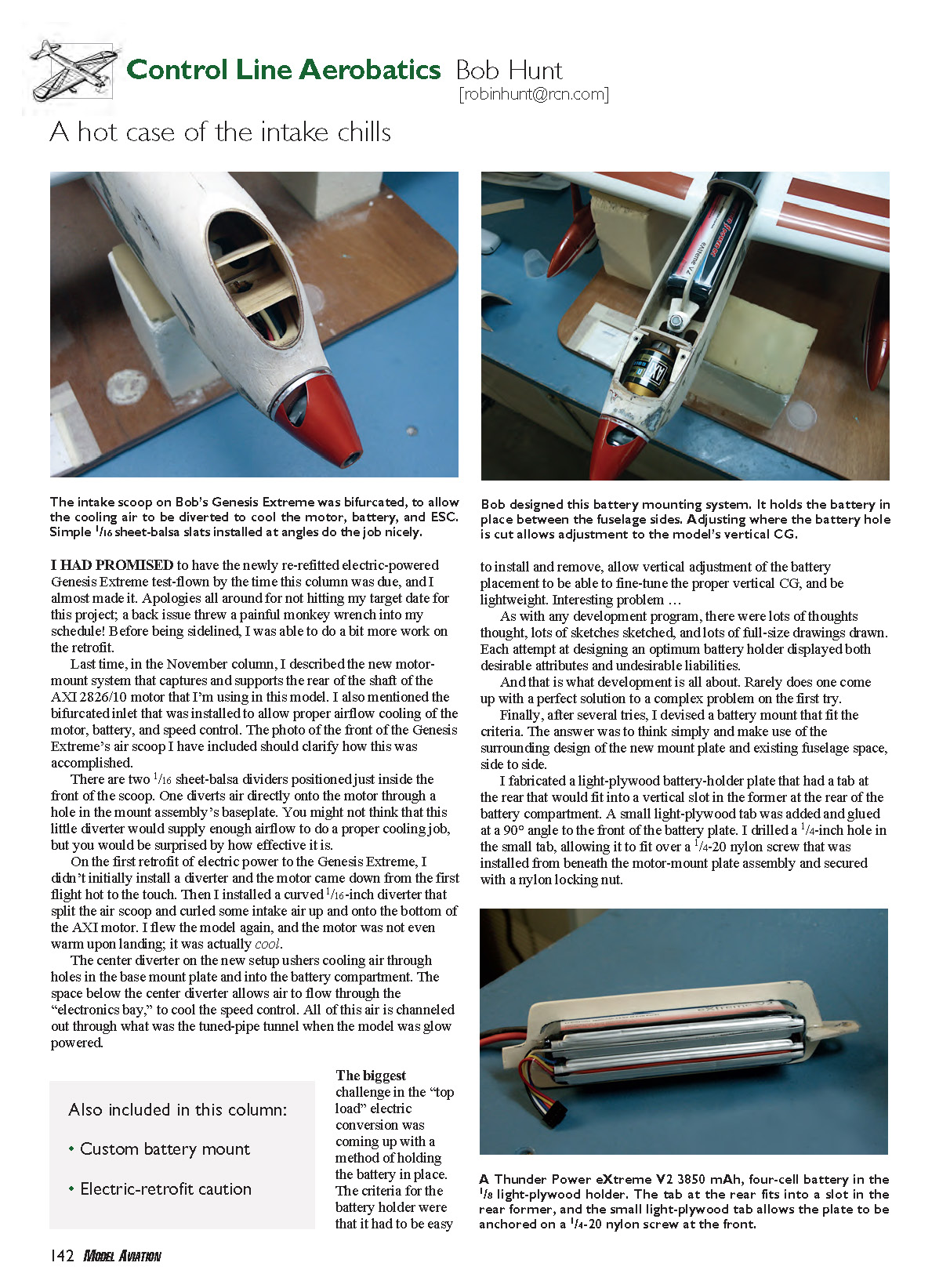
Last time, in the November column, I described the new motor-mount system that captures and supports the rear of the shaft of the AXI 2826/10 motor that I'm using in this model. I also mentioned the bifurcated inlet that was installed to allow proper airflow cooling of the motor, battery, and speed control. The photo of the front of the Genesis Extreme’s air scoop should clarify how this was accomplished.
There are two 1/16-inch sheet-balsa dividers positioned just inside the front of the scoop. One diverts air directly onto the motor through a hole in the mount assembly's baseplate. You might not think that this little diverter would supply enough airflow to do a proper cooling job, but you would be surprised by how effective it is.
On the first retrofit of electric power to the Genesis Extreme, I didn't initially install a diverter and the motor came down from the first flight hot to the touch. Then I installed a curved 1/16-inch diverter that split the air scoop and curled some intake air up and onto the bottom of the AXI motor. I flew the model again, and the motor was not even warm upon landing; it was actually cool.
The center diverter on the new setup ushers cooling air through holes in the base mount plate and into the battery compartment. The space below the center diverter allows air to flow through the electronics bay to cool the speed control. All of this air is channeled out through what was the tuned-pipe tunnel when the model was glow powered.
The biggest challenge in the "top load" electric conversion was coming up with a method of holding the battery in place. The criteria for the battery holder were that it had to be easy to install and remove, allow vertical adjustment of the battery placement to fine-tune the proper vertical CG, and be lightweight. Interesting problem.
As with any development program, there were lots of thoughts thought, lots of sketches sketched, and lots of full-size drawings drawn. Each attempt at designing an optimum battery holder displayed both desirable attributes and undesirable liabilities. And that is what development is all about. Rarely does one come up with a perfect solution to a complex problem on the first try.
Finally, after several tries, I devised a battery mount that fit the criteria. The answer was to think simply and make use of the surrounding design of the new mount plate and existing fuselage space, side to side.
I fabricated a light plywood battery-holder plate that had a tab at the rear that would fit into a vertical slot in the former at the rear of the battery compartment. A small light-plywood tab was added and glued at a 90° angle to the front of the battery plate. I drilled a 1/4-inch hole in the small tab, allowing it to fit over a 1/4-20 nylon screw that was installed from beneath the motor-mount plate assembly and secured with a nylon locking nut. A fiberglass arrow shaft was slid over the 1/4-20 nylon bolt, and that supplied a resting point for the tab on the battery plate. The length of that piece of arrow shaft determines the height of the front of the battery. Once the plate was installed, a nylon wing nut could be threaded onto the 1/4-20 nylon bolt, and the plate would be held secure. (The photos show a metal nut, because that's all I had at the time.)
I cut out the light-plywood battery-mount plate to allow the battery to be installed from the side with a slight press fit. The battery—a Thunder Power eXtreme V2 3850 mAh, four-cell unit—would sit in the horizontal position between the fuselage sides. The fact that the fuselage is narrow prevents the battery from cocking from side to side until it is secured.
I will add a minute rubber bumper on the outboard side of the battery to ensure that it will not twist in the plywood mounting plate, and apply a couple of small, short beads of clear acrylic glue where the battery contacts the plywood mounting plate.
The really nice feature of this mounting system is that the battery’s vertical placement can be adjusted by making several plates with the opening for the battery in different positions relative to the motor’s thrustline. All you need to do is test-fly the airplane with the battery at different vertical positions until you determine which one is best, and then duplicate that plate as many times as required to accommodate all the batteries you intend to use in that model.
It may sound complicated, but a look at the accompanying photos should clarify the battery mounting system.
If you are going to use the preceding system in an aircraft with a wider-than-normal fuselage, you might have to make two battery mounting plates and center the battery between them to prevent it from cocking from side to side under load. In that case, you would need to make two vertical slots in the aft former to accept the two separate tabs on the battery mount plates. It would be a bit heavier but would retain the attributes of speed of installation/removal and adjustability.
To achieve a proper CG location when using a relatively long battery—such as the Thunder Power eXtreme V2 3850 mAh unit—you may have to relieve the leading edge (LE) of the wing fairly far aft toward the bellcrank mount and the spar system of the typical CL Precision Aerobatics (Stunt) model.
You might have to rethink the design of the wing if you are relying on the inherent monocoque structure of a D-tube or C-tube LE to provide adequate strength from breaking.
I was able to chop out much of this material from my C-tube wing design in the Genesis Extreme, because I install robust basswood tension and compression joiners aft of the spar structure on my designs. I don’t rely on the LE tube structure to provide the bending/breaking strength at that point.
This is important and should be considered before attempting a retrofit of an electric system to a previously glow-powered model.
In a future column, I’ll describe and illustrate this tension and compression joiner system. It can be used on glow- or electric-powered models and allows a glow airplane’s fuel tank to be set very far aft into the wing for balancing purposes. It also doubles as the bellcrank mount.
Till next time, fly Stunt! MA
Sources
- Thunder Power
(702) 228-8883 www.thunderpowerrc.com
- Precision Aerobatics Model Pilots Association
Transcribed from original scans by AI. Minor OCR errors may remain.

