
CONTROL LINE COMBAT
Rich von Lopez, 8334 Colegio Dr., Los Angeles, CA 90045
In 2003 you will see more speed-limit competitions than ever before. The cash-money format for these contests will be in use more and more. The flyers in Central California in the Morgan Hill area advertised a contest in late April that offered a $1,000 first-place prize. I suspect that it will draw quite a few pilots. I also saw on the Combat website that there would be a money contest in the northeast part of the country.
I hope that all of the cash prizes do not ruin the sportsmanship aspect of these speed-limit contests. It never ceases to amaze me to see the killer instincts come out of usually calm modelers when there is money on the line.
The whole point of the 75 mph and 80 mph events was to bring new blood into Combat. Both speeds afford new and veteran pilots time to think and react in a deliberate manner instead of maneuvering at random in the hopes of cutting a streamer.
One issue that has been widely discussed is the use of shutoff devices in the speed-limit events. By rule it is a requirement in 80 mph, but not in 75 mph. Modelers are a resourceful bunch of people who are capable of fantastic inventions when presented with a task. I hope to see voluntary use by anyone who flies Combat.
I have been watching the Speed Channel quite a bit lately because I love all types of racing, be it auto or motorcycle. I did a bit of motorcycle road racing in the early 1970s when I could still fit on a 250cc Grand Prix Yamaha. I like some of the historical films of Formula 1 or AMA (American Motorcycle Association) Grand National events.
When you pay close attention to the equipment that was used back then, you can see tremendous advancements in the safety and reliability of the cars, the motorcycles, and the courses. The size of a tire on a current Superbike resembles that of an early Formula 1 car. The brakes are light-years ahead of the old drum brakes I had to contend with on my production 350cc Kawasaki. These brakes would fade so badly after a spirited ride that the brake lever would go all the way to the grip, and the machine would not stop.
When we know there is a better and safer way of doing things, it's lunacy to go back to inferior methods. It is so unfortunate that it takes a tragedy of a well-known personality to mandate safety changes. I am referring to the death of NASCAR's Dale Earnhardt Sr. and the now-mandated use of head-restraining devices. There are few accidents in model-aircraft Combat, but the potential is real. It is because I love the event that I advocate the use of shutoff devices in all of the events.
Depending on when you get your copy of Model Aviation, the Fédération Aéronautique Internationale (FAI) Combat Team Trials will have taken place or will be happening in a day or two. The Muncie, Indiana, venue is sure to draw a large number of pilots from across the country who will vie for the three U.S. spots plus the one Junior position.
There will not be much difference in equipment from one pilot to the next. The models will be mostly store-bought Ukrainian or Czech-built units that will vary only in how much trimming was done to them after the pilot got them. Those models come close to being competition-ready, but they do require some tweaking. Mike Willcox will be able to sit back and watch or pit knowing that he is the World Champion and will automatically get to defend his title in 2004. This July 4 weekend in Muncie will be full of action.
I purchased a box full of George Cleveland's Louisiana Barracudas for Fast and 80 mph Combat. They are built remarkably well and fly very well. However, you will need to find out where these models balance with your particular engine so that the boom can be cut to the proper length. Some pilots like Henry Nelson's backplate mount; others prefer two individual metal mounts. They will cost you roughly $55 including shipping, depending on how many you buy.
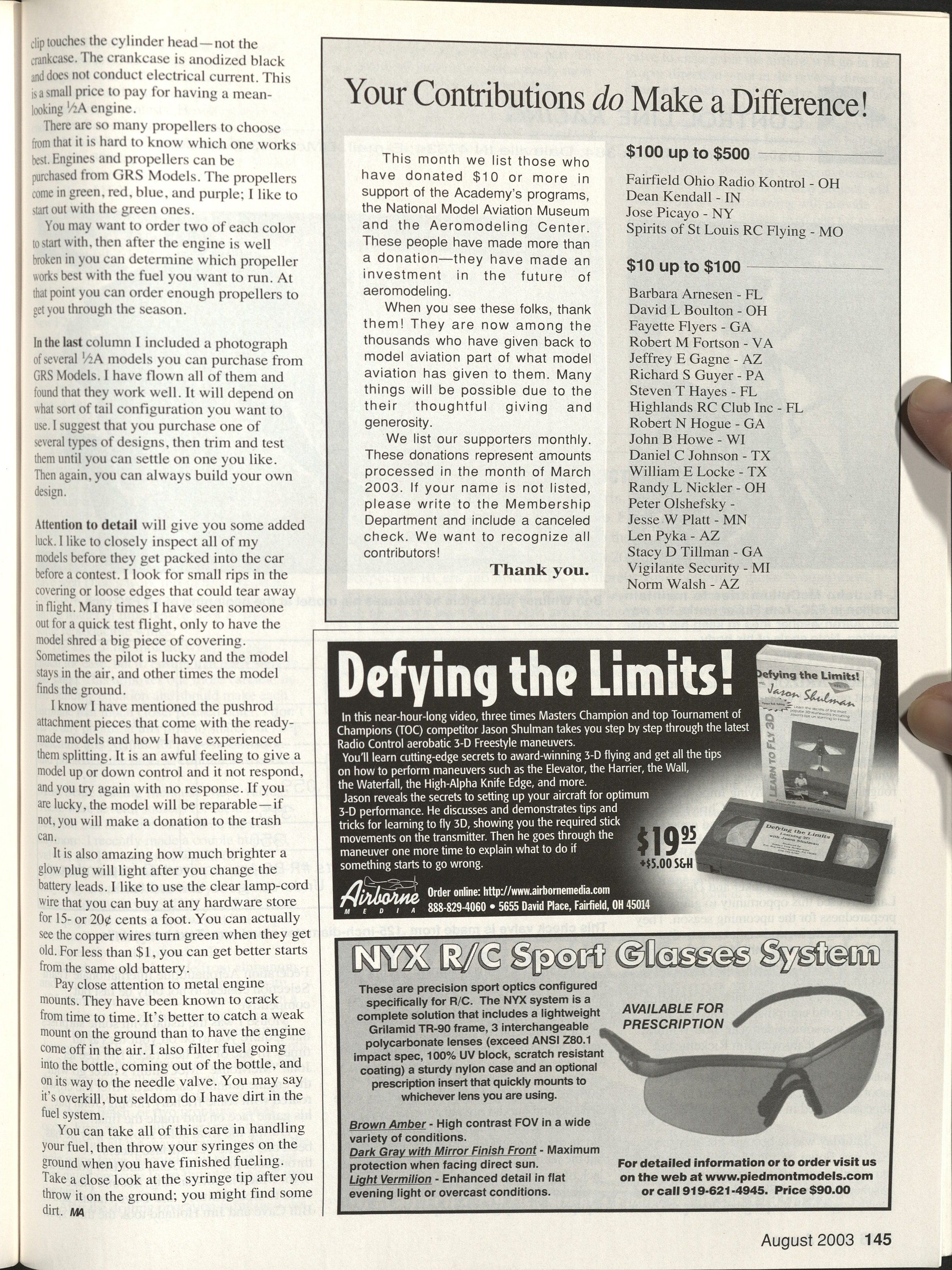
I truly love the way my own-design Fast models fly, but they are labor intensive. A combination of ready-built models with a few of my own will keep me going to contests on short notice. These models stay out on the lines, turn tight, and are easy to fly. George also has a boom version of an Andre Belaiev design for Fast and 80 mph that also works well.
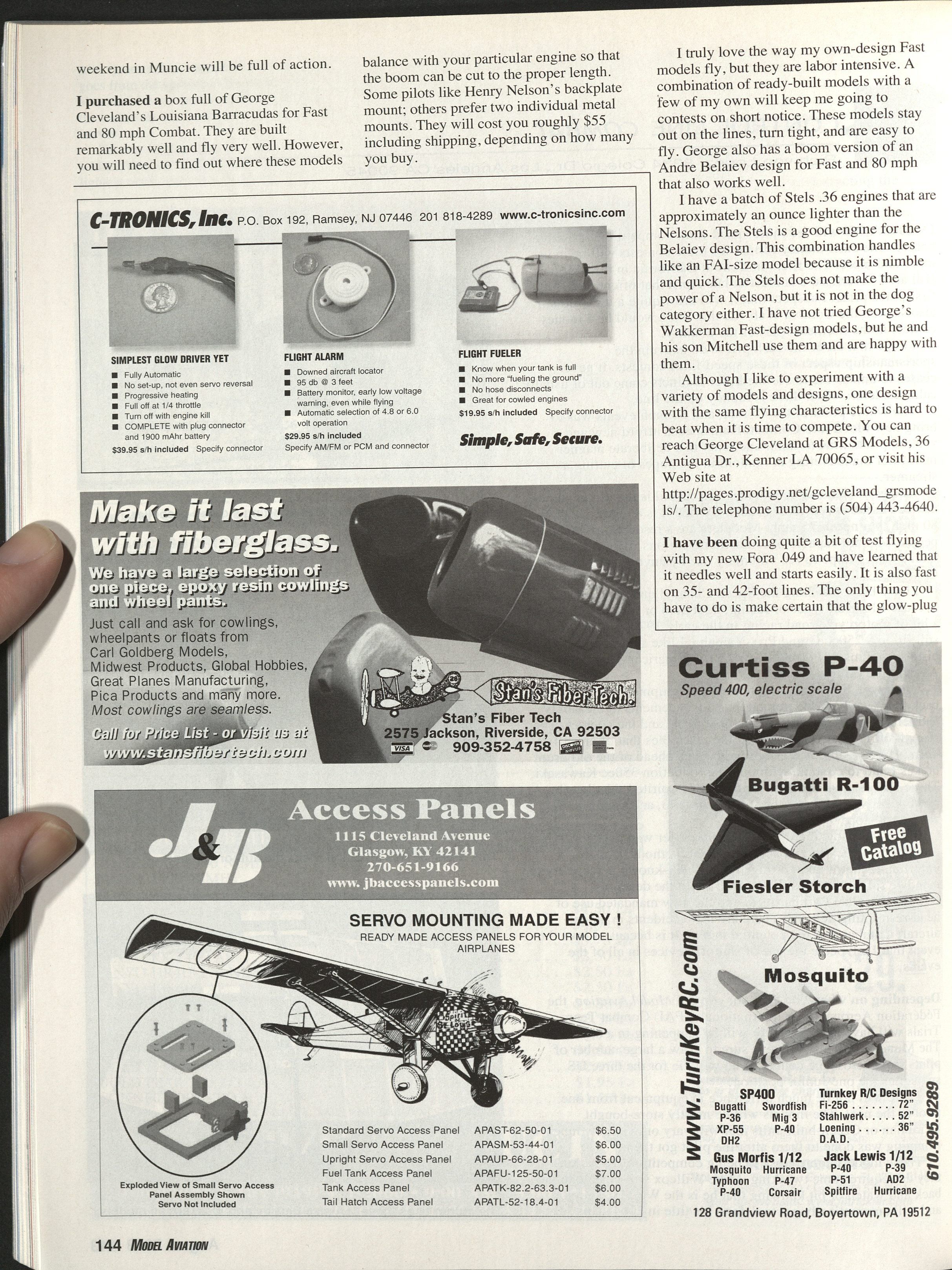
I have a batch of Stels .36 engines that are approximately an ounce lighter than the Nelsons. The Stels is a good engine for the Belaiev design. This combination handles like an FAI-size model because it is nimble and quick. The Stels does not make the power of a Nelson, but it is not in the dog category either. I have not tried George's Wakkerman Fast-design models, but he and his son Mitchell use them and are happy with them.
Although I like to experiment with a variety of models and designs, one design with the same flying characteristics is hard to beat when it is time to compete. You can reach George Cleveland at GRS Models, 36 Antigua Dr., Kenner, LA 70065, or visit his website at http://pages.prodigy.net/gcleveland_grsmodels/. The telephone number is (504) 443-4640.
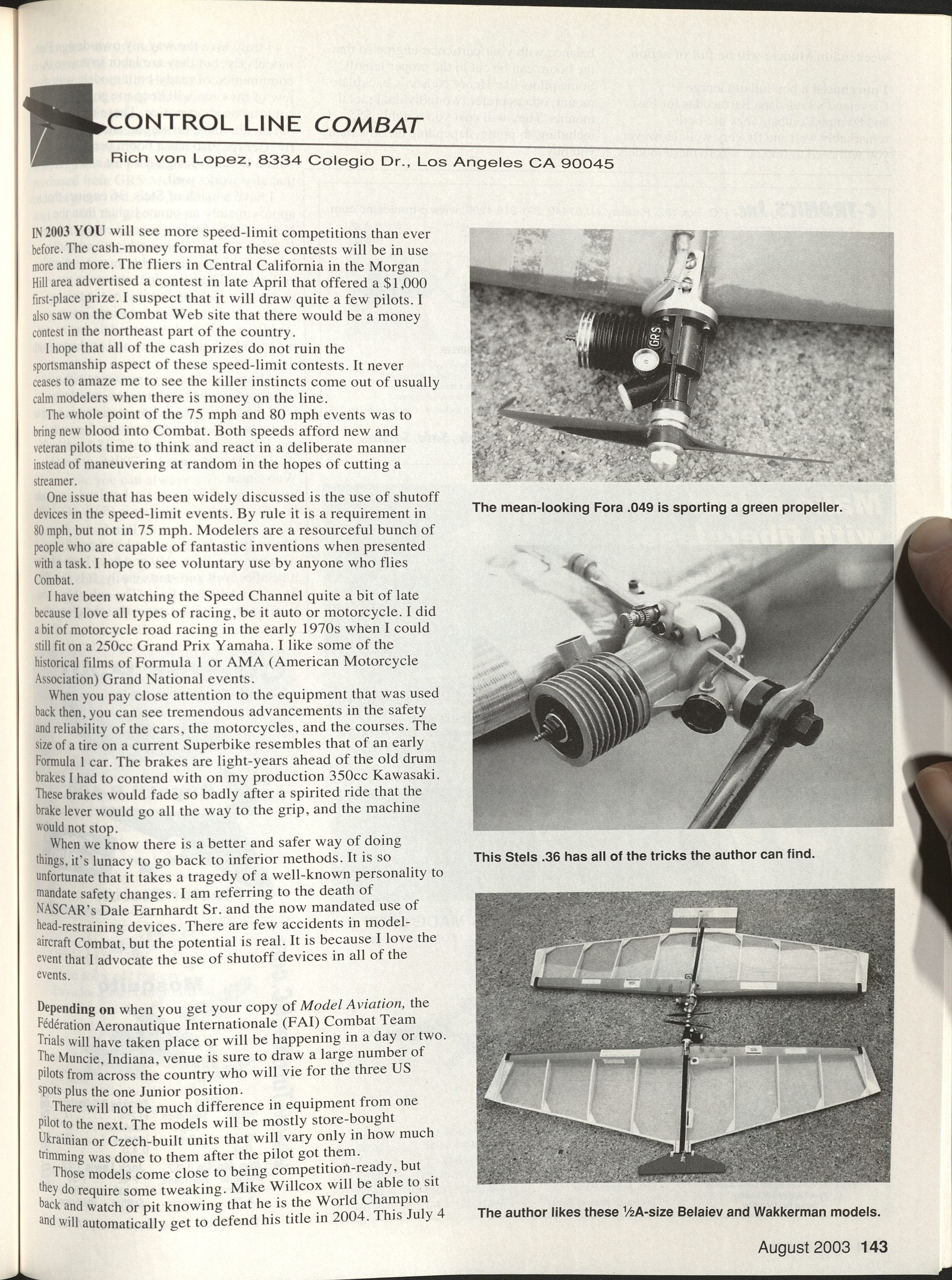
I have been doing quite a bit of test flying with my new Fora .049 and have learned that it needles well and starts easily. It is also fast on 35- and 42-foot lines. The only thing you have to do is make certain that the glow-plug clip touches the cylinder head — not the crankcase. The crankcase is anodized black and does not conduct electrical current. This is a small price to pay for having a mean-looking 1/2A engine.
There are so many propellers to choose from that it is hard to know which one works best. Engines and propellers can be purchased from GRS Models. The propellers come in green, red, blue, and purple; I like to start out with the green ones.
You may want to order two of each color to start with, then after the engine is well broken in you can determine which propeller works best with the fuel you want to run. At that point you can order enough propellers to get you through the season.
In the last column I included a photograph of several 1/2A models you can purchase from GRS Models. I have flown all of them and found that they work well. It will depend on what sort of tail configuration you want to use. I suggest that you purchase one of several types of designs, then trim and test them until you can settle on one you like. Then again, you can always build your own design.
Attention to detail will give you some added luck
I like to closely inspect all of my models before they get packed into the car before a contest. I look for small rips in the covering or loose edges that could tear away in flight. Many times I have seen someone out for a quick test flight, only to have the model shred a big piece of covering. Sometimes the pilot is lucky and the model stays in the air, and other times the model finds the ground.
I know I have mentioned the pushrod attachment pieces that come with the ready-made models and how I have experienced them splitting. It's an awful feeling to give a model up or down control and have it not respond when you try again. If you are lucky, the model will be reparable — if not, you will make a donation to the trash can.
It is also amazing how much brighter a glow plug will light after you change the battery leads. I like to use the clear lamp-cord wire that you can buy at any hardware store for 15¢ or 20¢ a foot. You can actually see the copper wires turn green when they get old. For less than $1, you can get better starts from the same old battery.
Pay close attention to metal engine mounts. They have been known to crack from time to time. It's better to catch a weak mount on the ground than to have the engine come off in the air. I also filter fuel going into the bottle, coming out of the bottle, and on its way to the needle valve. You may say it's overkill, but seldom do I have dirt in the fuel system.
You can take all of this care in handling your fuel, then throw your syringes on the ground when you have finished fueling. Take a close look at the syringe tip after you throw it on the ground; you might find some dirt.
- Pre-contest inspection checklist:
- Check covering for small rips or loose edges.
- Inspect pushrod attachments and control linkages for cracks or splits.
- Verify glow-plug clip contacts the cylinder head, not the crankcase.
- Replace old battery leads with clear lamp-cord wire if needed.
- Inspect metal engine mounts for cracks.
- Filter fuel into and out of the bottle and to the needle valve.
- Check syringe tips for dirt before use.
MA
Transcribed from original scans by AI. Minor OCR errors may remain.

