
CONTROL LINE COMBAT
Rich von Lopez, 8334 Colegio Dr., Los Angeles CA 90045
Planning a contest
At the start of each flying season, clubs and individuals think about hosting contests. There is usually quite a bit of preparation and planning that needs to take place before the event actually happens.
The first consideration is the date of the event. The organizers must make certain that the date does not conflict with other nearby or traditional major contests and that it does not come right before or after a nearby contest. Many well-meaning contest organizers are often frustrated because their events have poor turnouts. Most contest participants have a limited amount of vacation time and often have other commitments that prevent them from attending all the events they would like.
The key is to advertise your contest well in advance so that regular contest-goers can put it on their calendars long before it becomes full of other events and functions.
Publicity and reminders
An attractive contest flyer with all the key information is a must. It should include:
- date
- location
- contact information for at least two organizers
- directions to the flying field (include a map on the back of the handout if possible)
- any deviations from the rules
- the events to be flown
- telephone numbers of nearby motels
A nonflying member of the family or club can help with this item. It is a good idea to enlist the services of a computer hobbyist to make the flyer look professional.
Reminders, in person and via telephone or e-mail, are helpful in assuring that people will participate. Reminders and invitations to practice a couple of weeks in advance will help motivate individuals. If people feel ready and know that all of their equipment is in working order, they are more likely to show up for a competition.
Equipment and supplies
Make a list of all the things you think you will need to run the contest. Some basic items are often overlooked:
- table and chairs for the officials
- enough stopwatches in working order
- paper, pens, markers
- matching boards
- streamers
- clipboards
- traffic paint
- a pull-test scale or device
- a 100-foot tape measure
- a bullhorn or other sound-amplifying device
Stopwatches are inexpensive and a club or individual can afford to have several for contest use. Make certain to have other club members' help in making the list. When you have finalized the list, put a person's name next to the item for which he or she will be responsible. Make copies of the list, and make certain that all people who have a job get one.
Officials and hospitality
Most of what I am telling you may sound simple, but once you get busy with job responsibilities, family, and other interests, some things tend to get lost because of the hectic pace of life. Getting people to commit to working as officials is difficult these days. That means you should take care of those who do help.
A cooler full of bottled water and soft drinks, as well as lunch, should not be out of the question and will build goodwill. If you can, get one of the club members to bring the judges and workers sandwiches. This will cost less than running out to the local fast-food place. Coffee and doughnuts can be provided as the officials arrive in the morning.
Concessions and fund-raisers
Get some of the wives or others involved in setting up a concession stand. If there are den mothers or troop leaders, they can get Boy Scouts or Girl Scout troops to run the stand for a couple of hours during the day. This could be a 10 a.m.–2 p.m. project and a fund-raiser for them. Make sure you let the contestants know that there will be food available at the site.
T-shirts
At some of the bigger contests, T-shirts have been made available to the contestants. This involves some capital outlay up front and will require someone to do artwork. Predicting how many shirts to order and what sizes to stock is tricky. Producing T-shirts will require quite a bit of thought, and one or two people will need to see it through from design to closing the books after the contest.
Trophies and awards
Trophies can be a major expense for a club, and that money is seldom recuperated through entry fees. I have donated trophies to contests because I wanted to make certain that everyone had a good experience and would come back.
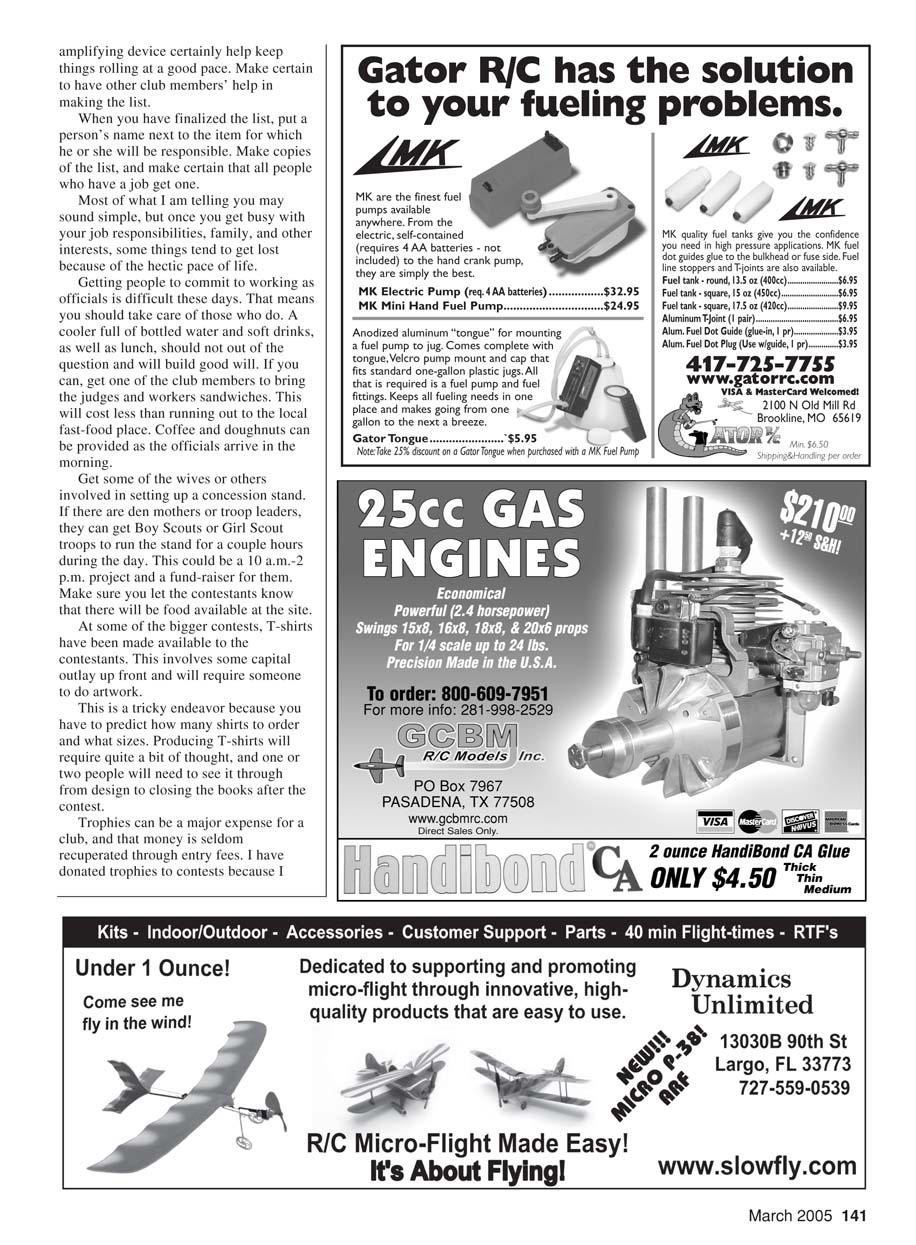
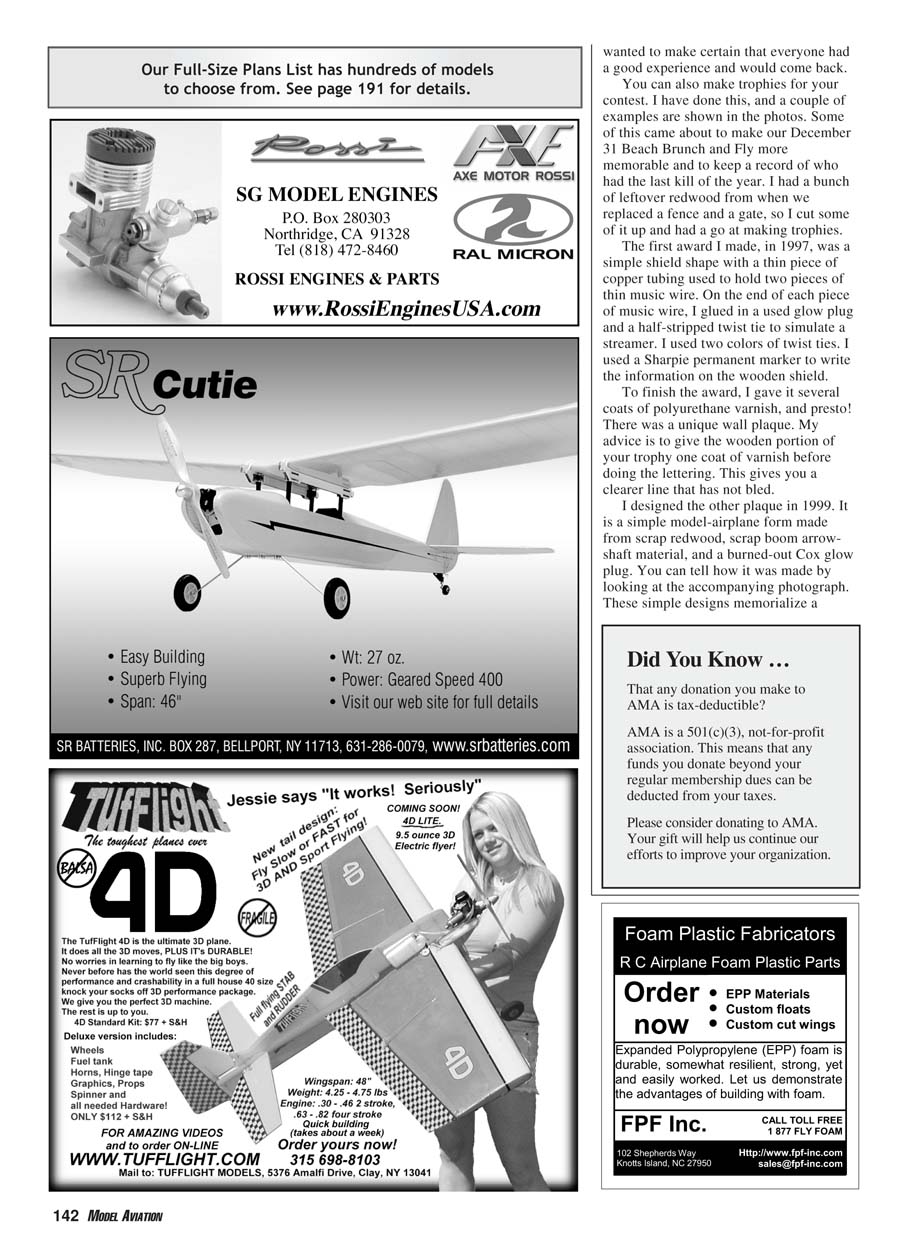
You can also make trophies for your contest. I have done this. Some of our trophies were created from leftover redwood from a fence and gate replacement. The first award I made, in 1997, was a simple shield shape with a thin piece of copper tubing used to hold two pieces of thin music wire. On the end of each piece of music wire I glued in a used glow plug and a half-stripped twist tie to simulate a streamer, using two colors of twist ties. I used a Sharpie permanent marker to write the information on the wooden shield. To finish the award, I gave it several coats of polyurethane varnish.
My advice is to give the wooden portion of your trophy one coat of varnish before doing the lettering; this gives you a clearer line that does not bleed.
I designed another plaque in 1999: a simple model-airplane form made from scrap redwood, scrap boom arrow-shaft material, and a burned-out Cox glow plug. These simple designs memorialize a contest while not taking up too much space in the house. After the fascination and thrill of winning the first few trophies wears off, they begin collecting dust and become a storage problem. These small mementos, on the other hand, can probably find a bit of wall space in the workshop.
Final thoughts
If you plan ahead and share the workload, you and your club can have an enjoyable contest that everyone will talk about. Give it a try and get everyone involved.
I read in the most recent Miniature Aircraft Combat Association (MACA) newsletter (MACA News) that Mike Willcox went to Saint Petersburg, Russia, for a World Cup contest and beat the best of the Russians on their own turf. It must feel good to give them a little payback after the clean 1–2–3 sweep they had at Muncie, Indiana, during the 2004 CL World Championships. Thank you, Mike, for making the Russians not appear so invincible.
There have been few instances of Americans winning in Europe or on foreign soil. I won a Class A Diesel contest in Peterborough, England, in 1982; Tom Fluker won the World Championships three weeks later in Oxelsund, Sweden; Mark Rudner won the Junior World Championships in Shanghai, China, in 1994; and Mike Willcox won the World Championships in Sebnitz, Germany, in 2002. If I have missed anyone who won somewhere outside the United States, do let me know.
Join MACA / Resources
You should join MACA to keep abreast of what is going on in the Combat world. Send your $15 dues to treasurer Gene Berry at 4610 89th St., Lubbock TX 79424. Make certain that you supply him with your AMA number and category.
Goran Olsson of Sweden has recently set up a Web site devoted entirely to Combat: http://groups.yahoo.com/group/cl_combat/. It is a good place to read about what is on the minds of the world Combat community.
MA
Transcribed from original scans by AI. Minor OCR errors may remain.

