
Control Line Combat - 2006/03
FAI F2D Combat equipment has come a long way
Rich Lopez [[email protected]]
Interest in FAI CL Combat—F2D—has been growing across the country among competitors and sport fliers. The availability of equipment and ease of its use probably has something to do with that. There are few motor sports in the world in which someone who is interested can just go out and buy inexpensive, competitive equipment.
I can remember the early days of F2D at the World Championships when all the competitors built their own models and the availability of the engines was spotty at best. At the 1982 World Championships in Sweden, Tom Fluker Jr. managed to win F2D with Fox .15 engines that Duke Fox custom-made for him. These limited-production Fox .15s are highly sought after by collectors.
Duke used a .35-size crankshaft in a .15 crankcase. This engine had one ball bearing and a bushing for the front of the crankshaft. Tom’s dad still had to do a tremendous amount of work to these engines to make them perform at their peak.
The propellers Tom used were specially built by Bill Lee, who made a mold and then laid them up. I am sure Bill went through the growing pains associated with trying something new. Getting the right mixture of fiberglass resin and carbon-fiber reinforcement material no doubt took several attempts. The rest of the pilots who had an interest in F2D had to rely on what was available in the hobby shops, which was usually wood or nylon mass-produced propellers.
I still have some of the propellers I carved and shaped for my Fox and SuperTigre .15s. I would cut down Tipan 7 x 4s a little at a time, until the engine gave good power. You had to like tinkering with engines to get maximum performance, and even then they were prone to parts failure. I would grind on the cylinder liners and then send them out to Bob Oge to have them chromed. Some of the local fliers would grind on the crankshafts to enlarge the hole so more air and fuel would go through. We soon learned the limit to how much metal could be removed.
All that tinkering was fun at the time, but it did cause frustration. The pilots with better connections, such as a machinist, were at a distinct advantage compared with the regular hobbyist.
These days it is possible for even the novice to have top-quality, reliable engines, models, and propellers, all of which can be purchased. This gives even the casual Sunday flier access to equipment that could be competitive at the international level.
Although the playing field has been leveled in terms of equipment, there is still a large gap in pilot skill. There are very few state (country)-sponsored pilots left, with the notable exception of the Chinese. The level of dedication and time an individual is willing to commit will probably determine who the next World Champions will be. Luck may have a bit to do with it as well.
Phoenix F2D contest
Early in November Steve Stewart and company hosted an F2D contest in Phoenix, Arizona, that required all the contestants to assist with judging and some of the contest operations. It seemed to work out well, and everyone seemed willing to participate.
Trying to run a full-blown two-models-per-contestant F2D contest requires a great deal of people power. You have the additional requirement of fuel management at F2D events that usually requires at least one individual to keep track of fuel bottles and their distribution.
Also, each competitor is required to wear a color of the streamer-identification vest. That by itself does not require a specific official, but it does necessitate someone to be mindful of the vests' locations. In the future more and more contests will require that competitors be asked to participate in contest operations.
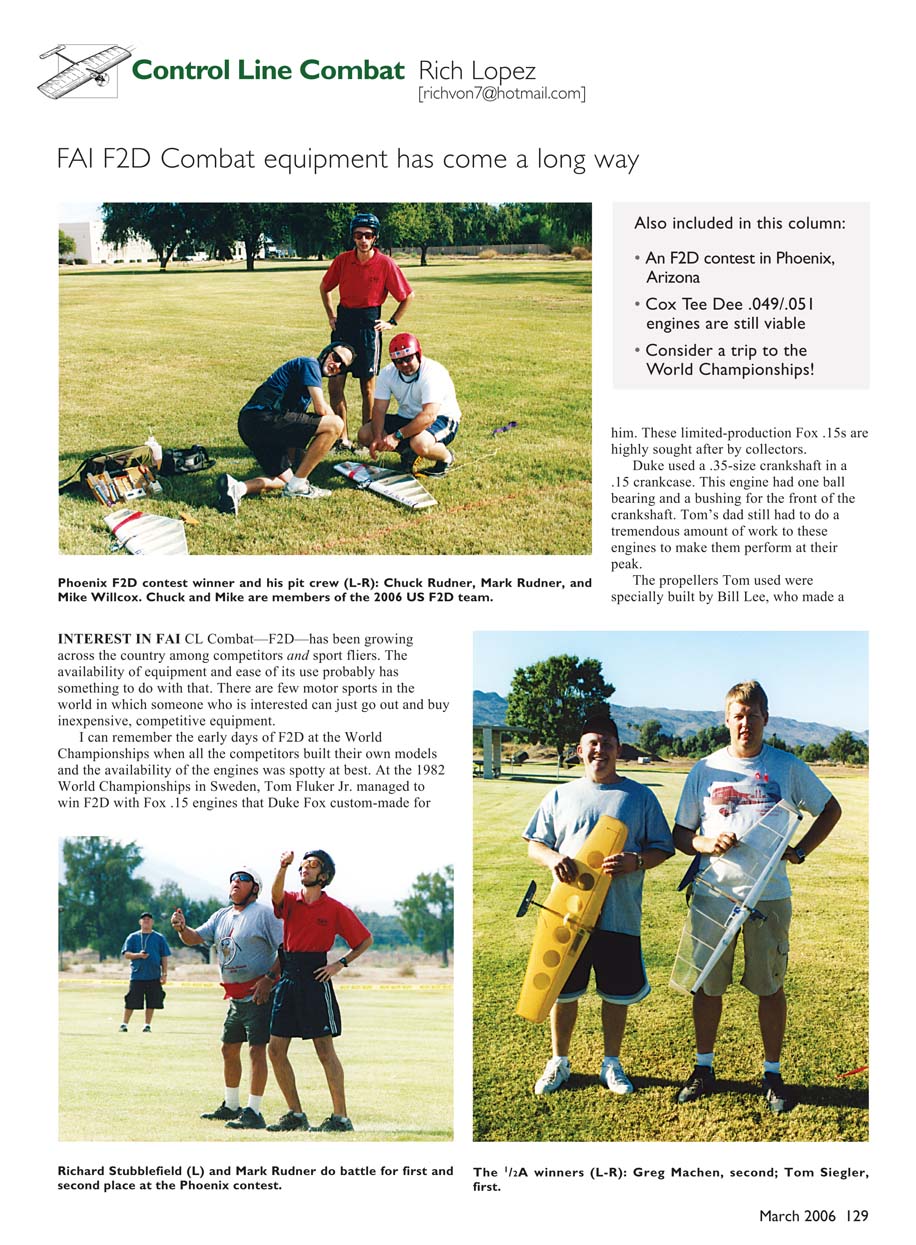
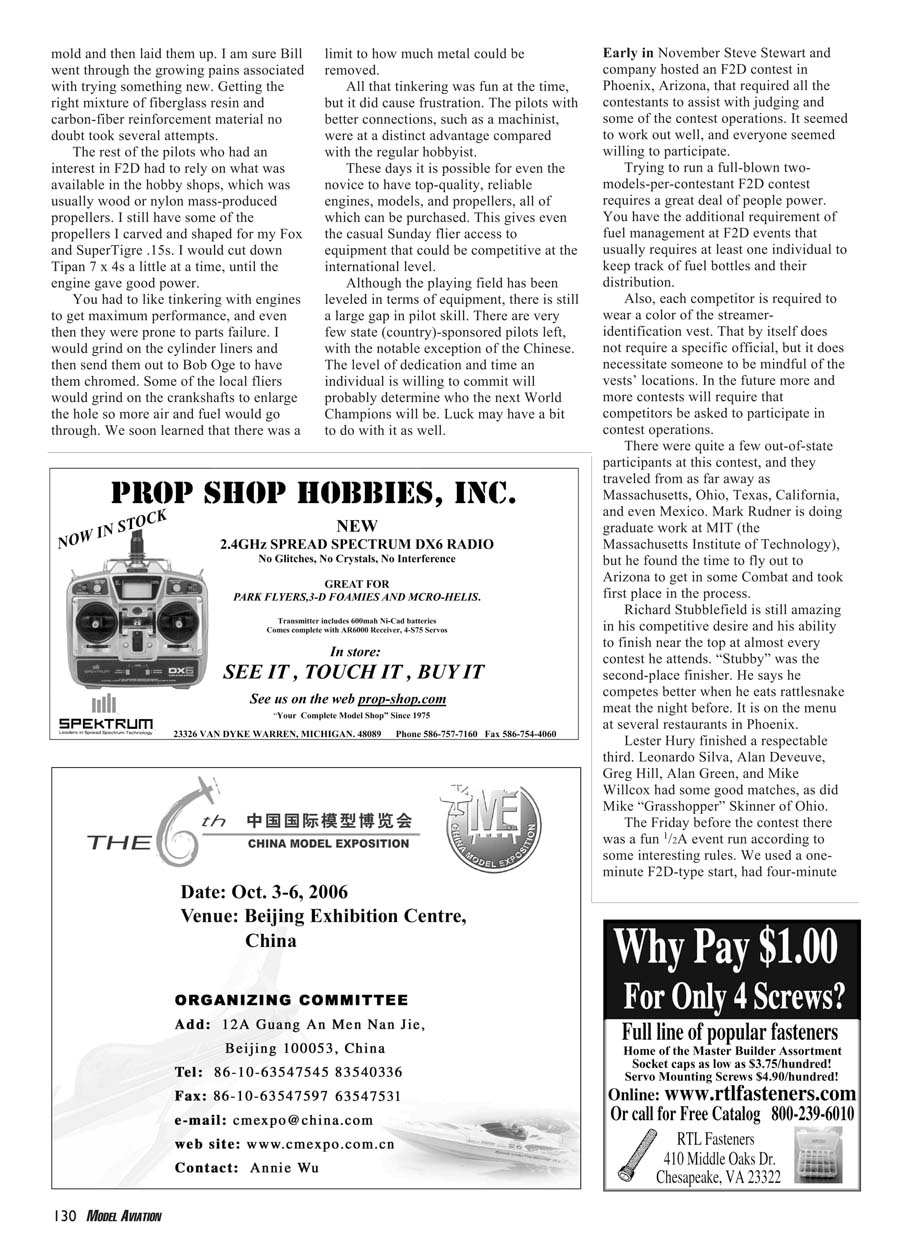
There were quite a few out-of-state participants at this contest; they traveled from as far away as Massachusetts, Ohio, Texas, California, and even Mexico. Mark Rudner is doing graduate work at MIT (the Massachusetts Institute of Technology), but he found the time to fly out to Arizona to get in some Combat and took first place in the process.
Richard Stubblefield is still amazing in his competitive desire and his ability to finish near the top at almost every contest he attends. "Stubby" was the second-place finisher. He says he competes better when he eats rattlesnake meat the night before. It is on the menu at several restaurants in Phoenix.
Lester Hury finished a respectable third. Other pilots who had notable matches included:
- Leonardo Silva
- Alan Deveuve
- Greg Hill
- Alan Green
- Mike Willcox
- Mike "Grasshopper" Skinner (Ohio)
Fun 1/2A event and equipment sources
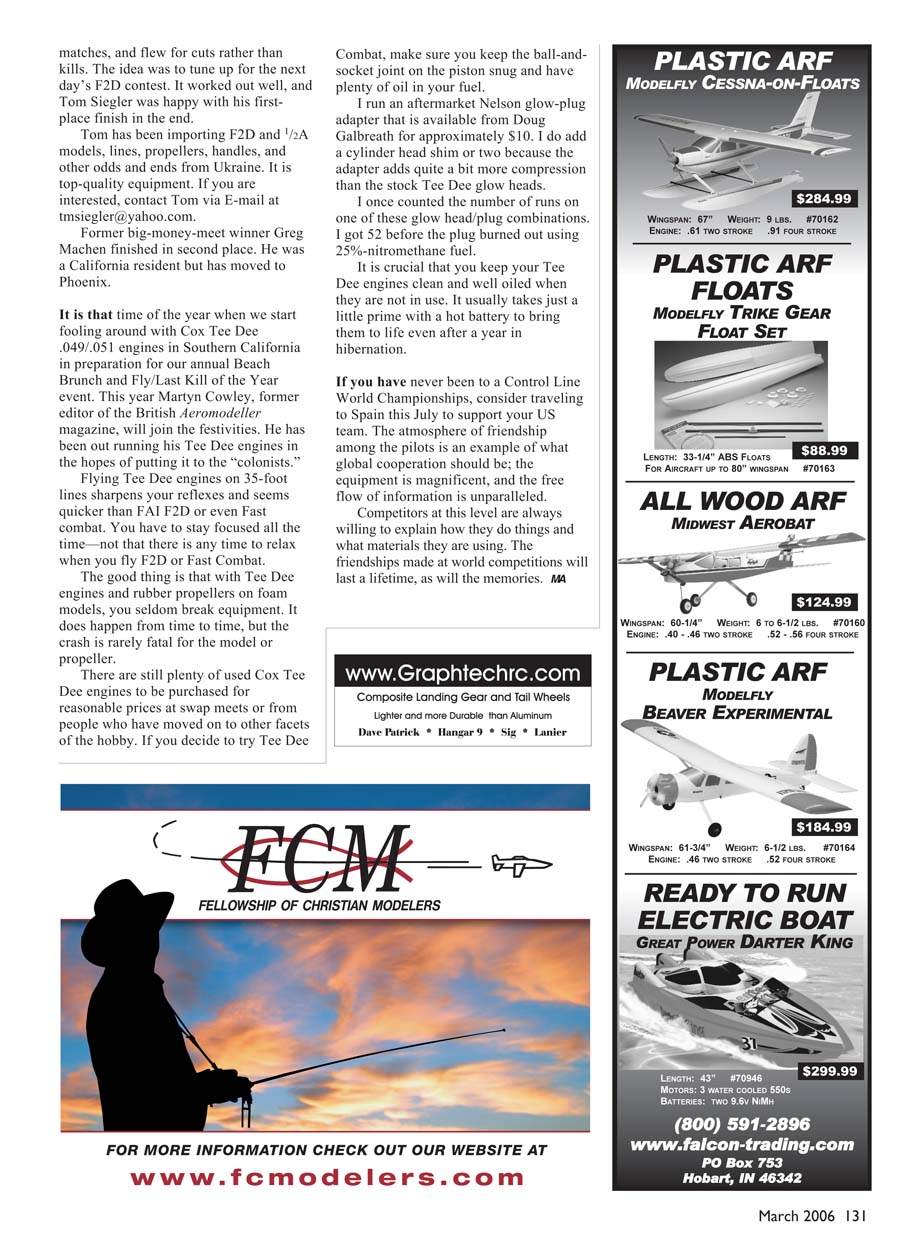
The Friday before the contest there was a fun 1/2A event run according to some interesting rules. We used a one-minute F2D-type start, had four-minute matches, and flew for cuts rather than kills. The idea was to tune up for the next day's F2D contest. It worked out well, and Tom Siegler was happy with his first-place finish in the end.
Tom has been importing F2D and 1/2A models, lines, propellers, handles, and other odds and ends from Ukraine. It is top-quality equipment. If you are interested, contact Tom via E-mail at [email protected].
Former big-money-meet winner Greg Machen finished in second place in the 1/2A event. He was a California resident but has moved to Phoenix.
Tee Dee .049/.051 combat
It is that time of the year when we start fooling around with Cox Tee Dee .049/.051 engines in Southern California in preparation for our annual Beach Brunch and Fly/Last Kill of the Year event. This year Martyn Cowley, former editor of the British Aeromodeller magazine, will join the festivities. He has been out running his Tee Dee engines in the hopes of putting it to the "colonists."
Flying Tee Dee engines on 35-foot lines sharpens your reflexes and seems quicker than FAI F2D or even Fast combat. You have to stay focused all the time—not that there is any time to relax when you fly F2D or Fast Combat. The good thing is that with Tee Dee engines and rubber propellers on foam models, you seldom break equipment. It does happen from time to time, but the crash is rarely fatal for the model or propeller.
There are still plenty of used Cox Tee Dee engines to be purchased for reasonable prices at swap meets or from people who have moved on to other facets of the hobby. If you decide to try Tee Dee Combat, make sure you keep the ball-and-socket joint on the piston snug and have plenty of oil in your fuel.
I run an aftermarket Nelson glow-plug adapter that is available from Doug Galbreath for approximately $10. I do add a cylinder head shim or two because the adapter adds quite a bit more compression than the stock Tee Dee glow heads.
I once counted the number of runs on one of these glow head/plug combinations. I got 52 before the plug burned out using 25% nitromethane fuel.
It is crucial that you keep your Tee Dee engines clean and well oiled when they are not in use. It usually takes just a little prime with a hot battery to bring them to life even after a year in hibernation.
World Championships invitation
If you have never been to a Control Line World Championships, consider traveling to Spain this July to support your US team. The atmosphere of friendship among the pilots is an example of what global cooperation should be; the equipment is magnificent, and the free flow of information is unparalleled.
Competitors at this level are always willing to explain how they do things and what materials they are using. The friendships made at world competitions will last a lifetime, as will the memories.
MA
Transcribed from original scans by AI. Minor OCR errors may remain.

