
Control Line Combat - 2006/09
What does the future hold for CL Combat?
By Rich Lopez ([email protected])
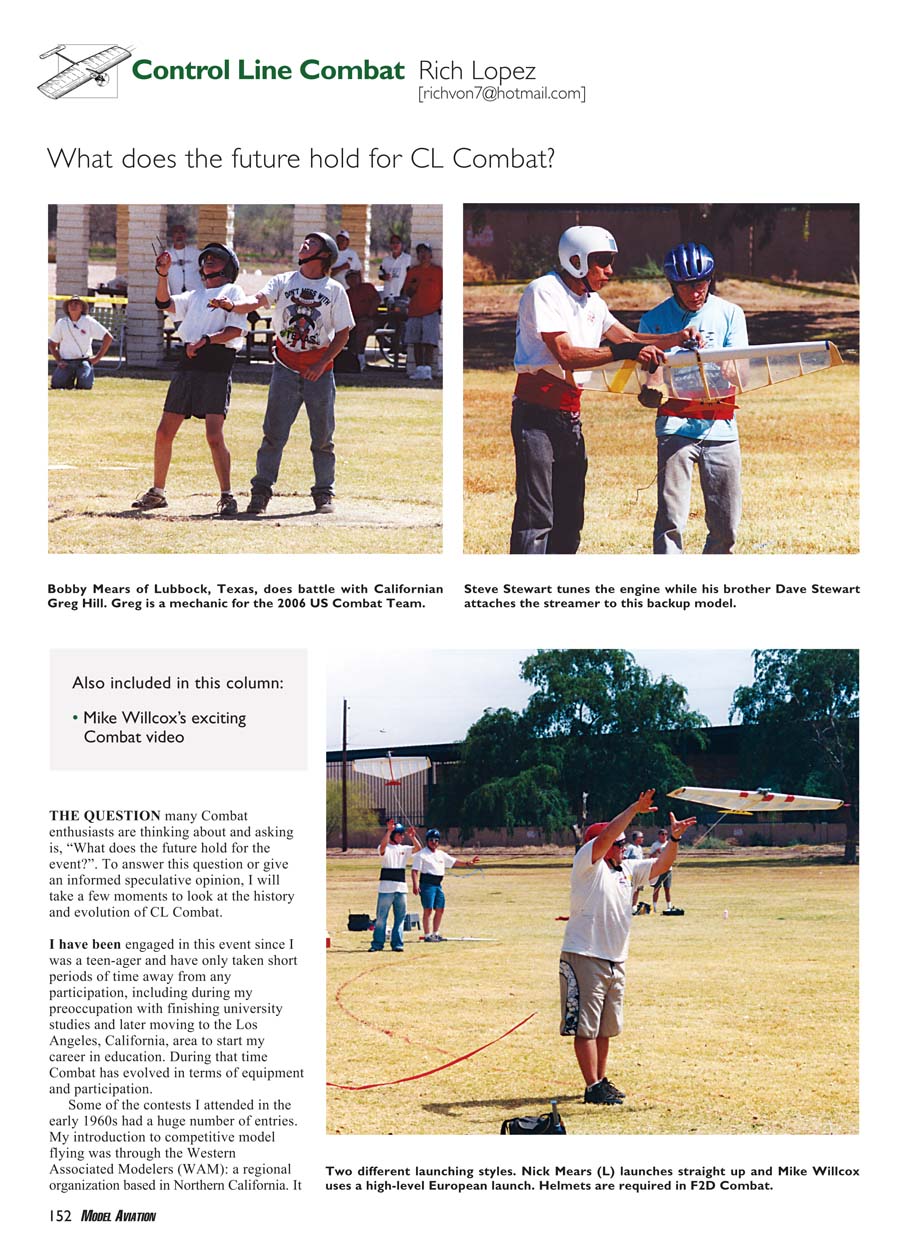
The question many Combat enthusiasts are asking is, “What does the future hold for the event?” To answer this or offer an informed speculative opinion, I’ll take a few moments to look at the history and evolution of CL Combat.
I have been engaged in this event since I was a teenager and have only taken short periods away from participation, including during my university studies and later when I moved to the Los Angeles area to start my career in education. During that time Combat has evolved in terms of equipment and participation. Some contests I attended in the early 1960s had huge numbers of entries. My introduction to competitive model flying was through the Western Associated Modelers (WAM), a regional organization based in Northern California.
It’s much easier for newcomers to get involved if they can buy a unit that is ready to fly, including the lines and handle. This is a small effort on my part to try to draw some new blood to the flying field. Only the most persistent new pilots will take the time to search all the websites to find the exact products they need to get their models into the air.
Something as simple as handing a newcomer a fuel bladder and then showing him or her how to use it can provide an additional flying partner or someone to launch a model for a practice match.
Much of what we Combat fliers do is by feel. We try to feel for a “bump” once the engine is primed and turned over by hand. We set the needle valve by listening to the engine and briefly pinching the fuel line to see if the engine RPM increases or falls off. The preceding is subjective. Although it may seem second nature to us now, we spend years developing our sense of feel. If the new enthusiast stands beside you and you take the time to describe the sensations that lead to developing a feel, you may have a shot at imparting this knowledge. This will shorten the learning curve and lead to a more proficient flying partner sooner.
The availability of good equipment is far better now than it was in the past. The problem is knowing where to find it. If you want the best Fast Combat engine on the planet, you have to seek out Henry Nelson. This is not too difficult if you belong to the AMA and read the MA ads. Getting the best FAI F2D Combat engines is another story. I recently purchased a number of Fora .15s, but I came into their possession through an indirect contact.
The new CL Combat pilot must ask many questions, surf the World Wide Web, go to contests, take lots of notes, and find out who is winning and what equipment the winners are using. Our hobby/sport is relatively inexpensive when compared to other forms of motorsports or even other hobbies, especially if you have the facts before you buy.
Current trends we must contend with include an aging group of pilots who are rapidly making an exit to rocking chairs and retirement. There are very few youngsters following in their footsteps to pick up the slack. Too many Combat event classes and too few contests for each event might also play a role in the declining participation rate.
There are now two versions of 1/2A Combat: Tee Dee .049/.051 (flown on 35-foot lines) and Cyclon/Fora high-performance .049 (flown on 42-foot lines). F2D—the international class—has a strong following around the world. Those who used to fly that event in the days of stinky diesel engines try to revive the past with a diesel event on 52-foot lines.
The Fast Combat crowd still loves unlimited nitromethane running through the cylinder of a well-built Nelson .36 engine, producing enough power to send you to the orthopedic surgeon for shoulder-tendon reattachment. Dr. Chuck Rudner has been observed performing this operation right on the field; it gives new meaning to the term “field repairs.”
A slower, friendlier version of the event is 75 or 80 mph Combat. This can be flown with the same models as Fast Combat, except with detuned engines. Fast Combat and 75/80 mph Combat are flown on 60-foot lines. Slow Combat may still be on the books, but it has largely passed away because of apathy and neglect.
With all these classes available, it is hard for competitors to stay focused and keep up with the new trends in each discipline. I go through cycles of flying strictly Tee Dee engines and then switching to Cyclon-powered 1/2As. Right now I am in an F2D phase, trying to keep Chuck Rudner sharp for the upcoming World Championships.
Recently a number of Americans have been traveling to Europe to participate in international competitions. The most recent pilot to distinguish himself with a second-place finish in Paris, France, was Tom Siegler of Texas, who accomplished this in late May 2006.
I’ve seen clips of a fascinating F2D Combat video produced by Mike Willcox ([email protected]). The footage is from the World Cup Contest held in late May 2006 in Houston, Texas. Many of the country’s best pilots were in attendance. For $22 you can buy one of these videos and watch it as many times as you want.
Mike used a tall pole to mount a camera and give the viewer a whole new perspective on the flying action. This would be an excellent item to share at a club meeting, and it just might be what’s needed to motivate prospective Combat pilots.
Transcribed from original scans by AI. Minor OCR errors may remain.

