
Control Line Combat - 2006/11
Not quite the last "BG" draws a host of Combat notables
By Rich Lopez ([email protected])
I just returned to Southern California after attending the 29th Bladder Grabber at Harvey Field in Snohomish, Washington. The Bladder Grabber, or BG as it is known to many Combat enthusiasts, was the brainchild of "Dirty" Dan Rutherford and his band of renegade Combat buddies who made up the "Jive Combat Team," along with Bob Carver.
Bob Carver is a creative and innovative individual who made a name for himself designing and building high-end stereophonic equipment. He is especially good at making super-powerful power amplifiers and had the financial backing to offer a significant amount of stereo gear as prizes for this Fast Combat contest.
Dirty Dan is good at promoting events, and he used his position as a columnist with Model Builder magazine to publicize the contest. He has a competitive personality that causes him to devote a tremendous amount of energy and time to whatever tickles his fancy. In the mid-1970s Dan was at the top of his game flying Combat. Fast Combat was the premier event in the US, while Slow, 1/2A, and FAI were merely alternate events. Most contests in the US offered trophies to the podium finishers; the idea of offering something of real value for flying Combat was truly novel.
Dan won the first BG and made sure everyone knew it through his writings. His columns had more than a few tongue-in-cheek references. From those interactions between Bob Carver and the members of the Jive Combat Team more than 30 years ago, the BG has become known around the world as the richest Combat meet in the world.
There have been many notable participants in the BG, including all three CL Combat World Champions from the US: Tom Fluker Jr., Mike Willcox, and Junior World Champion Mark Rudner. The Canadians used to field the "Dreaded Canadian Combat Contingent" that traveled across the border to compete. Some Soviet pilots made the trek on a couple of occasions, and national Mexican team members have also participated.
Chuck Rudner is the pilot with the most BG wins with four, including one edition that had roughly 65 entries. Phil (P.T.) Granderson of the Jive Combat Team racked up three wins and now flies CL Precision Aerobatics and builds beautiful models. David Owen recently won two BGs back to back. I had the good fortune to win two of the contests at different times.
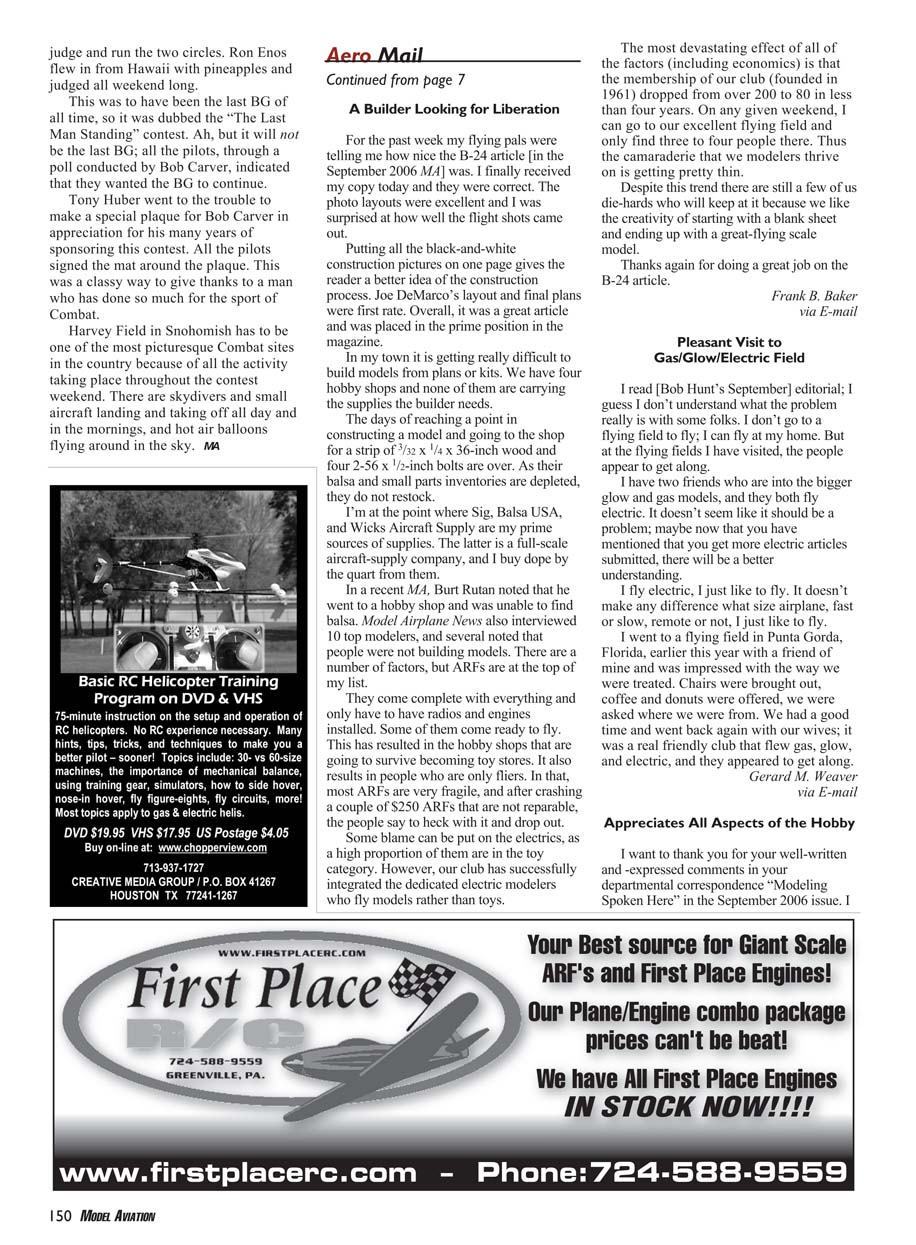
Some legends were present at the 29th BG to participate as pit crew or support personnel. Riley Wooten—a former National Champion and designer of the VooDoo, Vampire, Demon, Sneeker, and other models—was seen giving advice to three generations of Mears Combat pilots: James, Bobby, Andy, and Nick. James is one of the all-time best storytellers on Combat and non-Combat adventures. Former National Champion Larry Driskill attended and shared interesting stories from his career in the US Air Force. Other National Champions present included Richard Stubblefield of Houston, Texas, and George Cleveland of Kenner, Louisiana, who teamed up with Bob Burch of Chicago, Illinois.
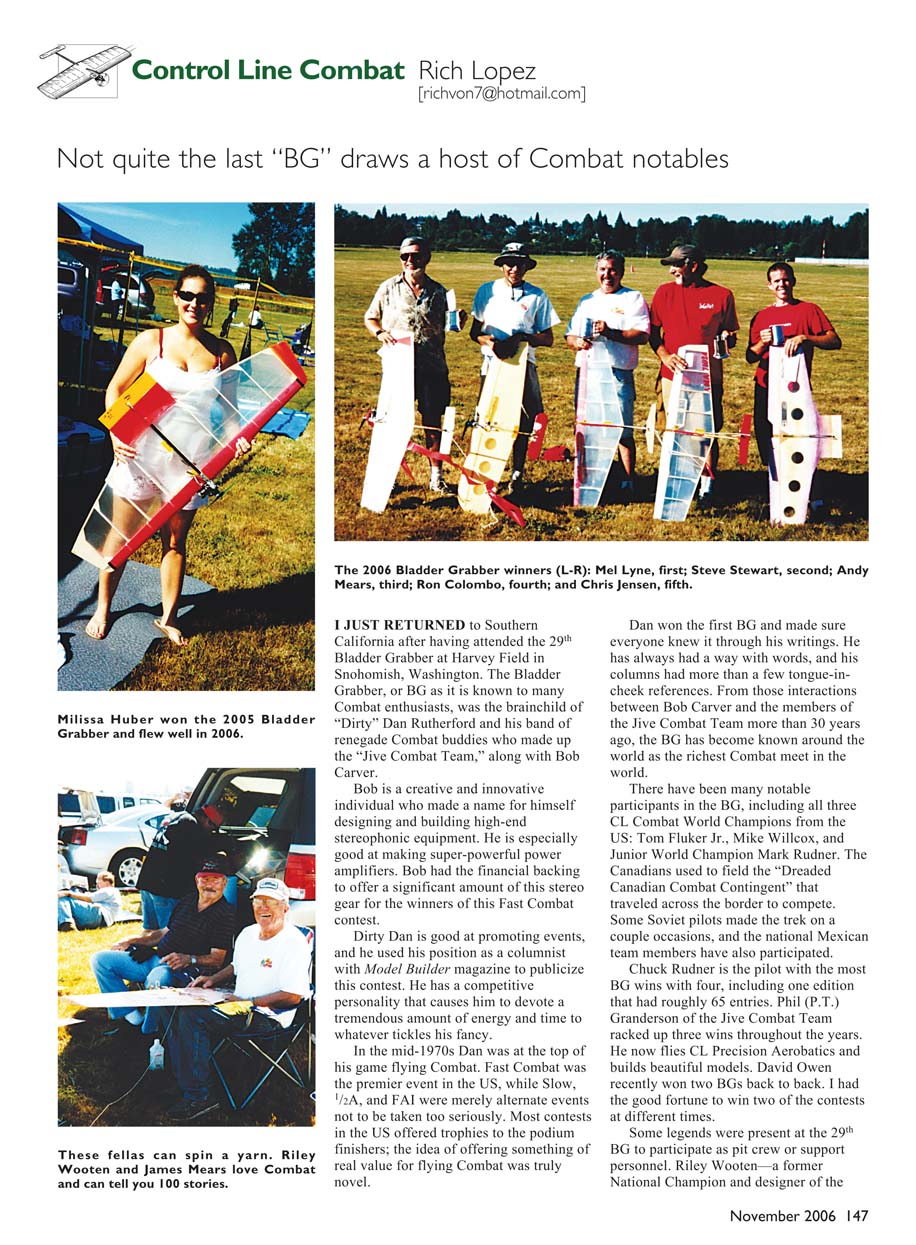
The best Fast Combat engine in the world is the Nelson, and designer and builder Henry Nelson was at the BG to give it a go. Last year's winner—and the only woman to have ever placed in the event—Milissa Huber was there this year to defend her title and sent three big-name pilots back to the pits with big "L"s on their scoresheets. I was the first to fall prey to Milissa; Alan DeVeuve and Nick Mears followed.
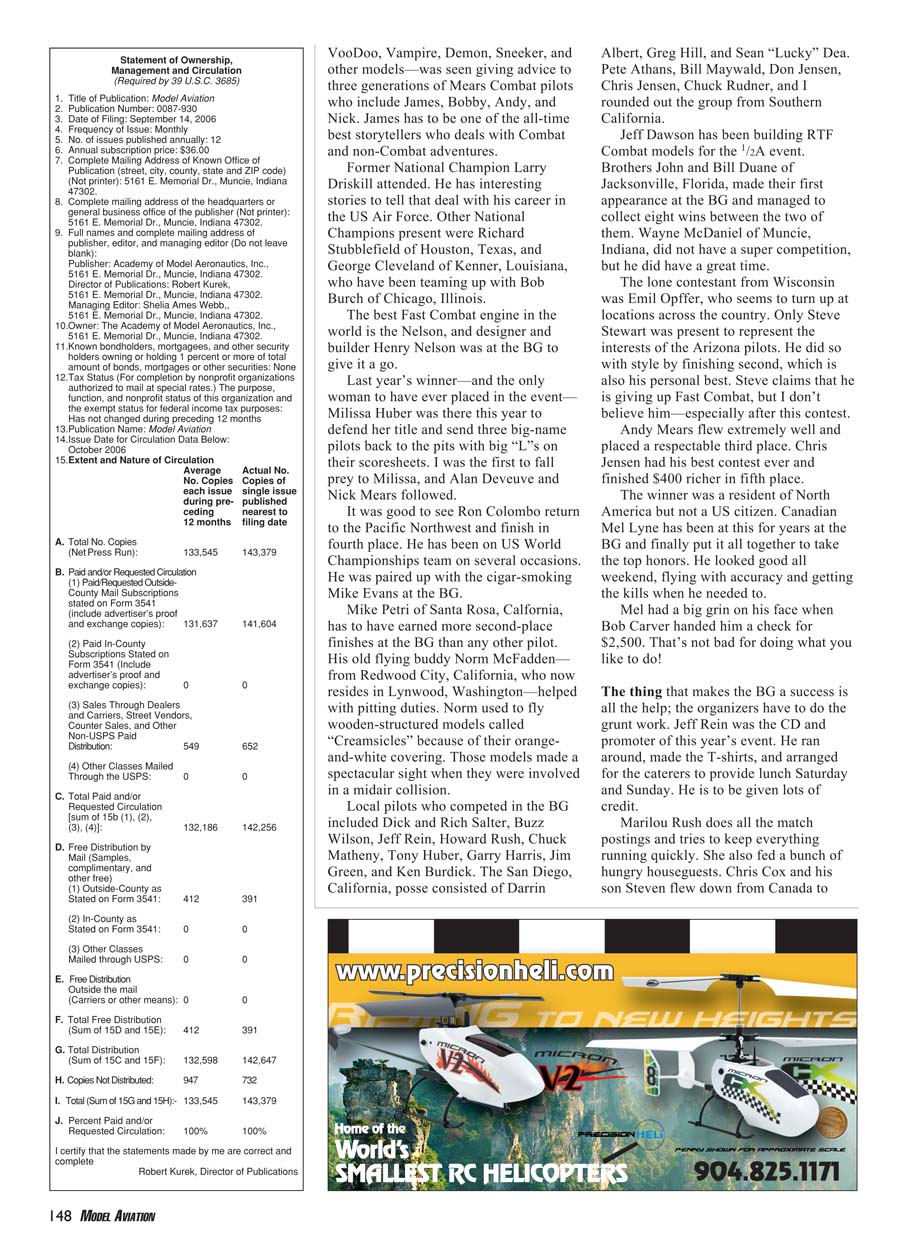
It was good to see Ron Colombo return to the Pacific Northwest and finish in fourth place. He has been on US World Championship teams on several occasions. He was paired up with the cigar-smoking Mike Evans at the BG.
Mike Petri of Santa Rosa, California, has to have earned more second-place finishes at the BG than any other pilot. His old flying buddy Norm McFadden—from Redwood City, California, who now resides in Lynnwood, Washington—helped with pitting duties. Norm used to fly wooden-structured models called "Creamsicles" because of their orange-and-white covering. Those models made a spectacular sight when they were involved in midair collisions.
Local pilots who competed in the BG included:
- Dick and Rich Salter
- Buzz Wilson
- Jeff Rein
- Howard Rush
- Chuck Matheny
- Tony Huber
- Garry Harris
- Jim Green
- Ken Burdick
The San Diego posse consisted of Darrin Albert, Greg Hill, and Sean "Lucky" Dea. Pete Athans, Bill Maywald, Don Jensen, Chris Jensen, Chuck Rudner, and I rounded out the group from Southern California.
Jeff Dawson has been building RTF Combat models for the 1/2A event. Brothers John and Bill Duane of Jacksonville, Florida, made their first appearance at the BG and managed to collect eight wins between the two of them. Wayne McDaniel of Muncie, Indiana, did not have a super competition, but he did have a great time.
The lone contestant from Wisconsin was Emil Opffer, who seems to turn up at locations across the country. Only Steve Stewart represented the Arizona pilots; he did so with style by finishing second, his personal best. Steve claims he is giving up Fast Combat, but I don't believe him—especially after this contest.
Andy Mears flew extremely well and placed a respectable third. Chris Jensen had his best contest ever and finished $400 richer in fifth place.
The winner was a resident of North America but not a US citizen. Canadian Mel Lyne has been coming to the BG for years and finally put it all together to take top honors. He looked good all weekend, flying with accuracy and getting the kills when he needed to. Mel had a big grin on his face when Bob Carver handed him a check for $2,500. That's not bad for doing what you like to do!
The thing that makes the BG a success is all the help; the organizers have to do the grunt work. Jeff Rein was the Contest Director and promoter of this year's event. He ran around, made the T-shirts, and arranged for the caterers to provide lunch Saturday and Sunday. He is to be given lots of credit.
Marilou Rush handled match postings and tried to keep everything running quickly. She also fed a bunch of hungry houseguests. Chris Cox and his son Steven flew down from Canada to judge and run the two circles. Ron Enos flew in from Hawaii with pineapples and judged all weekend long.
This was to have been the last BG of all time, so it was dubbed "The Last Man Standing" contest. Ah, but it will not be the last BG; all the pilots, through a poll conducted by Bob Carver, indicated that they wanted the BG to continue.
Tony Huber went to the trouble to make a special plaque for Bob Carver in appreciation for his many years of sponsoring the contest. All the pilots signed the mat around the plaque. This was a classy way to give thanks to a man who has done so much for the sport of Combat.
Harvey Field in Snohomish is one of the most picturesque Combat sites in the country because of all the activity throughout the contest weekend. There are skydivers and small aircraft landing and taking off all day and in the mornings, and hot air balloons flying around in the sky.
Transcribed from original scans by AI. Minor OCR errors may remain.

