
Control Line Combat
Rich Lopez [[email protected]]
French World Cup Grand Prix
In the November 2008 column, I mentioned that Mike Willcox, Richard Stubblefield, Roy Krupa, Allen Deveuve, Mark Rudner, Tom Seigler, Lester Haury, and I had planned to fly in the French World Cup Grand Prix the weekend before the CL World Championships in July. We entered the contest along with 83 pilots from around the globe. They, too, thought it would be good to get in a little flying against some of the best pilots in the world.
The French organizers used the same judges and jury that were to work the World Championships. You can do a bit of calculation to confirm that a contest consisting of 91 pilots flying a double-elimination format would take considerably more than two days of nonstop flying to complete.
At the end of Sunday, we had barely finished Round Two. The competitors were informed that Round Three was to be flown Monday, which was the WC competitors' official arrival date.
When we got to the field Monday morning, we were told that we could fly only until noon and that that would be the end of the contest. Many of the pilots, who had traveled specifically to Landres for the World Cup, were somewhat disappointed, to put it mildly.
The entry fee was 30 euros (roughly $38 per competitor). No attempt was made to refund any part of the competitors' money. I felt particularly bad for Tom Seigler, who was flying well and had three wins.
This could have been avoided the minute the organizers saw the high level of interest—by limiting entries and starting bright and early instead of at 11 a.m. The rain delay on Saturday afternoon served only to exacerbate the situation. I got in six flights, counting my three reflights, and the rest of our guys were still in, even though some chose not to fly the third round.
The idea of a World Cup before the World Championships is good, but it must be planned carefully and fully thought out.
Shutoffs
I was looking for new fuel-shutoff-device ideas since that rule will be in effect the same month and year as this MA issue. The only design that was on display was from Henning Forbech of Denmark. I have included photos of this unit in past CL Combat columns.
Boris Faizov of Russia is working on electronic units but did not have a working prototype to share yet. I intend to stay in touch with him to see what he develops.
New Cyclon F2D
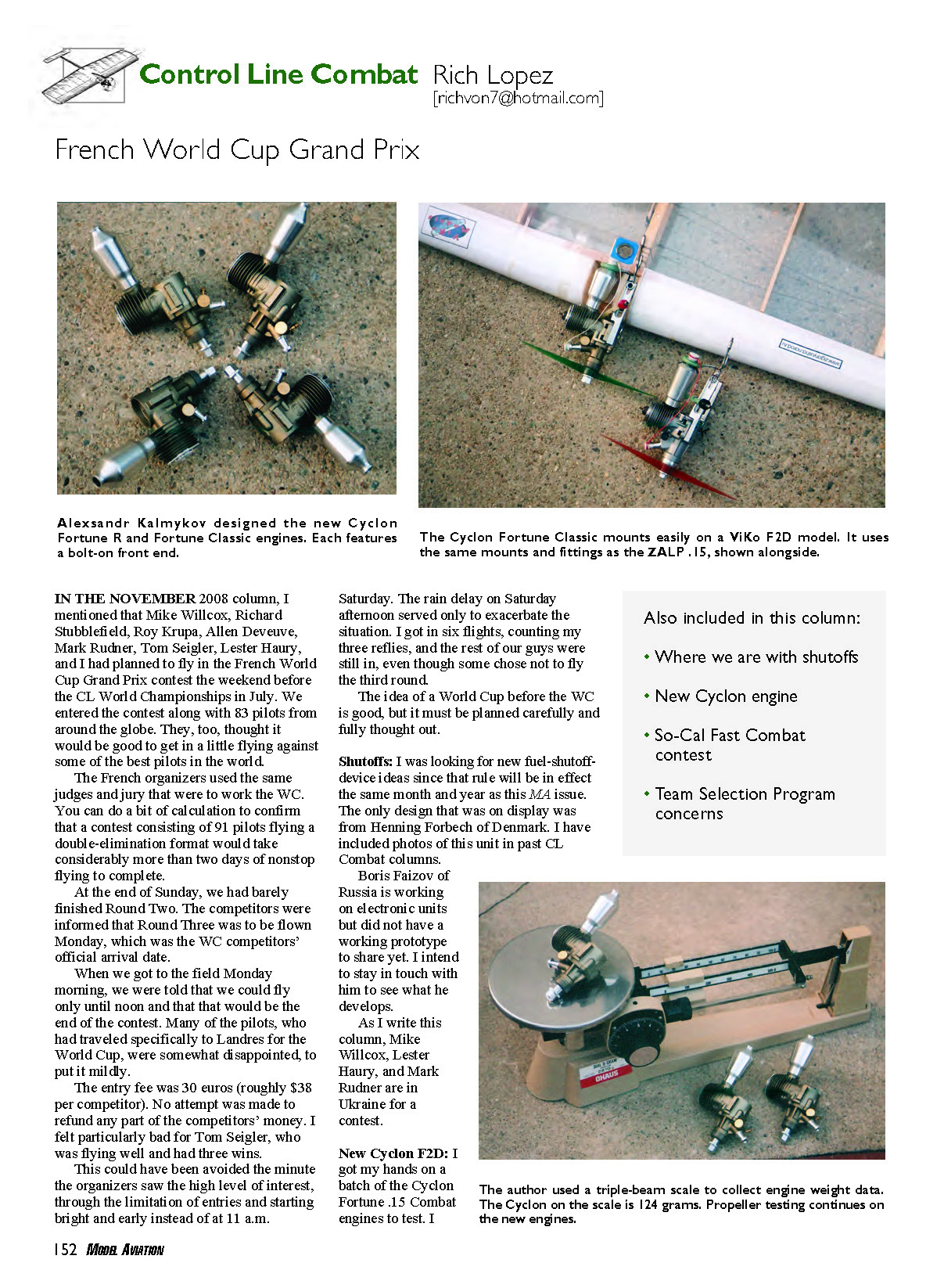
I got my hands on a batch of the Cyclon Fortune .15 Combat engines to test. I have both the inboard (designated "R") and outboard (designated "Classic") venturi configurations. This new design by Alexsandr Kalmykov in Novosibirsk, Russia, features a bolt-on front end. There are four stout 3 mm capscrews that hold the front end in place. This design does not incorporate the traditional bolt-on or screw-in backplate. According to the Cyclon website, the bolt-on front end would allow a pilot to change the whole front of the engine after a crash rather than try to flush out the dirt. That sounds good in theory; however, it is time-consuming to reassemble an engine once the front end has been removed. The difficulty comes from trying to line up the crankshaft pin to the connecting-rod hole. There is no good way to do this without a fair amount of trial and error. It took me a good 10–15 minutes the first time I tried this operation.
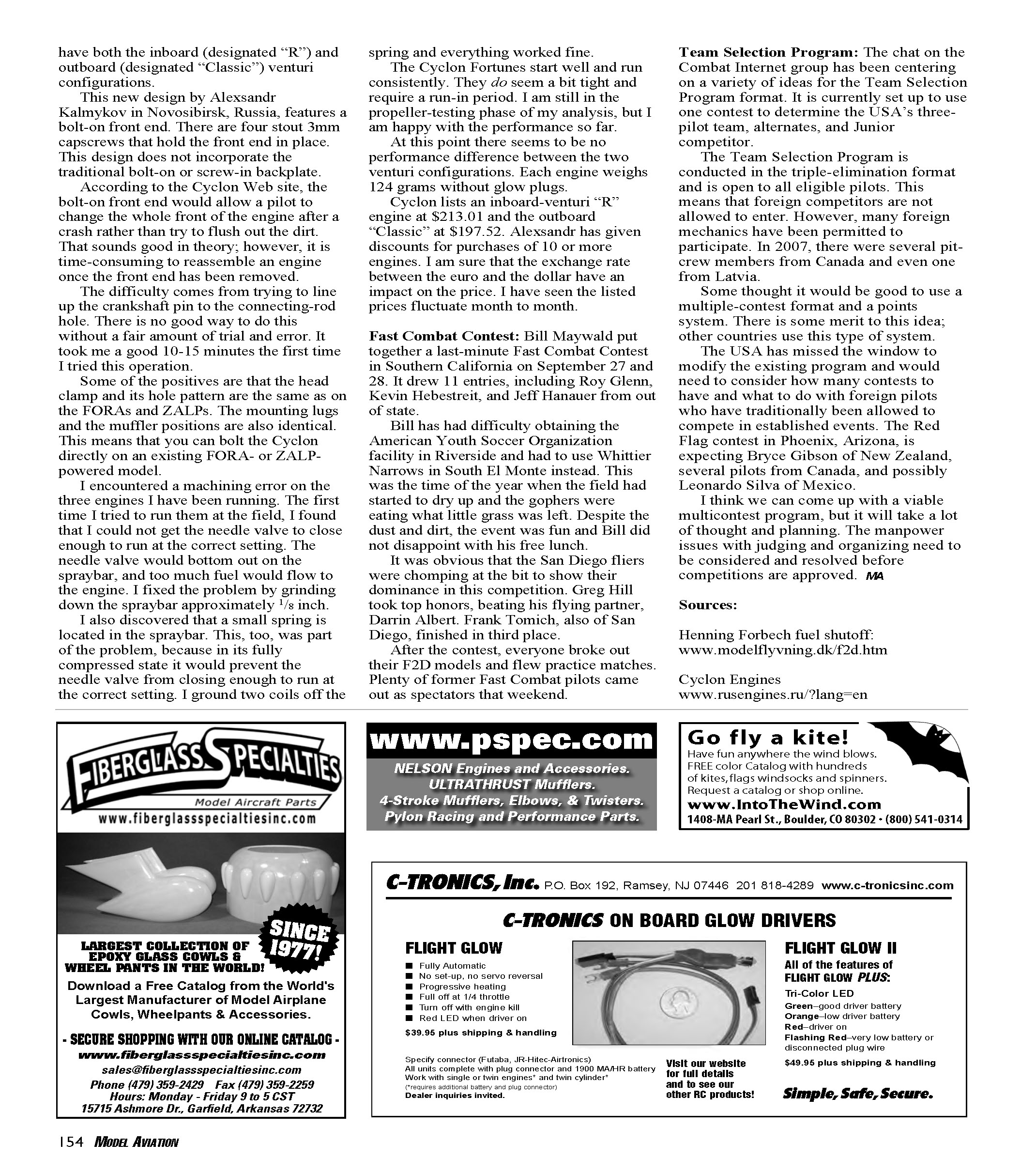
Some of the positives are that the head clamp and its hole pattern are the same as on the FORAs and ZALPs. The mounting lugs and the muffler positions are also identical. This means that you can bolt the Cyclon directly on an existing FORA- or ZALP-powered model.
I encountered a machining error on the three engines I have been running. The first time I tried to run them at the field, I found that I could not get the needle valve to close enough to run at the correct setting. The needle valve would bottom out on the spraybar, and too much fuel would flow to the engine. I fixed the problem by grinding down the spraybar approximately 1/8 inch.
I also discovered that a spring is located in the spraybar. This, too, was part of the problem, because in its fully compressed state it would prevent the needle valve from closing enough to run at the correct setting. I ground two coils off the spring and everything worked fine.
The Cyclon Fortunes start well and run consistently. They do seem a bit tight and require a run-in period. I am still in the propeller-testing phase of my analysis, but I am happy with the performance so far.
At this point there seems to be no performance difference between the two venturi configurations. Each engine weighs 124 grams without glow plugs.
Cyclon lists an inboard-venturi "R" engine at $213.01 and the outboard "Classic" at $197.52. Alexsandr has given discounts for purchases of 10 or more engines. I am sure that the exchange rate between the euro and the dollar has an impact on the price. I have seen the listed prices fluctuate month to month.
Fast Combat Contest
Bill Maywald put together a last-minute Fast Combat Contest in Southern California on September 27 and 28. It drew 11 entries, including Roy Glenn, Kevin Hebestreit, and Jeff Hanauer from out of state.
Bill has had difficulty obtaining the American Youth Soccer Organization facility in Riverside and had to use Whittier Narrows in South El Monte instead. This was the time of year when the field had started to dry up and the gophers were eating what little grass was left. Despite the dust and dirt, the event was fun and Bill did not disappoint with his free lunch.
It was obvious that the San Diego fliers were chomping at the bit to show their dominance in this competition. Greg Hill took top honors, beating his flying partner, Darrin Albert. Frank Tomich, also of San Diego, finished in third place.
After the contest, everyone broke out their F2D models and flew practice matches. Plenty of former Fast Combat pilots came out as spectators that weekend.
Team Selection Program
The chat on the Combat Internet group has been centering on a variety of ideas for the Team Selection Program format. It is currently set up to use one contest to determine the USA's three-pilot team, alternates, and Junior competitor.
The Team Selection Program is conducted in the triple-elimination format and is open to all eligible pilots. This means that foreign competitors are not allowed to enter. However, many foreign mechanics have been permitted to participate. In 2007, there were several pit-crew members from Canada and even one from Latvia.
Some thought it would be good to use a multiple-contest format and a points system. There is some merit to this idea; other countries use this type of system.
The USA has missed the window to modify the existing program and would need to consider how many contests to have and what to do with foreign pilots who have traditionally been allowed to compete in established events. The Red Flag contest in Phoenix, Arizona, is expecting Bryce Gibson of New Zealand, several pilots from Canada, and possibly Leonardo Silva of Mexico.
I think we can come up with a viable multicontest program, but it will take a lot of thought and planning. The manpower issues with judging and organizing need to be considered and resolved before competitions are approved. MA
Sources
- Henning Forbech fuel shutoff: www.modelflying.dk/f2d.htm
- Cyclon Engines: www.rusengines.ru/?lang=en
Transcribed from original scans by AI. Minor OCR errors may remain.

