
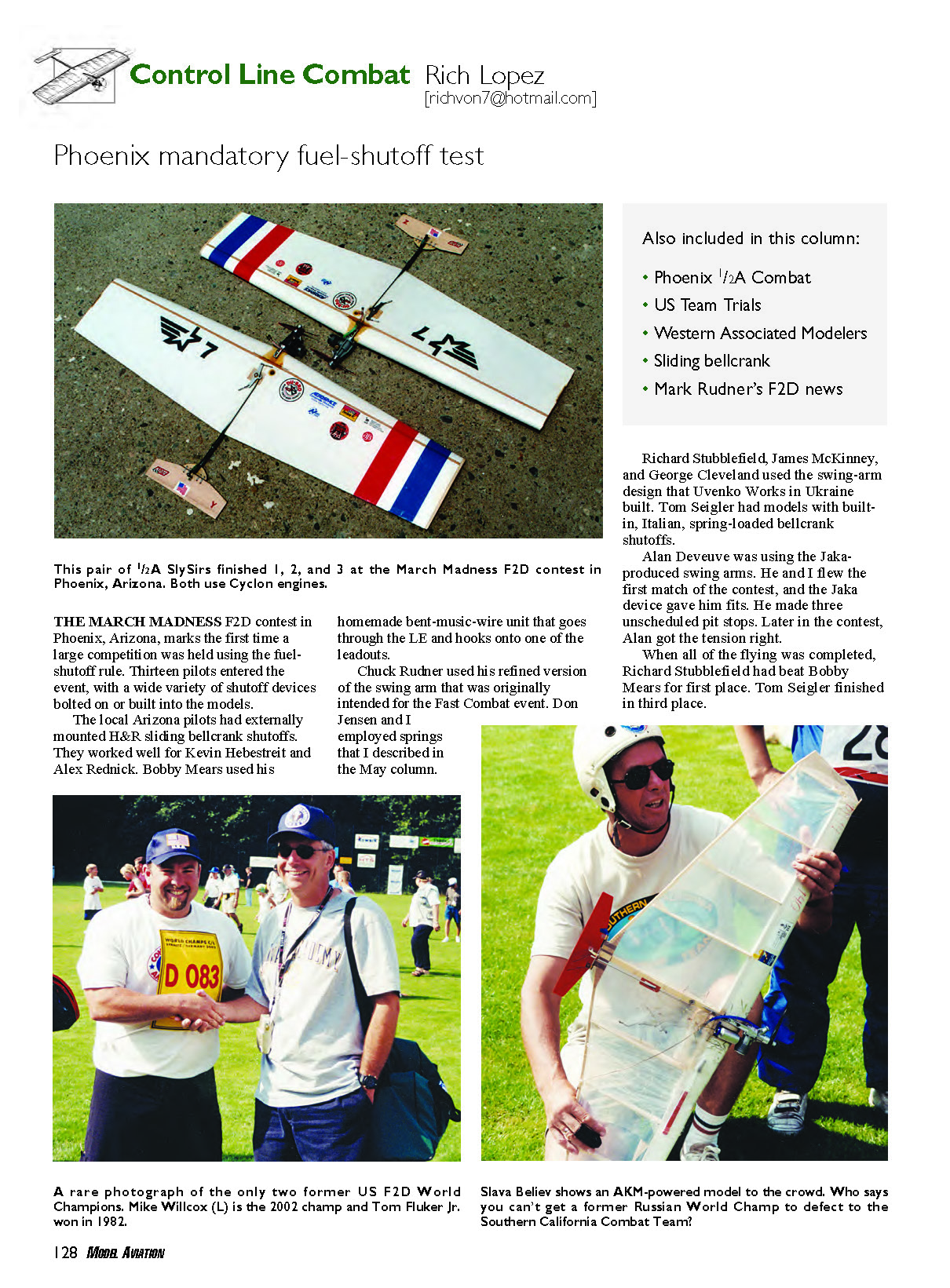
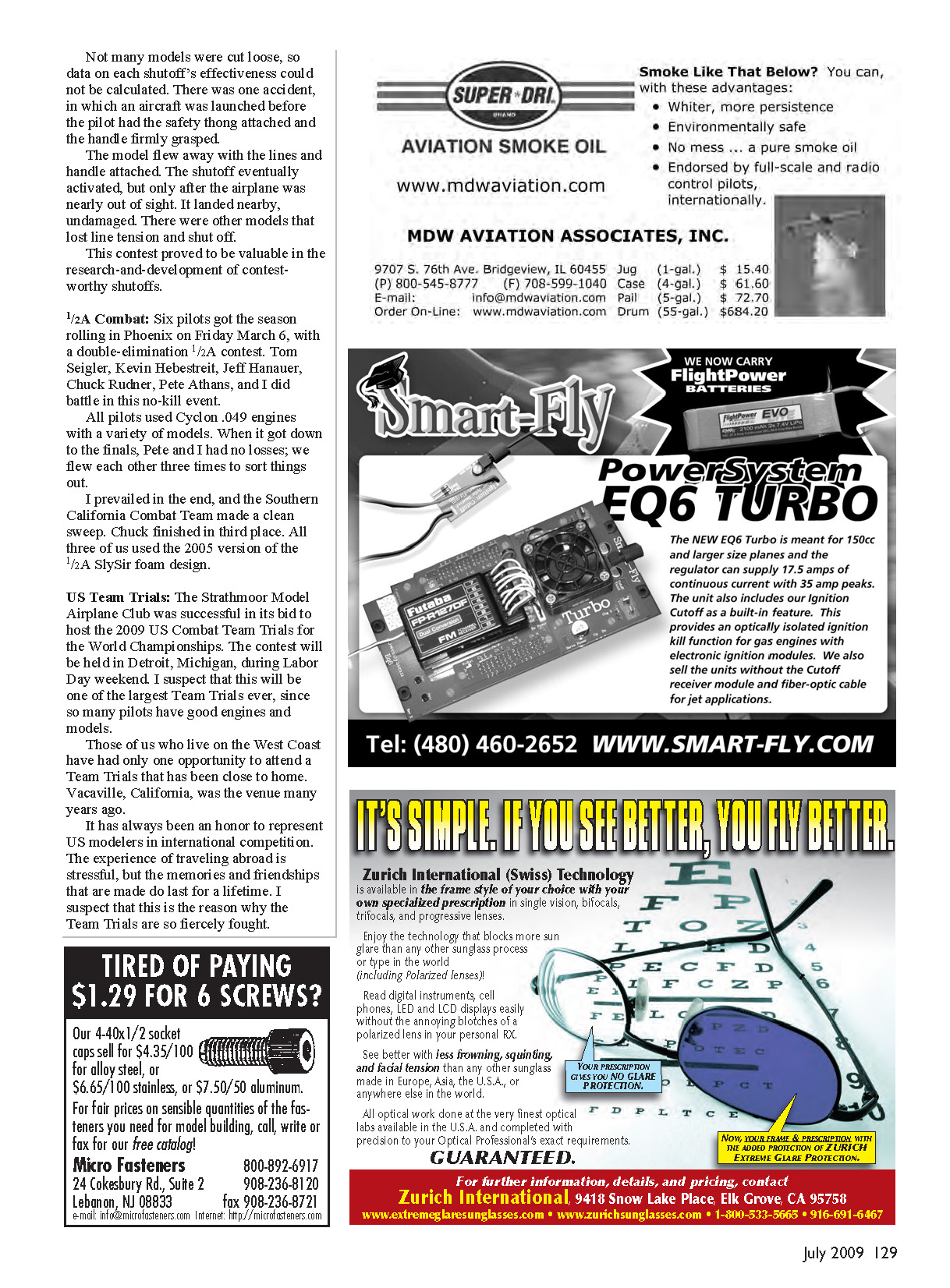
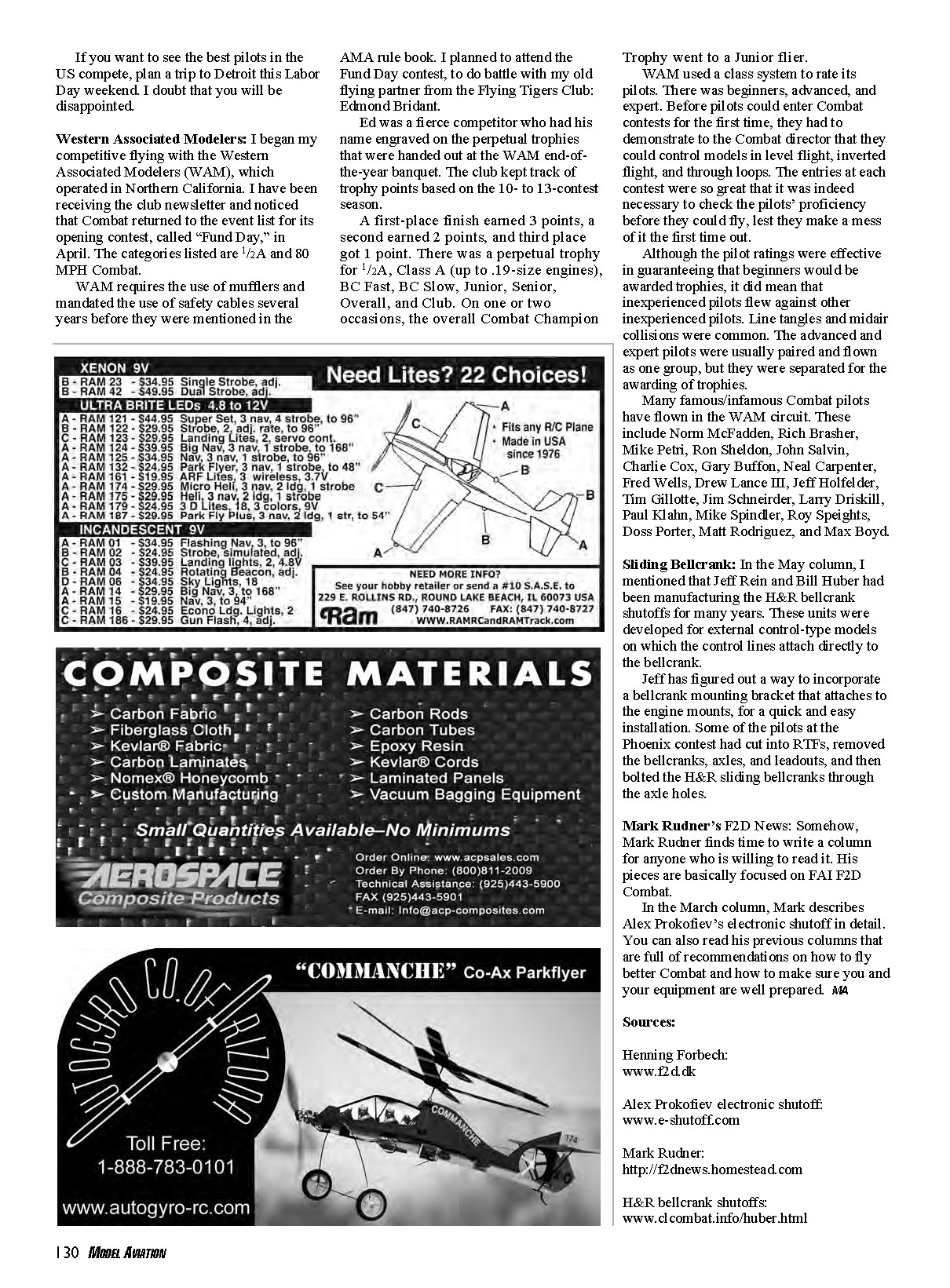
Control Line Combat - 2009/07
Phoenix mandatory fuel-shutoff test
The March Madness F2D contest in Phoenix, Arizona, was the first large competition held using the fuel-shutoff rule. Thirteen pilots entered, with a wide variety of shutoff devices bolted on or built into the models.
- Local Arizona pilots used externally mounted H&R sliding bellcrank shutoffs:
- Kevin Hebestreit — H&R sliding bellcrank (worked well)
- Alex Rednick — H&R sliding bellcrank (worked well)
- Bobby Mears — homemade bent-music-wire unit that goes through the leading edge and hooks onto a leadout
- Chuck Rudner — refined swing-arm originally intended for Fast Combat
- Don Jensen and the author — spring-type shutoffs described in the May column
- Richard Stubblefield, James McKinney, George Cleveland — swing-arm design built by Uvenko Works (Ukraine)
- Tom Seigler — built-in Italian spring-loaded bellcrank shutoffs
- Alan Deveuve — Jaka-produced swing arms (initially gave him problems; three unscheduled pit stops, later adjusted tension)
When all flying was completed, Richard Stubblefield beat Bobby Mears for first place; Tom Seigler finished third. Not many models were cut loose, so data on each shutoff’s effectiveness could not be calculated.
There was one accident: an aircraft was launched before the pilot had the safety thong attached and the handle firmly grasped. The model flew away with the lines and handle attached. The shutoff eventually activated, but only after the airplane was nearly out of sight; it landed nearby undamaged. There were other models that lost line tension and shut off. Overall, the contest proved valuable for the research and development of contest-worthy shutoffs.
1/2A Combat
Six pilots kicked off the season in Phoenix on Friday, March 6, with a double-elimination 1/2A contest:
- Tom Seigler
- Kevin Hebestreit
- Jeff Hanauer
- Chuck Rudner
- Pete Athans
- The author
This no-kill event featured Cyclon .049 engines and various models. In the finals, Pete Athans and the author arrived with no losses and flew each other three times to decide the winner. The author prevailed, giving the Southern California Combat Team a clean sweep. Chuck Rudner finished third. All three top pilots used the 2005 version of the 1/2A SlySir foam design.
US Team Trials
The Strathmoor Model Airplane Club won the bid to host the 2009 US Combat Team Trials for the World Championships. The trials will be held in Detroit, Michigan, during Labor Day weekend. Expect a large turnout, as many pilots now have competitive engines and models.
Representing US modelers internationally is an honor; the travel can be stressful, but the memories and friendships last a lifetime. If you want to see the best US pilots compete, plan a trip to Detroit over Labor Day weekend.
Western Associated Modelers
I began competitive flying with the Western Associated Modelers (WAM) in Northern California. Their newsletter showed that Combat returned to the event list for the opening contest, “Fund Day,” in April. Categories listed were 1/2A and 80 MPH Combat.
WAM required mufflers and mandated safety cables several years before those requirements appeared in the AMA rule book. I had planned to attend Fund Day to fly against my old partner from the Flying Tigers Club, Edmond Bridant. Ed was a fierce competitor whose name was engraved on perpetual trophies handed out at the WAM end-of-year banquet.
WAM kept track of trophy points over a 10–13 contest season:
- First place = 3 points
- Second place = 2 points
- Third place = 1 point
Perpetual trophies included: 1/2A, Class A (up to .19-size engines), BC Fast, BC Slow, Junior, Senior, Overall, and Club. On a few occasions the overall Combat Champion Trophy went to a Junior flier.
WAM used a class system to rate pilots: beginner, advanced, and expert. Before a new pilot could enter Combat contests, the Combat director required demonstrations of level flight, inverted flight, and loops to ensure basic proficiency. High entry numbers made these checks necessary to avoid chaos on the first outing.
While pilot ratings helped ensure beginners could win trophies among their peers, it also meant inexperienced pilots often flew against each other, leading to line tangles and midair collisions. Advanced and expert pilots were usually paired and flown as one group but were separated for awarding trophies.
Many notable Combat pilots have flown in the WAM circuit, including:
- Norm McFadden
- Rich Brasher
- Mike Petri
- Ron Sheldon
- John Salvin
- Charlie Cox
- Gary Buffon
- Neal Carpenter
- Fred Wells
- Drew Lance III
- Jeff Holfelder
- Tim Gillotte
- Jim Schneider
- Larry Driskill
- Paul Klahn
- Mike Spindler
- Roy Speights
- Doss Porter
- Matt Rodriguez
- Max Boyd
Sliding Bellcrank
In the May column I noted that Jeff Rein and Bill Huber have manufactured the H&R bellcrank shutoffs for many years. These units were developed for external control–type models where the control lines attach directly to the bellcrank.
Jeff has devised a bellcrank mounting bracket that attaches to engine mounts for quick and easy installation. Some Phoenix pilots cut into RTFs, removed the bellcranks, axles, and leadouts, then bolted H&R sliding bellcranks through the axle holes.
Mark Rudner's F2D News
Mark Rudner regularly writes a column focused on FAI F2D Combat. In his March column he describes Alex Prokofiev’s electronic shutoff in detail. His previous columns contain many recommendations on flying better Combat and preparing equipment.
Sources
- Henning Forbech: www.f2d.dk
- Alex Prokofiev electronic shutoff: www.e-shutoff.com
- Mark Rudner: http://f2dnews.homestead.com
- H&R bellcrank shutoffs: www.clcombat.info/huber.html
Transcribed from original scans by AI. Minor OCR errors may remain.

