
Chicago Combat Challenge 2009
Seventeen pilots from the US, Canada, and Mexico made the trip to the Chicago Combat Challenge in Romeoville, Illinois, to do battle with F2D (FAI Combat) models for a bit of prize money. The contest took place the weekend of August 1–2.
The circle marshal, Jordy Segal, tested fuel-shutoff devices during the first round prior to the start of each match. Even though many types of systems were being used, they all passed the test.
Aeromodelers are clever people by nature, and they tend to seek efficient and effective solutions to problems. That tendency shows in the quest for an efficient, inexpensive, and reliable shutoff device.
There were several versions of the swing-arm–type shutoffs, which use centrifugal force for operation. The ones Chuck Rudner employs are highly modified, Russian-made Fast Combat units adapted for use on F2D models. Chuck changes the angles of the swing arms and machines brass weights in various sizes for them. Testing is done with a full streamer and usually not the fastest engine, so the worst-case scenario is simulated.
Tom Seigler used Italian spring-loaded bellcrank units that had been installed by the builder. You can see these units on Henning Forbech’s website (address in the Sources list).
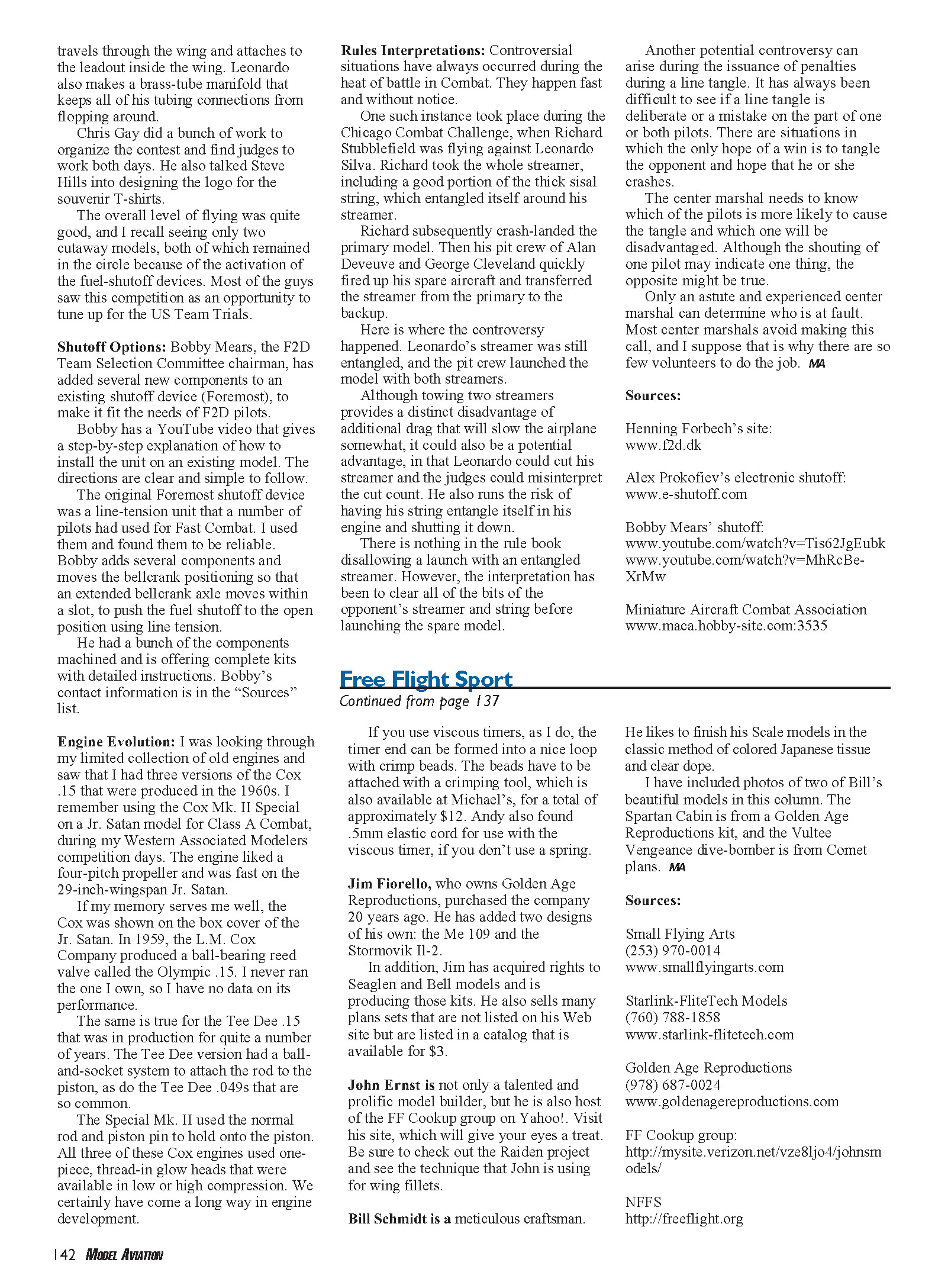
The winner, Louie Scavone, has a highly effective line-tension device: music wire bent carefully and attached to the engine mounts with a lock nut. Louie uses Spiderwire (from fishing-supply stores) to attach the music wire to the leadouts. A photograph shows how simple this is to replicate.
Louie flew effectively throughout the contest and did not damage any models the entire weekend. He was calm in the circle and in control of his aircraft. He will need to be taken seriously at the US Team Trials.
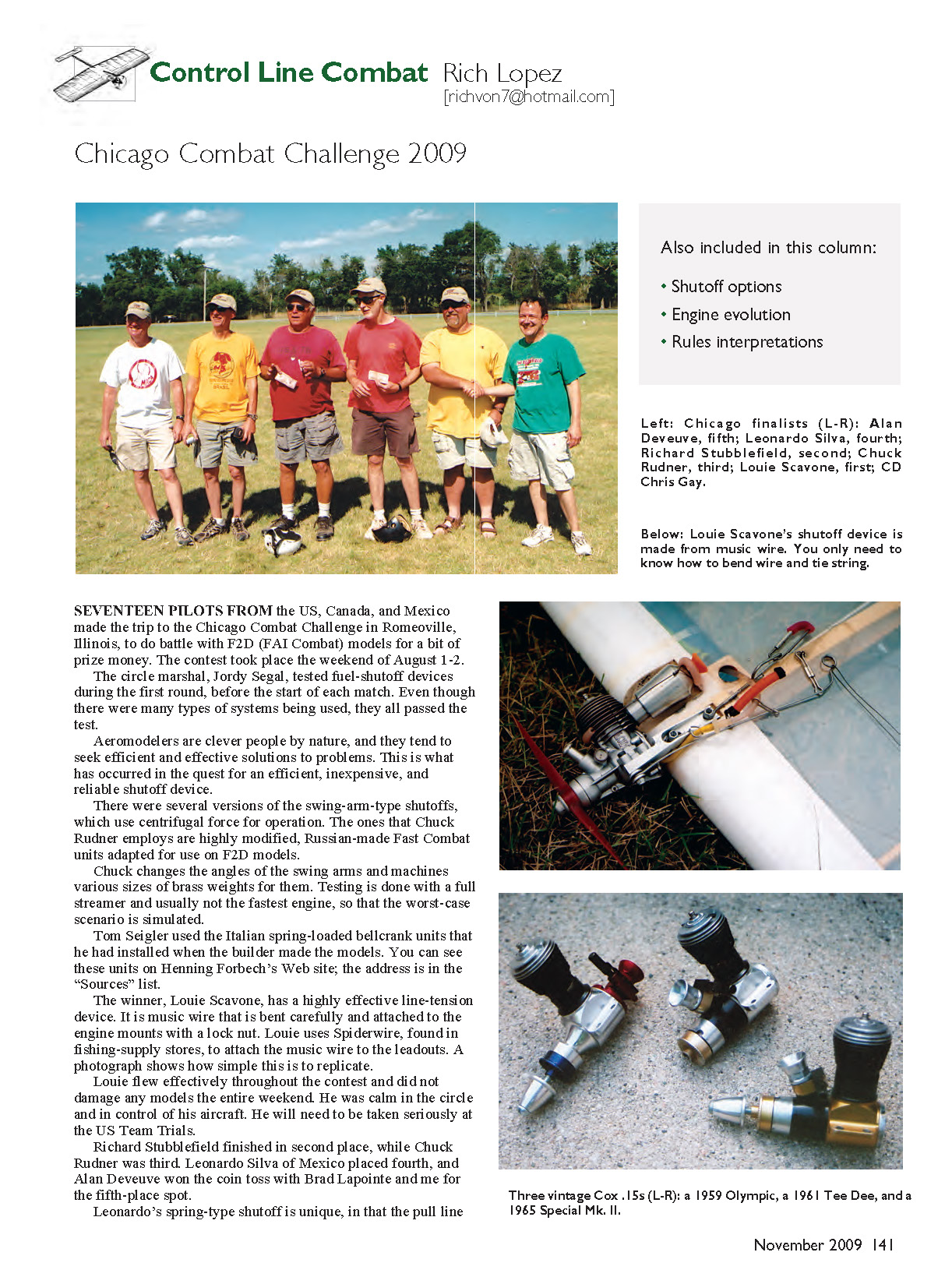
Richard Stubblefield finished in second place, while Chuck Rudner was third. Leonardo Silva of Mexico placed fourth, and Alan Deveuve won the coin toss with Brad Lapointe and me for the fifth-place spot.
Leonardo’s spring-type shutoff is unique: the pull line travels through the wing and attaches to the leadout inside the wing. Leonardo also makes a brass-tube manifold that keeps all of his tubing connections from flopping around.
Chris Gay did a lot of work organizing the contest and finding judges to work both days. He also persuaded Steve Hills to design the logo for the souvenir T-shirts.
The overall level of flying was quite good. I recall seeing only two cutaway models, both of which remained in the circle because their fuel-shutoff devices activated. Most of the competitors saw this event as an opportunity to tune up for the US Team Trials.
Shutoff Options
Bobby Mears, the F2D Team Selection Committee chairman, has added several new components to an existing shutoff device (Foremost) to make it better suited to F2D pilots’ needs.
Bobby has a YouTube video that gives a step-by-step explanation of how to install the unit on an existing model. The directions are clear and simple to follow.
The original Foremost shutoff device was a line-tension unit that a number of pilots had used for Fast Combat; I found them reliable. Bobby adds several components and repositions the bellcrank so that an extended bellcrank axle moves within a slot, pushing the fuel shutoff to the open position using line tension.
He had a bunch of the components machined and is offering complete kits with detailed instructions. Bobby’s contact information is in the Sources list.
Engine Evolution
I was looking through my limited collection of old engines and found three versions of the Cox .15 produced in the 1960s. I remember using the Cox Mk. II Special on a Jr. Satan model for Class A Combat during my Western Associated Modelers competition days. The engine liked a four-pitch propeller and was fast on the 29-inch wingspan Jr. Satan.
If my memory serves me well, the Cox was shown on the box cover of the Jr. Satan. In 1959 the L.M. Cox Company produced a ball-bearing reed valve called the Olympic .15. I never ran the one I own, so I have no data on its performance.
The same is true for the Tee Dee .15, which was produced for quite a number of years. The Tee Dee version had a ball-and-socket system to attach the rod to the piston, as do the common Tee Dee .049s.
The Special Mk. II used the normal rod and piston pin to hold onto the piston. All three of these Cox engines used one-piece, thread-in glow heads available in low or high compression. We certainly have come a long way in engine development.
Rules Interpretations
Controversial situations have always occurred during the heat of battle in Combat. They happen fast and without notice.
One such instance took place during the Chicago Combat Challenge when Richard Stubblefield was flying against Leonardo Silva. Richard took the whole streamer, including a good portion of the thick sisal string, which entangled itself around his streamer. Richard subsequently crash-landed his primary model. Then his pit crew, Alan Deveuve and George Cleveland, quickly fired up his spare aircraft and transferred the streamer from the primary to the backup.
Here the controversy arose: Leonardo’s streamer was still entangled, and the pit crew launched the model with both streamers. Although towing two streamers provides the distinct disadvantage of additional drag that will slow the airplane, it could also be a potential advantage in that Leonardo could cut his streamer and judges might misinterpret the cut count. He also ran the risk of having his string entangle in his engine and shut it down.
There is nothing in the rule book disallowing a launch with an entangled streamer. However, common interpretation has been to clear all parts of the opponent’s streamer and string before launching the spare model.
Another potential controversy can arise during the assessment of penalties for a line tangle. It has always been difficult to tell if a line tangle is deliberate or accidental on the part of one or both pilots. There are situations in which a pilot’s only hope of a win is to tangle the opponent and hope they crash.
The center marshal needs to know which pilot is more likely to have caused the tangle and which will be disadvantaged. Although the shouting of one pilot may indicate one thing, the opposite might be true. Only an astute and experienced center marshal can determine who is at fault. Most center marshals avoid making this call, which is likely why there are so few volunteers for the job.
Sources
- Henning Forbech’s site: www.f2d.dk
- Alex Prokofiev’s electronic shutoff: www.e-shutoff.com
- Bobby Mears’ shutoff (YouTube):
- www.youtube.com/watch?v=Tis62JgEubk
- www.youtube.com/watch?v=MhRcBe-XrMw
- Miniature Aircraft Combat Association: www.maca.hobby-site.com:3535
Transcribed from original scans by AI. Minor OCR errors may remain.

