
Control Line Navy Carrier
Dick Perry [[email protected]]
Schedule for Carrier action at the upcoming AMA Nats
As I outlined in the April column, the 2008 CL Navy Carrier Nats will be flown over three days. The schedule is as follows:
- Wednesday, July 16: AMA Profile Carrier, Navy Carrier Society (NCS) Sportsman Profile Carrier
- Thursday, July 17: AMA Class I, Class II Navy Carrier
- Friday, July 18: .15 Carrier (glow and electric combined), Sig Skyray Carrier (glow and electric combined), Nostalgia Carrier (Profile, Class I, Class II), Electric Carrier (Profile, Class I, Class II)
Sponsorship for the unofficial events is provided by the NCS, the North Coast Control Line Club of Cleveland, Sig Manufacturing Company, and some fellow Carrier modelers. Peter Mazur is seeking sponsors for the electric-power events; I’ll announce that information in the next column and in the Nats reporting. Ted Kraver has volunteered to serve as our event director for the official flying days.
There is still considerable experimentation going on in the electric-powered Carrier events. I hope to have more information to report following the Nats about the types of equipment being used, battery voltages and capacities, motor specifications, ESC current capacities, and other useful details to help establish workable equipment combinations.
eLogger and data logging
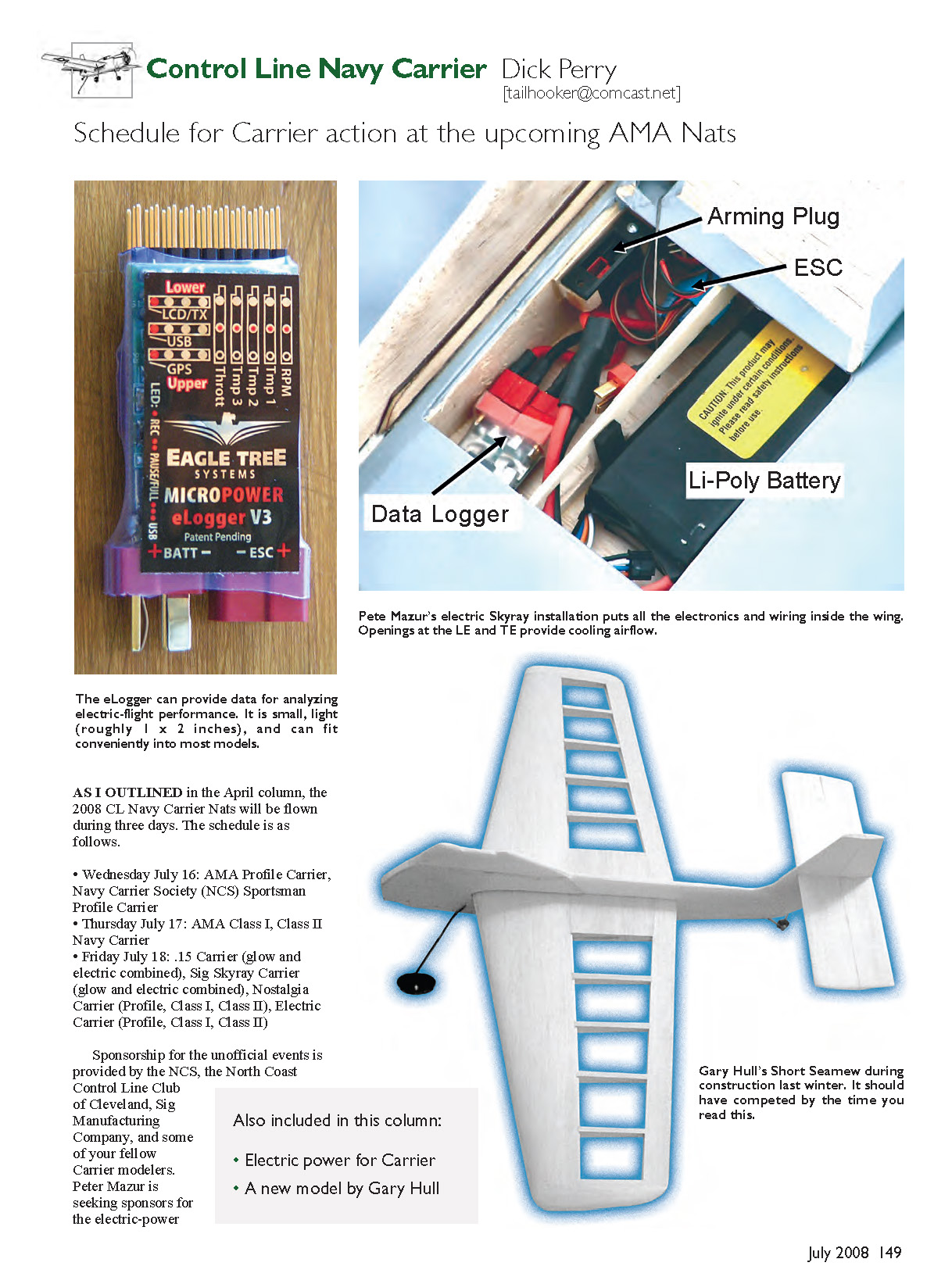
Pete Mazur has used electronic datalogging, and I have also acquired the appropriate equipment. We are using the eLogger from Eagle Tree Systems. This device provides time-based recording for voltage and current in its basic form. Additional data recording is available through plug-in modules for temperature, RPM, servo data, altitude, and airspeed.
The eLogger can provide real-time readouts to a computer during ground testing or recorded data following a flight. The computer program calculates power and battery capacity used and displays the recorded data channels.
Power requirements and electric setups
One of the first questions for anyone planning to enter electric Carrier events is: how much power is needed for adequate performance? Most experimentation has focused on Skyray and .15 Carrier. Because those are speed-limited events, power requirements are effectively capped along with speed.
Power required increases rapidly with speed. The drag on a model varies with the square of the speed, and since power is drag times speed, required power increases approximately with the cube of speed. For example, increasing speed from 75 mph to 95 mph requires more than twice the power; adding 30 mph can require nearly three times the power.
Pete Mazur’s electric Skyray needs approximately 750–800 watts of input power to achieve a 75 mph high-speed score. For comparison, 1 horsepower is roughly equal to 750 watts. Pete is currently flying with a 4S LiPo battery pack (nominal 14.4 V) with a capacity of 3300 mAh. Smaller batteries did not have the capacity to sustain a good low-speed portion of the flight.
Motor specifications typically include limits on continuous and short-duration power or current. Battery packs are usually rated for maximum continuous current and often specify a peak current for limited periods.
For sizing equipment, use input power as an estimate: electrical power is voltage multiplied by current (P = V × I). There are numerous losses and inefficiencies between the battery and the propeller, but battery voltage times current is a useful measure of total system input power.
Motors, propellers, torque, and rotation
Internal-combustion engines vary in torque through each revolution. The power stroke lasts for less than one-third of each revolution, followed by coasting during intake/exhaust and deceleration during compression.
Electric motors, by contrast, apply a nearly constant torque that is considerably smoother than the cyclic variation of a two-stroke engine. Because of this smooth torque, electric propellers can be thinner and lighter than glow propellers. Electrics can certainly use glow propellers, and glow propellers may provide a wider tuning range for optimizing performance.
As with internal-combustion engines, electric propellers are available for either direction of rotation. Reverse-rotation (pusher) propellers are offered in fewer diameters, pitches, and blade areas, whether glow or electric.
Some Carrier modelers prefer a pusher propeller and reverse-rotation engines. With glow power, handling advantages are small and the choice is largely personal preference and availability of performance-tuning options.
Power delivered to the propeller is the product of torque and rotational speed. High-revving, low-torque glow engines typically have less adverse effect on a properly trimmed model in slow flight. Motors—especially outrunners—produce more torque at lower RPM for a given power output. That high torque can roll a model toward the center of the circle quite easily, making reverse (left-hand) rotation nearly essential for outrunners or geared motors. The advantage with brushless motors is that they can run in either direction simply by reversing two of the three input wires.
Notes on models and requests
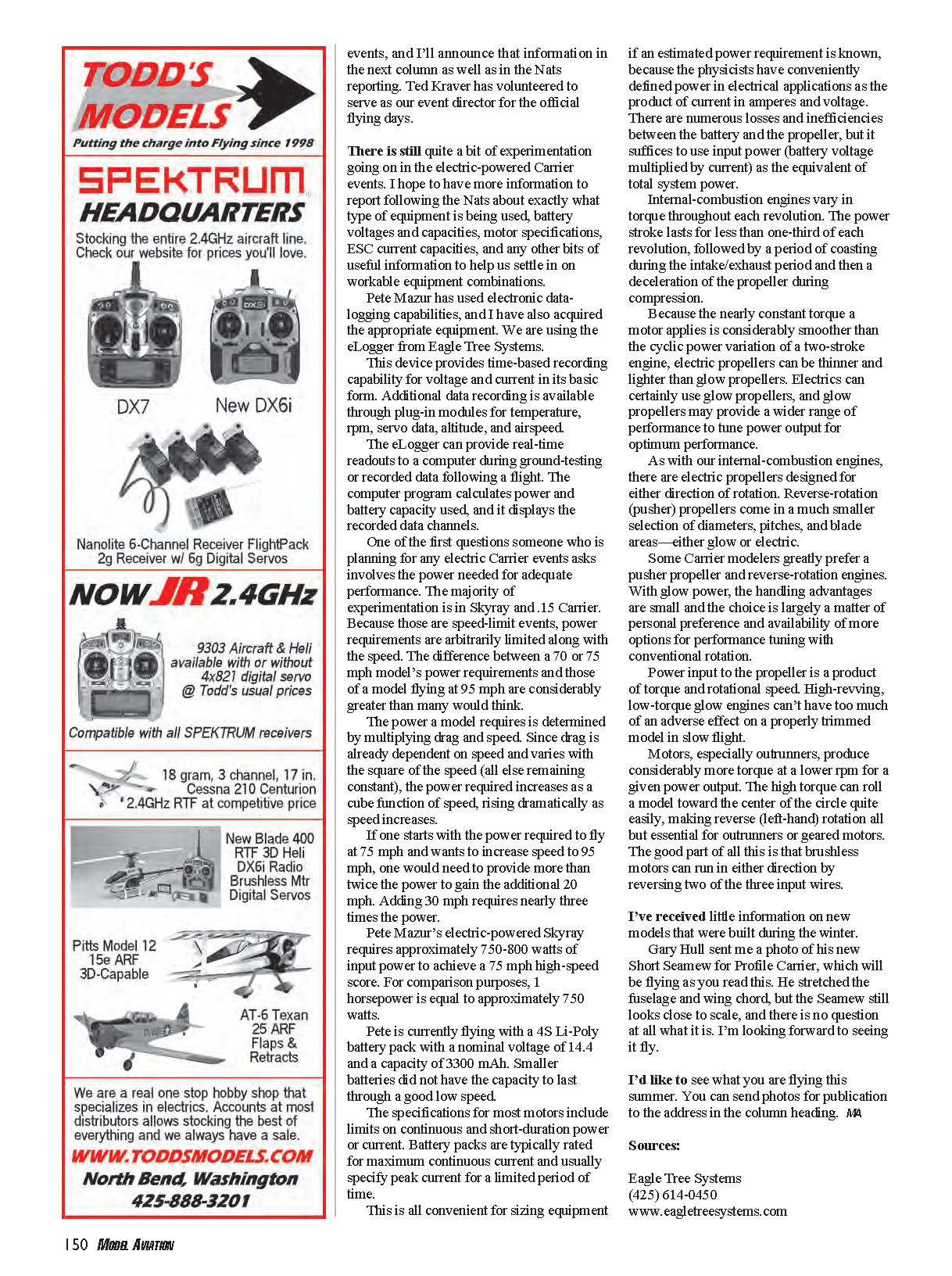
I’ve received little information on new models built over the winter. Gary Hull sent a photo of his new Short Seamew for Profile Carrier, which will be flying now. He stretched the fuselage and wing chord, but the Seamew still looks close to scale and is instantly recognizable. I’m looking forward to seeing it fly.
I’d like to see what you’re flying this summer. You can send photos for publication to the address in the column heading.
Sources
- Eagle Tree Systems
(425) 614-0450 www.eagletreesystems.com
Transcribed from original scans by AI. Minor OCR errors may remain.

