
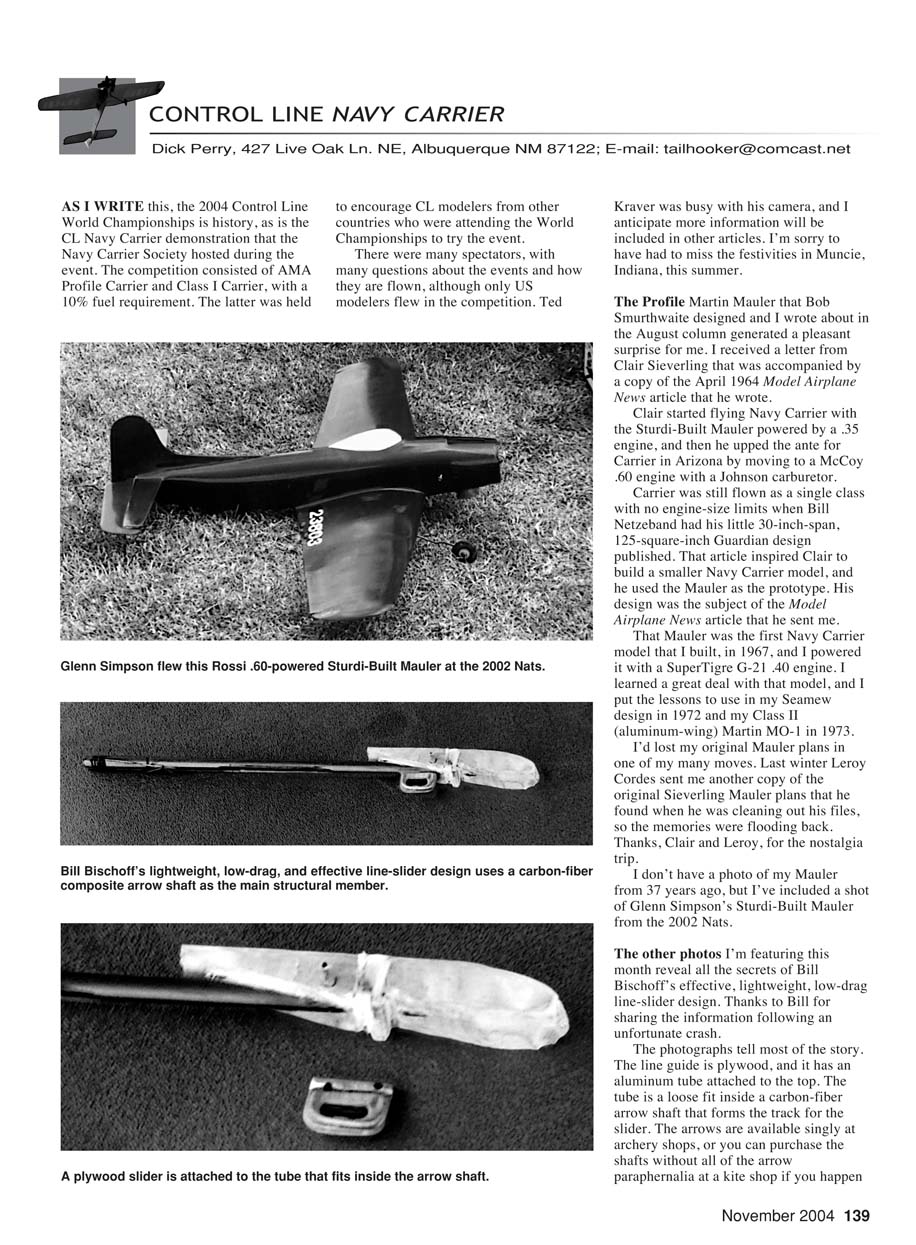
CONTROL LINE NAVY CARRIER
Dick Perry, 427 Live Oak Ln. NE, Albuquerque NM 87122; E-mail: [email protected]
2004 World Championships and CL Navy Carrier demonstration
As I write this, the 2004 Control Line World Championships is history, as is the CL Navy Carrier demonstration that the Navy Carrier Society hosted during the event. The competition consisted of AMA Profile Carrier and Class I Carrier, with a 10% fuel requirement. The latter was held to encourage CL modelers from other countries who were attending the World Championships to try the event.
There were many spectators, with many questions about the events and how they are flown, although only U.S. modelers flew in the competition. Ted Kraver was busy with his camera, and I anticipate more information will be included in other articles. I’m sorry to have had to miss the festivities in Muncie, Indiana, this summer.
Mauler nostalgia
The Profile Martin Mauler that Bob Smurthwaite designed and that I wrote about in the August column generated a pleasant surprise for me. I received a letter from Clair Sieverling that was accompanied by a copy of the April 1964 Model Airplane News article that he wrote.
Clair started flying Navy Carrier with the Sturdi-Built Mauler powered by a .35 engine, and then he upped the ante for Carrier in Arizona by moving to a McCoy .60 engine with a Johnson carburetor. Carrier was still flown as a single class with no engine-size limits when Bill Netzeband had his little 30-inch-span, 125-square-inch Guardian design published. That article inspired Clair to build a smaller Navy Carrier model, and he used the Mauler as the prototype. His design was the subject of the Model Airplane News article that he sent me.
That Mauler was the first Navy Carrier model that I built, in 1967, and I powered it with a SuperTigre G-21 .40 engine. I learned a great deal with that model, and I put the lessons to use in my Seamew design in 1972 and my Class II (aluminum-wing) Martin MO-1 in 1973. I’d lost my original Mauler plans in one of my many moves. Last winter Leroy Cordes sent me another copy of the original Sieverling Mauler plans that he found when he was cleaning out his files, so the memories were flooding back. Thanks, Clair and Leroy, for the nostalgia trip.
I don’t have a photo of my Mauler from 37 years ago, but I’ve included a shot of Glenn Simpson’s Sturdi-Built Mauler from the 2002 Nats.
Bill Bischoff’s line-slider design (lightweight, low-drag)
The other photos I’m featuring this month reveal all the secrets of Bill Bischoff’s effective, lightweight, low-drag line-slider design. Thanks to Bill for sharing the information following an unfortunate crash. The photographs tell most of the story.
Construction and components:
- The line guide is plywood with an aluminum tube attached to the top.
- The aluminum tube is a loose fit inside a carbon-fiber arrow shaft that forms the track for the slider.
- Arrow shafts are available singly at archery shops, or you can purchase the shafts without arrow components from a kite shop if you have one in your area.
- A slot is cut in one side of the shaft, and the shaft is glued into a thick rib in the wing structure.
Release mechanism:
- The release consists of a wire pin inserted through the metal tube in the rib, through the side of the arrow shaft, and into a hole drilled in the metal tube of the slider.
- The pin can be pulled by:
- a line attached to the throttle or elevator leadout,
- a wire attached to the bellcrank, or
- a wire actuated by the tailhook.
Finishing and assembly:
- After the initial fit and finish are accomplished on the internal components and the release mechanism, the slider can be removed for finishing the model.
- When the airplane is finished, insert the slider from the rear of the arrow shaft.
- Glue the rear stop into the shaft at the appropriate place.
- A small-diameter wire, bound and glued to the outside of the shaft, forms a catch to keep the slider at the rearmost position for low-speed flight.
Transcribed from original scans by AI. Minor OCR errors may remain.

