

Control Line Navy Carrier - 2006/10
Dick Perry [[email protected]]
Topeka, Kansas, Combat Air Museum at Forbes Field
Also included in this column:
- Ron Duly’s Class II Guardian resurrection
- 2007 Navy Carrier rules
As I was driving to the AMA Nats this summer, I noticed a billboard advertising the Combat Air Museum in Topeka, Kansas. Since it is hard for me to pass any aviation museum, I stopped at Forbes Field, where the museum is located, and spent an enjoyable two hours touring the aircraft and exhibits with docent Ralph Knehans.
The Combat Air Museum is housed in a World War II–era hangar and a Cold War B-47 maintenance hangar on the former Forbes Air Force Base, located south of Topeka. The museum’s holdings include veteran aircraft from World War II, Korea, and Vietnam, with enough Navy airplanes for any carrier modeler.
There is a Grumman F4F-3 Wildcat that was returned to flying condition after decades in Lake Michigan, a Korean War–veteran F9F Panther, a Blue Angels F11F Tiger, and a Douglas F3D Skyknight. The museum’s Lockheed EC-121 saw service in Vietnam and is open to allow visitors to view the stations from which controllers helped manage the air war over the north.
For a much better description than I have space for here, visit www.combatairmuseum.org.
Duly Guardian
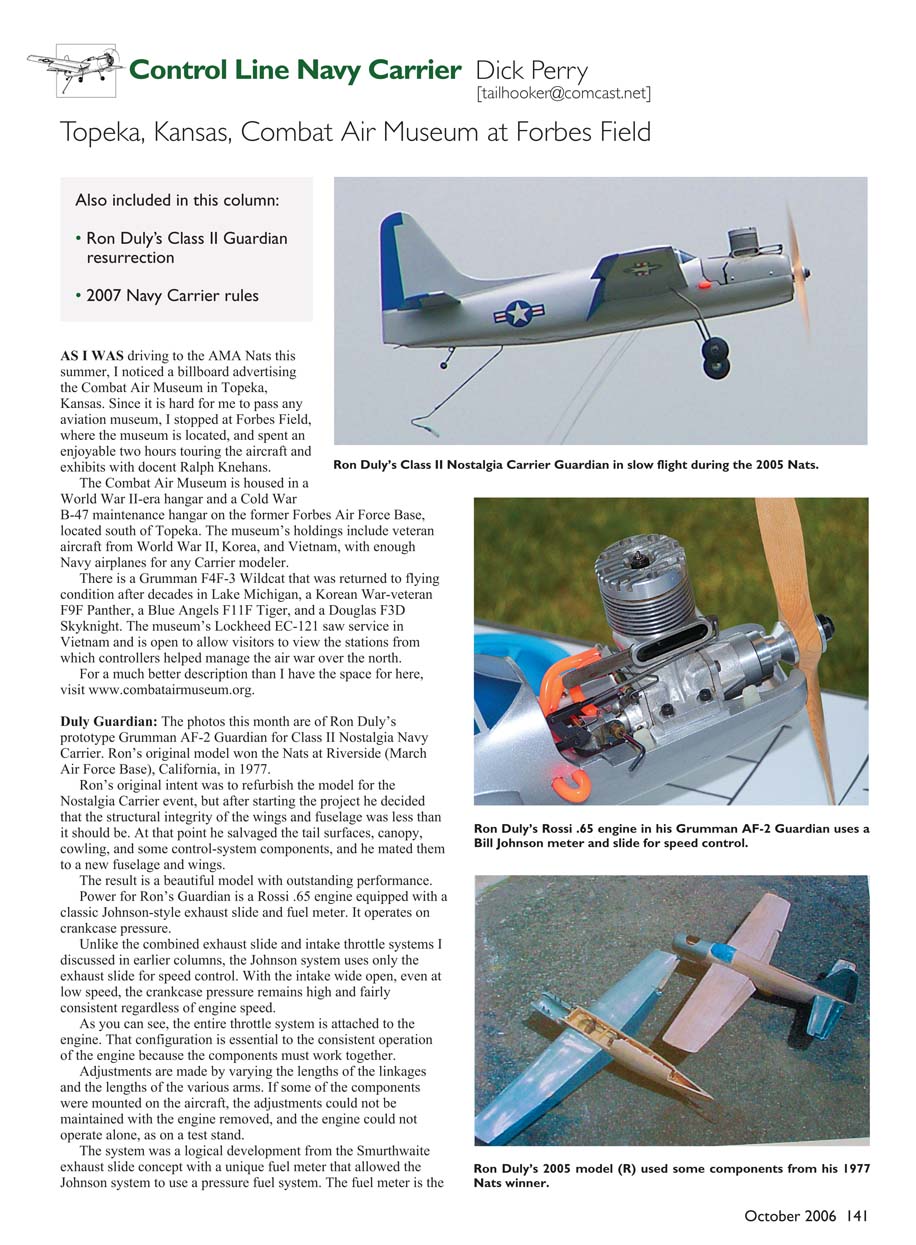
The photos this month are of Ron Duly’s prototype Grumman AF-2 Guardian for Class II Nostalgia Navy Carrier. Ron’s original model won the Nats at Riverside (March Air Force Base), California, in 1977.
Ron’s original intent was to refurbish the model for the Nostalgia Carrier event, but after starting the project he decided that the structural integrity of the wings and fuselage was less than it should be. At that point he salvaged the tail surfaces, canopy, cowling, and some control-system components, and mated them to a new fuselage and wings. The result is a beautiful model with outstanding performance.
Power for Ron’s Guardian is a Rossi .65 engine equipped with a classic Johnson-style exhaust slide and fuel meter. It operates on crankcase pressure.
Unlike the combined exhaust-slide-and-intake-throttle systems I discussed in earlier columns, the Johnson system uses only the exhaust slide for speed control. With the intake wide open, even at low speed the crankcase pressure remains high and fairly consistent regardless of engine speed.
The entire throttle system is attached to the engine. That configuration is essential to consistent operation because the components must work together. Adjustments are made by varying the lengths of the linkages and the various arms. If some components were mounted on the aircraft, the adjustments could not be maintained with the engine removed, and the engine could not operate alone, as on a test stand.
The system was a logical development from the Smurthwaite exhaust-slide concept with a unique fuel meter that allowed the Johnson system to use a pressure fuel system. The fuel meter is the device at the top of the backplate in the photograph. It was constructed from telescoping brass tubing with a piece of Tygon fuel line serving as a seal around the rotating inner tubing. This was (and still is) a consistent system as long as the variables of fuel and propeller were not changed significantly.
2007 Rules
Final voting on the rules changes for 2007 has been completed. There are no significant modifications. Most of the changes are editorial in nature, with some minor adjustments to deck and circle marking, and to timing.
Center marking will eliminate the movable plate, which is rarely used. Deck specifications will allow the use of thread laid out on the ground as a means of identifying late takeoffs and early landings on decks, and will add visible markers to make landing areas of ground-based carrier decks easier to see from the center of the circle. Timing changes will include designation of the two timers who will serve as the official timers unless their recorded times vary by more than the record requirements.
The new rules will be published on the AMA web site (www.modelaircraft.org) in January 2007.
MA
Transcribed from original scans by AI. Minor OCR errors may remain.

