
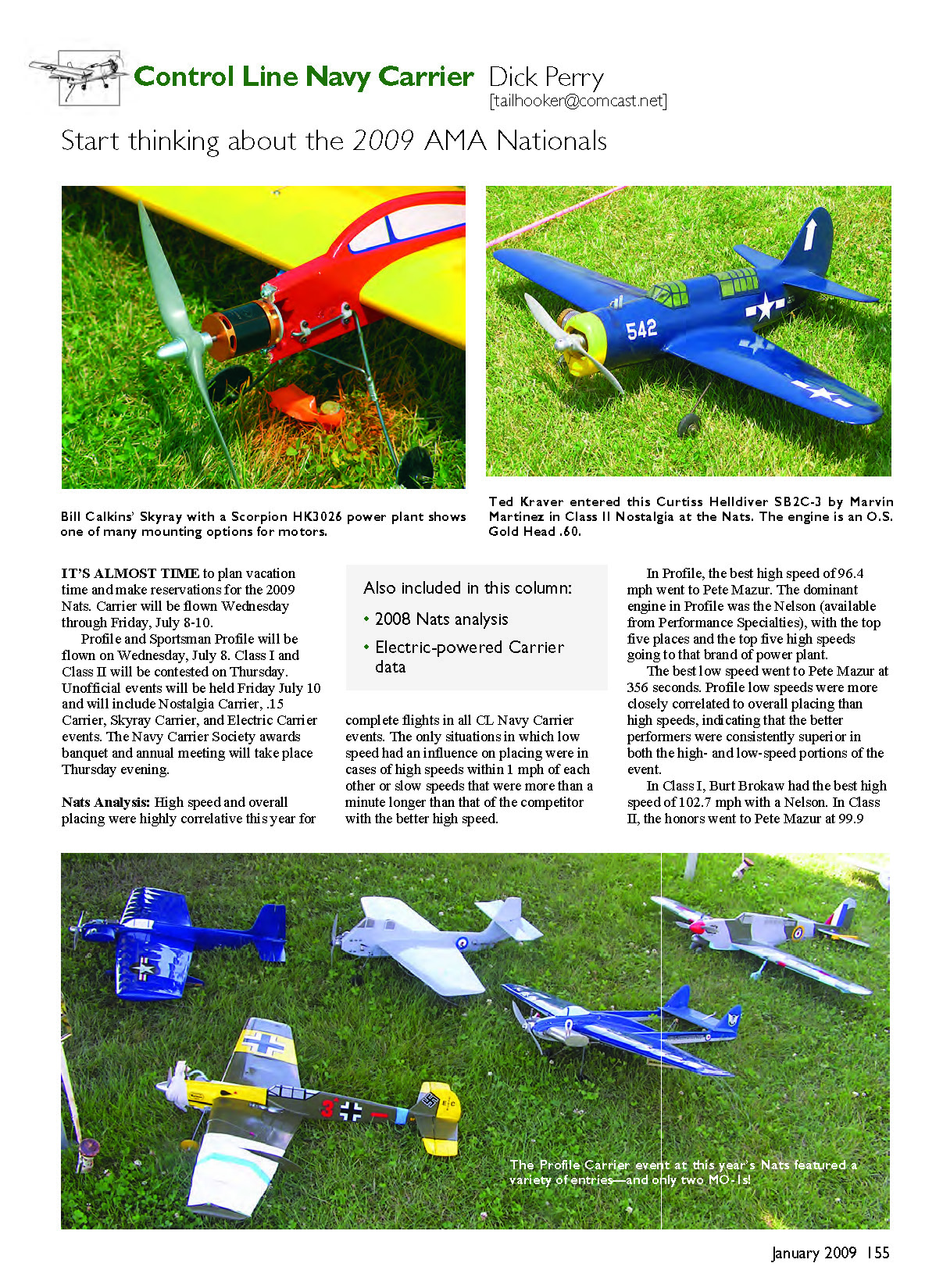
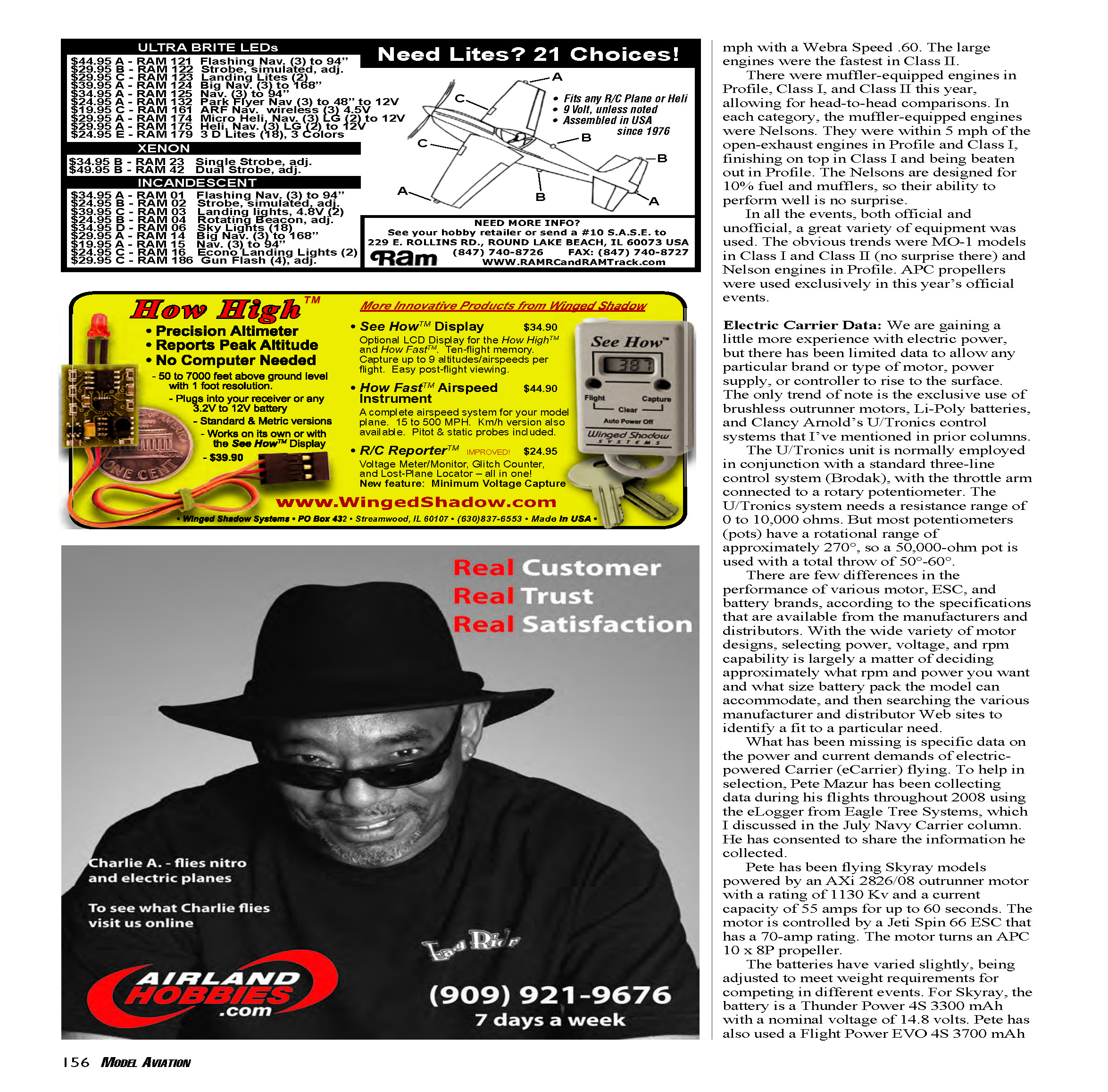
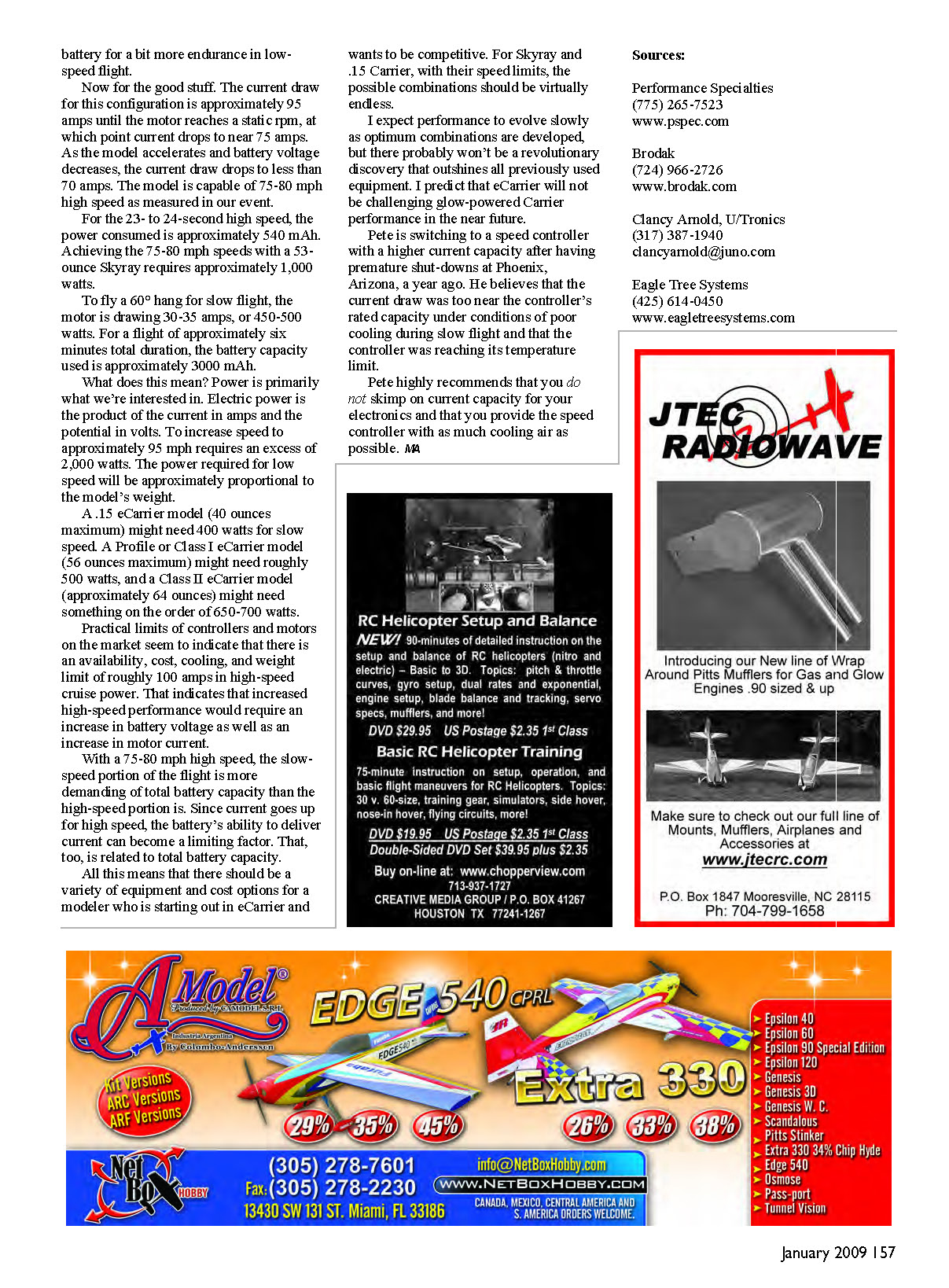
Control Line Navy Carrier - 2009/01
Dick Perry [[email protected]]
Start thinking about the 2009 AMA Nationals
Also included in this column:
- 2008 Nats analysis
- Electric-powered Carrier data
It's almost time to plan vacation time and make reservations for the 2009 Nats. Carrier will be flown Wednesday through Friday, July 8–10.
Profile and Sportsman Profile will be flown on Wednesday, July 8. Class I and Class II will be contested on Thursday. Unofficial events will be held Friday, July 10, and will include Nostalgia Carrier, .15 Carrier, Skyray Carrier, and Electric Carrier events. The Navy Carrier Society awards banquet and annual meeting will take place Thursday evening.
Nats Analysis
High speed and overall placing were highly correlated this year for complete flights in all CL Navy Carrier events. The only situations in which low speed had an influence on placing were in cases of high speeds within 1 mph of each other or slow speeds that were more than a minute longer than that of the competitor with the better high speed.
In Profile, the best high speed of 96.4 mph went to Pete Mazur. The dominant engine in Profile was the Nelson (available from Performance Specialties), with the top five places and the top five high speeds going to that brand of power plant.
The best low speed went to Pete Mazur at 356 seconds. Profile low speeds were more closely correlated to overall placing than high speeds, indicating that the better performers were consistently superior in both the high- and low-speed portions of the event.
In Class I, Burt Brokaw had the best high speed of 102.7 mph with a Nelson. In Class II, the honors went to Pete Mazur at 99.9 mph with a Webra Speed .60. The larger engines were the fastest in Class II.
There were muffler-equipped engines in Profile, Class I, and Class II this year, allowing for head-to-head comparisons. In each category the muffler-equipped engines were Nelsons. They were within 5 mph of the open-exhaust engines in Profile and Class I, finishing on top in Class I and being beaten out in Profile. Nelsons are designed to run on 10% fuel with mufflers, so their ability to perform well is no surprise.
In all the events, both official and unofficial, a great variety of equipment was used. The obvious trends were MO-1 models in Class I and Class II and Nelson engines in Profile. APC propellers were used exclusively in this year’s official events.
Electric Carrier Data
We are gaining a little more experience with electric power, but there has been limited data to allow any particular brand or type of motor, power supply, or controller to rise to the surface. The only trend of note is the exclusive use of brushless outrunner motors, Li-Poly batteries, and Clancy Arnold’s U/Tronics control systems that I’ve mentioned in prior columns.
The U/Tronics unit is normally employed in conjunction with a standard three-line control system (Brodak), with the throttle arm connected to a rotary potentiometer. The U/Tronics system needs a resistance range of 0 to 10,000 ohms. But most potentiometers (pots) have a rotational range of approximately 270°, so a 50,000-ohm pot is used with a total throw of 50°–60°.
There are few differences in the performance of various motor, ESC, and battery brands, according to specifications available from the manufacturers and distributors. With the wide variety of motor designs, selecting power, voltage, and rpm capability is largely a matter of deciding approximately what rpm and power you want and what size battery pack the model can accommodate, and then searching the various manufacturer and distributor web sites to identify a fit to a particular need.
What has been missing is specific data on the power and current demands of electric-powered Carrier (eCarrier) flying. To help in data collection, Pete Mazur collected data during his flights throughout 2008 using the eLogger from Eagle Tree Systems, which I discussed in the July Navy Carrier column. He has consented to share the information he collected.
Pete has been flying Skyray models powered by an AXi 2826/08 outrunner motor with a rating of 1130 kV and a current capacity of 55 amps for up to 60 seconds. The motor is controlled by a Jeti Spin 66 ESC rated at 70 amps. The motor turns an APC 10x8P propeller.
The batteries have varied slightly, being adjusted to meet weight requirements for competing in different events. For Skyray, the battery is a Thunder Power 4S 3300 mAh (nominal voltage 14.8 V). Pete has also used a Flight Power EVO 4S 3700 mAh battery for a bit more endurance in low-speed flight.
Measured performance for this configuration:
- Initial current draw is approximately 95 amps until the motor reaches a static rpm, at which point current drops to near 75 amps.
- As the model accelerates and battery voltage decreases, current draw drops to less than 70 amps.
- The model is capable of 75–80 mph high speed as measured in our event.
- For the 23–24 second high-speed sprint, the battery capacity consumed is approximately 540 mAh.
- Achieving 75–80 mph with a 53-ounce Skyray requires approximately 1,000 watts.
- To fly a 60° hang for slow flight, the motor draws 30–35 amps, or about 450–500 watts.
- For a flight of approximately six minutes total duration, the battery capacity used is approximately 3,000 mAh.
What does this mean? Power is the product of current (amps) and voltage (volts). To increase speed to approximately 95 mph requires an excess of about 2,000 watts. The power required for low speed will be approximately proportional to the model's weight.
Estimated slow-speed power needs by class:
- .15 eCarrier model (40 oz maximum): ~400 watts
- Profile or Class I eCarrier model (56 oz maximum): ~500 watts
- Class II eCarrier model (≈64 oz): ~650–700 watts
Practical limits of controllers and motors on the market suggest an availability, cost, cooling, and weight limit of roughly 100 amps in high-speed cruise power. That indicates increased high-speed performance would require higher battery voltage as well as increased motor current.
With a 75–80 mph high speed, the slow-speed portion of the flight is more demanding of total battery capacity than the high-speed portion is. Since current increases for high speed, the battery's ability to deliver current can become a limiting factor; that, too, is related to total battery capacity.
All this means there should be a variety of equipment and cost options for a modeler starting out in eCarrier who wants to be competitive. For Skyray and .15 Carrier, with their speed limits, the possible combinations should be virtually endless.
I expect performance to evolve slowly as optimum combinations are developed, but there probably won't be a revolutionary discovery that outshines all previously used equipment. I predict that eCarrier will not be challenging glow-powered Carrier performance in the near future.
Pete is switching to a speed controller with a higher current capacity after experiencing premature shut-downs at Phoenix, Arizona, a year ago. He believes the current draw was too near the controller's rated capacity under conditions of poor cooling during slow flight and that the controller was reaching its temperature limit.
Pete highly recommends that you do not skimp on current capacity for your electronics and that you provide the speed controller with as much cooling air as possible.
Sources
- Performance Specialties
(775) 265-7523 www.pspec.com
- Brodak
(724) 966-2726 www.brodak.com
- Clancy Arnold, U/Tronics
(317) 387-1940 [email protected]
- Eagle Tree Systems
(425) 614-0450 www.eagletreesystems.com
Transcribed from original scans by AI. Minor OCR errors may remain.

