

Control Line Navy Carrier
Dick Perry [[email protected]]
Carrier Plus XI event brief
The October contest in Phoenix, Arizona, hosted by Ted Kraver and the Central Arizona CL Club, was a great success. There was outstanding weather, and many contestants advanced their positions in the Navy Carrier Society's Top 20 listing for 2008.
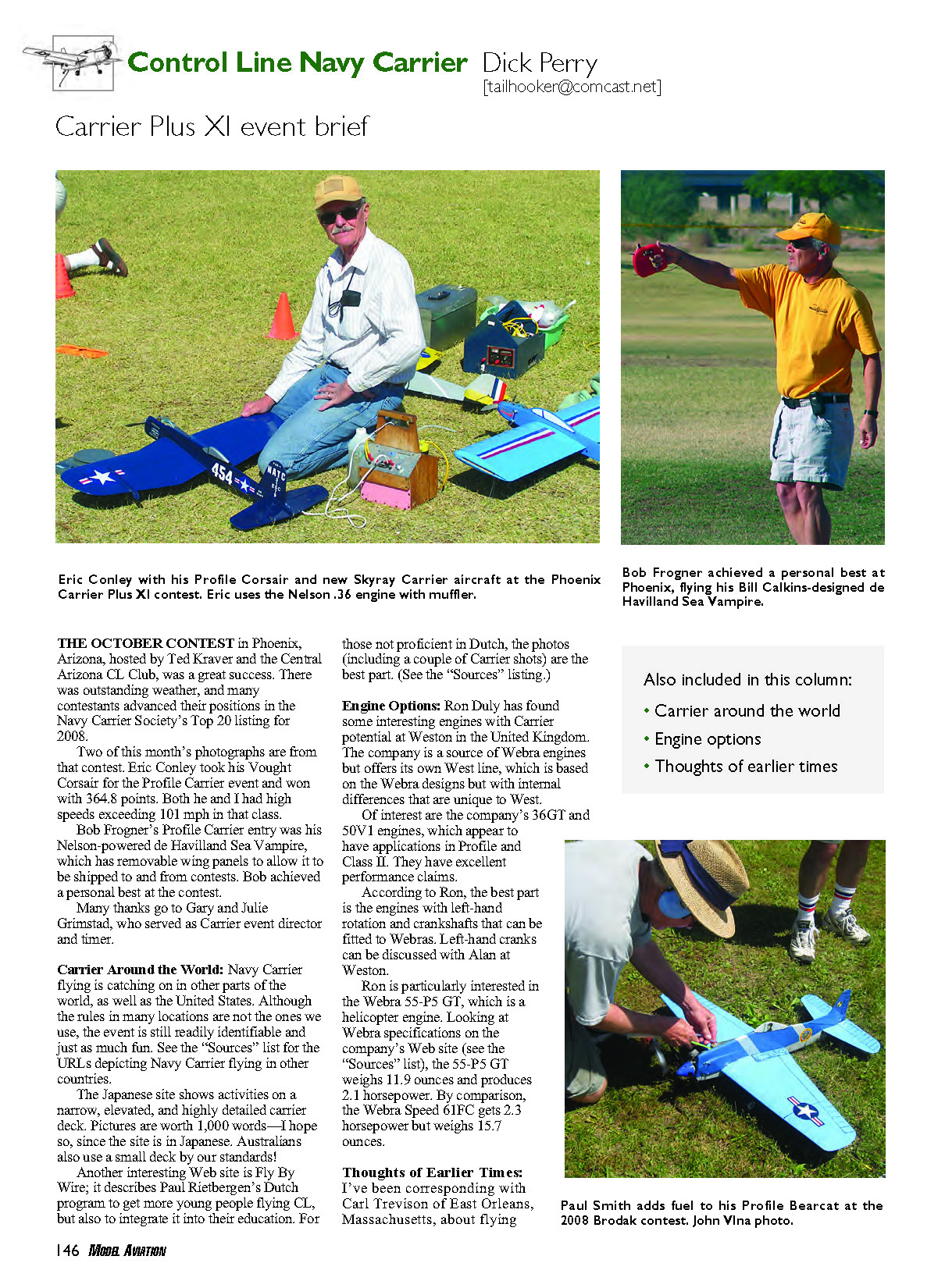
Two of this month's photographs are from that contest. Eric Conley took his Vought Corsair for the Profile Carrier event and won with 364.8 points. Both he and I had high speeds exceeding 101 mph in that class.
Bob Frogner's Profile Carrier entry was his Nelson-powered de Havilland Sea Vampire, which has removable wing panels to allow it to be shipped to and from contests. Bob achieved a personal best at the contest.
Many thanks go to Gary and Julie Grimstad, who served as Carrier event director and timer.
Carrier Around the World: Navy Carrier flying is catching on in other parts of the world, as well as the United States. Although the rules in many locations are not the ones we use, the event is still readily identifiable and just as much fun. See the "Sources" list for the URLs depicting Navy Carrier flying in other countries.
The Japanese site shows activities on a narrow, elevated, and highly detailed carrier deck. Pictures are worth 1,000 words—I hope so, since the site is in Japanese. Australians also use a small deck by our standards! Another interesting website is Fly By Wire; it describes Paul Rietbergen's Dutch program to get more young people flying CL, and to integrate it into their education. For those not proficient in Dutch, the photos (including a couple of Carrier shots) are the best part. (See the "Sources" listing.)
Engine Options: Ron Duly has found some interesting engines with Carrier potential at Weston in the United Kingdom. The company is a source of Webra engines but offers its own West line, which is based on the Webra designs but with internal differences that are unique to West. Of interest are the company's 36GT and 50V1 engines, which appear to have applications in Profile and Class II. They have excellent performance claims.
According to Ron, the best part is the engines with left-hand rotation and crankshafts that can be fitted to Webras. Left-hand cranks can be discussed with Alan at Weston.
Ron is particularly interested in the Webra 55-P5 GT, which is a helicopter engine. Looking at Webra specifications on the company's website (see the "Sources" list), the 55-P5 GT weighs 11.9 ounces and produces 2.1 horsepower. By comparison, the Webra Speed 61FC gets 2.3 horsepower but weighs 15.7 ounces.
Thoughts of Earlier Times: I've been corresponding with Carl Trevison of East Orleans, Massachusetts, about flying roughly 50 years ago in the Northeast. His reminiscences bring back a few memories of my own. He wrote:
"This old Control Line guy recently pulled out a cardboard box that hadn't been opened for about 45 years. In it were various engines including Fox 35 Stunt, Veco 35, Fox 35 Combat Special and finally a McCoy 60. Most engines had broken wooden Top Flite propellers, still in the condition that I left them 45-plus years ago.
"Out of the same box came recollections of a kid who (prior to having a driver's license) was shuttled to model airplane contests throughout Connecticut by friends' dads (God bless them all). We flew in Trumbull, Hazardville and Milford, with Hazardville and Milford having separate flying rings for Stunt, Combat and Carrier (wow).
"My first attempt at Carrier was with a Berkeley SBD Dauntless powered by a K&B 35. Motor speed was controlled by an exhaust back-pressure throttle that my dad machined for me in his machine shop. The third line for speed control was a length of monofilament fishing line. It stretched when you pulled it for low speed runs, but it worked and was cheap. The handle was an old EZ Just Stunt handle. I never won, but had loads of fun trying.
"A little later I got a real job, leaving lawn mowing and leaf raking behind. Now I was able to afford a 'real engine,' my prized, used McCoy 60, which was pretty well the standard for Carrier in those days, along with the Dooling 61. Wow, what a piece of machinery this was. Hooked up to a Sterling Guardian I was flying with the big boys at age 16. Never did very well.
"Even though gasoline was 26 cents per gallon and I was driving a Fiat 500 with two cylinders and 26 HP, it was still hard to afford to get away to contests. My friends Tom and Don (still dear friends after all these years) would often go with me with airplanes taking up most of the back seat.
"I put all of the engines back in the box. The broken propellers just as I left them 45 years ago when I 'clunked' it in on the Carrier deck (or Stunt circle or Combat circle), still a little dirt on the propellers from the grass fields.
"My fond memories are back in the cardboard box along with my old engines. Maybe I'll open it up again next year. It really felt good to go back there for a while." MA
Sources:
- Navy Carrier in Japan: http://home1.catvmics.ne.jp/~naruse99/e/index.htm
- Navy Carrier in the United Kingdom: http://www.cheffers.co.uk/carrier.html
- Navy Carrier in Australia: http://clamf.aerosports.net.au
- Fly By Wire: http://www.flybywire.org/
- Weston UK: +44(0)1795 521030 +44(0)1795 522020 http://www.westonuk.co.uk
- Webra Engines: http://www.webra-austria.at/index1.php?lang=EN
Transcribed from original scans by AI. Minor OCR errors may remain.

