

Control Line Navy Carrier
Dick Perry [[email protected]]
Carrier ARF options, conversions, and modifications
Since the rules changed and the Sterling Guardian became outdated for Navy Carrier competition, there has been ongoing interest in readily available kits for our events. A couple of profile MO-1 kits have been highly competitive, and Brodak still offers the Bob Smurthwaite Bearcat and Skyraider. Brodak also sells the Calkins Guardian, which can be very competitive with a few modifications. Pete Mazur won Profile Navy Carrier at the 2009 Nationals with the design, scoring 358.6 points.
For Class I and Class II, options have been limited for practical purposes, except for converting the profile MO-1s to full-bodied models with new fuselages. More recently, several ARFs (not kits) have appeared on the market. The initial impetus for these ARFs was an AMA RC Combat event for 1/12-scale models, which dictated a scale tolerance of either 5% or 10% (rules have since changed). Those models were designed for .15–.25 cu. in. engines and typically do not include landing gear, so conversions require strengthening, adding a control-line system, landing gear, and a tailhook. Even so, converting an ARF usually requires less workshop time than building from scratch or from a kit.
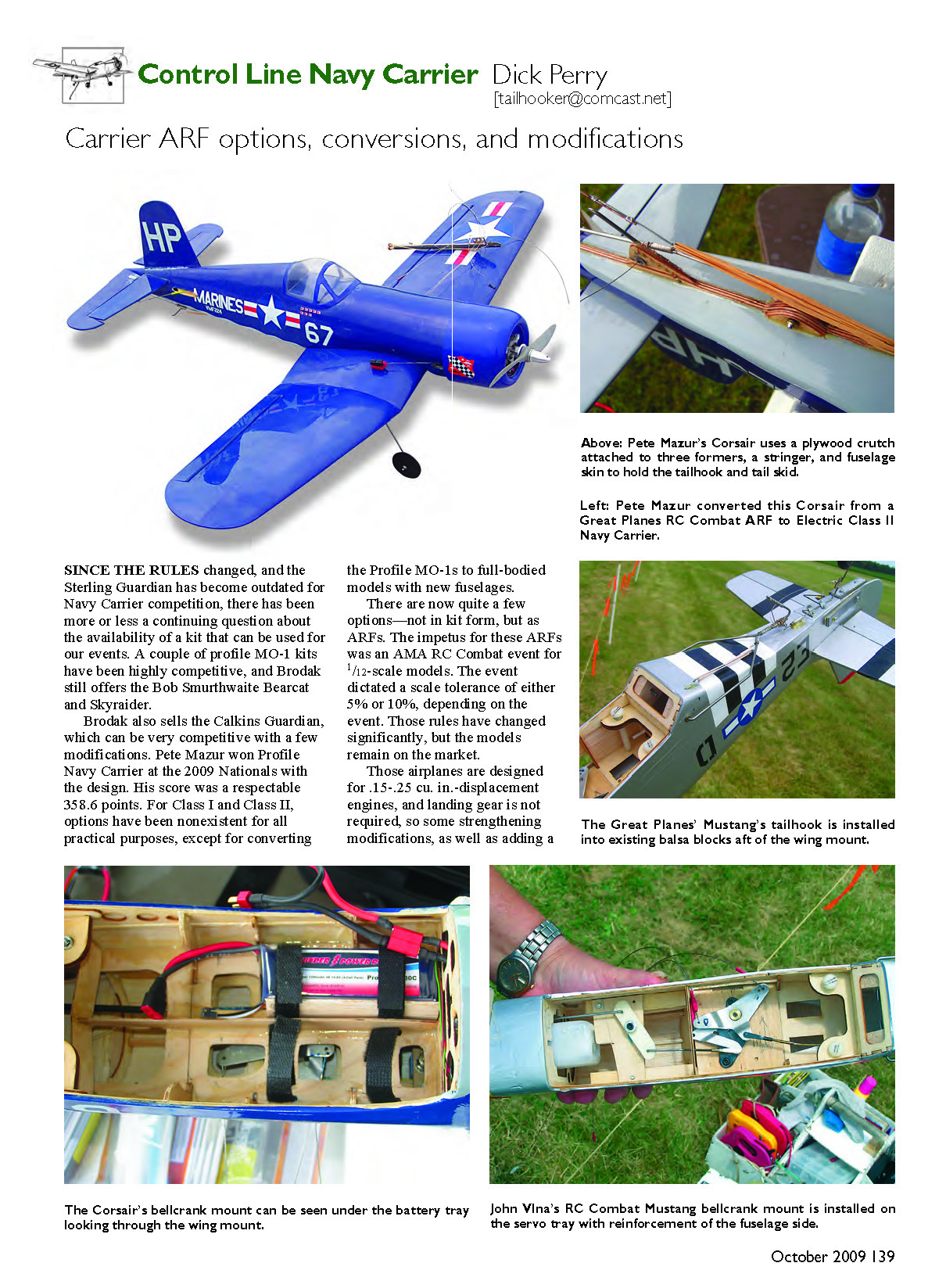
The examples shown in the photos are from the Great Planes Combat line: Corsair, Mustang, and Spitfire. The Corsair is the largest (43.25 in. span, roughly 349 sq. in. wing area), while the Mustang and Spitfire each have about 250–275 sq. in. wing area. Pete Mazur converted the Corsair for Electric Class II. John Vlna’s Mustang is also a Class II model but uses a SuperTigre .46 glow engine.
Probably one of the most important modification steps is strengthening the fuselage side where the bellcrank platform is installed. The fuselage needs to withstand the pull test; the original side material is often only about 1/16 in. balsa. Additional thickness, bulkheads, and/or gussets are typically required. With removable wings, the bellcrank should be installed in the fuselage for proper load transfer. Pete and John used grooved blocks for installing the landing gear; tie these blocks solidly into the existing wing structure. The photos suggest some possible modifications, and neither Pete’s nor John’s models have difficulty passing the pull test.
The ARF listing below includes the aircraft name, wingspan, wing area (assuming the ARF is built to scale), construction material (built-up or foam), and the power for which the model was designed (electric or glow). Manufacturers’ offerings change frequently, so some models may be unavailable by the time this is printed, and additional possibilities may appear.
Be creative and may you have good hunting. — R.P.
ARF models and specifications
Great Planes Model Manufacturing:
- Combat Corsair: Wingspan 43.25 in.; Wing area 349 sq. in.; Construction: built-up; Power: glow
- Combat Spitfire: Wingspan 39 in.; Wing area 270 sq. in.; Construction: built-up; Power: glow
- Combat Mustang: Wingspan 38.5 in.; Wing area 250 sq. in.; Construction: built-up; Power: glow
Hobby Lobby:
- Art-Tech F4U Corsair: Wingspan 39.5 in.; Wing area 285 sq. in.; Construction: foam; Power: electric
- Art-Tech P-51 Mustang: Wingspan 37.75 in.; Wing area 245 sq. in.; Construction: foam; Power: electric
- Hobby Lobby F-4 Phantom II EDF: Wingspan 28.38 in.; Wing area 250 sq. in.; Construction: foam; Power: electric
- Alfa Model Bristol Beaufighter: Wingspan 40.38 in.; Wing area 248 sq. in.; Construction: foam; Power: electric
- de Havilland Mosquito: Wingspan 45.25 in.; Wing area 307 sq. in.; Construction: foam; Power: electric
ParkZone:
- F4U Corsair: Wingspan 44 in.; Wing area 350 sq. in.; Construction: foam; Power: electric
- T-28 Trojan: Wingspan 44 in.; Wing area 322 sq. in.; Construction: foam; Power: electric
Hobby People:
- Model Tech P-51: Wingspan 43.3 in.; Wing area 316 sq. in.; Construction: built-up; Power: glow
AirBorne Models / World Models:
- AT-6 EP: Wingspan 44 in.; Wing area 295 sq. in.; Construction: built-up; Power: electric
- P-51 EP (light): Wingspan 39.5 in.; Wing area 282 sq. in.; Construction: built-up; Power: electric
- Spitfire (light): Wingspan 39.5 in.; Wing area 257 sq. in.; Construction: built-up; Power: electric
- Zero (light): Wingspan 39.5 in.; Wing area 264 sq. in.; Construction: built-up; Power: electric
Notes on conversion
- Strengthen fuselage sides (add ply doublers, bulkheads, gussets) where bellcrank/platform is installed to pass pull test.
- Install bellcrank in fuselage for proper load transfer, especially with removable wings.
- Use grooved blocks for landing-gear attachment and tie them firmly into wing structure.
- Verify scale compliance for your event before conversion; Great Planes models above are confirmed to meet the author’s event scale requirements.
- The Model Tech Mustang listed is designed for larger glow engines; check power compatibility before modifying.
Sources and contacts
Richard L. Perry 427 Live Oak Ln. NE Albuquerque, NM 87122
Brodak Manufacturing
- Phone: (724) 966-2726
- Web: www.brodak.com
Great Planes Model Manufacturing
- Phone: (800) 637-7660
- Web: www.greatplanes.com
Hobby Lobby
- Phone: (866) 412-1444
- Web: www.hobby-lobby.com
ParkZone
- Phone: (800) 338-4639
- Web: www.parkzone.com
Hobby People
- Phone: (800) 854-8471
- Web: www.hobbypeople.net
AirBorne Models / World Models
- Phone: (925) 371-0921
- Web: www.airborne-models.com
Navy Carrier Society
Transcribed from original scans by AI. Minor OCR errors may remain.

