
CONTROL LINE RACING
James Holland, [email protected]
I'll begin my first column for MA by thanking Bob Hunt for giving me the chance to do this and my fellow CL racers for freely sharing much of the information I will be using.
Introduction
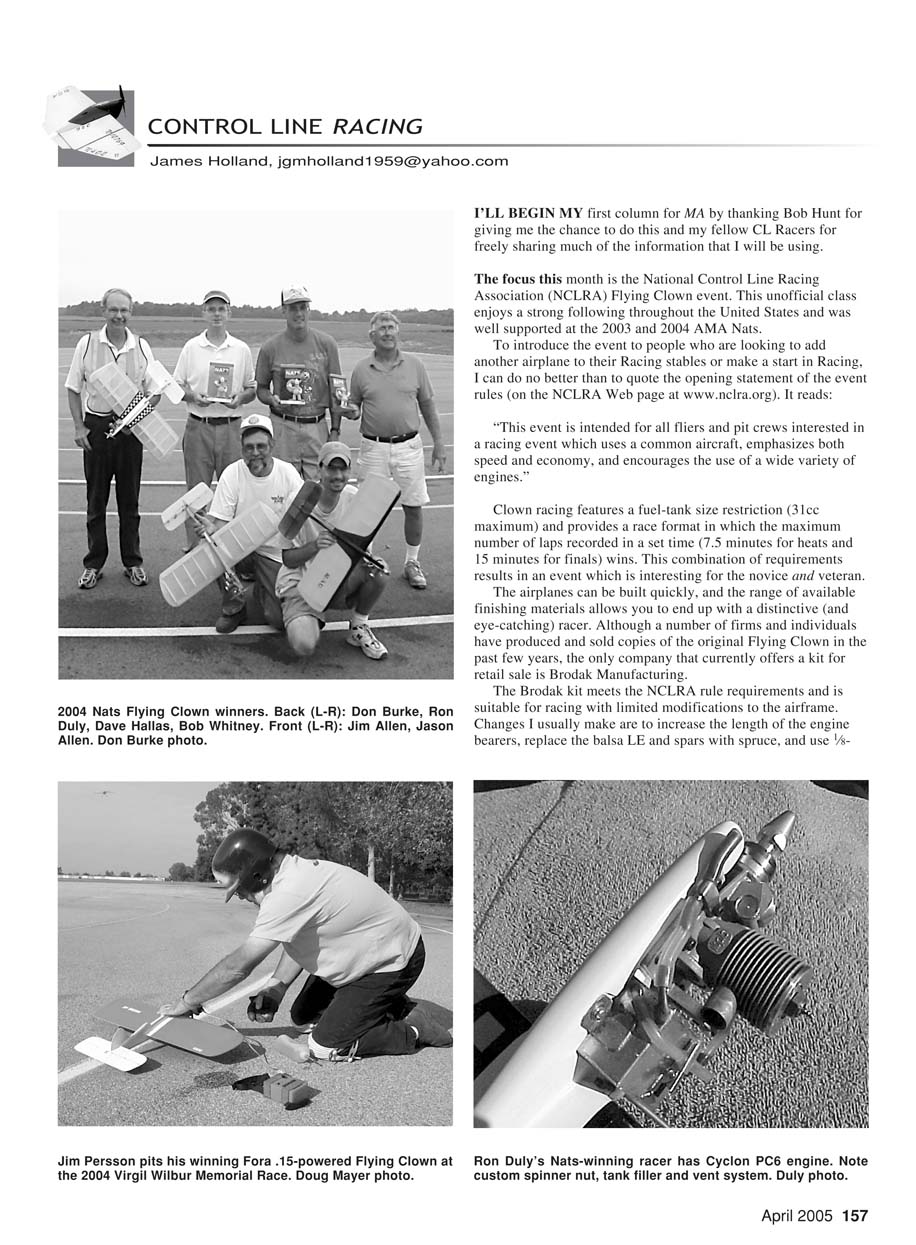
The focus this month is the National Control Line Racing Association (NCLRA) Flying Clown event. This unofficial class enjoys a strong following throughout the United States and was well supported at the 2003 and 2004 AMA Nats.
To introduce the event to people who are looking to add another airplane to their racing stables or make a start in racing, I can do no better than to quote the opening statement of the event rules (on the NCLRA Web page at www.nclra.org):
“This event is intended for all fliers and pit crews interested in a racing event which uses a common aircraft, emphasizes both speed and economy, and encourages the use of a wide variety of engines.”
Clown racing features a fuel-tank size restriction (31 cc maximum) and provides a race format in which the maximum number of laps recorded in a set time (7.5 minutes for heats and 15 minutes for finals) wins. This combination of requirements results in an event that is interesting for both novices and veterans.
The airplane and kit
The airplanes can be built quickly, and the range of available finishing materials allows you to end up with a distinctive (and eye-catching) racer. Although a number of firms and individuals have produced and sold copies of the original Flying Clown in past years, the only company that currently offers a kit for retail sale is Brodak Manufacturing.
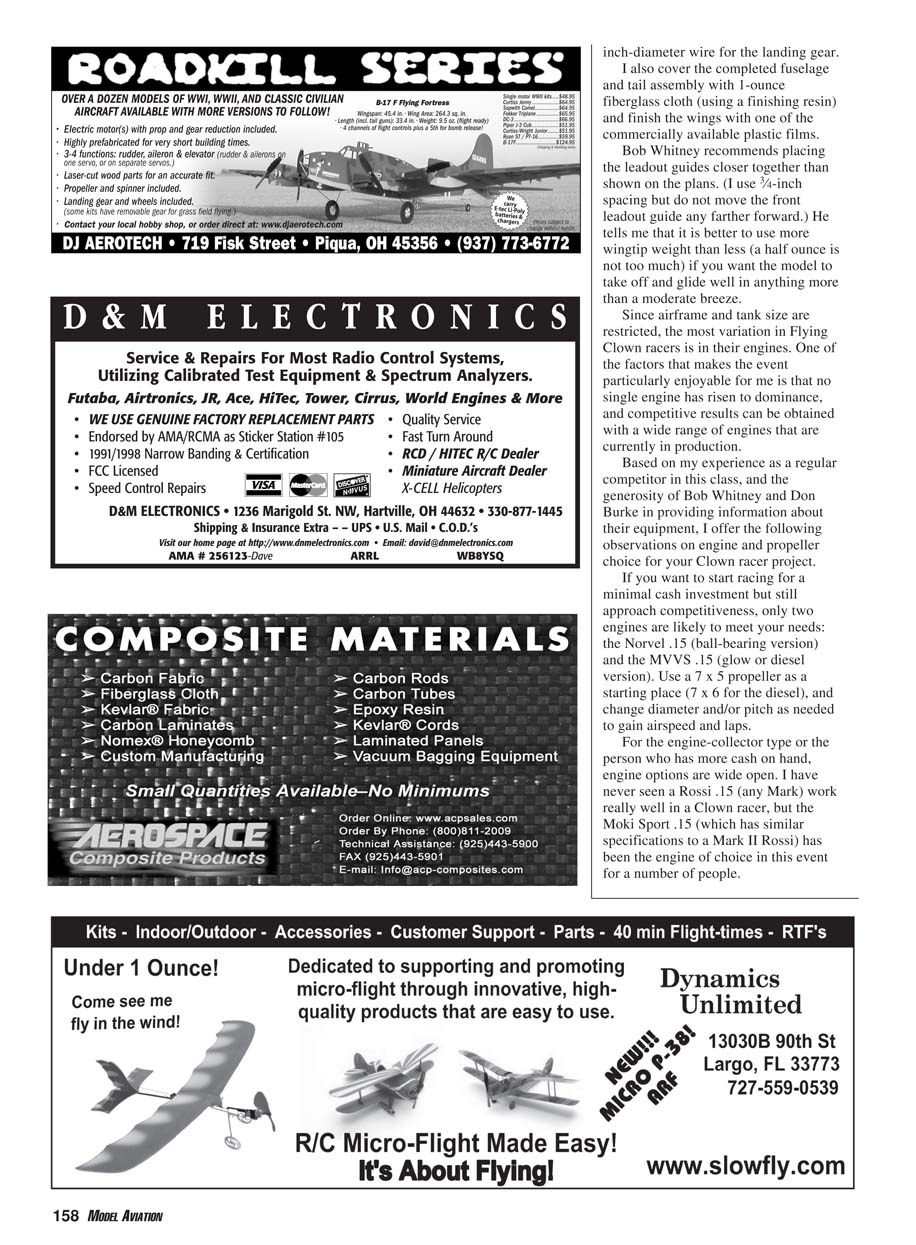
The Brodak kit meets the NCLRA rule requirements and is suitable for racing with limited modifications to the airframe. Typical changes I make include:
- Increasing the length of the engine bearers.
- Replacing the balsa leading edge and spars with spruce.
- Using 1/8-inch-diameter wire for the landing gear.
- Covering the completed fuselage and tail assembly with 1-ounce fiberglass cloth and finishing with a resin.
- Finishing the wings with a commercially available plastic film.
Bob Whitney recommends placing the leadout guides closer together than shown on the plans. I use 3/4-inch spacing but do not move the front leadout guide any farther forward. He also suggests using more wingtip weight rather than less (a half ounce is not too much) if you want the model to take off and glide well in anything more than a moderate breeze.
Engines and propellers — general observations
Since airframe and tank size are restricted, the most variation in Flying Clown racers is in their engines. No single engine has risen to dominance; competitive results can be obtained with a wide range of engines currently in production. Based on my experience as a regular competitor and information from Bob Whitney and Don Burke, here are observations on engine and propeller choice.
If you want to start racing with minimal cash investment but still be competitive, two engines are likely to meet your needs:
- Norvel .15 (ball-bearing version) — start with a 7 x 5 prop.
- MVVS .15 (glow or diesel version) — start with a 7 x 5 prop (7 x 6 for diesel).
Change diameter and/or pitch as needed to gain airspeed and laps.
For the engine-collector or someone with more funds, options are wide open. A few notable engines and notes:
- Rossi .15 (any Mark): I have not seen it work really well in a Clown.
- Moki Sport .15: Similar in specification to an early Rossi and has been an engine of choice for several competitors. Although out of production for at least 10 years, you can find them at swap meets or online. They respond well to modified heads that use the Nelson plug and like roughly 7 x 6 propellers (Master Airscrew 7 x 6 works well).
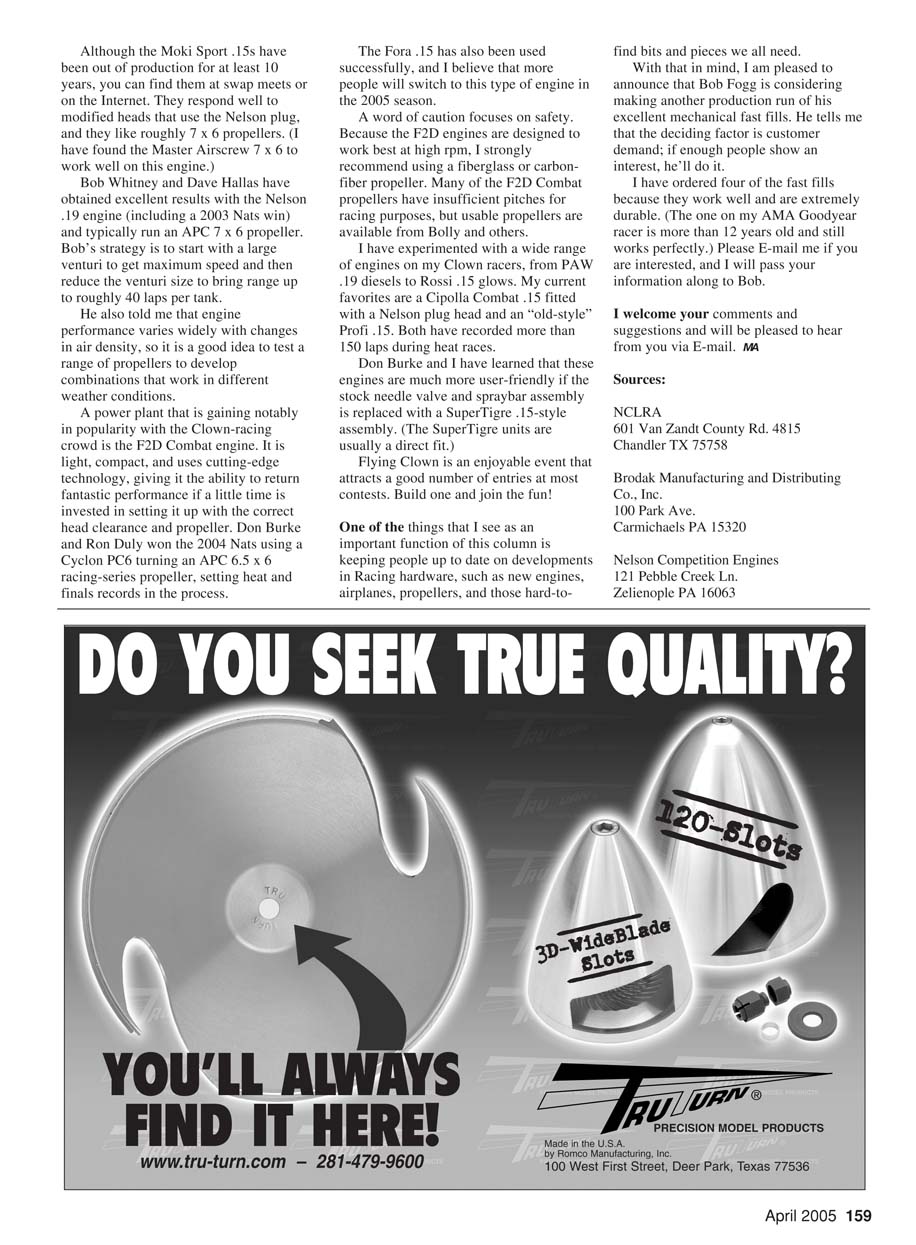
- Cyclon PC6 .15: My own Nats-winning Clown uses a Cyclon PC6 .15. Performance is similar to a Moki Sport but somewhat less expensive. Typical prop range: 7 x 3.5 to 7 x 4.5; some use a 6.75 x 4.25 carbon-fiber prop. If using a small-diameter prop, install a spinner to reduce drag and avoid tip breakage. With a tuned pipe (if permitted), these small engines can be quite quick without necessarily using more fuel. Start fuel-mixture settings rich and then lean for best speed and economy rather than maximum rpm.
- Nelson .19: Bob Whitney and Dave Hallas have obtained excellent results (including a 2003 Nats win), typically running an APC 7 x 6 prop. Bob’s strategy is to start with a large venturi for maximum speed, then reduce venturi size to bring range up to roughly 40 laps per tank. Engine performance varies widely with air density, so test a range of propellers to develop combinations that work in different conditions.
- F2D Combat engines: Gaining popularity — light, compact, and using cutting-edge technology. They can return fantastic performance if set up properly (correct head clearance and propeller). Because they run best at high RPM, I strongly recommend using a fiberglass or carbon-fiber propeller. Many F2D combat propellers have insufficient pitch for racing, but usable props are available from Bolly and others.
- Fora .15: Has been used successfully; I expect more people will switch to this type of engine in the 2005 season.
- Cipolla Combat .15 (with Nelson plug head) and Profi .15: My current favorites; both have recorded more than 150 laps during heat races.
- PAW .19 diesel and other diesels: Diesels will require a slightly different setup — generally a larger prop and a bit more wingtip weight.
A practical tip: glow-plug choice is not critical with modern glow engines; a standard medium plug will work in most cases. For diesel engines, use the slightly different setup noted above.
Don Burke and I have learned that many engines are more user-friendly if the stock needle valve and spraybar assembly is replaced with a SuperTigre .15-style assembly. SuperTigre units are usually a direct fit.
Propeller advice
- Start with the recommended props above and experiment. Small changes in diameter and pitch can significantly affect speed and economy.
- Use a spinner with small-diameter props to reduce drag and prevent tip breakage.
- Test props across different weather conditions because air density changes performance.
Testing and tuning
Give yourself time to test and tune the racer at a local field before the big event. Weather, especially wind, will dictate what adjustments you need to make to:
- Wing incidence
- Thrust line
- Leadout geometry
Also pay attention to how the model trims at both full and reduced throttle settings.
Safety
A word of caution on safety: because high-rpm engines (especially F2D types) are used, use durable props (fiberglass or carbon fiber) and choose appropriate bearings, spinners, and mounting hardware to reduce risk of prop failure or injury.
Events and camaraderie
Flying Clown is an enjoyable event that attracts good entries at most contests. Build one and join the fun — the planes are affordable, easy to build, and provide exciting racing without requiring a large investment in engines. If you have questions or want information about setups and props I've used, feel free to contact me.
Mechanical fast fills
One of the things I see as an important function of this column is keeping people up to date on developments in racing hardware, such as new engines, airplanes, propellers, and those hard-to-find bits and pieces we all need.
With that in mind, Bob Fogg is considering making another production run of his excellent mechanical fast fills. The deciding factor is customer demand; if enough people show interest, he’ll do it. I have ordered four of the fast fills because they work well and are extremely durable (the one on my AMA Goodyear racer is more than 12 years old and still works perfectly). Please e-mail me if you are interested, and I will pass your information along to Bob.
Closing
I welcome your comments and suggestions and will be pleased to hear from you via e-mail.
MA
Sources
- NCLRA
601 Van Zandt County Rd. 4815 Chandler, TX 75758
- Brodak Manufacturing and Distributing Co., Inc.
100 Park Ave. Carmichaels, PA 15320
- Nelson Competition Engines
121 Pebble Creek Ln. Zelienople, PA 16063
Transcribed from original scans by AI. Minor OCR errors may remain.

