
CONTROL LINE SCALE
Bill Boss, 77-06 269th St., New Hyde Park NY 11040
Cardboard for model construction?
Most of you have probably built models from standard balsa and hardwood kits, designed your own, or tried ARFs that generally use a considerable amount of foam in their construction. Perhaps you would like to try something different for that next Fun or Sport Scale model.
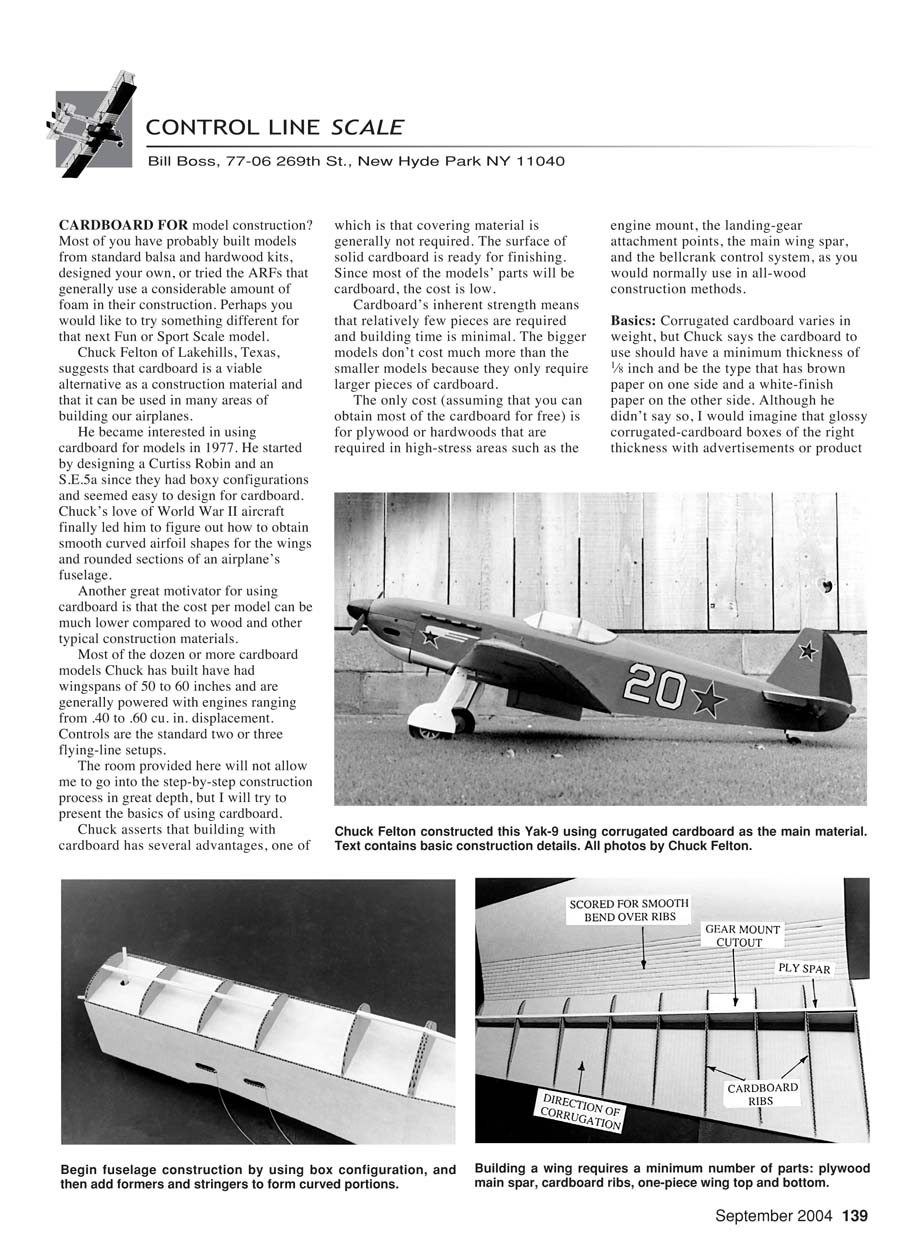
Chuck Felton of Lakehills, Texas, suggests that cardboard is a viable alternative as a construction material and that it can be used in many areas of building our airplanes.
He became interested in using cardboard for models in 1977. He started by designing a Curtiss Robin and an S.E.5a since they had boxy configurations and seemed easy to design for cardboard. Chuck’s love of World War I aircraft finally led him to figure out how to obtain smooth curved airfoil shapes for the wings and rounded sections of an airplane’s fuselage.
Another great motivator for using cardboard is that the cost per model can be much lower compared to wood and other typical construction materials.
Most of the dozen or more cardboard models Chuck has built have had wingspans of 50 to 60 inches and are generally powered with engines ranging from .40 to .60 cu. in. displacement. Controls are the standard two- or three-flying-line setups.
The space here will not allow a step-by-step construction process in great depth, but the basics of using cardboard are presented below.
Advantages
- Covering material is generally not required because the surface of solid cardboard is ready for finishing.
- Since most parts are cardboard, material cost is low (assuming you can obtain cardboard for free).
- Cardboard’s inherent strength means relatively few pieces are required and building time is minimal.
- Larger models don't cost much more than smaller ones because they only require larger pieces of cardboard.
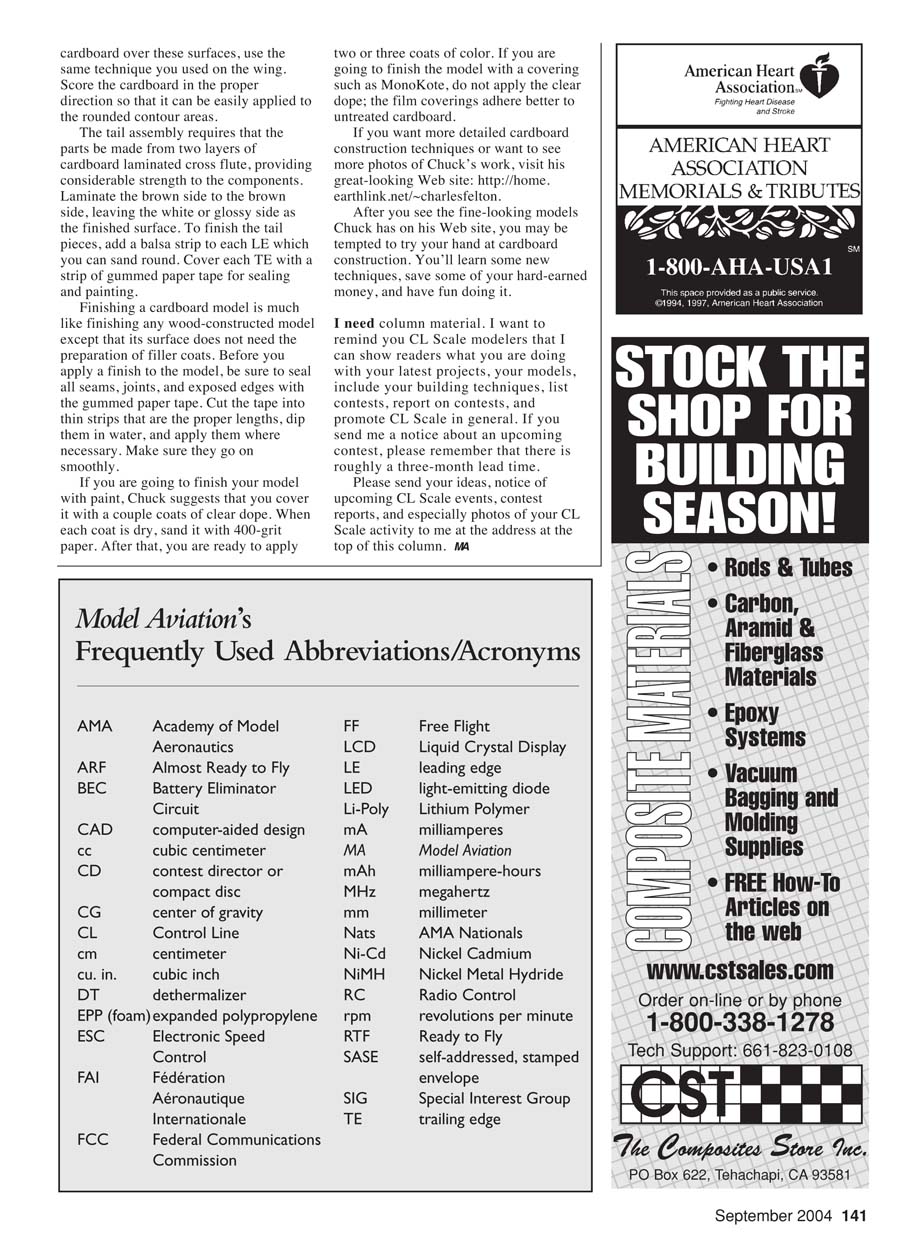
- Only limited use of plywood or hardwood is necessary in high-stress areas such as the engine mount, landing-gear attachment points, main wing spar, and bellcrank control system—just as in all-wood construction.
Basics: cardboard, glue, and sources
- Corrugated cardboard varies in weight; use cardboard with a minimum thickness of 1/8 inch. Prefer the type with brown paper on one side and a white-finish paper on the other side. Glossy corrugated boxes with pictures or advertisements can also work.
- Sources: products you buy, box manufacturers, or local stores that routinely dispose of cardboard boxes.
- Glue: water-based types such as white glue or Titebond are preferred. Spray adhesives and contact cements work but set almost instantly and do not allow repositioning.
Construction overview
If you have a set of full-size plans, trace and transfer part outlines to the cardboard.
Wing example:
- Obtain a piece of cardboard large enough to make the top and bottom of one half of the wing in one piece.
- Trace the wing outline on the brown side of the cardboard and cut it out.
- Mark the spar and rib locations and glue them in place on what will be the inside surface.
- Crease/score the area of the cardboard that will become the top wing covering several times so it will form smoothly over the ribs.
Scoring technique:
- Score with a good straightedge and a screen-mending tool (available at hardware stores). The tool has two wheels roughly 1-1/4 to 1-1/2 inches across. Use the semi-round wheel (not the U-shaped end) to score the cardboard.
- Score across the corrugation — not in line with it. Scoring with the corrugation risks cutting into the cardboard and prevents a smooth surface over the ribs.
Other wing and tip notes:
- Seal the TE or other seams with strips of gummed paper tape, available in various widths at stationery stores.
- Make wingtips from balsa blocks: shape, sand, and glue in place.
Fuselage:
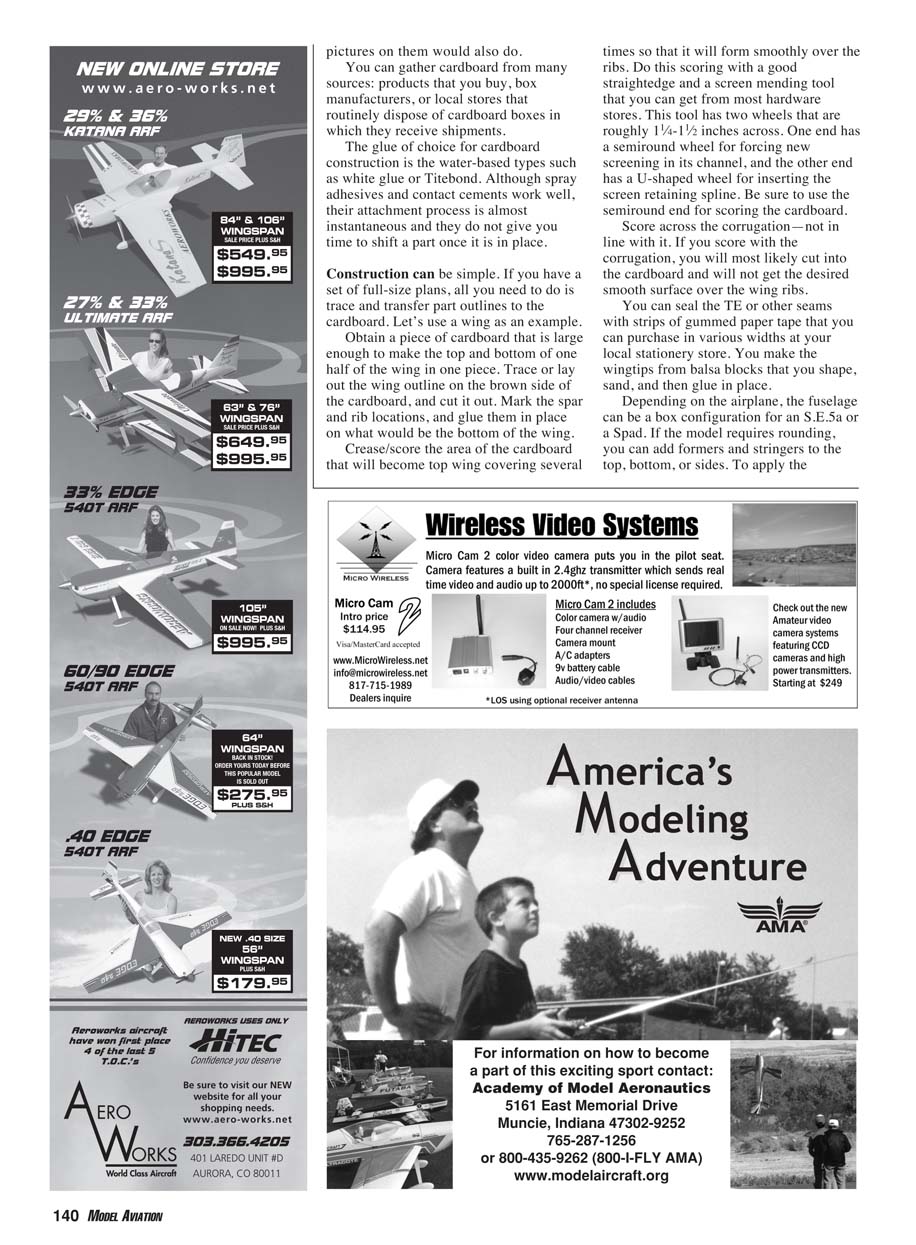
- For box configurations (e.g., S.E.5a or Spad) build as usual.
- For rounded fuselages, add formers and stringers to the top, bottom, or sides.
- To apply the skin: place the blank skin over the fuselage and draw lines for the formers and stringers on the inside of the skin.
- For larger models, use two skins: an inner skin to shape the fuselage and an outer skin for final surface texture. Apply the inner skin and let it dry thoroughly before adding formers and stringers, then apply the outer skin.
- Apply cardboard over rounded surfaces using the same scoring technique used on the wing; score in the proper direction so the skin conforms to the contour.
Tail assembly:
- Make tail parts from two layers of cardboard laminated cross-flute for considerable strength.
- Laminate brown-side to brown-side, leaving the white or glossy side as the finished surface.
- Add a balsa strip to each leading edge (LE) and sand it round.
- Cover each trailing edge (TE) with a strip of gummed paper tape for sealing and painting.
Finishing
- Seal all seams, joints, and exposed edges with gummed paper tape before applying finish. Cut tape into thin strips, dip in water, and apply smoothly.
- If painting: apply a couple coats of clear dope; when each coat is dry, sand with 400-grit paper. Then apply two or three coats of color.
- If using a film covering such as MonoKote: do not apply clear dope; film coverings adhere better to untreated cardboard.
Resources
- For more detailed techniques and photos of Chuck’s work, visit: http://home.earthlink.net/~charlesfelton
After you see the fine-looking models on his Web site, you may be tempted to try cardboard construction. You’ll learn new techniques, save money, and have fun doing it.
Column contributions
I need column material. I want to remind CL Scale modelers that I can show readers what you are doing with your latest projects and models, include your building techniques, list contests, report on contests, and promote CL Scale in general. If you send a notice about an upcoming contest, please remember there is roughly a three-month lead time.
Please send your ideas, notices of upcoming CL Scale events, contest reports, and especially photos of your CL Scale activity to me at the address at the top of this column.
MA
Transcribed from original scans by AI. Minor OCR errors may remain.

