
CONTROL LINE SCALE
Bill Boss, 77-06 269th St., New Hyde Park NY 11040
Frank Slavin's Aeronca Champ 85
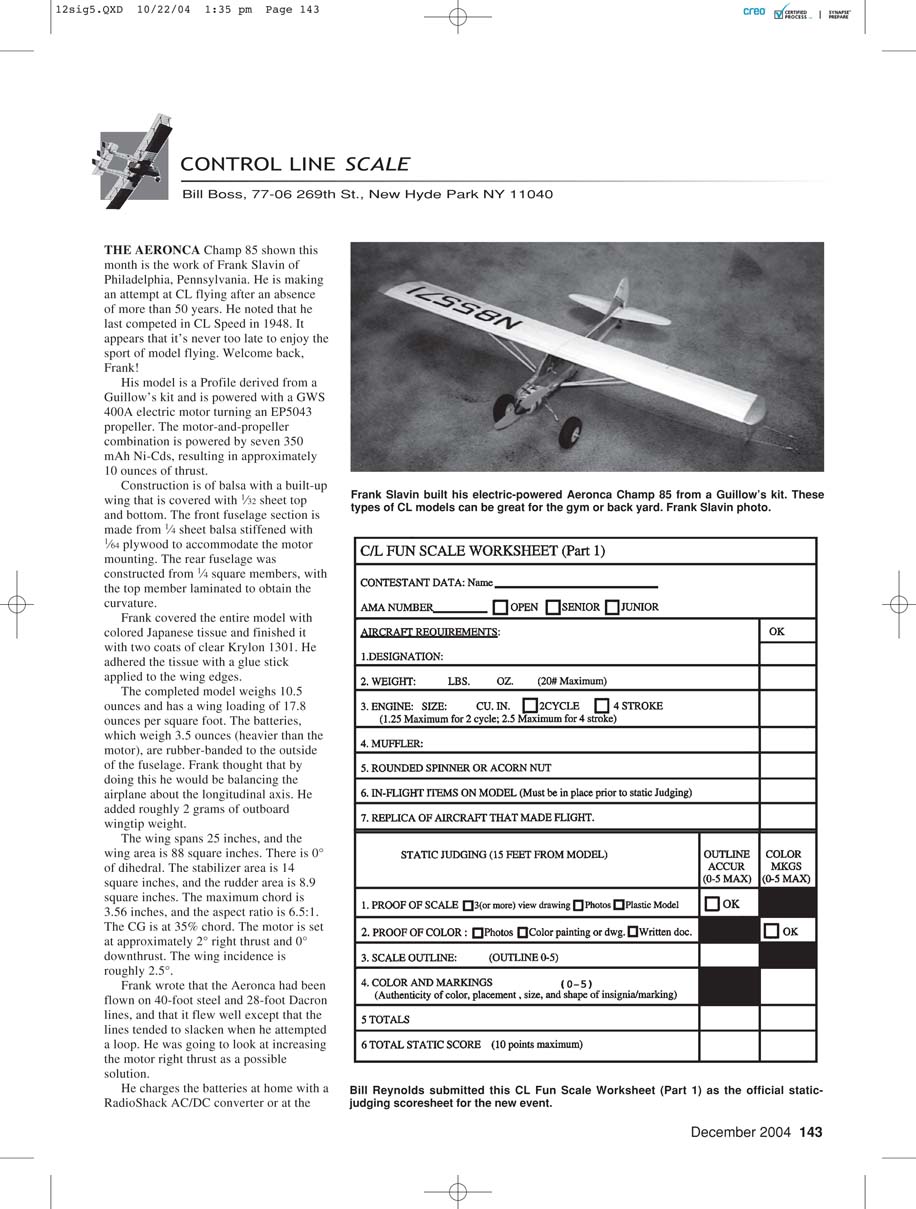
The Aeronca Champ 85 shown this month is the work of Frank Slavin of Philadelphia, Pennsylvania. He is making an attempt at CL flying after an absence of more than 50 years — he last competed in CL Speed in 1948. It appears that it's never too late to enjoy the sport of model flying. Welcome back, Frank!
His model is a profile derived from a Guillow's kit and is powered with a GWS 400A electric motor turning an EP5043 propeller. The motor-and-propeller combination is powered by seven 350 mAh Ni-Cd cells, resulting in approximately 10 ounces of thrust.
Construction
- Airframe: balsa construction with a built-up wing.
- Wing covering: 1/32" sheet top and bottom.
- Front fuselage: made from 1/4" sheet balsa stiffened with 1/64" plywood for motor mounting.
- Rear fuselage: constructed from 1/4" square members, with the top member laminated to obtain curvature.
- Finish: entire model covered with colored Japanese tissue and finished with two coats of clear Krylon 1301. Tissue was adhered using a glue stick applied to the wing edges.
Specifications
- Completed weight: 10.5 ounces
- Batteries weight: 3.5 ounces (heavier than the motor)
- Wing span: 25 inches
- Wing area: 88 square inches
- Wing loading: 17.8 ounces per square foot
- Dihedral: 0°
- Stabilizer area: 14 square inches
- Rudder area: 8.9 square inches
- Maximum chord: 3.56 inches
- Aspect ratio: 6.5:1
- Center of gravity: at 35% chord
- Motor thrust setting: approximately 2° right thrust and 0° downthrust
- Wing incidence: roughly 2.5°
The batteries are rubber-banded to the outside of the fuselage; Frank hoped this would help balance the airplane about the longitudinal axis. He also added roughly 2 grams of outboard wingtip weight.
Flight and operation
Frank wrote that the Aeronca had been flown on 40-foot steel lines and 28-foot Dacron lines, and that it flew well except that the lines tended to slacken when he attempted a loop. He planned to look at increasing the motor right thrust as a possible solution.
He charges the batteries at home with a RadioShack AC/DC converter or at the field from the car cigarette lighter through an ammeter. A full charge provides roughly three minutes of flight time.
I thank Frank for sharing his experience with an electric-powered profile scale model, and I encourage anyone else doing the same to let us know about your projects. This kind of model flying is well suited to large school gyms and playgrounds, and it would go a long way toward solving the noise problem. It might also be great for those who live in country settings and have big enough back yards — the quietness wouldn't bother your next-door neighbors.
Rules and competition changes
Scale rules changes were again a subject for consideration during the recent rules-change cycle. Several amendments passed that will affect CL Scale.
- CLG-05-1CP1 — Control Line General (clarification)
- Background: Under "Control Line General" in the 2002–2004 Competition Regulations, section 2 stated that a model's elevation control must be accomplished through manipulation of the control surfaces, and that manipulation could be done by mechanical means or by electrical impulses transmitted through the lines. It did not address what other operational features of a model are permissible.
- Issue: For years, Scale modelers have used two- or three-line systems, electronics, or combinations thereof to operate many operational features, even though the rule specified control-surface manipulation only. Recently, the use of radio transmission for controlling CL models' operational features surfaced and was being experimented with.
- Change: The last line of "Control Line General" section 2 now reads: "Such manipulation of control surfaces, and any other of the model's operational features, may be accomplished by mechanical means, electrical impulses transmitted through the line(s), or by any other system that does not interfere with the control of any other model or present a safety hazard to competitors or spectators. The use of radio control to accomplish any control function on a control line model is specifically prohibited."
- Effect: This clarifies the old rule, leaves the door open for development of new noninterfering systems, and specifically prohibits radio control for CL models to reduce the possibility of interference with RC activities and improve safety.
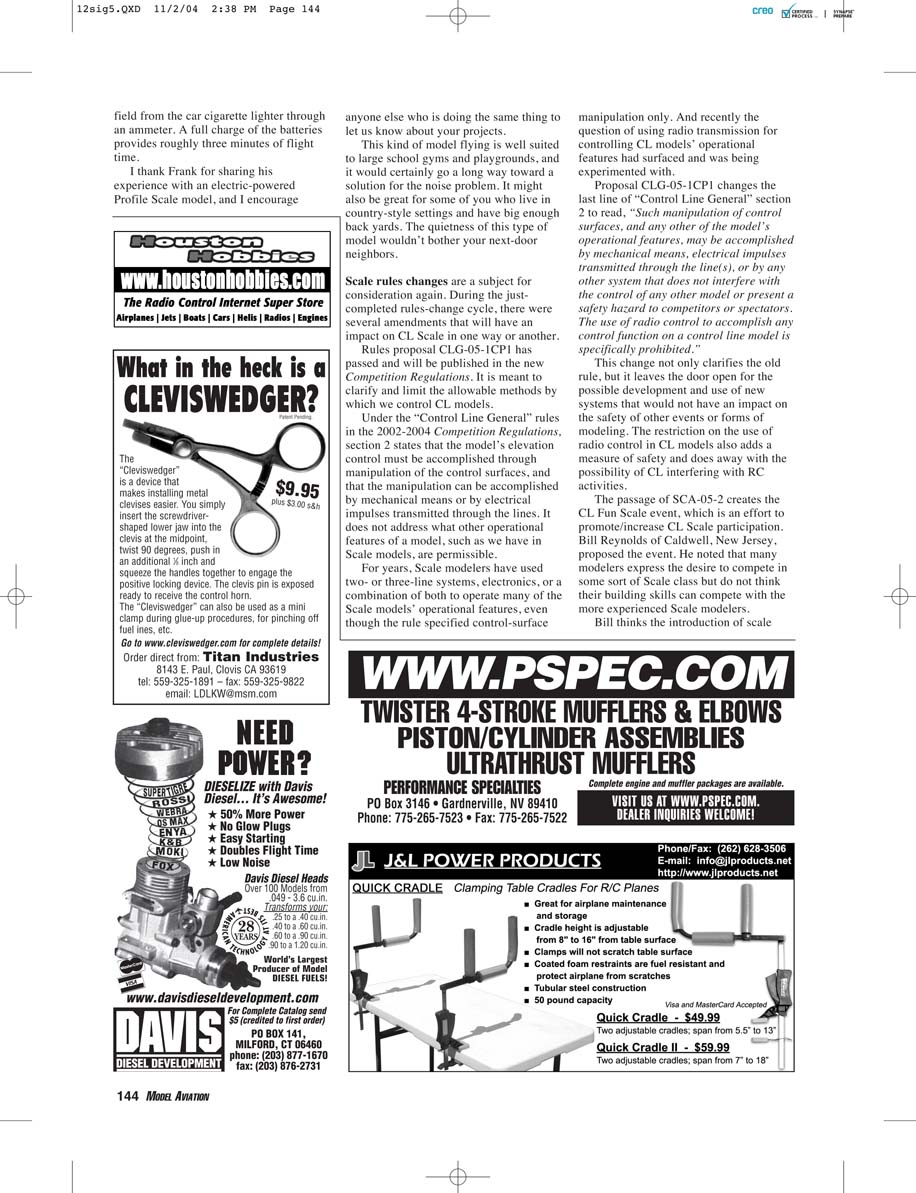
- SCA-05-2 — CL Fun Scale (new event)
- Passage of this proposal creates the CL Fun Scale event to promote and increase CL Scale participation. Bill Reynolds of Caldwell, New Jersey, proposed the event.
- Purpose: Many modelers want to compete in Scale but feel their building skills don't match experienced Scale modelers. The availability of scale ARFs and RTFs suggests a way to encourage participation by placing emphasis on flying rather than building.
- Rules: Fun Scale is open to modeler-built or factory-built scale models. The rules are the same as for Sport Scale (event 509) except for static judging:
- Static scale outline score: 0–5 points for proving the model is of a full-scale aircraft that does or did exist.
- Additional 0–5 points may be awarded for proof of color-and-markings.
- Scoring: Official score = static judging (max 10 points) + flight score (max 100 points) = possible total of 110 points.
- Note: The CL Fun Scale scoresheet Part 1 (for static judging) is included in this month’s column. The flight scoresheet (Part 2) is on page 161 of the 2002–2004 Competition Regulations.
- SCA-05-12 — Common static-judging worksheet
- Proposal to provide a common worksheet for static judging of CL and RC Sport Scale events failed in final voting.
- SCA-05-1 — Pull-test table change
- The pull-test table for CL Scale models (page 157 of the 2002–2004 Competition Regulations) was amended. The last line—for models in the 15- to 20-pound category—was changed from "5G 80-pound maximum" to "5G 80-pound minimum."
- SCA-05-5 — Profile Scale landing gear exemption
- This proposal exempts CL Profile Scale models from having to include retractable landing gear when the prototype had retractable gear. The requirement appears in paragraph 4.2, item e, of the "Control Line Scale Flight Judging Guide" (page 163).
Additional notes:
- The rules-change cycle has been returned to two years. Although compressed, the cross-proposal phase remains. If you want to submit proposals, get them in early.
- Technical Director Steve Kaluf noted that an Internet version of the Competition Regulations will be made available on the AMA web site (www.modelaircraft.org). It will be the most up-to-date version and will include emergency/safety or interpretation changes that might go into effect during the rules-change cycle. Look to the web version for final/full wording of all passed proposals.
Please send ideas, notice of upcoming CL Scale events, contest reports, and especially photos of CL Scale activity to me at the address at the top of this column.
MA
Transcribed from original scans by AI. Minor OCR errors may remain.

