
CONTROL LINE SCALE
Bill Boss 77-06 269th St., New Hyde Park, NY 11040
Is Fun Scale really fun?
You might ask what prompted me to ask that question. There are two things. First, in the last column I wrote about CL Scale rules changes for 2005, and I wrote that CL Fun Scale has been added to the list of official AMA events.
Second is an article by Mark Lanterman in the July/August Replica—the newsletter of the National Association of Scale Aeromodelers (NASA)—titled "Fun-Scale 'Ringers'?" It deals with his experience as an entrant in RC Fun Scale at the 2004 Nats and "ringers" in the event, but it also has some helpful suggestions about what a newcomer to Scale competition should consider. Although his suggestions relate to the RC event, they are basic and can apply to CL Scale as well.
To begin with, Mark wrote about "ringers," which are highly noted and experienced competitors who enter the Fun Scale event, which is meant to lure the new, or inexperienced, modelers into Scale competition.
The first impression you get is that he is against accomplished Scale modelers who might have competed in Scale Masters or Top Gun competing in Fun Scale. However, later he sort of reverses his opinion after having placed in the top four against two highly respected and competent modelers who have been top finishers for many years in RC Scale competitions.
When reading about Mark's experience, I came to the conclusion that he believes that almost any modeler who enters Fun Scale should be able to compete against the more experienced modelers, and that the average modeler should be able to compete with an inexpensive model in an event that only requires him or her to prove that it is of a full-scale airplane and is the appropriate color.
Although his experience against the highly competitive modelers was positive, it may not be so for most inexperienced contestants. There are some factors that allowed him to compete with the high-level entrants. The Fun event is not about the detailing and operational features we can cram into a Scale model, but about the flying. I suspect that his flying RC for 30 years or more, and most likely being a fairly good pilot, is what allowed him to place in the top three in the event.
What interested me most about his article were the suggestions that a newcomer to the Fun Scale event should consider. Following are his ideas, expressed as they might fit CL Scale and the modeler who has some experience but hasn't tried building or flying Scale models.
- Find a model that suits your flying ability. Not everyone is cut out to fly a sophisticated model such as a P-51, a P-40, or a full-fledged bomber. If you have flown Profile Scale models, your next step might be a full-bodied airplane. As Mark suggested, there are many good and a great assortment of ARF-type models from which to choose. Many of them can easily be converted to CL use. Instead of radio installation, all you need is a three-line bellcrank system so that throttle control can be used.
- Find a unique color scheme that shows well in the air. A sky-blue or gray model might look good on the ground, but it may not show up well once airborne. A subject with a bright color scheme will show up well in the air, not only for the judges but for the spectators. A unique color scheme will help your model stand out against the competition.
- Choose a set of maneuvers or operational features that you can perform comfortably. Be sure that you know how to control your model during the takeoff and landing procedures. A smooth rollout and gradual takeoff and climb to level flight is essential. The same applies to the landing: a slow, gradual decline in altitude and throttle back to landing speed for a no-bounce landing is most impressive to the judges and gives you satisfaction for a flight well done.
If you perform flight maneuvers such as loops or wingovers, be sure of your competency in doing them. Keep your flights smooth and effortless.
- Practice. I have written many times about the need to practice. I agree with Mark’s suggestion to "get to know your airplane and become comfortable with it."
Fly the model as often as possible and learn its capabilities. This means flying in all kinds of flying conditions, including when it’s calm or windy; when the wind seems to be on the wrong side of the circle; and early and late in the day as conditions change—not only for the flight but for engine response.
- When at a contest, keep the judges in mind. This involves several things, one of which is answering all of their questions. Make your flight plan clear, and do any special maneuvers or flight operations after the mandatory 10 flight laps.
Keep safety in mind when starting your engine(s). Make certain that your engine-starting area is clear of judges and spectators, and ensure that only your engine-starting helper is in the flight circle.
Make sure that your maneuvers or operational-feature functions are performed on a part of the circle that provides the judges with a clear view of the action.
Remember to be courteous. Speak clearly when providing information, and don’t forget to thank judges or those who have helped you.
Mark concluded his article by noting that he had changed his mind about "ringers" and that he had found them useful as something to shoot for. He also noted that if you have been hesitant about competing in Fun Scale, go out and get a good-flying scale ARF, practice as much as possible, and go out and beat the experienced pilots.
I agree 100% with Mark’s recommendation to fly the ARF as a beginning point for the Fun Scale event, but I don’t quite agree with his idea that you should be able to compete against top-notch modelers.
Every effort to provide an event such as Profile Scale for CL beginners has met with only moderate success because of the ready influx of the more experienced modelers. Their participation tends to discourage the newcomer from getting involved.
Let’s keep the Fun Scale event for beginners. It’s the only way we are going to see if the new category will do what it is intended to do: get new blood into CL Scale.
Scale World Championships CD
Scale World Championships CD: Dale Campbell—a 2004 F4B team member—has produced a CD on which there are several video segments and more than 300 pictures showing models, modelers from around the world, Polish landmarks, the local people, and contest officials.
The Scale World Championships was held at the Polish Air Force Academy in Deblin, Poland. Dale said that he would provide a copy of the CD to anyone who is interested. The cost is $5 to cover the packaging and postage. Write to him at: Dale Campbell 126 Wise Rd. Vale, NC 28168
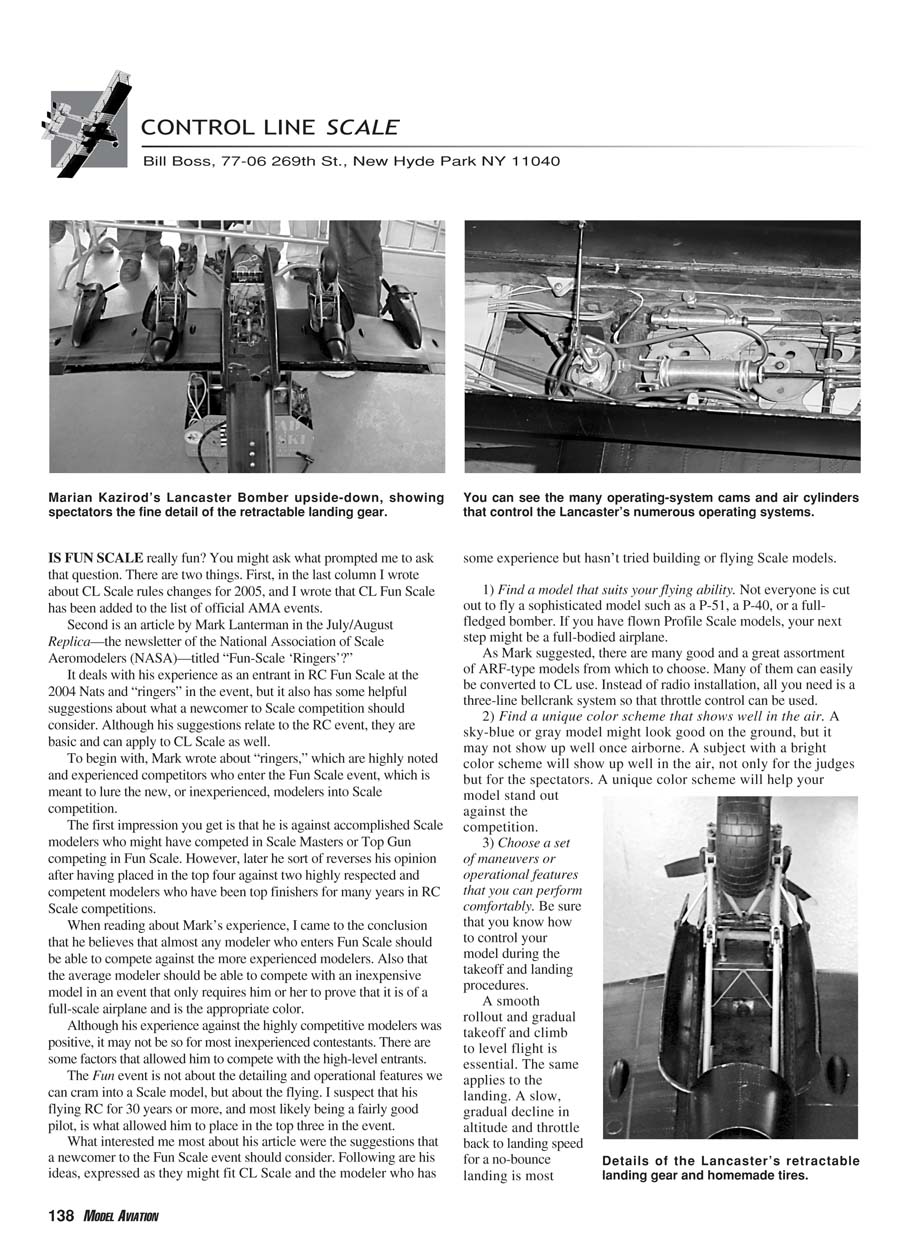
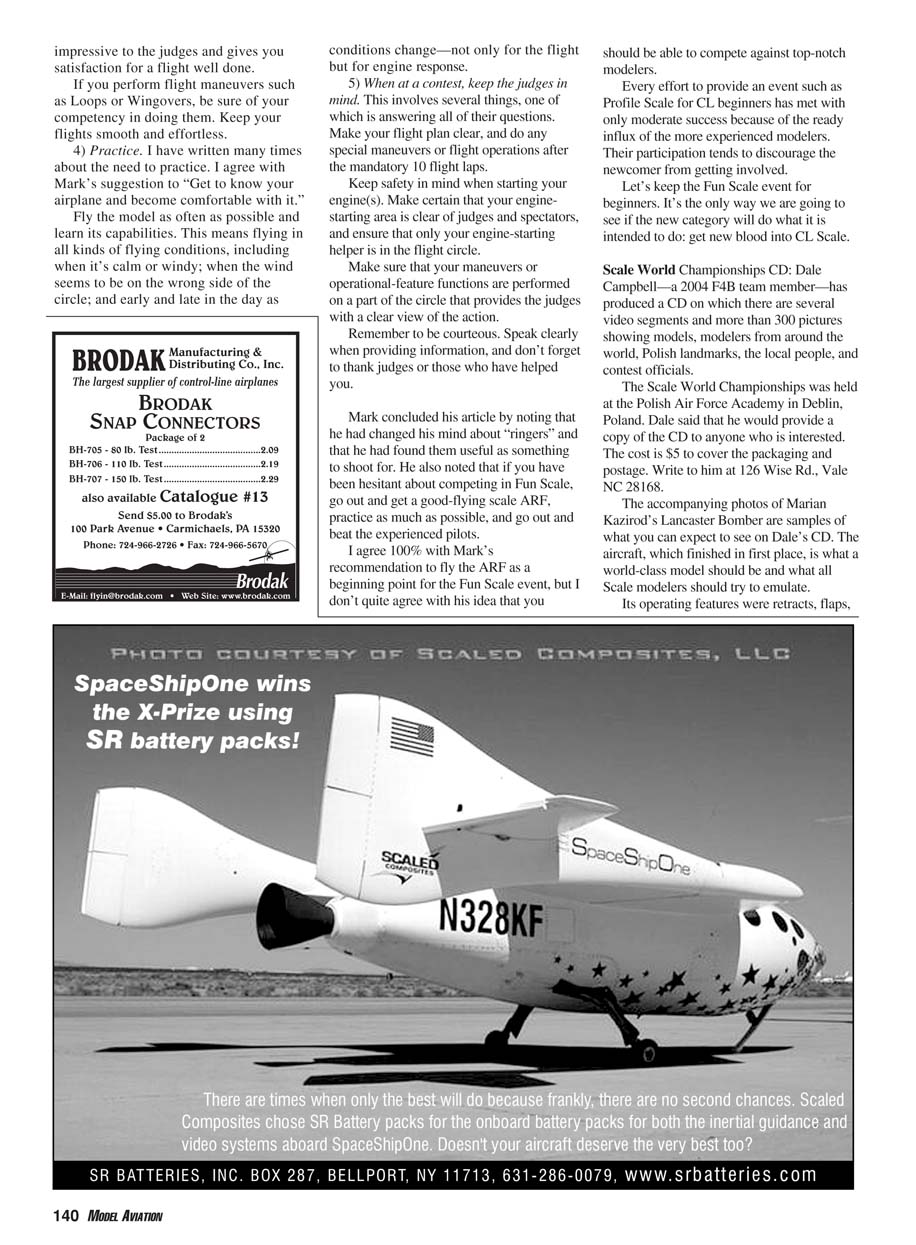
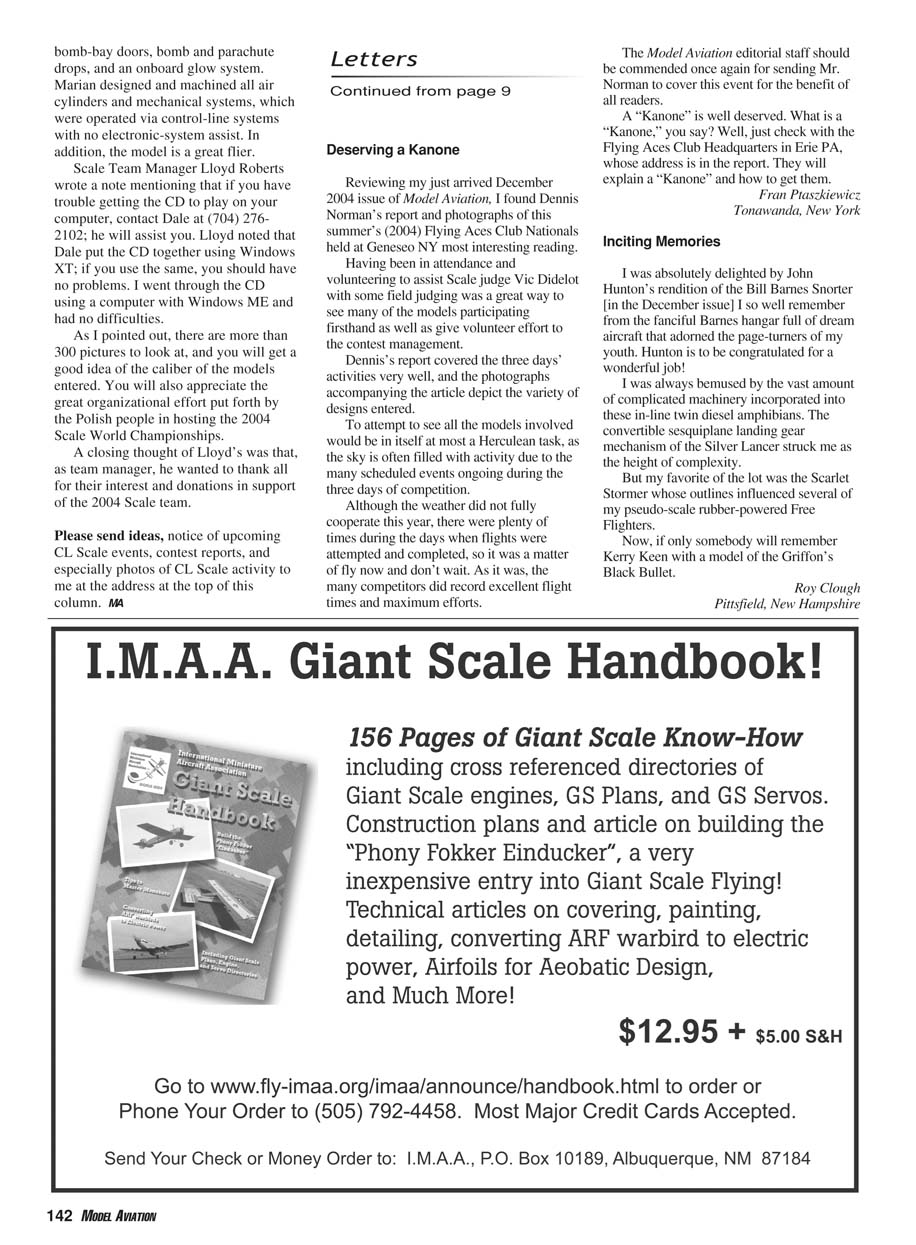
The accompanying photos of Marian Kazirod’s Lancaster Bomber are samples of what you can expect to see on Dale’s CD. The aircraft, which finished in first place, is what a world-class model should be and what all Scale modelers should try to emulate.
Its operating features were retracts, flaps, a bombardier’s clear nose section, and all of the many features and functions the full-size aircraft has. You can see the many operating-system cams and air cylinders that control the Lancaster’s numerous operating systems: bomb-bay doors, bomb and parachute drops, and an onboard glow system.
Marian designed and machined all air cylinders and mechanical systems, which were operated via control-line systems with no electronic-system assist. In addition, the model is a great flier.
Scale Team Manager Lloyd Roberts wrote a note mentioning that if you have trouble getting the CD to play on your computer, contact Dale at (704) 276-2102; he will assist you. Lloyd noted that Dale put the CD together using Windows 98; if you use the same, you should have no problems. I went through the CD using a computer with Windows ME and had no difficulties.
As I pointed out, there are more than 300 pictures to look at, and you will get a good idea of the caliber of the models entered. You will also appreciate the great organizational effort put forth by the Polish people in hosting the 2004 Scale World Championships.
A closing thought of Lloyd’s was that, as team manager, he wanted to thank all for their interest and donations in support of the 2004 Scale team.
Please send ideas, notice of upcoming CL Scale events, contest reports, and especially photos of CL Scale activity to me at the address at the top of this column.
MA
Transcribed from original scans by AI. Minor OCR errors may remain.

