
Control Line Scale — Bill Boss [[email protected]]
The second 1cc Multi Engine Profile Scale competition
Ted Kraver reports that the Second Annual 1cc Multi-Engine Profile Scale Contest, run by the Cholla Choppers club, was a great success. The event was held in Tucson, Arizona, October 11–12, 2008. Ted noted that Mike Keville, control-line contest innovator extraordinaire and contest director, must be given credit for originating and promoting an event that is drawing more contestants each year. The weather was great, and a relaxed atmosphere among the contestants provided for some fine camaraderie and model flying.
Two categories were flown: the Limited Class, in which no throttles or maneuvers were allowed, and the Unlimited Class, in which throttle control and flight maneuvers were permitted.
Leroy Black won Unlimited with his Messerschmitt Me 410, using a standard three-line control system to throttle two Norvel .061 engines. The full-scale Me 410 was made in two main variations: the A-1 fighter-bomber and the A-2 heavy fighter. The fighter-bomber was not widely used, but the heavy-fighter versions saw service up to the end of World War II.
Dick Byron, a multiple CL Scale winner at AMA Nationals in the 1970s and 1980s, finished second in Tucson with his Mitsubishi Ki-83 powered by two AP Wasp .061 engines controlled by an electric throttle system. The full-scale Ki-83, armed with four cannons, was developed as a long-range escort fighter. It had a top speed of about 438 mph and excellent maneuverability, but the prototype did not appear until November 1944, limiting its service.
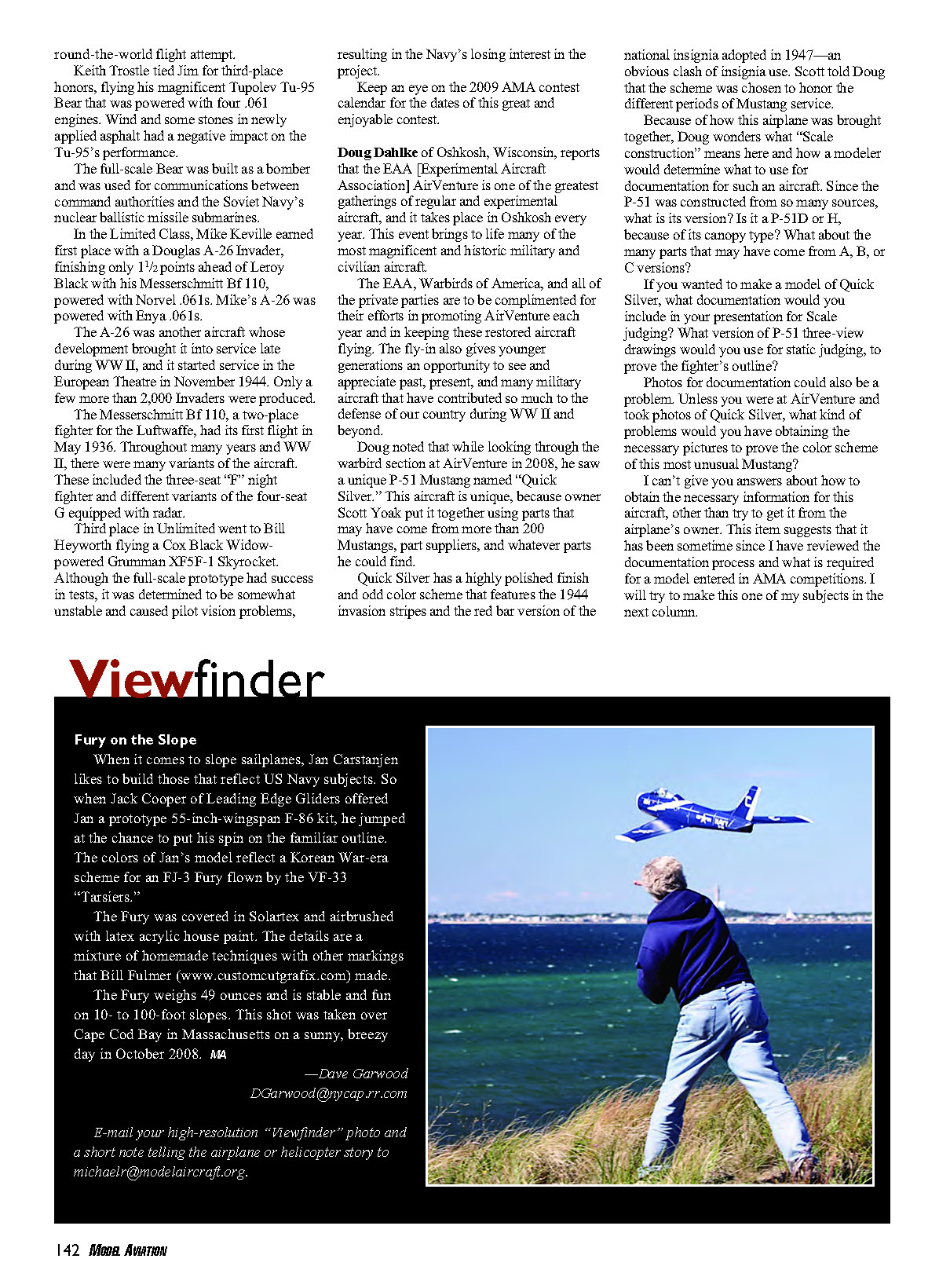
Jim Hoffman entered a Lockheed Electra powered with two electronically controlled AP Wasp .061 engines. His model’s color scheme represented Amelia Earhart’s Electra used in her round-the-world flight attempt. Keith Trostle tied Jim for third place, flying a Tupolev Tu-95 Bear powered with four .061 engines. Wind and some stones in newly laid asphalt negatively affected the Tu-95’s performance. The full-scale Tu-95 was built as a bomber and was also used for communications between command authorities and the Soviet Navy’s nuclear ballistic missile submarines.
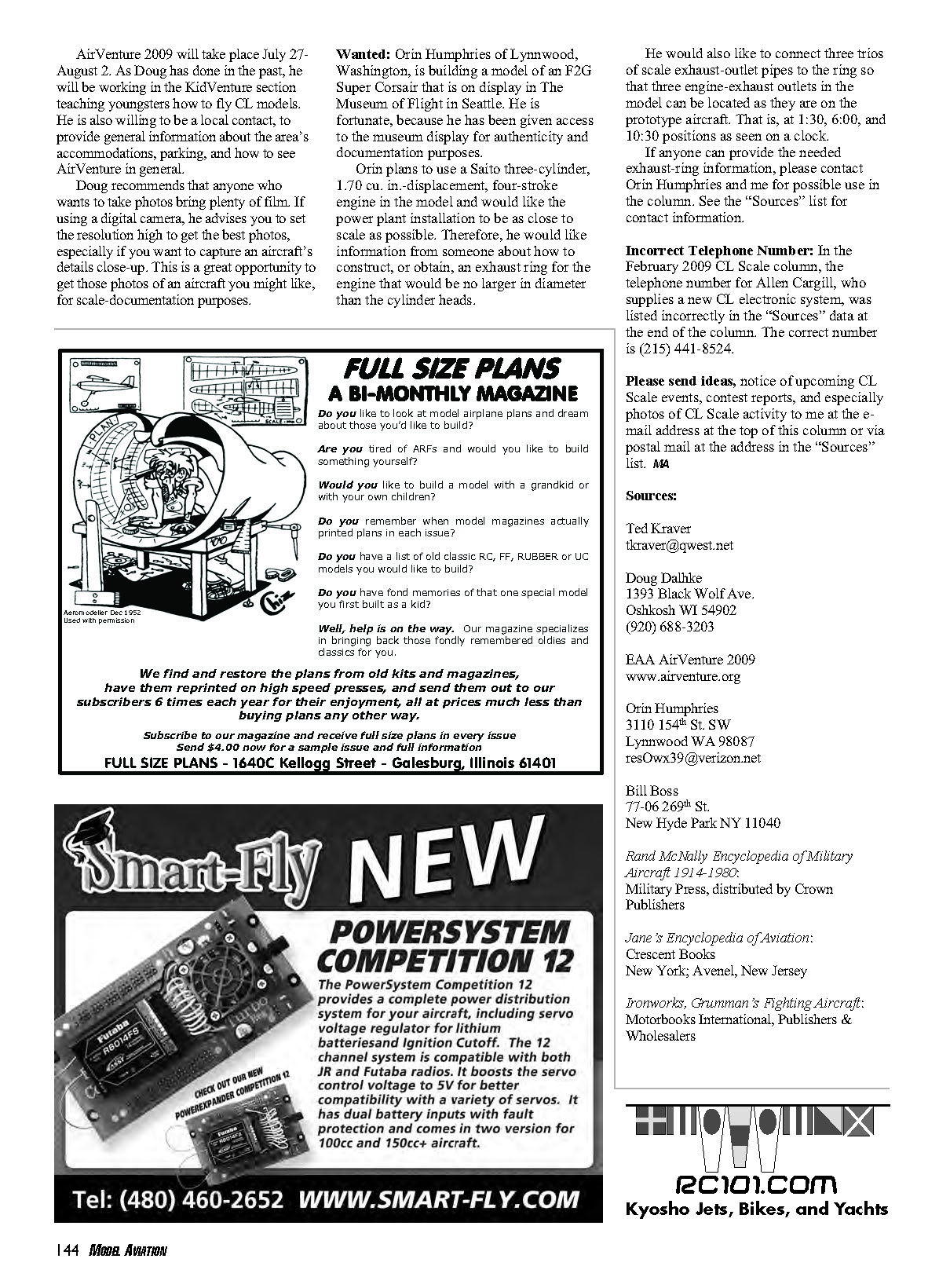
In the Limited Class, Mike Keville earned first place with a Douglas A-26 Invader, finishing only 1.5 points ahead of Leroy Black flying a Messerschmitt Bf 110 powered with Norvel .061s. Mike’s A-26 used Enya .061s. The A-26 entered service late in WWII (European service beginning in November 1944) and only a little over 2,000 Invaders were produced. The Messerschmitt Bf 110 was a two-place fighter for the Luftwaffe with many variants produced during its service life, including the three-seat F night fighter and various G variants equipped with radar.
Third place in Unlimited went to Bill Heyworth flying a Cox Black Widow–powered Grumman XF5F-1 Skyrocket. Although the full-scale prototype performed well in tests, it was considered somewhat unstable and caused pilot-vision problems, and the U.S. Navy ultimately lost interest in the project.
Keep an eye on the 2009 AMA contest calendar for the dates of this enjoyable contest.
EAA AirVenture and the P-51 "Quick Silver"
Doug Dahlke of Oshkosh, Wisconsin, reports that EAA AirVenture is one of the greatest gatherings of regular and experimental aircraft and takes place in Oshkosh every year. The event brings to life many magnificent and historic military and civilian aircraft. The EAA, Warbirds of America, and many private organizations deserve compliments for promoting AirVenture each year and for keeping restored aircraft flying. The fly-in also gives younger generations an opportunity to see and appreciate aircraft that contributed so much to national defense during WWII and beyond.
While looking through the warbird section at AirVenture 2008, Doug saw a unique P-51 Mustang named "Quick Silver." The aircraft is unusual because owner Scott Yoak assembled it using parts that may have come from more than 200 Mustangs, various part suppliers, and whatever parts he could find. Quick Silver has a highly polished finish and an odd color scheme that features 1944 invasion stripes alongside the red-bar version of the national insignia adopted in 1947—an obvious clash of insignia usage. Scott told Doug the scheme was chosen to honor different periods of Mustang service.
Doug raises several scale-documentation questions about Quick Silver: What does "scale construction" mean for an aircraft assembled from so many sources? How would a modeler determine documentation for such an aircraft for scale judging? Is it a P-51D or an H because of canopy type? What about parts from A, B, or C versions? If you wanted to make a model of Quick Silver, what documentation would you include in your presentation for scale judging? Which P-51 three-view drawings would you use for static judging to prove the fighter's outline? Photos for documentation could also be a problem—unless you were at AirVenture and took photos, obtaining pictures to prove the color scheme of this unusual Mustang could be difficult.
I cannot give definitive answers about obtaining the necessary information for this particular aircraft other than to suggest contacting the airplane’s owner. This item suggests it has been some time since I reviewed the documentation process and what is required for a model entered in AMA competitions. I will try to make this topic one of my subjects in a future column.
AirVenture 2009 will take place July 27–August 2. As in past years, Doug will be working in the KidVenture section teaching youngsters how to fly control-line models. He is also willing to be a local contact to provide general information about accommodations, parking, and how to see AirVenture in general.
Doug recommends that anyone who wants to take photos bring plenty of film. If using a digital camera, set the resolution high to get the best photos, especially for close-up aircraft details. This is a great opportunity to get photos you might need for scale documentation.
Wanted
Orin Humphries of Lynnwood, Washington, is building a model of an F2G Super Corsair that is on display in The Museum of Flight in Seattle. He has been given access to the museum display for authenticity and documentation purposes.
Orin plans to use a Saito three-cylinder, 1.70 cu in displacement, four-stroke engine in the model and would like the power-plant installation to be as close to scale as possible. He seeks information about how to construct or obtain an exhaust ring for the engine that would be no larger in diameter than the cylinder heads. He also wants to connect three trios of scale exhaust-outlet pipes to the ring so the three model-exhaust outlets can be located as on the prototype aircraft (at the 1:30, 6:00, and 10:30 positions on a clock face).
If anyone can provide the needed exhaust-ring information, please contact Orin Humphries and me for possible use in the column. See the "Sources" list for contact information.
Incorrect telephone number
In the February 2009 CL Scale column, the telephone number for Allen Cargill, who supplies a new CL electronic system, was listed incorrectly in the "Sources" data at the end of the column. The correct number is (215) 441-8524.
Please send ideas, notice of upcoming CL Scale events, contest reports, and especially photos of CL Scale activity to me at the e-mail address at the top of this column or via postal mail at the address in the Sources list.
Sources
- Ted Kraver
- Doug Dahlke
1393 Black Wolf Ave. Oshkosh, WI 54902 (920) 688-3203
- EAA AirVenture 2009
- Orin Humphries
3110 154th St. SW Lynnwood, WA 98087 [email protected]
- Bill Boss
77-06 26th St. New Hyde Park, NY 11040
- Rand McNally, Encyclopedia of Military Aircraft 1914–1980: Military Press, distributed by Crown Publishers
- Jane's Encyclopedia of Aviation: Crescent Books, New York; Avenel, New Jersey
- Ironworks, Grumman's Fighting Aircraft: Motorbooks International, Publishers & Wholesalers
Transcribed from original scans by AI. Minor OCR errors may remain.

