
Control Line Scale - 2009/06
Model documentation for competition
Bill Boss [[email protected]]
In the last column (April 2009), I wrote about the problems of providing documentation for a model that is made from a one-of-a-kind aircraft, such as the “Quick Silver” P-51 Mustang. The full-scale airplane, seen at the Experimental Aircraft Association’s AirVenture 2008 in Oshkosh, Wisconsin, was constructed using parts salvaged from many other Mustangs. Obtaining proof-of-documentation data, three-views, etc., for such a special airplane is often a challenge because the information must come from a single source: the aircraft owner.
For most scale modelers, especially beginners, there are basic steps and sources you can use to obtain the necessary documentation for your scale model, whether it is being made for static or flight competition.
Choosing a subject
One of the first things to consider is the type of airplane you want to model. Most modelers have a favorite era or class of aircraft — military, civilian, or a particular historic period. If you’re a beginner at scale modeling, select a subject within your building and flying capabilities. A four-engine bomber, for example, is usually not a good choice for a first project.
Once you decide on the type of aircraft, start collecting documentation. I can’t emphasize enough that before you start building, it is crucial to gather all documentation.
Rules and score sheets
The first two pieces of information you should obtain are the rules and score sheets for static and flight judging. You can find the AMA Competition Regulations on the AMA website or get a copy from AMA Headquarters. Knowing the rules is important whether you are building for control line (CL), radio control (RC), or free flight (FF).
In addition to learning the rules that apply to your event, get the general scale guidelines and “The Unified Scale Judging Regulations.” These cover Scale Judging Procedures, the Builder of the Model rule, Proof of Scale, Safety Declaration, and how to apply the rules during competition.
You can access event score sheets on the National Association of Scale Aeromodelers (NASA) website. Score sheets are good guides for learning what documentation is needed to prove that the details you apply to a model are true to the prototype.
- The CL Sport Scale (AMA event 509) static score sheet covers the model’s outline accuracy, craftsmanship, and finish, and provides scoring values for each category.
- The flight score sheet covers your flight plan from takeoff to landing and your ability to choose as many as six flight options the prototype might have been capable of doing.
The score sheets are designed to be easy to use and understand.
Three-views and photos
Three-view drawings are most important because they show the prototype’s outline in front, side, and top views. A good set of three-views may also show fine details such as color-and-markings and external fittings.
If the three-view shows special wing rigging, antennas, auxiliary fuel tanks, or lettering such as “No Step,” “Oil,” and “Fuel Filler” caps, make every effort to incorporate these details into the model.
Photos are required to support the model’s details and should provide proof of the color-and-markings and the details taken from the three-views. Pictures and three-views should complement each other.
If you can find a full-scale aircraft at a museum or local airport that you want to model, take advantage of the opportunity to obtain the necessary photos. Capture front, both side views, and three-quarters rear views of the airplane. Top-view pictures may be difficult, but photos of the underwing, landing gear, lettering, insignia, and flying-surface hinging should be relatively easy to get. Today’s digital cameras allow you to capture many more images than you need, so be selective in what you use for documentation.
Pay particular attention to color-and-markings. If your model represents a particular aircraft in a specific fighter squadron or group, make sure the colors and markings are applied accurately and supported by the three-views or photos you provide. Apply all insignia, aircraft numbers, and as many small details as possible — these little things can make a big difference in your score.
Documentation limits and sources
How much documentation should you have? If your event falls within the AMA categories, there are limits on the amount of documentation you need to present. The CL Sport Scale rules limit documentation to eight pages. Such guidelines help judges manage the time required to process models during scale static judging.
If you have trouble obtaining three-views and photos, try Bob’s Aircraft Documentation — they have thousands of Foto Paaks and three-views available. The NASA website can also provide sources for documentation.
Preparation and flying
Once your model is completed, it is imperative that it flies well. Ensure that the engine is well broken-in to eliminate starting and overheating problems. Your model needs a reliable powerplant to taxi, take off, fly the required number of laps, and land.
The only way to make sure your model performs well is to practice as much as possible before any competition. Take your time and get to know how your model behaves — that effort will pay dividends.
Example: Stearman 4EM Senior Speedmail
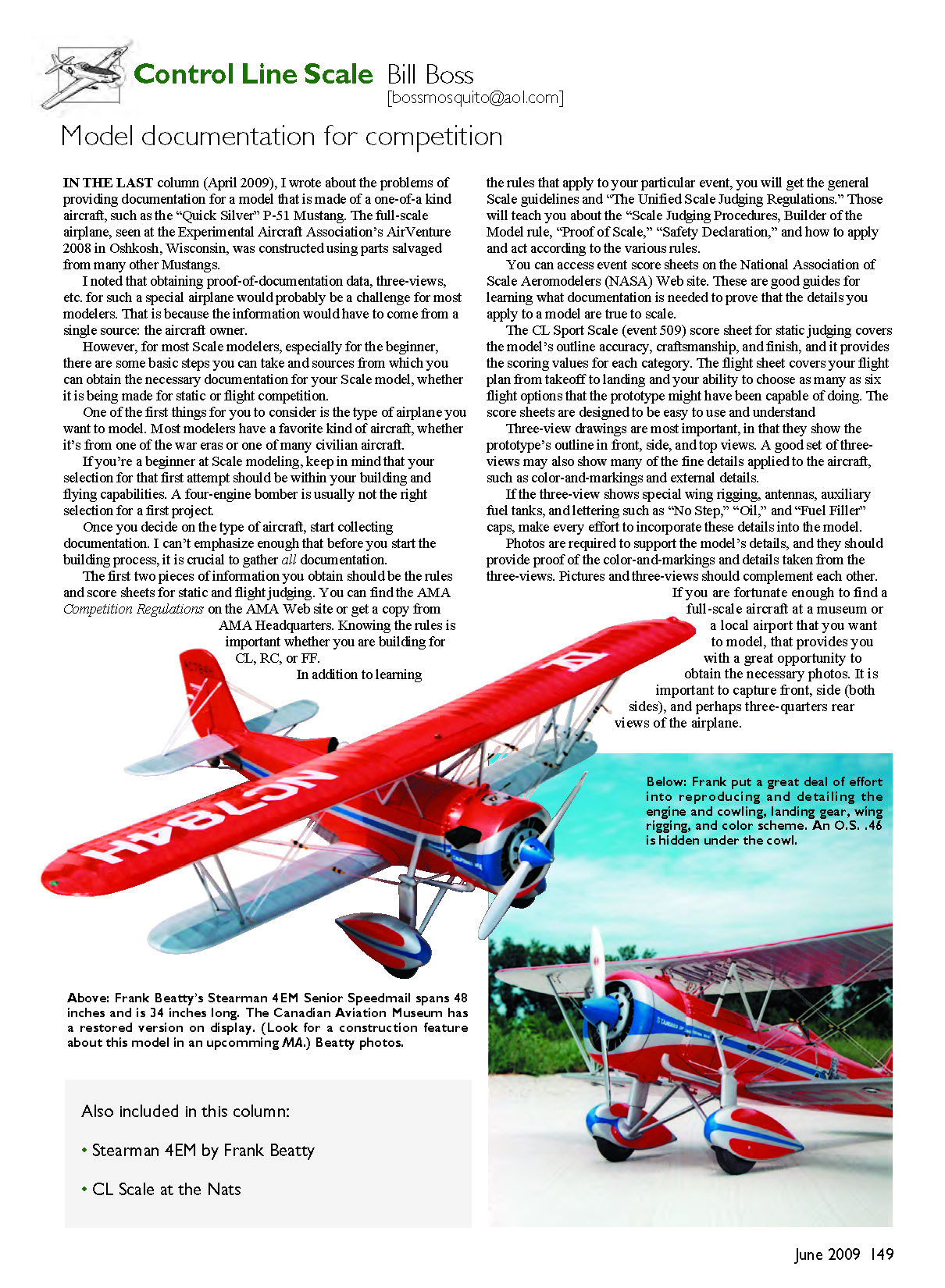
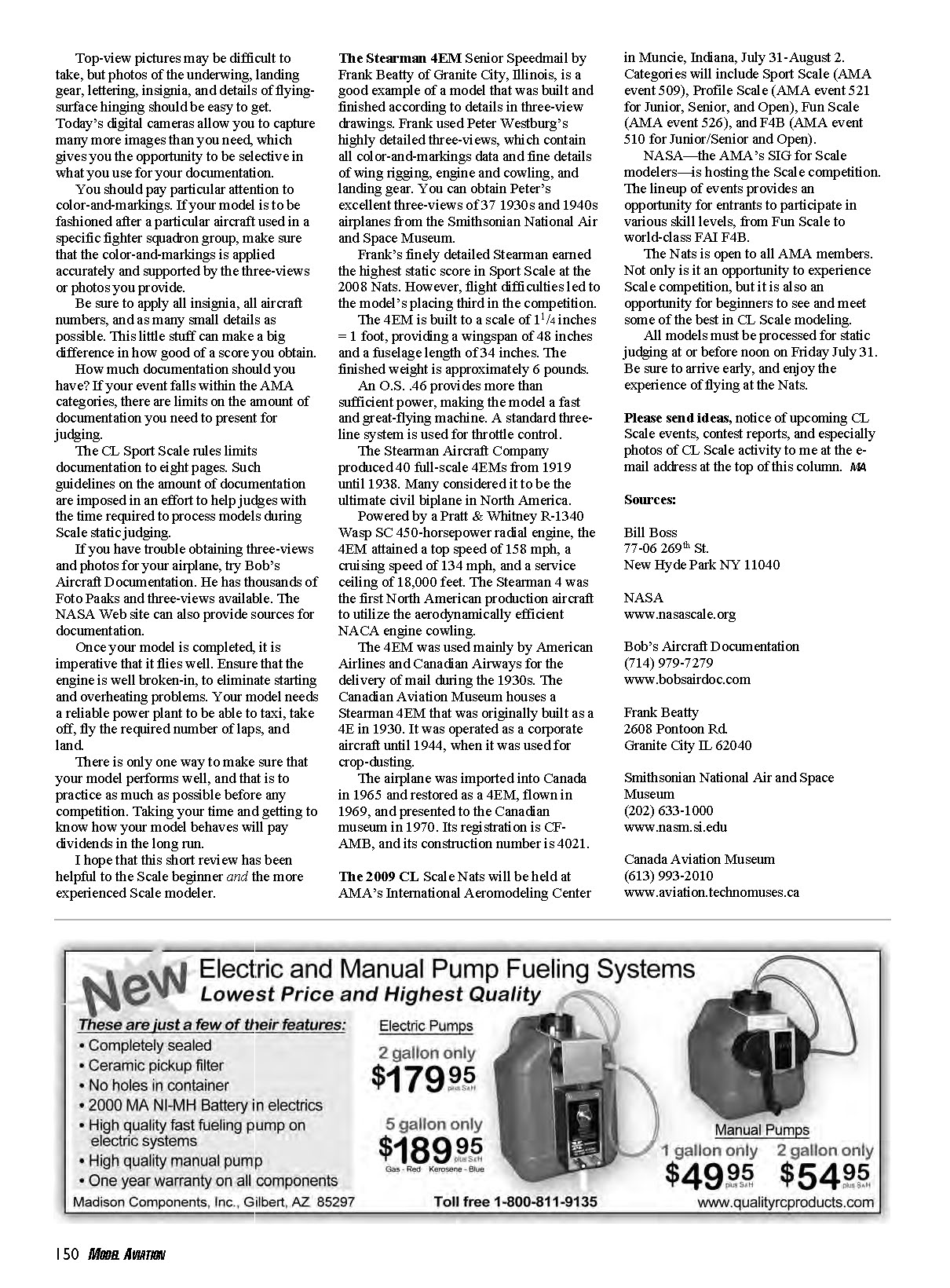
The Stearman 4EM Senior Speedmail by Frank Beatty of Granite City, Illinois, is a good example of a model built and finished according to three-view details. Frank used Peter Westburg’s highly detailed three-views, which contain all color-and-markings data and fine details of wing rigging, engine cowling, and landing gear. You can obtain Peter’s excellent three-views of 37 1930s and 1940s airplanes from the Smithsonian National Air and Space Museum.
Frank’s finely detailed Stearman earned the highest static score in Sport Scale at the 2008 Nats; however, flight difficulties led to the model’s placing third overall.
- Scale: 1 1/4 inches = 1 foot
- Wingspan: 48 inches
- Fuselage length: 34 inches
- Finished weight: approximately 6 pounds
- Power: O.S. .46 provides ample power; model is fast and a good flyer
- Controls: standard three-line system used for throttle control
Background on the full-scale 4EM:
- The Stearman Aircraft Company produced 40 full-scale 4EMs from 1919 until 1938.
- Powered by a Pratt & Whitney R-1340 Wasp SC 450-horsepower radial engine.
- Top speed: 158 mph; cruising speed: 134 mph; service ceiling: 18,000 feet.
- The 4 was the first North American production aircraft to use the NACA engine cowling.
- The 4EM was used mainly by American Airlines and Canadian Airways for mail delivery during the 1930s.
A Canadian Aviation Museum Stearman 4EM (registration CF-AMB, construction number 4021) was originally built as a 4E in 1930, operated as a corporate aircraft until 1944, used for crop-dusting, imported into Canada in 1965, restored as a 4EM and flown in 1969, then presented to the museum in 1970.
2009 CL Scale Nats
The 2009 CL Scale Nats will be held at AMA’s International Aeromodeling Center in Muncie, Indiana, July 31–August 2. Categories will include:
- Sport Scale (AMA event 509)
- Profile Scale (AMA event 521 — Junior, Senior, and Open)
- Fun Scale (AMA event 526)
- F4B (AMA event 510 — Junior/Senior and Open)
NASA (the AMA’s Special Interest Group for scale modelers) is hosting the scale competition. The lineup of events provides an opportunity for entrants at various skill levels, from Fun Scale to world-class FAI F4B.
The Nats is open to all AMA members. It’s an opportunity to experience scale competition and for beginners to meet some of the best in CL scale modeling. All models must be processed for static judging at or before noon on Friday, July 31. Be sure to arrive early and enjoy the experience of flying at the Nats.
Contact, submissions, and sources
Please send ideas, notices of upcoming CL scale events, contest reports, and especially photos of CL scale activity to me at the email address at the top of this column.
Sources:
- Bill Boss
77-06 269th St. New Hyde Park, NY 11040
- NASA
- Bob’s Aircraft Documentation
(714) 979-7279 www.bobsairdoc.com
- Frank Beatty
2608 Pontoon Rd. Granite City, IL 62040
- Smithsonian National Air and Space Museum
(202) 633-1000 www.nasm.si.edu
- Canada Aviation Museum
(613) 993-2010 www.aviation.technomuses.ca
Transcribed from original scans by AI. Minor OCR errors may remain.

