

Control Line Scale
Bill Boss [[email protected]]
The 22nd annual Broken Arrow contest
The Lafayette Esquadrille model airplane club will host the Broken Arrow 22 Stunt and Scale Contest at Buder Park in Valley Park, Missouri, September 26 and 27, 2009. The flying site is located at the intersection of Interstate 44 and Missouri Highway 141.
The contest will include Profile and Sport Scale and will offer handmade awards for Civilian and Military classes in each event. Robert Arata is the contest director and can furnish full contest details. See the "Sources" list at the end of this column for his telephone number.
Of special interest at this contest is an additional 1/2A Twin Profile Scale event. It is the brainchild of Tim Pansic of Wood River, Illinois. The most unique aspect of this event is that Tim will pay $25 to any contestant who enters a legal 1/2A twin-engine profile model. The guidelines are as follows.
- The model must be a profile of a propeller-driven, twin-engine airplane from any country and any year that can be documented. According to Tim, almost 300 prototypes worldwide can be modeled.
- Engines must be two .049s; you may use any brand, any propeller, and any fuel. Mufflers are not required.
- No throttles or working features are allowed, and the entire control system must be exposed.
- No points will be given for speed or maneuvers.
- Lines will be provided or you may use your own. Proxy fliers are allowed.
- The model must weigh no more than 20 ounces dry (without fuel).
Static judging will be limited to only the appeal of each airplane. There are normally three judges who consider the model’s design, originality, and workmanship.
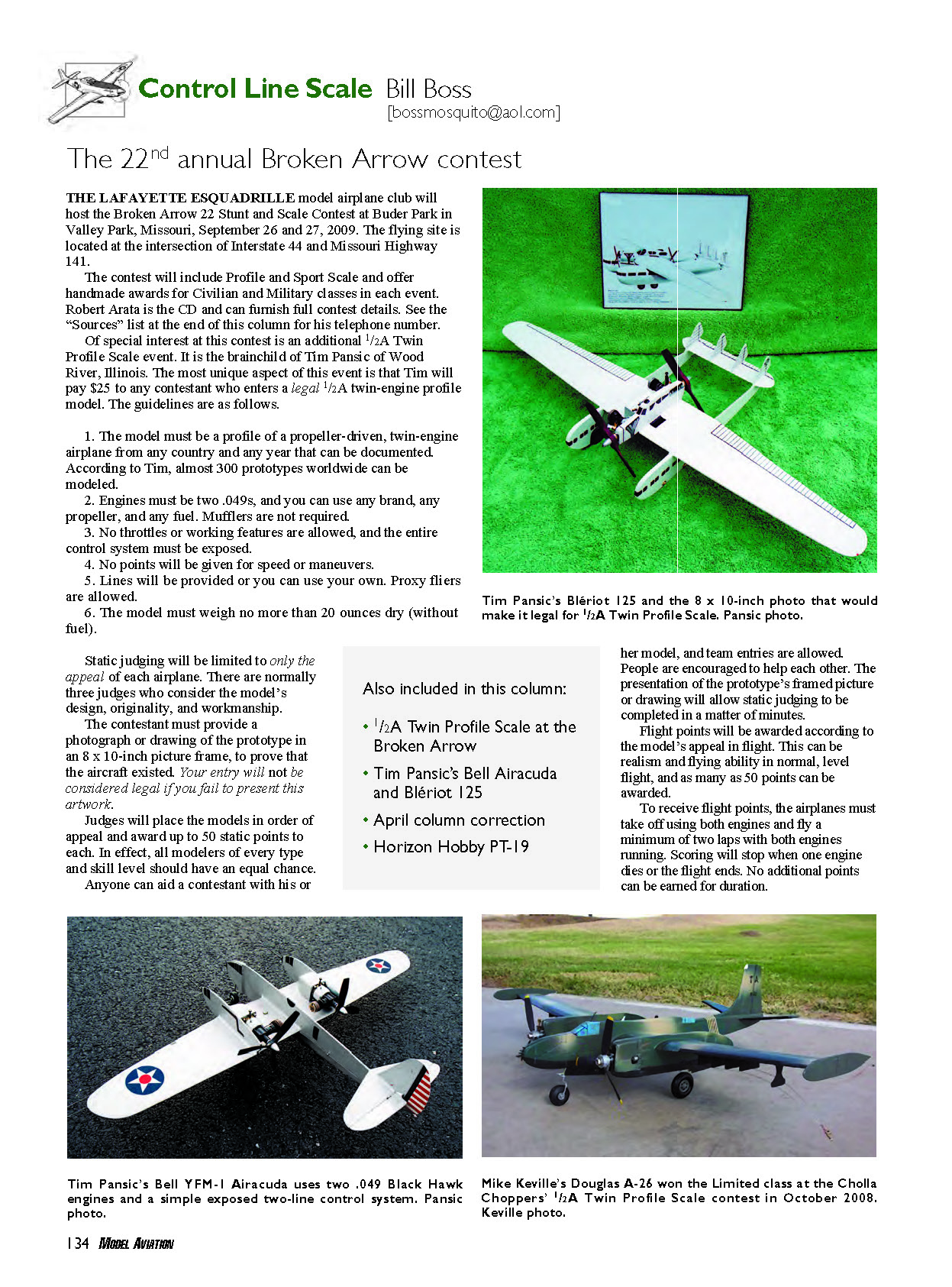
The contestant must provide a photograph or drawing of the prototype in an 8 x 10-inch picture frame to prove that the aircraft existed. Your entry will not be considered legal if you fail to present this artwork.
Judges will place the models in order of appeal and award up to 50 static points to each. In effect, all modelers of every type and skill level should have an equal chance. Anyone can aid a contestant with his or her model, and team entries are allowed. People are encouraged to help each other. The presentation of the prototype’s framed picture or drawing will allow static judging to be completed in a matter of minutes.
Flight points will be awarded according to the model’s appeal in flight. This can be realism and flying ability in normal, level flight, and as many as 50 points can be awarded.
To receive flight points, the airplanes must take off using both engines and fly a minimum of two laps with both engines running. Scoring will stop when one engine dies or the flight ends. No additional points can be earned for duration.
Three attempts will be allowed for two official flights. An attempt will consist of one lap in any manner or at the point when the judges think you have obvious problems that require adjustment or repair. They will not hurry you before you are ready to release the model.
In addition to $25 for a legal entry in 1/2A Twin Profile Scale, cash prizes of $100, $75, and $50 will be awarded to the top three places. (The first-place finisher will receive $125.) The event is open to any AMA member. Only one model is allowed per contestant. In all respects, the judges’ decisions will be final.
Also included in this column:
- 1/2A Twin Profile Scale at the Broken Arrow
- Tim Pansic’s Bell Airacuda and Blériot 125
- April column correction
- Horizon Hobby PT-19
The object of this simple class, and of the awards, is to encourage contestants to build unique models and come out for a day of great camaraderie and fun with your fellow modelers.
This month’s photos show two types of models that can be entered in 1/2A Twin Profile Scale—the Bell Airacuda and the Blériot 125—both of which Tim Pansic built. The Blériot 125 is shown with a framed picture of the prototype to demonstrate a legal entry for the class.
Tim constructed the airplanes mostly from 1/8-inch light plywood, and they are finished with Klass Kote epoxy paints. Simple two-line bellcrank systems control the models, and all control systems are exposed.
The Airacuda has a wingspan of 28 inches, weighs 19.5 ounces, and is equipped with two .049 Black Hawk engines. The Blériot 125 spans 28 inches, weighs 16 ounces, and is powered with two .049 Cox Tee Dee engines.
Although the Airacuda and the Blériot 125 are uncommon, the 125 is by far the rarest and most unusual full-scale aircraft from the 1930s. It was conceived as a passenger airplane and was debuted at the 1930 Paris Salon de l’Aéronautique.
Its basic construction material was wood, and twin fuselages supported the high wing that spanned 96 feet, 5.5 inches. The 125 featured luxurious cabins for six passengers, sanitary facilities, and a baggage compartment.
The cabin above the wing’s center section housed the three crew members and the forward and aft 550-horsepower Hispano-Suiza engines that drove tractor- and pusher-type propellers. The airplane had a unique landing gear assembly that comprised tandem pairs of wheels that were partially concealed in the bottom of each fuselage.
Although Leon Kirste’s full-scale 125 design was considered to be somewhat ahead of its time, it demonstrated poor flight characteristics when piloted for the first time on March 9, 1931. Testing continued into 1933, and although the airplane received a civil registration of F-ALZD, it failed to gain flight certification and was scrapped the following year.
Tim Pansic notes that the Blériot 125 is just one of the hundreds of twin-engine subjects that can be modeled. All you have to do to find one is research the many aviation encyclopedias that you can probably find in local libraries.
Caption Correction
In the April 2009 column, I wrote that Leroy Black's Messerschmitt Bf 110, with the common German camouflage scheme, placed second behind Mike Keville's Douglas A-26 in the Cholla Choppers club's October 2008 1/2A contest. Only 1.5 points separated the two in the standings.
The Bf 110 was incorrectly identified as the A-26 in a photo caption. This month I am featuring a picture of Mike's A-26. I included details about both prototype aircraft in the April column.
Electric PT-19
Horizon Hobby is offering the E-flite PT-19 450 ARF (item EFL2675), which might be of interest to CL fliers who want to try electric power. It spans 45 inches and is said to fly well.
The PT-19 can be completed for RC or CL. Included are a bellcrank and leadouts. The handle and flying lines can be obtained separately, if you don't already have them.
This airplane comes covered and ready for assembly. You can find the other items that are needed to finish it for flight on the Horizon Hobby Web site. See the "Sources" data at the end of the column for the address.
Thanks to Stan Alexander for bringing this item to our attention.
Please send ideas, notice of upcoming CL Scale events, contest reports, and especially photos of CL Scale activity to me at the e-mail address at the top of this column or to the street address in the "Sources" list.
Sources:
- Bill Boss
77-06 269th St. New Hyde Park, NY 11040
- Horizon Hobby
(800) 338-4639 www.horizonhobby.com
- Blériot 125 information: The Complete Encyclopedia of World Aircraft (ISBN 0760705925)
Barnes & Noble (800) 843-2665 www.bn.com
- Tim Pansic
(618) 254-8138
- Robert Arata
(636) 391-0272
- Klass Kote
(612) 243-1234 www.klasskote.com
Transcribed from original scans by AI. Minor OCR errors may remain.

