
CONTROL LINE SPEED
Dave Mark, Box 371, Fenton MI 48430; E-mail: [email protected]
About the author
We have gone quite awhile with no Speed column in Model Aviation. During a conversation I had with Bob Hunt prior to the Nationals this past summer, I inquired about the missing column. He reached through the telephone and twisted my arm, and here I am! Let me introduce myself.
I have built and flown model airplanes for a long time. Until approximately five years ago it was a radio control (RC) model in my backyard. I spent much of the RC time with gliders. Then one day a lifelong friend of mine—Barry Tippett—stopped by with a packet of pictures he snapped at a Speed meet he had attended. I looked at the pictures and asked many questions. Barry slid a plan across the table and said, "Why don't you build one?" I have been hooked ever since.
Now, a few years later, I attend roughly five contests a year. I have attended six Nationals and placed at five of them, with a second, two thirds, a fourth, and a fifth. I have no records yet, so I still consider myself a beginner in this most interesting part of the model-airplane hobby. As a beginner, in future columns I will try to answer some of the many questions that come up when a person builds his or her first Speed model and flies it.
B Speed
Several years ago high nitromethane was the rule in this event. Nitro mixes higher than 70% were needed to hit and exceed the 200-mile-per-hour mark.
During these high-nitro days the SuperTigre X29 was the engine of choice, and many improvements were made to get the engine to produce the horsepower needed for 200+ mph flights. New pistons had to be produced because the material in the Tigre pistons was too soft. Extensive timing changes needed to be made to the cylinder liner and disk rotor. New cylinder heads were needed to work with the nitro.
The models were of conventional symmetrical design with small changes to accommodate the tuned pipe. The nitro produced enough power at the rich takeoff setting so that it was possible to set the engine rich and launch the model; when it transitioned to full pipe there was enough fuel to do the job and not melt down if everything was right. One lean run would melt the top out of the piston—the high nitro and tuned pipe were not forgiving at all to a missed setting.
When the nitro content was reduced to 10%, speeds in this event plunged to the high 160s. The Tigre and other engines disliked the low-nitro fuel. The new fuel did not produce enough power at rich settings to get the model off the ground. Speedsters tried many approaches to overcome the fuel-feed problems. Centrifugal switches that richened the mixture after takeoff were used with limited success. Pipe pressure with metal tanks was difficult to set and inconsistent.
The engine supply for B Speed improved greatly when Henry Nelson began producing the Front Intake Rear Exhaust .29 that he supplies with a tuned pipe designed for use with low-nitro fuel. The engine uses the same .750-inch-diameter crankshaft as the Nelson .40. The crankcase is also the same as the .40's, except that the cylinder-liner bore was reduced so that the cylinder would not need very thick walls. The piston/cylinder set is of the AAC (aluminum-aluminum chrome) configuration and is set up as shipped so tight that it is difficult to turn over slowly. This combination on low-nitro fuel is forgiving to lean runs. The only drawback mentioned is the long run time required to break in the engine. This is best done in the air and can be seen by speed increasing with each flight.
Speed fliers who began working with the Nelson on the test bench said that it produced tremendous power on 10% nitro, but the fuel-feed problems were worse with this engine because of the massive intake.
A partial solution to the problem was found by copying the models used in the Fédération Aéronautique Internationale (FAI) Speed events. The asymmetrical design allowed for the exact placement of the fuel tank required to provide fuel when the engine was on the pipe. The takeoff problems persisted, however.
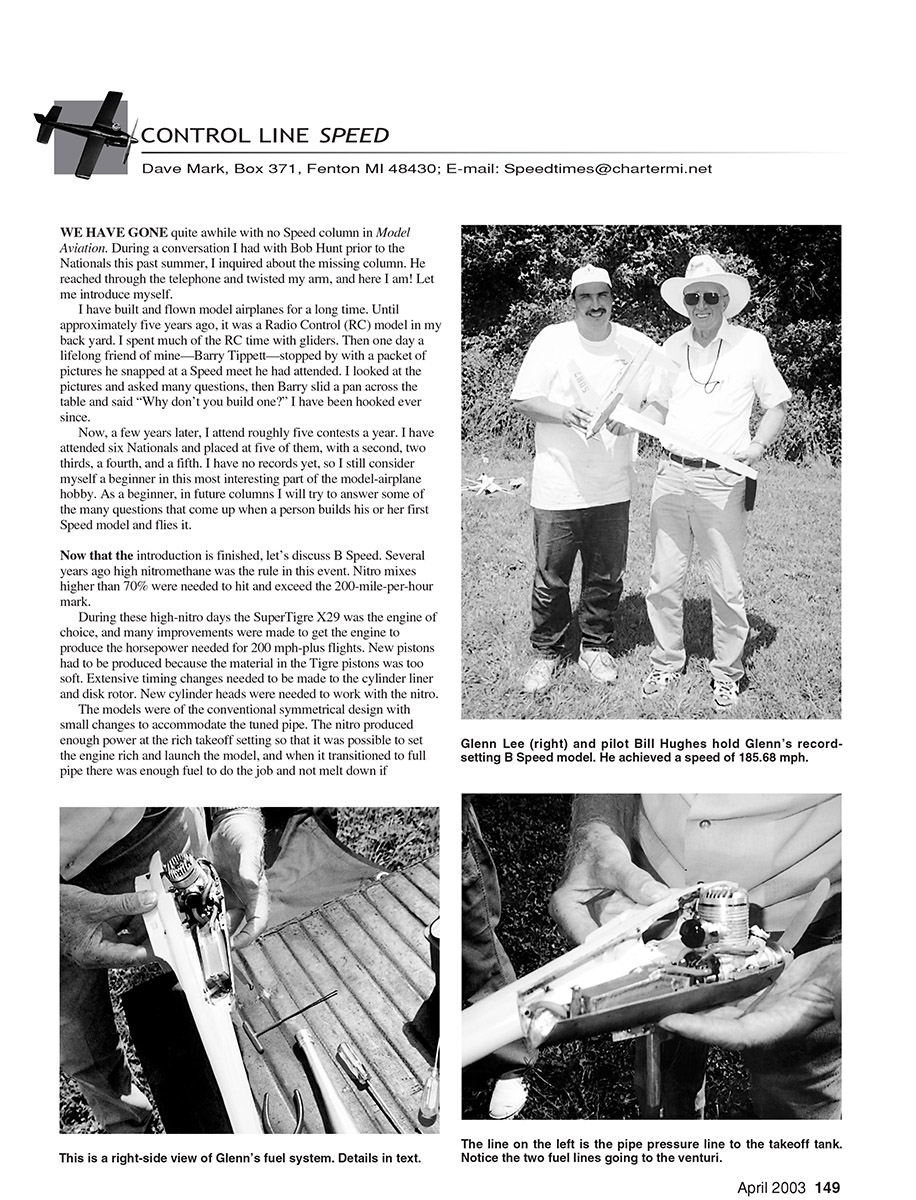
Former Speed columnist Glenn Lee has overcome the fuel-feed problems. His asymmetrical model uses a fuel system that allows lean high-power takeoffs along with the exact setting needed when the engine comes on the pipe.
Glenn’s solution is to build two tanks in his model:
- A small takeoff tank that uses the space in the backplate of the engine and extends roughly 1/2 inch from the backplate. A needle valve is soldered onto the back of this small tank and a fuel line runs along the left side of the engine to the venturi. This tank is pressurized with pipe pressure.
- The main, larger tank is placed and adjusted as is standard practice in FAI models.
This combination allows Glenn to set the takeoff tank lean enough to develop all the power needed to get the model airborne and begin to build speed. Just as the takeoff tank runs out of fuel, the speed is high enough that the main tank is feeding the model as it comes on the pipe.
Glenn’s best time this year was recorded at Detroit, Michigan: 185.68 mph, a record in this event. He said the engine is very tight and he expects higher speeds when he finds the right propeller.
Get involved / Contact
Anyone interested in more information about control line speed should consider joining the North American Speed Society (NASS). Write to NASS at Box 371, Fenton MI 48430-0371.
That’s it for now. I’ll be back in three months. Please send me any pictures or requests for items you would like to see in the column. If you’d like a reply, an SASE would be appreciated.
Transcribed from original scans by AI. Minor OCR errors may remain.

