
CONTROL LINE SPEED
Dave Mark, Box 371, Fenton MI 48430; E-mail: [email protected]
Timing a Speed Flight
Timing a Speed flight is the act that tells us how our model performed. Today many good digital stopwatches are available, ranging from those built into a wristwatch to ones with special functions. A few allow split timing so that a single lap can be timed while the whole flight is being timed. When the flight is completed, the time still needs to be converted to mph to determine how well it went.
Speed Calculating Stopwatch (Technika)
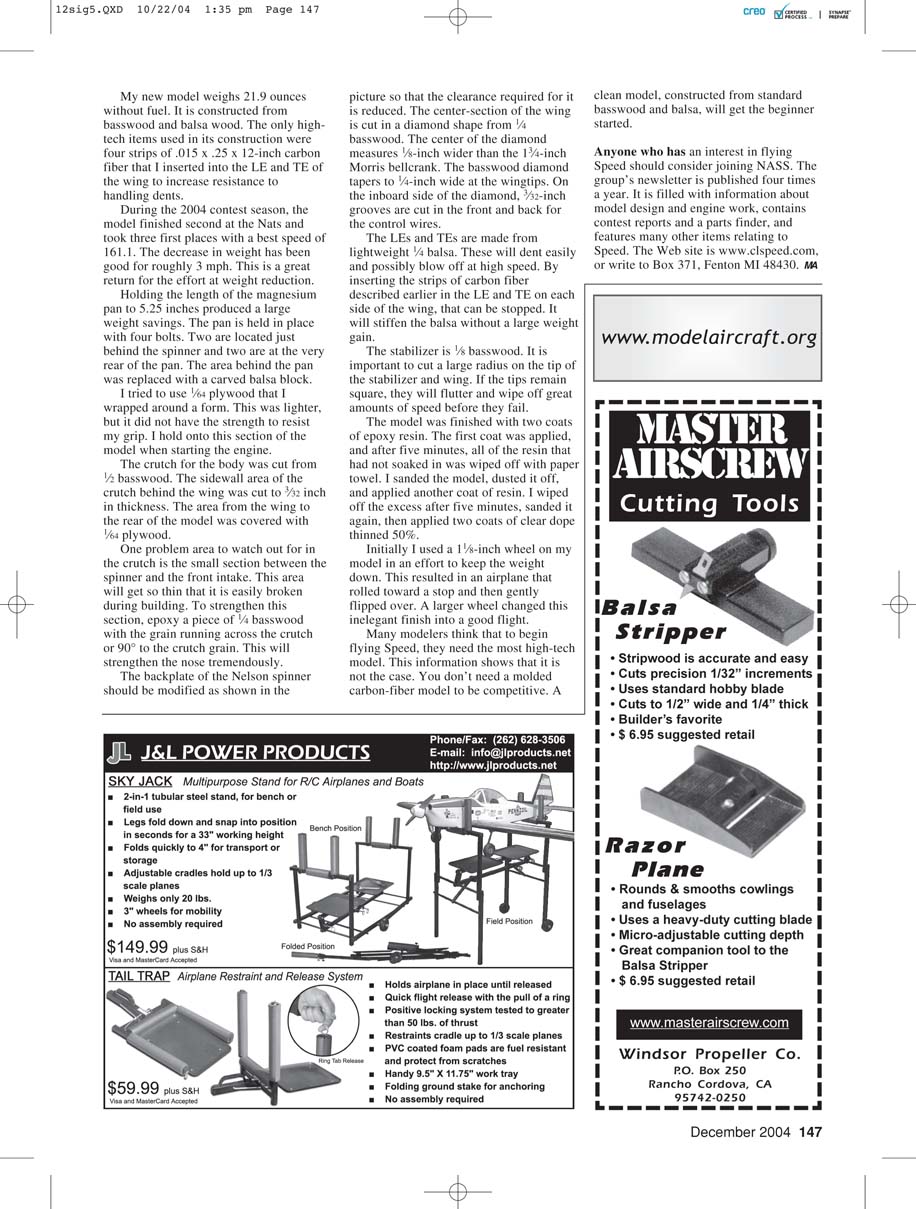
A company named Technika has made this a much easier task. It sells a watch marketed to the NASCAR crowd called the Speed Calculating Stopwatch. Key features:
- Enter the distance of the timed event (for Formula 40 enter 1 mile; for events timed on a 1/2-mile distance enter 0.5).
- Start the watch at the model’s release and stop it at the end of the timed laps; the speed is displayed in mph.
- Can be set for English or metric lengths.
- Allows as many as 100 split times, enabling recording of each lap of a timed run.
Ordering information:
- Technika Web site: www.technika.com
- Sales office: (480) 348-0278 (ask for item 810047)
- Price: $38 plus shipping
After mine arrived I compared it to the old speed charts I had been using and noticed slight differences. Technika confirmed the watch’s algorithms are correct and offered documentation certifying its accuracy back to the U.S. Bureau of Standards.
Why the Watch Differs from Old Charts
The difference is slight—on the order of a few hundredths of a mile per hour. It occurs because the distance we fly is not an exact 1/2-mile or mile length; many timing charts were based on the assumption that the distance was exact. To avoid these small discrepancies, the North American Speed Society (NASS) strongly suggests contest speeds be calculated using a set of formulas printed regularly in the NASS newsletter, Speed Times.
The small error in the watch’s speed does not detract from its value to a Speed flier, but contest speeds should be calculated using the official formulas to determine placing.
My New Formula 40 Model
In a previous column I described plans to construct a lighter model for the Formula 40 event. My old airplane, powered by a Nelson .40, weighed 27.6 ounces (without fuel) and achieved a best speed of 159.0 mph on its best day at Dayton, Ohio; other flights that day ranged from 153.0 to 157.5 mph.
The new model weighs 21.9 ounces without fuel and is constructed from basswood and balsa. The only high-tech items used were four strips of 0.015 x 0.25 x 12-inch carbon fiber inserted into the leading edge (LE) and trailing edge (TE) of the wing to increase resistance to handling dents. During the 2004 contest season the model finished second at the Nats and took three first places with a best speed of 161.1 mph. The decrease in weight produced roughly a 3 mph gain—an excellent return for the weight reduction effort.
Construction Details
- Magnesium pan: Holding the length to 5.25 inches produced a large weight savings. The pan is held in place with four bolts—two just behind the spinner and two at the very rear of the pan. The area behind the pan was replaced with a carved balsa block.
- Nose reinforcement: I tried 1/64-inch plywood wrapped around a form for the nose area; it was lighter but lacked the strength to resist my grip when starting the engine. Strengthen this area by epoxying a piece of 1/4-inch basswood with the grain running across the crutch (90° to the crutch grain).
- Crutch and body: The crutch for the body was cut from 1/8-inch basswood. The sidewall area of the crutch behind the wing was cut to 3/32 inch in thickness. The area from the wing to the rear of the model was covered with 1/64-inch plywood.
- Spinner and center-section: The backplate of the Nelson spinner should be modified (as shown in the original picture) to reduce required clearance. The center-section of the wing is cut in a diamond shape from 1/4-inch basswood. The center of the diamond measures 1/8 inch wider than the 1 3/4-inch Morris bellcrank. The basswood diamond tapers to 1/4 inch wide at the wingtips. On the inboard side of the diamond, 3/32-inch grooves are cut in the front and back for the control wires.
- LE and TE construction: LEs and TEs are made from lightweight 1/4-inch balsa. These dent easily and can blow off at high speed. Inserting the carbon fiber strips described earlier into the LE and TE on each side of the wing stiffens the balsa without a large weight gain.
- Stabilizer: The stabilizer is 1/8-inch basswood. It is important to cut a large radius on the tip of the stabilizer and wing. If tips remain square, they will flutter and lose significant speed before failing.
Finishing and Flight Characteristics
- Finish: The model was finished with two coats of epoxy resin. Apply the first coat, wait five minutes, then wipe off resin that has not soaked in with a paper towel. Sand, dust off, and apply a second coat. Wipe off the excess after five minutes, sand again, then apply two coats of clear dope thinned 50%.
- Wheels: Initially I used a 1-1/8-inch wheel to keep weight down. This caused the airplane to roll toward a stop and then gently flip over. Switching to a larger wheel corrected this and produced a good finish.
Getting Started in Speed
Many modelers think they need the most high-tech model to begin flying Speed. That is not the case. A clean model constructed from standard basswood and balsa will get a beginner started and can be competitive.
Anyone interested in flying Speed should consider joining NASS. The newsletter is published four times a year and is filled with information about model design and engine work, contest reports, a parts finder, and many other items relating to Speed.
- NASS Web site: www.clspeed.com
- Mail: Box 371, Fenton MI 48430
Transcribed from original scans by AI. Minor OCR errors may remain.

