
Control Line Speed — 2007/03
Jerry Rocha's .21 Sport Speed record setter
I have written about the benefits of having a well-thought-out model, fuel system, and approach to flying a Speed model. Jerry Rocha of Napa, California, demonstrated the benefits of this systematic approach in 2006 with his .21 Sport Speed model.
Competition and record
He placed first in every contest he entered that summer, including a win at the Nats, and set a record at a contest in Merced, California, with a speed of 159.65 mph. In December 1998 the team of Fogg and Brown set the record of 158.39 mph that stood for eight years.
Engine installation and fuel system
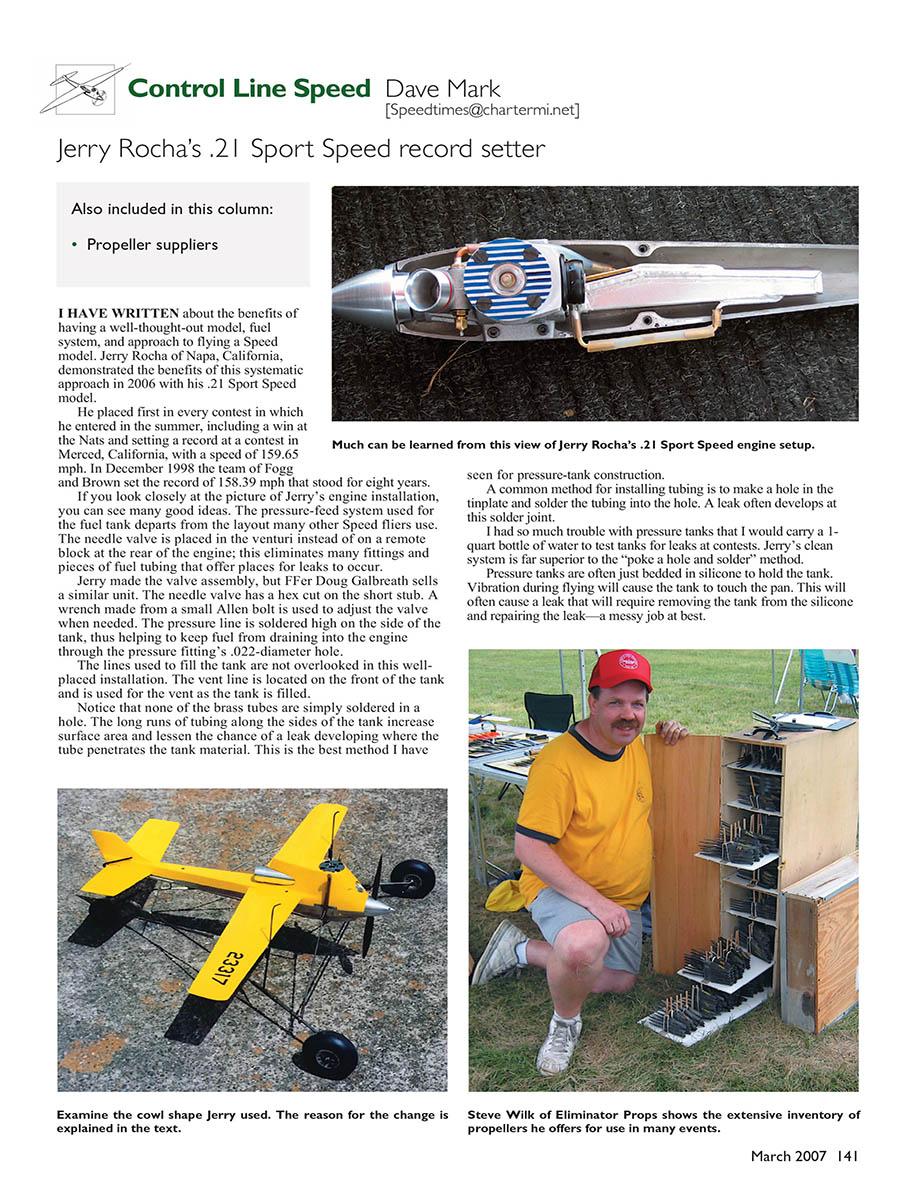
If you look closely at the picture of Jerry’s engine installation, you can see many good ideas. The pressure-feed system used for the fuel tank departs from the layout many other Speed fliers use. The needle valve is placed in the venturi instead of on a remote block at the rear of the engine; this eliminates many fittings and pieces of fuel tubing that offer places for leaks to occur.
Jerry made the valve assembly, but FFer Doug Galbreath sells a similar unit. The needle valve has a hex cut on the short stub. A wrench made from a small Allen bolt is used to adjust the valve when needed. The pressure line is soldered high on the side of the tank, helping to keep fuel from draining into the engine through the pressure fitting’s 0.022-inch-diameter hole.
The lines used to fill the tank are not overlooked in this well-placed installation. The vent line is located on the front of the tank and is used as the vent when the tank is filled. Notice that none of the brass tubes are simply soldered in a hole. The long runs of tubing along the sides of the tank increase surface area and lessen the chance of a leak developing where the tube penetrates the tank material. This is the best method I have seen for pressure-tank construction.
A common method for installing tubing is to make a hole in the tinplate and solder the tubing into the hole. A leak often develops at this solder joint. I had so much trouble with pressure tanks that I would carry a 1-quart bottle of water to test tanks for leaks at contests. Jerry’s clean system is far superior to the “poke a hole and solder” method.
Tank mounting and isolation
Pressure tanks are often just bedded in silicone to hold the tank. Vibration during flying will cause the tank to touch the pan. This will often cause a leak that requires removing the tank from the silicone and repairing the leak—a messy job at best.
Jerry’s method eliminates the chances of that happening. He glues a piece of balsa wood to the bottom of the tank with silicone glue. After that sets, he trims the wood to match the tank. Then he glues the tank into position using silicone. He ensures that the tank does not touch the pan by using a volt ohmmeter to make sure no contact occurs between the tank and the pan. The filler pipes are isolated from the pan and model with short pieces of fuel tubing, as can be seen in the pictures.
Wing, pan, and cowling
Jerry is quick to give credit to his friends who helped him with parts and ideas for his record holder. He said Luke Roy machined the wing for him on a three-axis CNC mill. The wing uses a lifting airfoil in the center and transitions to a symmetrical shape at the tips. Luke also machined the pan from a casting supplied by Bill Husted. Those names may be familiar: Husted and Roy developed the record-holding Rattler 29 and have held records in piston-powered Speed events.
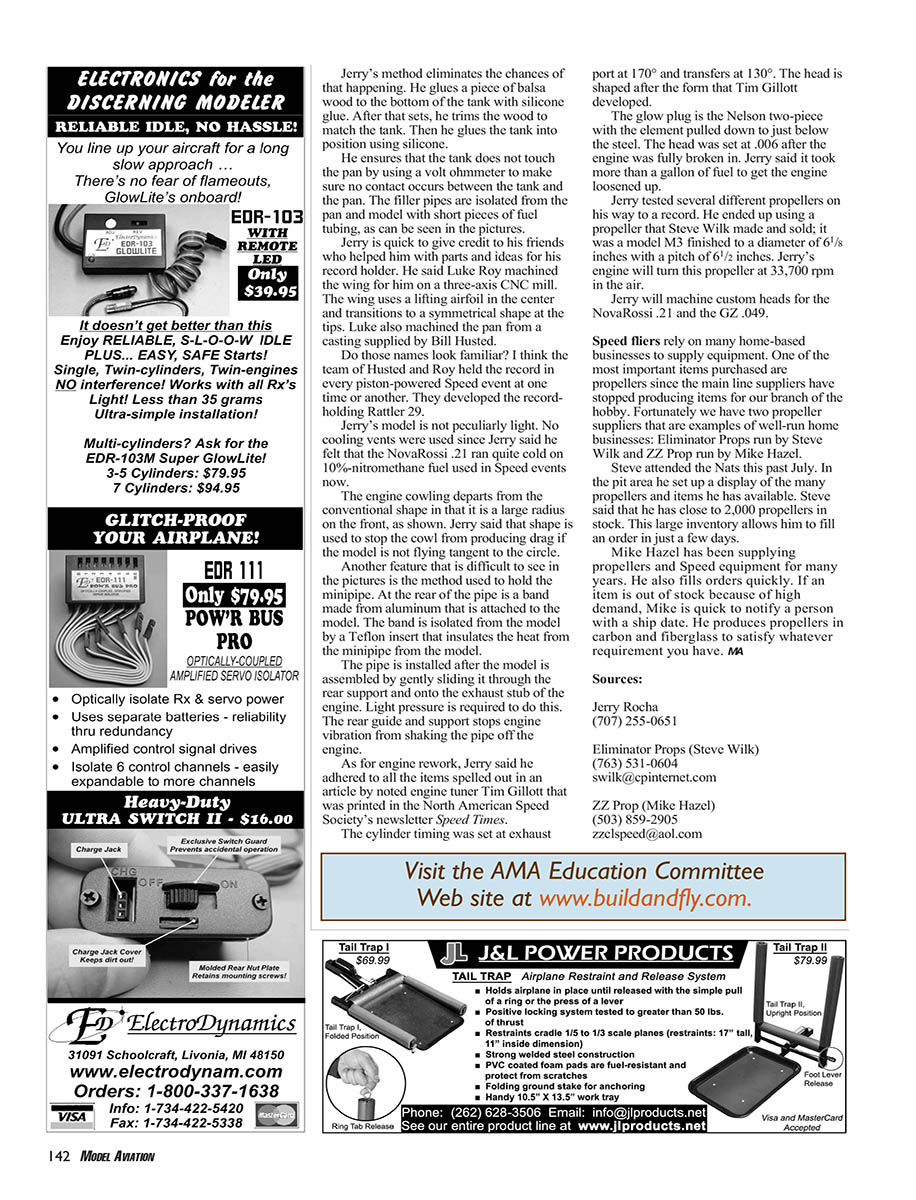
Jerry’s model is not peculiarly light. No cooling vents were used since Jerry felt the NovaRossi .21 ran quite cold on the 10% nitromethane fuel used in Speed events now. The engine cowling departs from the conventional shape in that it has a large radius on the front. Jerry said that shape is used to prevent the cowl from producing drag if the model is not flying tangent to the circle.
Exhaust and minipipe mounting
Another feature that is difficult to see in the pictures is the method used to hold the minipipe. At the rear of the pipe is a band made from aluminum that is attached to the model. The band is isolated from the model by a Teflon insert that insulates the heat from the minipipe.
The pipe is installed after the model is assembled by gently sliding it through the rear support and onto the exhaust stub of the engine. Light pressure is required to do this. The rear guide and support stop engine vibration from shaking the pipe off the engine.
Engine rework and tuning
As for engine rework, Jerry said he adhered to all the items spelled out in an article by noted engine tuner Tim Gillott printed in the North American Speed Society’s newsletter Speed Times.
- Cylinder timing: exhaust port at 170°, transfers at 130°.
- Head: shaped to the form developed by Tim Gillott.
- Glow plug: Nelson two-piece with the element pulled down to just below the steel shell.
- Head setting: .006 inch after the engine was fully broken in.
Jerry said it took more than a gallon of fuel to get the engine loosened up.
Jerry tested several different propellers on his way to the record. He ended up using a propeller that Steve Wilk made and sold: a model M3 finished to a diameter of 6 1/8 inches with a pitch of 6 1/2 inches. Jerry’s engine will turn this propeller at 33,700 rpm in the air.
Jerry will machine custom heads for the NovaRossi .21 and the GZ .049.
Propeller suppliers and small businesses
Speed fliers rely on many home-based businesses to supply equipment. One of the most important items purchased are propellers since the main line suppliers have stopped producing them for this branch of the hobby. Fortunately we have two propeller suppliers that are examples of well-run home businesses:
- Eliminator Props (Steve Wilk): Steve attended the Nats this past July and set up a display in the pit area of the many propellers and items he has available. He said he has close to 2,000 propellers in stock, which allows him to fill an order in just a few days.
- ZZ Prop (Mike Hazel): Mike has been supplying propellers and Speed equipment for many years. He fills orders quickly and notifies customers of ship dates when items are out of stock due to high demand. He produces propellers in carbon and fiberglass to satisfy different requirements.
Sources
- Jerry Rocha: (707) 255-0651
- Eliminator Props (Steve Wilk)
- Phone: (763) 531-0604
- Email: [email protected]
- ZZ Prop (Mike Hazel)
- Phone: (503) 859-2905
- Email: [email protected]
Transcribed from original scans by AI. Minor OCR errors may remain.

