
Convention 2006 - 2006/04
By Michael Ramsey
The promotion of aeromodeling takes many forms. We see it in the products offered by manufacturers, the special interest groups that moderate competitions and events, and especially in the everyday modeler who comes out to show off a new aircraft creation. Regardless of one’s particular interest in the hobby, AMA is willing to be a part of it and help make it fun, safe, and enjoyable for anyone. The Academy hosts, in part or in whole, many events, all of which are organized to promote aeromodeling.
Take part in any club event—whether it's flying or a monthly meeting—and AMA is a part of it. Club members are, by definition, local ambassadors of AMA, and without provocation they spread the values and joy of aviation modeling. This is the philosophy behind the AMA Convention.
The convention center is a place to gather all that is monumental and popular in aeromodeling under one roof in a convenient location. It’s a "reunion" of sorts for the procreation of fresh ideas, the telling of traditions and history, and the opportunity for all ambassadors to illuminate our youth so they can share the magic of flight.
Born from the International Modeler Show (IMS), founded long ago by Bill and Anita Northrop, AMA has built on their foundation and cultivated that tradition of promoting modeling by boldly nurturing its following into what is now known as the AMA Convention.
This year’s event was held at the Ontario Convention Center in Ontario, California, as it has been for the past two years. The Ontario Convention Center appealed to the AMA board as an attractive location for expanding the event because of its opportune location, modern facilities, and enormous showroom. In addition, it is a great area of the southern California valley to sightsee—especially if you’re an aviation enthusiast. Two of the most famous air museums are located less than an hour’s drive from the convention center, not to mention the other attractions available for the entire family.
The 2006 convention was held the third week of January, from Friday the 13th to Sunday the 15th. For those of you who are superstitious: I walked under two ladders, stepped on countless cracks, and may not have broken a mirror, but several grains of salt were sacrificed during a breakfast meeting. I’m still here and, to my knowledge, everyone including myself got through the weekend without as much as a hangnail. The weather was bright (except for a little rain on Saturday) and cool. I’m happy to report that geologic anomalies bore no witness at our show.
As with the AMA Nationals, the AMA Convention is a place where you’ll meet a large portion of the headquarters staff and Executive Council members who make the Academy so well run. For the West Coast contingent, this is an opportunity to match an email or telephone call with a face and greet those who make up the nuts and bolts of the association.
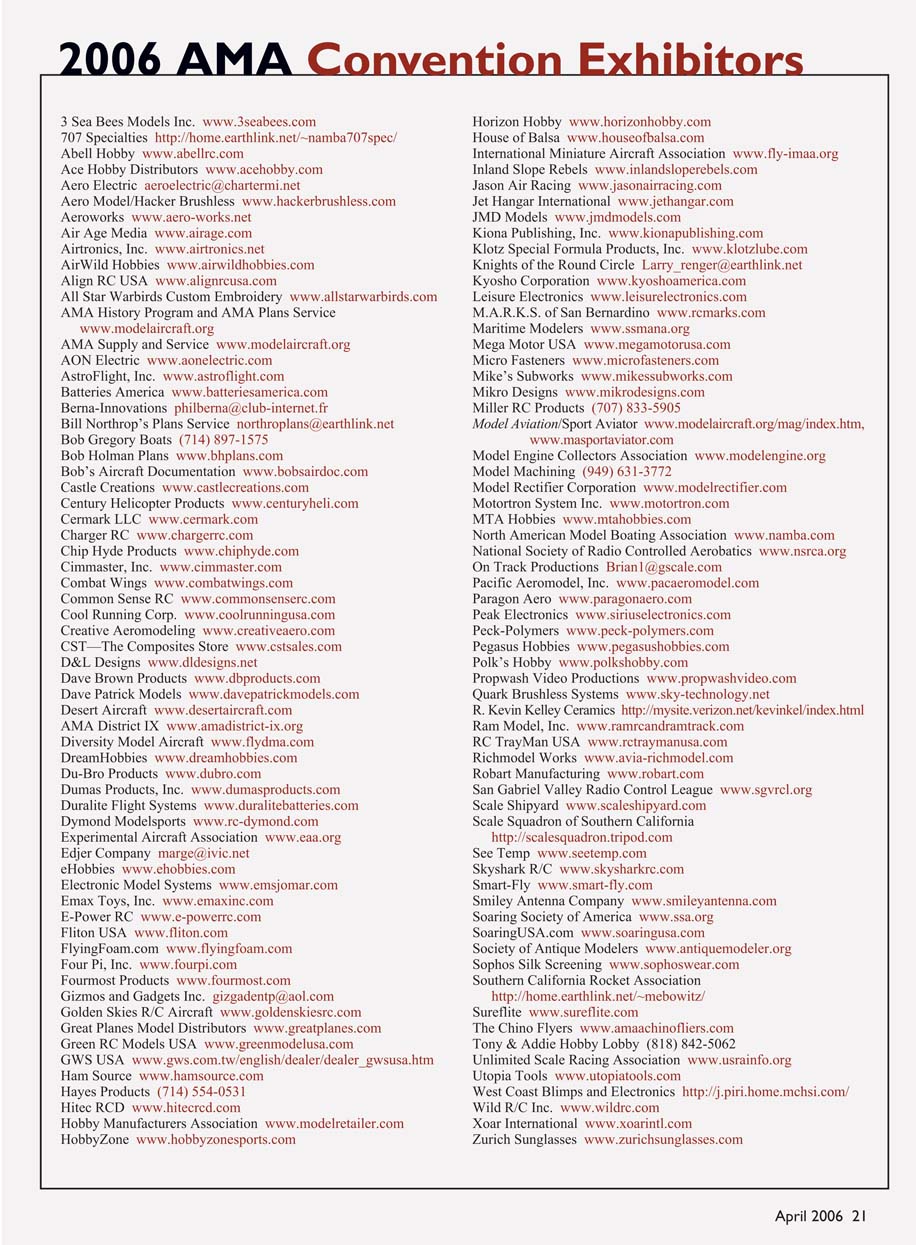
The layout of the showroom floor was designed to be open, with wide aisles between exhibitors. At the center of it all was a "village" area where AMA personnel could easily be found. The show interior was filled with 138 exhibitors covering 258 table spaces. Roughly 8,000 guests visited the convention during the course of the weekend.
Demonstration areas were easy to find at the far end of the exhibit hall. They included a large boat pond active with ships and submersibles of every type, and beside it were two full-scale aircraft displays. One featured Jason Somes' legendary Reno-class AlleyCat racer. Next to that was Mike Reagan’s unbelievably light, American-made, state-of-the-art sailplane the Sparrow Hawk. Loaded with all the extra high-altitude equipment, the all-composite aircraft still weighed less than 200 pounds.
As if the full-scale displays weren't impressive enough, Bill Hempel—a professional unmanned aerial vehicle (UAV) pilot and one of the most talented RC pilots in the country—displayed his new 52% Edge 540 from Advanced Composite Manufacturing. He thinks highly of his aircraft and treasures them almost as much as he does his models. Bill brought a family of three daughters—Brittany, Madison, and Caylie—who were present Saturday and Sunday to help show how well engineered his new airplane was built.
Around the cockpit area of the big model all radio equipment had been neatly arranged fore and aft of the opening, and at the floor of the compartment was a plate angled backward. I thought I might have been mistaken, but it looked as though there were dainty footprints imprinted comically on the floor. As I learned, those Keds treads belonged to Bill’s 6-year-old daughter Caylie. I met her after I drifted by the aircraft that Saturday morning; I saw her cheery head and shoulders inside the almost custom-fit green-tinted canopy. She gave me a thumbs up and then surprised me again by working the aircraft control surfaces vigorously back and forth.
Bill was close by and couldn’t help but laugh as he stood out of view. He wasn’t holding the transmitter, though. Caylie popped the cockpit open, bringing the side-hinged, perfect-fitting cover to rest with the safety cable holding it off to the side as if it were a full-scale airplane. The transmitter was tray-mounted inside the cockpit for Caylie to operate easily. Then she stood upright in the cockpit, all 46 pounds of her, brought her left foot up onto the wing, stepped all the way onto it, and then jumped off the aircraft.
“So Bill, do you think this Edge is tough enough to hold up to the typical dramatic demonstrations we’re so used to seeing you do?” I asked.
“Though my daughter will never fly in this aircraft, I’m confident that its maiden flight will be very pleasing,” he answered, laughing.
Since the Edge weighs 75 pounds, it will be registered in AMA’s RC Experimental Class. Although the preceding story is a little on the dramatic side, such special exhibits are what make conventions so memorable.
Those who came to the show as public guests were welcomed to play out some experiences of their own. For youngsters, the make-and-take areas were extremely busy all weekend. Also on that far end of the exhibit hall was the rocket-building area, where some of the finest-built specimens of rocketry were displayed.
Quest Aerospace donated the rocket kits, and the Southern California Rocket Association (SCRA) volunteered to mentor anyone interested in getting into the hobby. Modelers from SCRA supervised the assembly of the guests' rockets, which they took home free of charge. Building seminars were held every hour during the three days.
As at most conventions (many incorrectly refer to them as trade shows), a large static display was prepared to welcome local modelers to compete in a beauty competition. This was by no means "Top Gun"-class judging, but many of the models could contend with the big boys. Trophies and cash prizes were awarded to first- through third-place finishers.
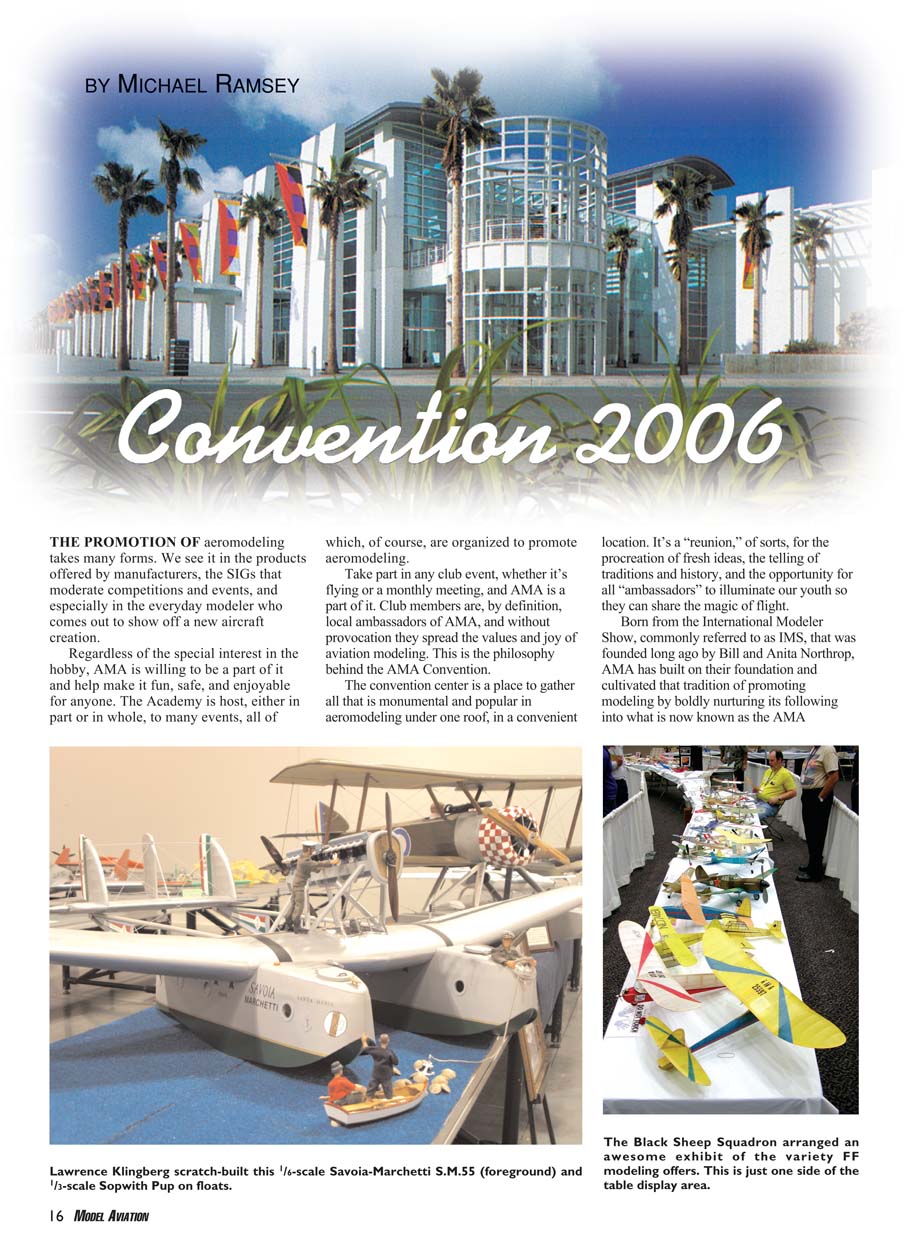
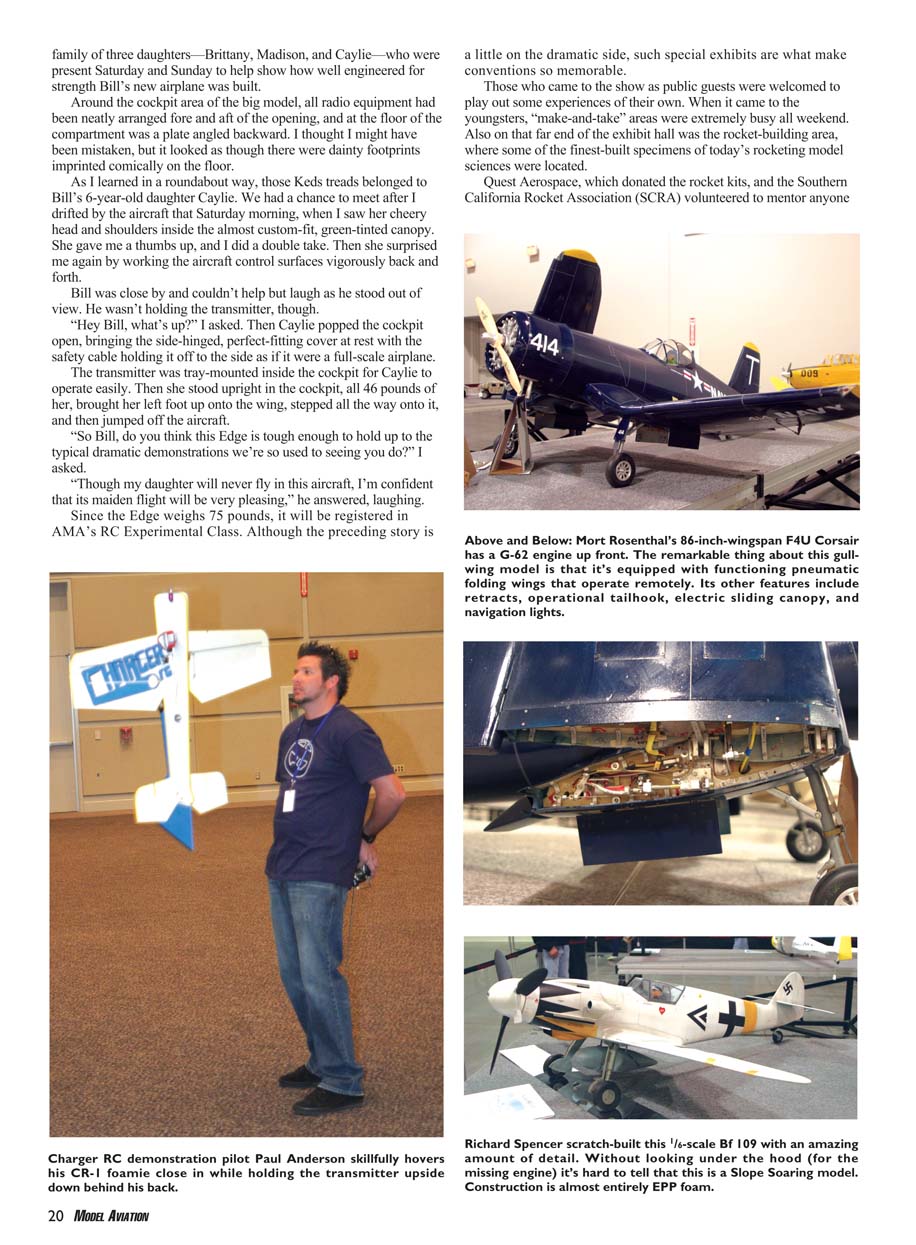
One of the most unique aircraft was by veteran modeler Lawrence Klingberg. He scratch-builds most of his creations, including his 1/6-scale Savoia-Marchetti S.M.55. It is a skillful depiction of the Santa Maria—the first aircraft to cross the Atlantic Ocean in May 1927, according to the display text—predating Ryan Aircraft and Charles Lindbergh's solo New York-to-Paris flight. Lawrence and I had a pleasant conversation about his methodology for layout and construction of the all-wood model. It quickly became obvious why he's such a respected member of the Scale Squadron of Southern California. His intense activity in the preservation of aviation history is a rewarding asset to AMA District X.
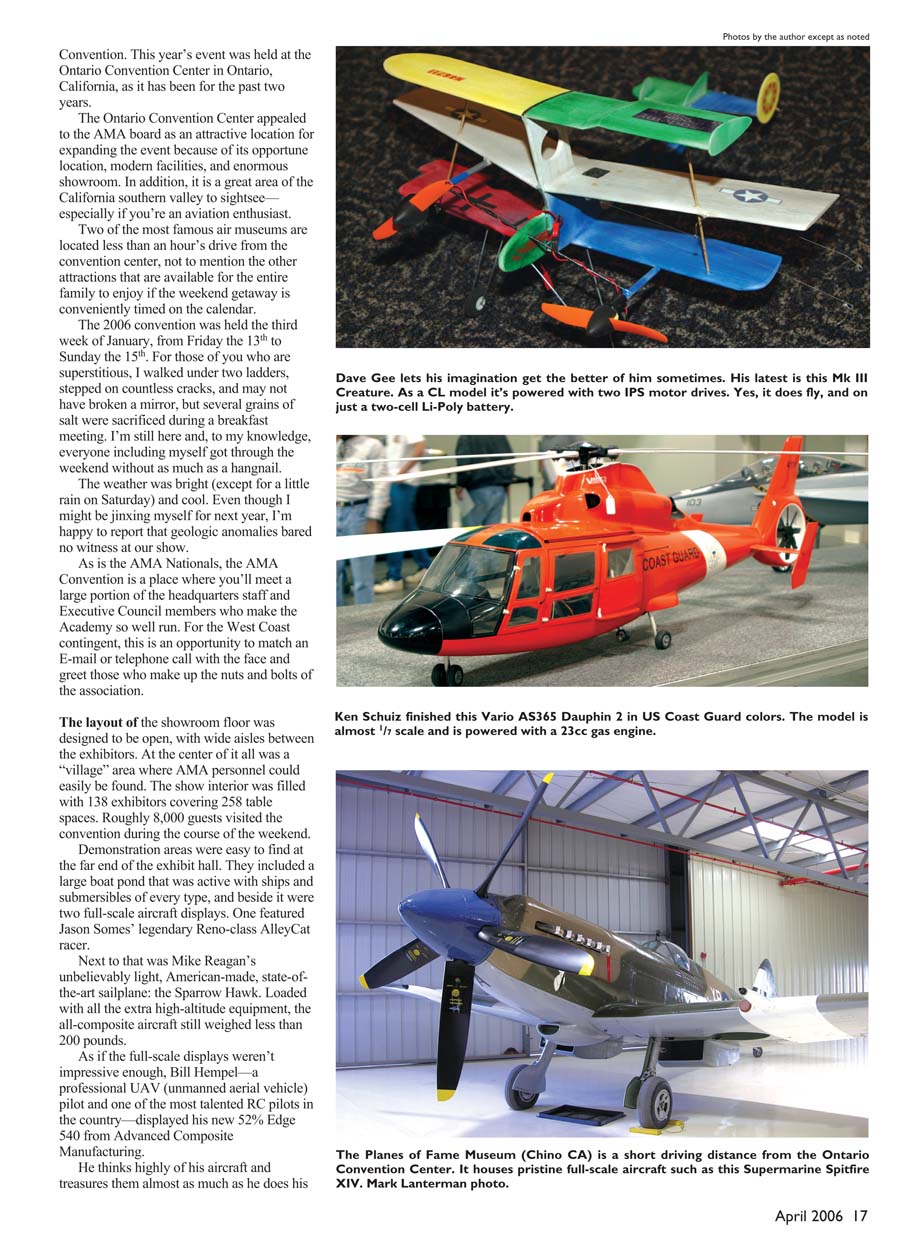
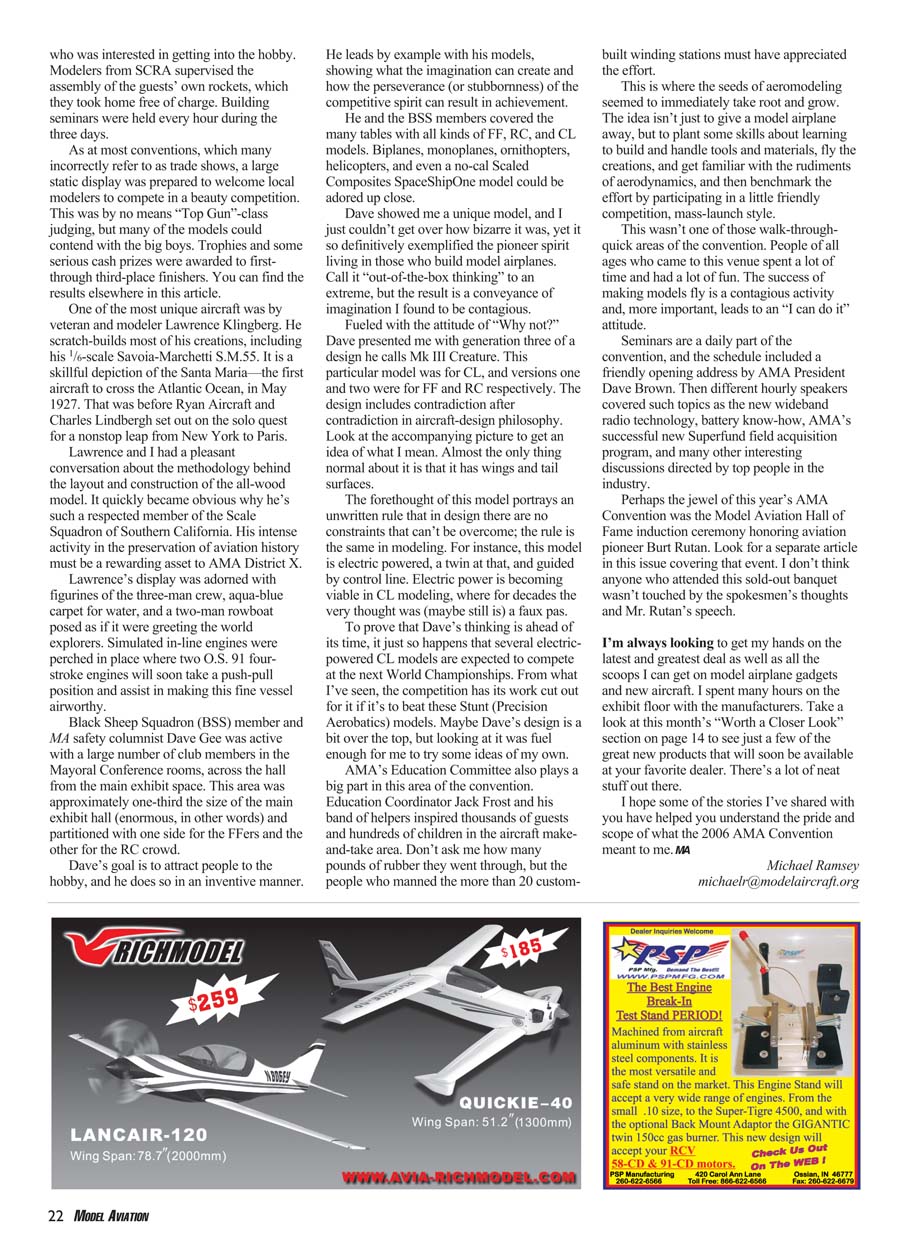
Black Sheep Squadron (BSS) member and MA safety columnist Dave Gee was active with a large number of club members in the Mayoral Conference rooms, across the hall from the main exhibit space. This area was approximately one-third the size of the main exhibit hall and partitioned with one side for free-flight (FF) enthusiasts and the other for the radio-control crowd.
Dave's goal is to attract people to the hobby, and he does so inventively. He leads by example with his models, showing what imagination can create and how perseverance (or stubbornness) can result in achievement. He and the BSS members covered many tables with all kinds of FF, RC, and control-line (CL) models: biplanes, monoplanes, ornithopters, helicopters, and even a no-cal Scaled Composites SpaceShipOne model.
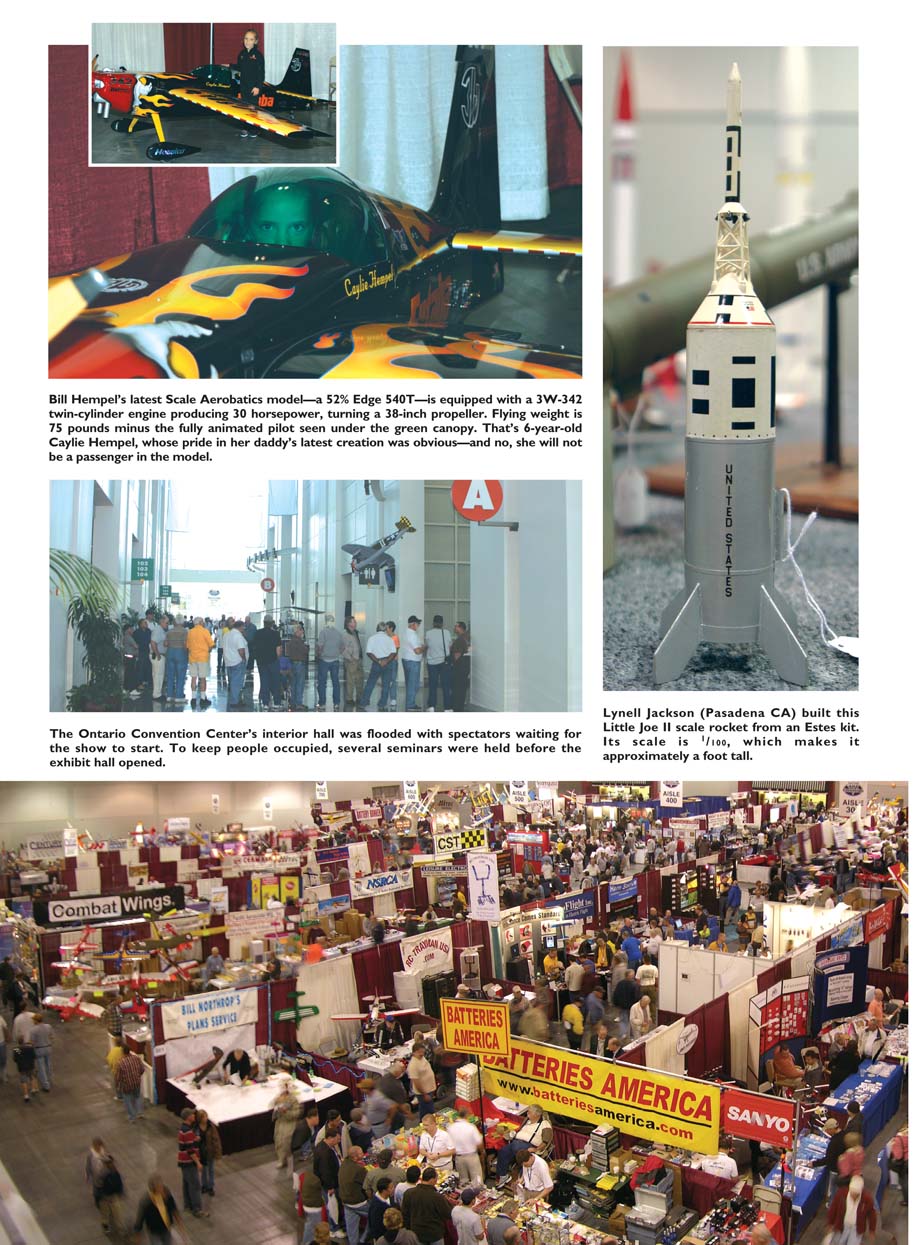
Dave showed me a unique model I couldn't get over—it so definitively exemplified the pioneer spirit living in those who build model airplanes. Fueled with the attitude of "Why not?" Dave presented generation three of a design he calls the Mk III Creature. This particular model was for CL; versions one and two were for FF and RC respectively. The design includes contradiction after contradiction in aircraft-design philosophy. Almost the only thing normal about it is that it has wings and tail surfaces.
The forethought behind this model portrays an unwritten rule that in design there are no constraints that can't be overcome; the rule is the same in modeling. For instance, this model is electric powered (a twin at that) and guided by control line. Electric power is becoming viable in CL modeling, where for decades the very thought was a faux pas. To prove that Dave's thinking is ahead of its time, several electric-powered CL models are expected to compete at the next World Championships.
AMA's Education Committee also plays a big part in the convention. Education Coordinator Jack Frost and his band of helpers inspired thousands of guests and hundreds of children in the aircraft make-and-take area. The people who manned the more than 20 custom-built winding stations must have appreciated the effort. This is where the seeds of aeromodeling seemed to immediately take root and grow. The idea isn't just to give a model airplane away, but to plant some skills about learning to build and handle tools and materials, fly the creations, and get familiar with the rudiments of aerodynamics, then benchmark that effort by participating in a little friendly competition, mass-launch style.
This wasn't one of those walk-through-quick areas of the convention. People of all ages spent a lot of time and had a lot of fun. The success of making models fly is contagious and, more important, leads to an "I can do it" attitude.
Seminars are a daily part of the convention. The schedule included a friendly opening address by AMA President Dave Brown. Hourly speakers covered topics such as new wideband radio technology, battery know-how, AMA's Superfund field acquisition program, and other industry discussions directed by top people in the hobby.
Perhaps the jewel of this year's AMA Convention was the Model Aviation Hall of Fame induction ceremony honoring aviation pioneer Burt Rutan. Look for a separate article in this issue covering that event. I don't think anyone who attended the sold-out banquet wasn't touched by the speakers' thoughts and Mr. Rutan's speech.
I spent many hours on the exhibit floor with manufacturers, looking for the latest and greatest gear and the scoops on new aircraft. See the "Worth a Closer Look" section in this issue for just a few of the great new products soon to be available at your favorite dealer.
I hope the stories I've shared help you understand the pride and scope of what the 2006 AMA Convention meant to me.
Michael Ramsey [email protected]
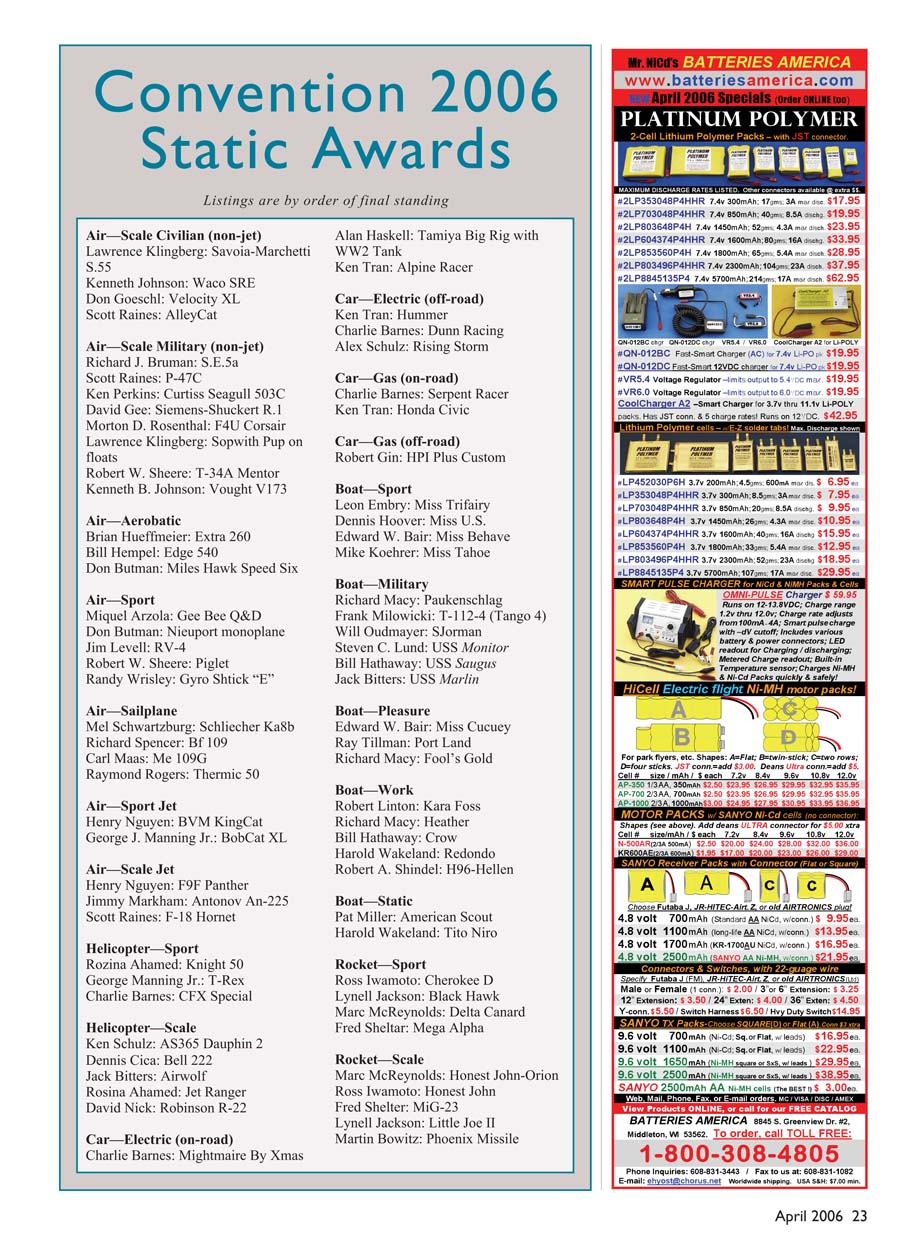
Convention 2006 Static Awards
Listings are by order of final standing
Air — Scale Civilian (non-jet)
- Lawrence Klingberg: Savoia-Marchetti S.55
- Kenneth Johnson: Waco SRE
- Don Goeschl: Velocity XL
- Scott Raines: AlleyCat
Air — Scale Military (non-jet)
- Richard J. Bruman: S.E.5a
- Scott Raines: P-47C
- Ken Perkins: Curtiss Seagull 503C
- David Gee: Siemens-Schuckert R.1
- Morton D. Rosenthal: F4U Corsair
- Lawrence Klingberg: Sopwith Pup on floats
- Robert W. Sheere: T-34A Mentor
- Kenneth B. Johnson: Vought V173
Air — Aerobatic
- Brian Hueffmeier: Extra 260
- Bill Hempel: Edge 540
- Don Butman: Miles Hawk Speed Six
Air — Sport
- Miguel Arzola: Gee Bee Q&D
- Don Butman: Nieuport monoplane
- Jim Levell: RV-4
- Robert W. Sheere: Piglet
- Randy Wrisley: Gyro Shtick "E"
Air — Sailplane
- Mel Schwartzburg: Schleicher Ka8b
- Richard Spencer: Bf 109
- Carl Maas: Me 109G
- Raymond Rogers: Thermic 50
Air — Sport Jet
- Henry Nguyen: BVM KingCat
- George J. Manning Jr.: BobCat XL
Air — Scale Jet
- Henry Nguyen: F9F Panther
- Jimmy Markham: Antonov An-225
- Scott Raines: F-18 Hornet
Helicopter — Sport
- Rozina Ahamed: Knight 50
- George Manning Jr.: T-Rex
- Charlie Barnes: CFX Special
Helicopter — Scale
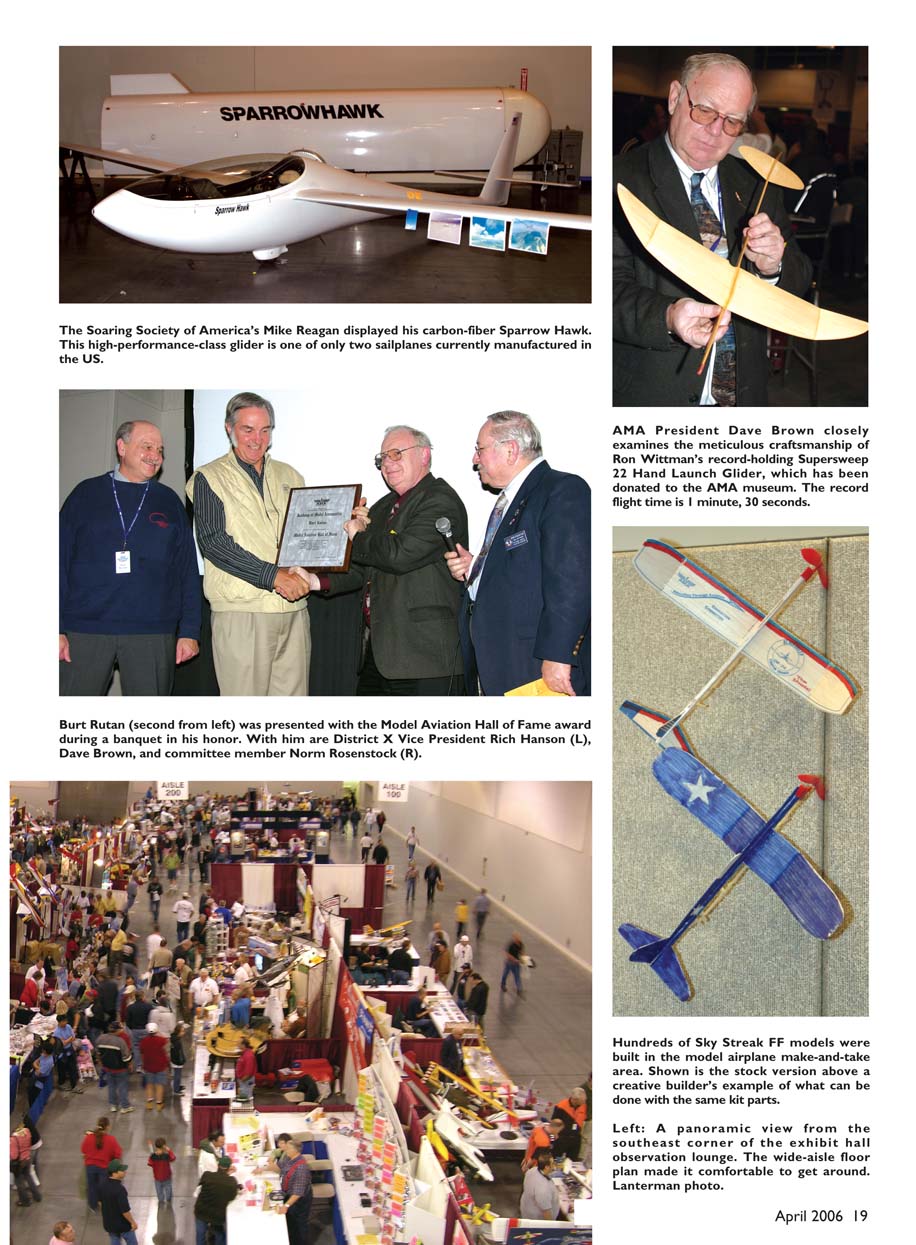
- Ken Schulz: AS365 Dauphin 2
- Dennis Cica: Bell 222
- Jack Bitters: Airwolf
- Rosina Ahamed: Jet Ranger
- David Nick: Robinson R-22
Car — Electric (on-road)
- Charlie Barnes: Mightmare By Xmas
Car — Electric (off-road)
- Ken Tran: Hummer
- Charlie Barnes: Dunn Racing
- Alex Schulz: Rising Storm
Car — Gas (on-road)
- Charlie Barnes: Serpent Racer
- Ken Tran: Honda Civic
Car — Gas (off-road)
- Robert Gin: HPI Plus Custom
Boat — Sport
- Leon Embry: Miss Trifairy
- Dennis Hoover: Miss U.S.
- Edward W. Bair: Miss Behave
- Mike Koehrer: Miss Tahoe
Boat — Military
- Richard Macy: Paukenschlag
- Frank Milowicki: T-112-4 (Tango 4)
- Will Oudmayer: SJorman
- Steven C. Lund: USS Monitor
- Bill Hathaway: USS Saugus
- Jack Bitters: USS Marlin
Boat — Pleasure
- Edward W. Bair: Miss Cucuey
- Ray Tillman: Port Land
- Richard Macy: Fool's Gold
Boat — Work
- Robert Linton: Kara Foss
- Richard Macy: Heather
- Bill Hathaway: Crow
- Harold Wakeland: Redondo
- Robert A. Shindel: H96-Hellen
Boat — Static
- Pat Miller: American Scout
- Harold Wakeland: Tito Niro
Rocket — Sport
- Ross Iwamoto: Cherokee D
- Lynell Jackson: Black Hawk
- Marc McReynolds: Delta Canard
- Fred Sheltar: Mega Alpha
Rocket — Scale
- Marc McReynolds: Honest John-Orion
- Ross Iwamoto: Honest John
- Fred Sheltar: MiG-23
- Lynell Jackson: Little Joe II
- Martin Bowitz: Phoenix Missile
Transcribed from original scans by AI. Minor OCR errors may remain.

