
From the Copilot’s Seat
By Gary Fitch, Executive Vice President
A geotextile runway: hard work but good results
As reported last month in Bob Brown’s and Dave Mathewson’s columns, AMA will be celebrating National Model Aviation Day on August 17, which will be roughly 1½ months away when you read this. I encourage our clubs to plan a flying event that day and to invite their communities to participate. Consider having a benefit fun-fly with the proceeds going to the Wounded Warrior Project. This charity uses its funds to support the rehabilitation of our injured military personnel, and you couldn’t find a more worthy cause. If you haven’t planned an event for National Model Aviation Day, please consider doing so.
I have been involved in my club’s discussion on the possibility of installing a geotextile material on a portion of our 1,050-foot runway. Although we have a good flying site, smaller electric-powered models and EDF aircraft either can’t take off from a grass strip or their landing gear or vertical stabilizers are damaged when they get caught in the grass and flip over. Smaller electrics offer a less-expensive entry point for people new to our hobby.
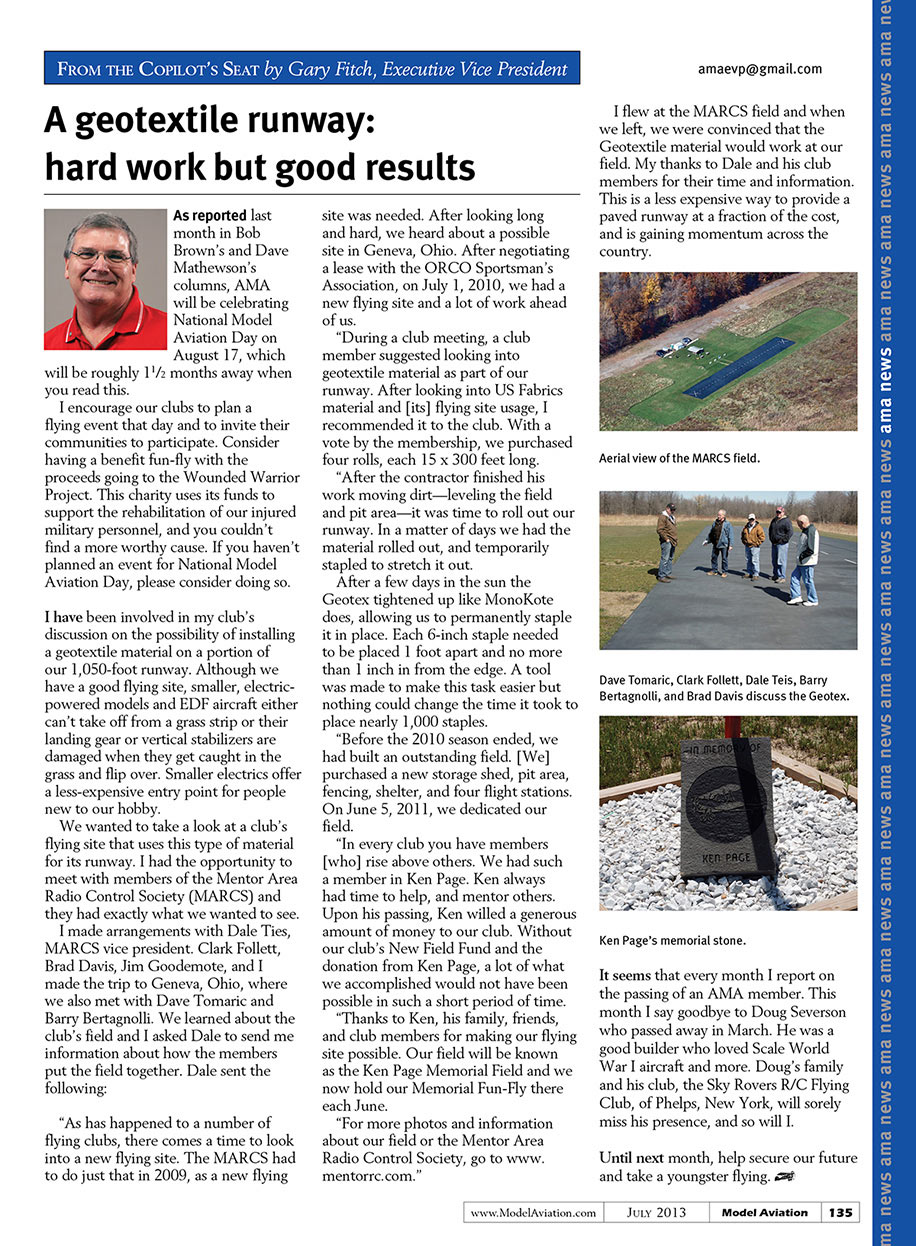
We wanted to take a look at a club’s flying site that uses this type of material for its runway. I had the opportunity to meet with members of the Mentor Area Radio Control Society (MARCS) and they had exactly what we wanted to see. I made arrangements with Dale Teis, MARCS vice president. Clark Follett, Brad Davis, Jim Goodemote, and I made the trip to Geneva, Ohio, where we also met with Dave Tomaric and Barry Bertagnolli. We learned about the club’s field, and I asked Dale to send me information about how the members put the field together. Dale sent the following account.
MARCS account (Dale Teis)
As has happened to a number of flying clubs, there comes a time to look into a new flying site. MARCS had to do just that in 2009, as a new flying site was needed. After looking long and hard, we heard about a possible site in Geneva, Ohio. After negotiating a lease with the ORCO Sportsman’s Association, on July 1, 2010, we had a new flying site and a lot of work ahead of us.
During a club meeting, a club member suggested looking into geotextile material as part of our runway. After looking into US Fabrics material and its flying-site usage, I recommended it to the club. With a vote by the membership, we purchased four rolls, each 15 x 300 feet long.
After the contractor finished his work moving dirt—leveling the field and pit area—it was time to roll out our runway. In a matter of days we had the material rolled out and temporarily stapled to stretch it out. After a few days in the sun the geotextile tightened up like MonoKote does, allowing us to permanently staple it in place. Each 6-inch staple needed to be placed 1 foot apart and no more than 1 inch in from the edge. A tool was made to make this task easier, but nothing could change the time it took to place nearly 1,000 staples.
Before the 2010 season ended, we had built an outstanding field. We purchased a new storage shed, pit area, fencing, shelter, and four flight stations. On June 5, 2011, we dedicated our field.
In every club you have members who rise above others. We had such a member in Ken Page. Ken always had time to help and mentor others. Upon his passing, Ken willed a generous amount of money to our club. Without our club’s New Field Fund and the donation from Ken Page, a lot of what we accomplished would not have been possible in such a short period of time.
Thanks to Ken, his family, friends, and club members for making our flying site possible. Our field will be known as the Ken Page Memorial Field and we now hold our Memorial Fun-Fly there each June.
For more photos and information about our field or the Mentor Area Radio Control Society, go to www.mentorrc.com.
I flew at the MARCS field and when we left, we were convinced that the geotextile material would work at our field. My thanks to Dale and his club members for their time and information. This is a less expensive way to provide a paved runway at a fraction of the cost, and it is gaining momentum across the country.
It seems that every month I report on the passing of an AMA member. This month I say goodbye to Doug Severson, who passed away in March. He was a good builder who loved scale World War I aircraft and more. Doug’s family and his club, the Sky Rovers R/C Flying Club of Phelps, New York, will sorely miss his presence, and so will I.
Until next month, help secure our future and take a youngster flying.
Transcribed from original scans by AI. Minor OCR errors may remain.

