
From the Copilot's Seat by Gary Fitch, Executive Vice President
Goodbye to EC members and another aviation family story
Happy holidays, everyone! This time of year, those of us on the AMA Executive Council (EC) get a breather. We aren’t driving to events each weekend or in all-too-frequent meetings. It is a brief respite. It’s time for family and friends, time to reflect on what has been accomplished, and think about those we lost in 2013.
We are saying goodbye to our fellow EC members and friends, Jose Soto from District V, and Jim Wallen from District IX. We wish them the best. Thank you for your efforts in making AMA a better organization!
We will welcome two new vice presidents to the EC who have yet to be determined as this is written. With only two exceptions, each EC member has served for six years or fewer, and we appreciate the new ideas that come from fresh minds.
AMA is growing again and much has been done to secure our members’ future. For all of this, I am thankful!
A couple of months ago I wrote about Captain John Sabini and how model aviation had such an impact on his family. That prompted an email from Ed Sarkisian, who is a captain with United Airlines flying 757s and 767s. He is sharing a similar story about how model aviation influenced his family’s lives.
“I was four years old, in 1961, when my dad built a model Cessna 180, and to this day I distinctly recall going into the basement shop and seeing my dad work on this airplane, watching it come together. I remember lots of sanding and delicate cutting.
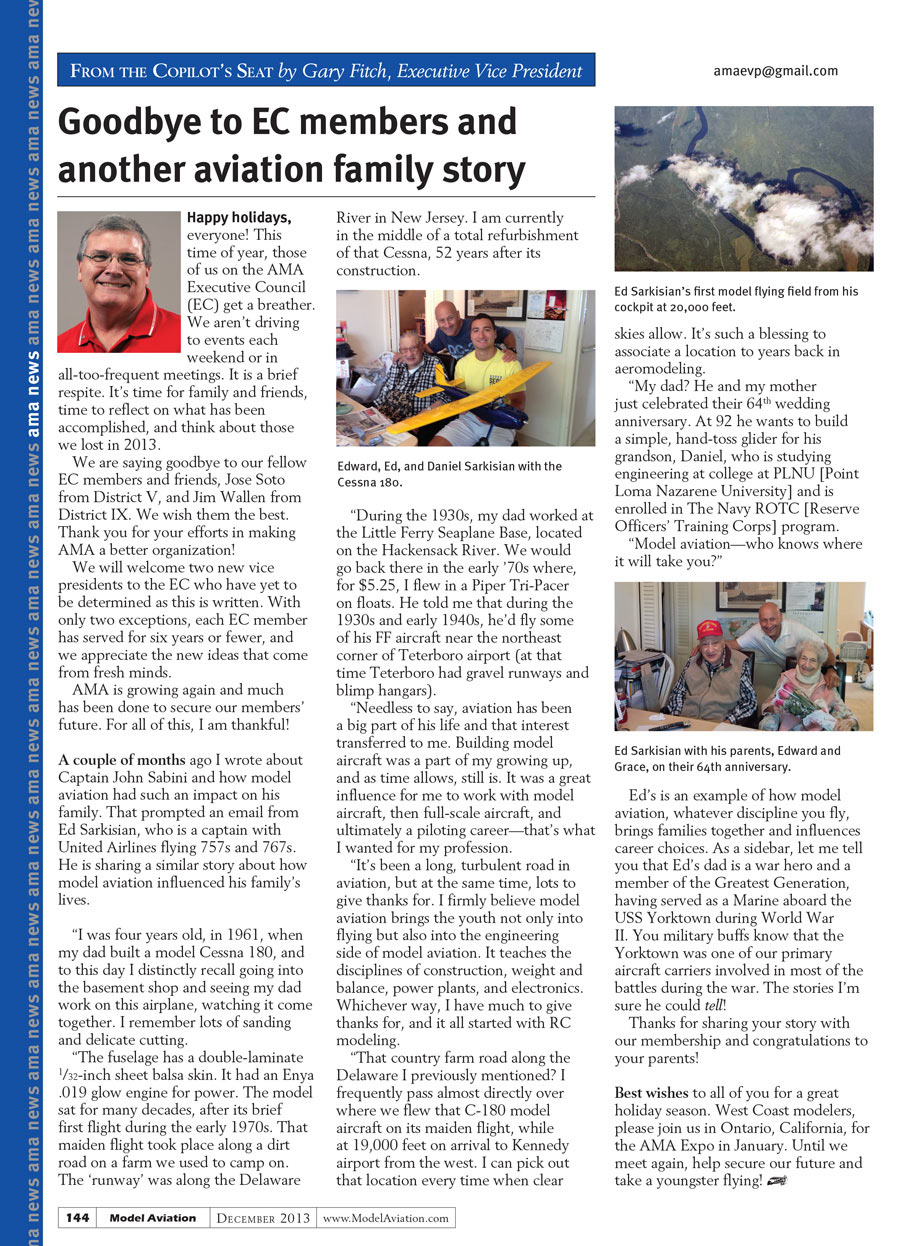
“The fuselage has a double-laminate 1/32-inch sheet balsa skin. It had an Enya .019 glow engine for power. The model sat for many decades, after its brief first flight during the early 1970s. That maiden flight took place along a dirt road on a farm we used to camp on. The ‘runway’ was along the Delaware River in New Jersey. I am currently in the middle of a total refurbishment of that Cessna, 52 years after its construction.
“During the 1930s, my dad worked at the Little Ferry Seaplane Base, located on the Hackensack River. We would go back there in the early ’70s where, for $5.25, I flew in a Piper Tri-Pacer on floats. He told me that during the 1930s and early 1940s, he’d fly some of his FF aircraft near the northeast corner of Teterboro airport (at that time Teterboro had gravel runways and blimp hangars).
“Needless to say, aviation has been a big part of his life and that interest transferred to me. Building model aircraft was a part of my growing up, and as time allows, still is. It was a great influence for me to work with model aircraft, then full-scale aircraft, and ultimately a piloting career—that’s what I wanted for my profession.
“It’s been a long, turbulent road in aviation, but at the same time, lots to give thanks for. I firmly believe model aviation brings the youth not only into flying but also into the engineering side of model aviation. It teaches the disciplines of construction, weight and balance, power plants, and electronics. Whichever way, I have much to give thanks for, and it all started with RC modeling.
“That country farm road along the Delaware I previously mentioned? I frequently pass almost directly over where we flew that C-180 model aircraft on its maiden flight, while at 19,000 feet en route to Kennedy airport from the west. I can pick out that location every time when clear skies allow. It’s such a blessing to associate a location to years back in aeromodeling.
“My dad? He and my mother just celebrated their 64th wedding anniversary. At 92 he wants to build a simple, hand-toss glider for his grandson, Daniel, who is studying engineering at college at PLNU [Point Loma Nazarene University] and is enrolled in The Navy ROTC [Reserve Officers’ Training Corps] program.
“Model aviation—who knows where it will take you?”
Ed’s is an example of how model aviation, whatever discipline you fly, brings families together and influences career choices. As a sidebar, let me tell you that Ed’s dad is a war hero and a member of the Greatest Generation, having served as a Marine aboard the USS Yorktown during World War II. You military buffs know that the Yorktown was one of our primary aircraft carriers involved in most of the battles during the war. The stories I’m sure he could tell!
Thanks for sharing your story with our membership and congratulations to your parents!
Best wishes to all of you for a great holiday season. West Coast modelers, please join us in Ontario, California, for the AMA Expo in January. Until we meet again, help secure our future and take a youngster flying!
Transcribed from original scans by AI. Minor OCR errors may remain.

