
Curtiss CW-24B
Build a scale version of the U.S. Army’s test-bed aircraft
by Laddie Mikulasko
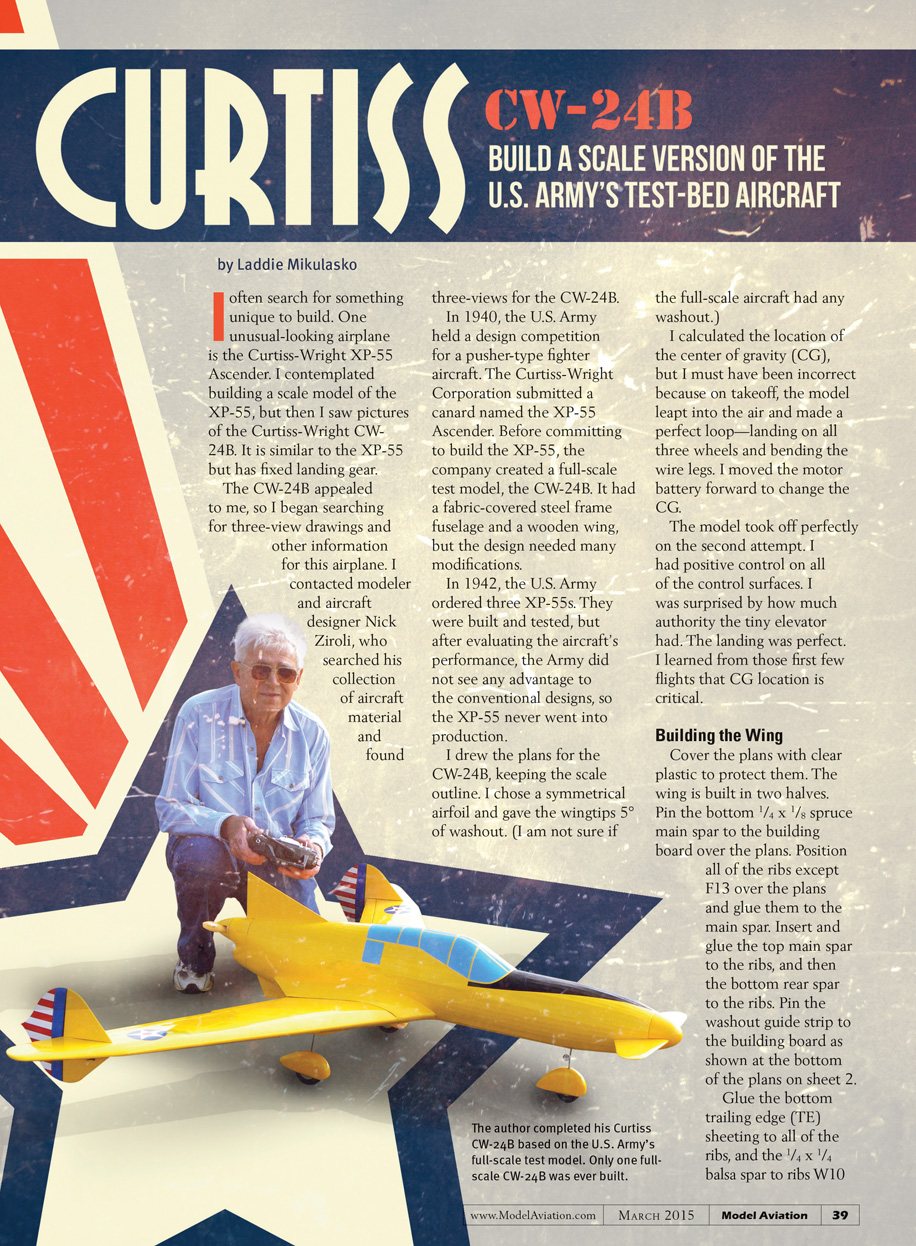
I often search for something unique to build. One unusual-looking airplane is the Curtiss-Wright XP-55 Ascender. I contemplated building a scale model of the XP-55, but then I saw pictures of the Curtiss-Wright CW-24B. It is similar to the XP-55 but has fixed landing gear. The CW-24B appealed to me, so I began searching for three-view drawings and other information for this airplane. I contacted modeler and aircraft designer Nick Ziroli, who searched his collection of aircraft material and found three-views for the CW-24B.
In 1940, the U.S. Army held a design competition for a pusher-type fighter aircraft. The Curtiss-Wright Corporation submitted a canard named the XP-55 Ascender. Before committing to build the XP-55, the company created a full-scale test model, the CW-24B. It had a fabric-covered steel-frame fuselage and a wooden wing, but the design needed many modifications. In 1942, the U.S. Army ordered three XP-55s. They were built and tested, but after evaluating the aircraft’s performance, the Army did not see any advantage over conventional designs, so the XP-55 never went into production.
I drew the plans for the CW-24B, keeping the scale outline. I chose a symmetrical airfoil and gave the wingtips 5° of washout (I am not sure if the full-scale aircraft had any washout). I calculated the location of the center of gravity (CG), but I must have been incorrect because on takeoff the model leapt into the air and made a perfect loop—landing on all three wheels and bending the wire legs. I moved the motor battery forward to change the CG.
The model took off perfectly on the second attempt. I had positive control on all control surfaces. I was surprised by how much authority the tiny elevator had. The landing was perfect. I learned from those first few flights that CG location is critical.
Building the Wing
Preparation
- Cover the plans with clear plastic to protect them.
- The wing is built in two halves.
- Gather spars, ribs, sheeting, capstrips, plywood brackets, hardwood blocks for the landing gear, hinge spar, side plates, and hardware for servos and control horns.
Assembly (one wing half at a time)
- Pin the bottom 1/4 x 1/8" spruce main spar to the building board over the plans.
- Position all of the ribs (except F13) over the plans and glue them to the main spar.
- Insert and glue the top main spar to the ribs, then glue the bottom rear spar to the ribs.
- Pin the washout guide strip to the building board as shown on the plans.
- Glue the bottom trailing-edge (TE) sheeting to all of the ribs.
- Glue the 1/4 x 1/4" balsa spar to ribs W10 through W13.
- Glue on the top TE sheeting.
- Glue the sub-leading-edge (LE) sheet to all of the ribs and sand its edge so it follows the ribs’ contour.
- Glue on the top LE sheeting.
- Apply adhesive to the balsa sheeting between ribs W1 and W4 and between the LE and TE sheeting.
- Glue the balsa sheeting between ribs W10 and W13 as well.
- Glue the capstrips to the ribs.
- Pull the extension wires for the aileron and the rudder servos.
- Flip the wing onto its back and sand the sub-LE on an angle so it follows the contour of the ribs.
- Apply adhesive to the LE sheeting, but be careful not to alter the washout.
- Glue the hardwood blocks together for the landing gear; the landing-gear blocks should have grooves to accept the landing-gear wire.
- Glue in the aileron supports and the rudder servo mountings.
- Glue the bottom sheeting over ribs W6, W7, and W10 through W13.
- Adhere the bottom capstrips.
- Cut out the aileron from the wing.
- Glue the hinge spar and the side plates to the wing.
- Attach the plywood plate inside the aileron to hold the control horn.
- Glue the LE and side plates to the aileron, then finish-sand the wing.
Build the other half of the wing in the same manner, then glue the two wing halves together. Smear adhesive onto the plywood brackets and slide them behind the main spars between ribs F2. Pin the dihedral shims under the...
Transcribed from original scans by AI. Minor OCR errors may remain.

