

Dave finds cool gadgets at the Toledo Show
There is always something new in our hobby—a trend or tool or some cool technological development—to keep us interested. The Toledo Weak Signals RC Expo is a great place to see the latest inventions, especially all the new safety-related products that could justify my trip to the show (and all the money I spent there).
As a semi-prominent member of the media, I wore my press pass, nametag, and Model Aviation hat. It was humbling that everyone kept asking, “Now exactly who are you again?” I’m far from an expert in most areas of this sport, so it’s fun to admire equipment from other niches. Some products are specialized, but other items, such as the Sky Limit altitude limiter from Winged Shadow Systems, are for general use.
This gadget cuts the throttle when a model reaches a preset altitude or flight time. Electric motors can be turned off, and gas or glow engines can be throttled to a reliable idle point. You can also choose to allow or inhibit restarts after reaching the limit.
It’s difficult to estimate your model’s altitude while in the air, and none of us want to bust the ceiling of our flying site, right? This product will show you how high your models are really flying. If your local flying site is serious about models staying under the height limit, then the Sky Limit might be just what it needs.
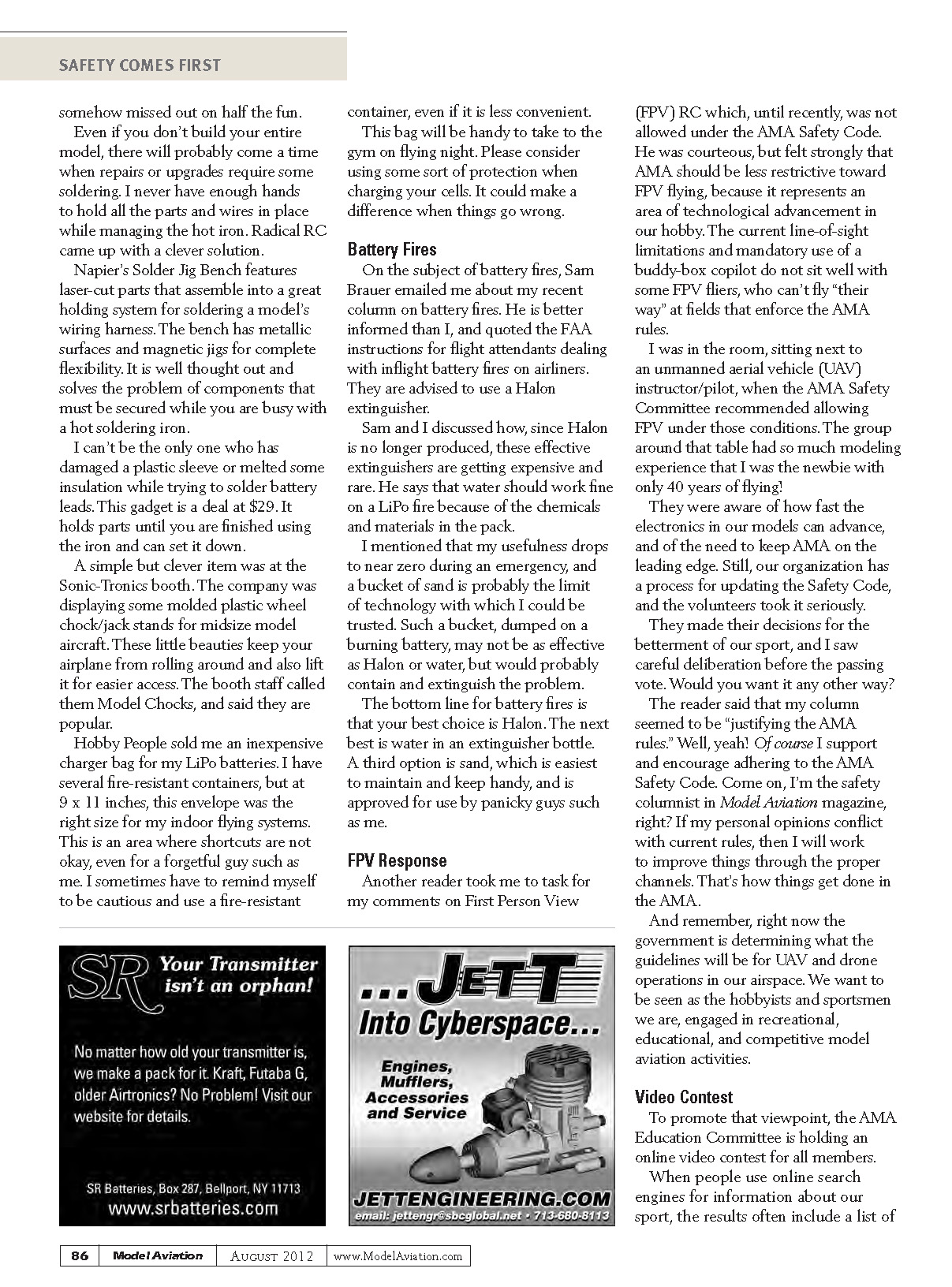
Mountain Models had a display of charming, nostalgia-styled models with high-quality, laser-cut parts. They were so beautifully designed that I couldn’t resist buying a couple. These small airplanes are meant for micro-RC electric, but mine will be upgraded to free flight (FF) with a CO2 motor.
I told the man in the booth that I’d plug his line of artistically designed airplanes if he could give me an angle to relate them to safety. He said, “Well, they’re so small and light that they don’t hurt as much if they hit you.” Yup, that’s what he said, and what’s worse is that it worked—here’s the plug! I think companies such as Mountain Models are great for our hobby because such appealing kits encourage pilots to build airplanes. Laser-cut kits go together faster and easier than old-fashioned cut-out-the-parts models.
A flier who builds his or her own aircraft knows it inside and out. This makes for a safer aircraft and operator. Part of me always feels bad for a non-builder pilot, as if he or she somehow missed out on half the fun.
Even if you don't build your entire model, there will probably come a time when repairs or upgrades require some soldering. I never have enough hands to hold all the parts and wires in place while managing the hot iron. Radical RC came up with a clever solution.
Napier's Solder Jig Bench features laser-cut parts that assemble into a great holding system for soldering a model's wiring harness. The bench has metallic surfaces and magnetic jigs for complete flexibility. It is well thought out and solves the problem of components that must be secured while you are busy with a hot soldering iron.
I can't be the only one who has damaged a plastic sleeve or melted some insulation while trying to solder battery leads. This gadget is a deal at $29. It holds parts until you are finished using the iron and can set it down.
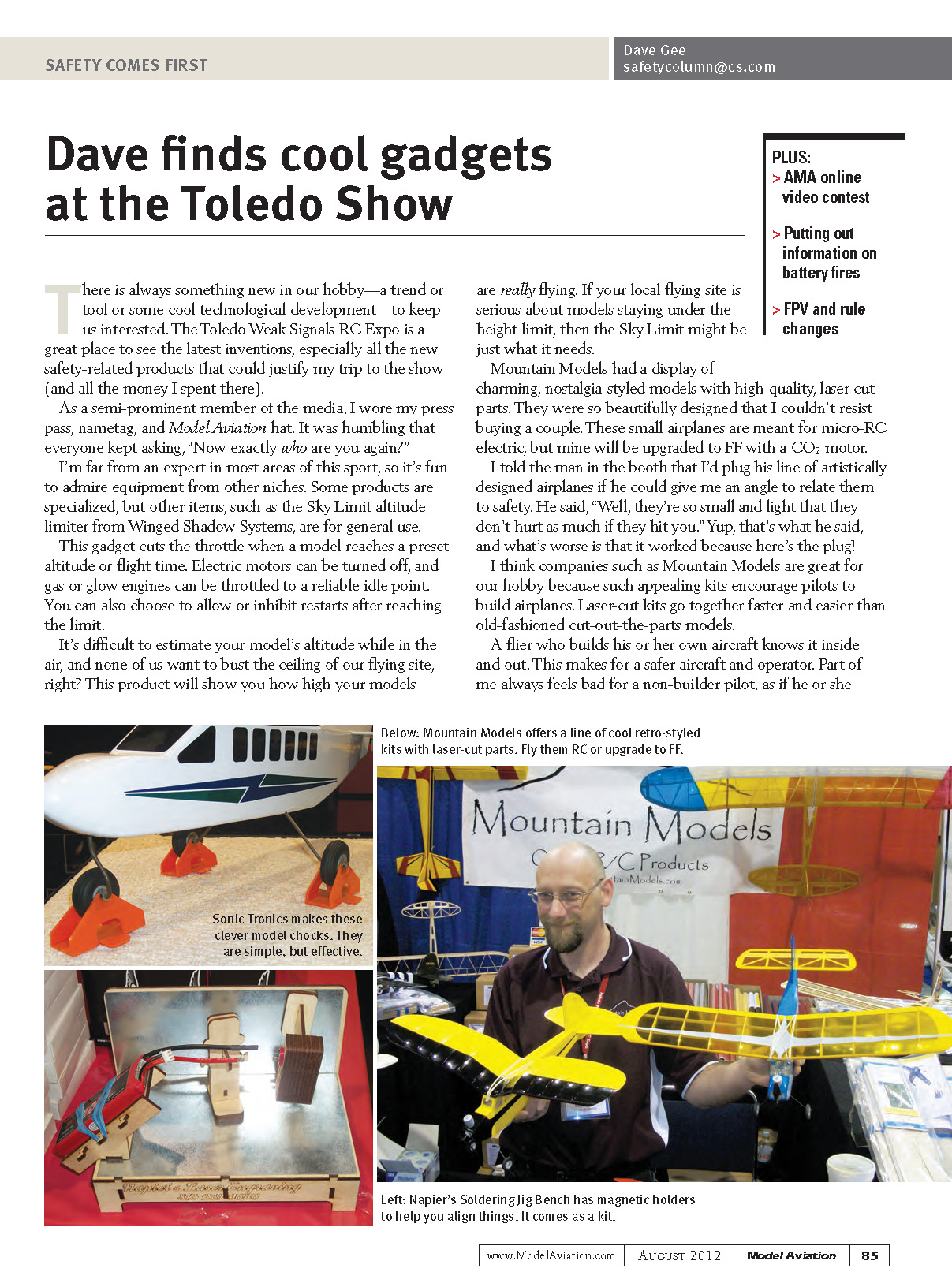
A simple but clever item was at the Sonic-Tronics booth. The company was displaying some molded plastic wheel chock/jack stands for midsize model aircraft. These little beauties keep your airplane from rolling around and also lift it for easier access. The booth staff called them Model Chocks, and said they are popular.
Hobby People sold me an inexpensive charger bag for my LiPo batteries. I have several fire-resistant containers, but at 9 x 11 inches, this envelope was the right size for my indoor flying systems. This is an area where shortcuts are not okay, even for a forgetful guy such as me. I sometimes have to remind myself to be cautious and use a fire-resistant container, even if it is less convenient.
This bag will be handy to take to the gym on flying night. Please consider using some sort of protection when charging your cells. It could make a difference when things go wrong.
Battery Fires
On the subject of battery fires, Sam Brauer emailed me about my recent column on battery fires. He is better informed than I, and quoted the FAA instructions for flight attendants dealing with inflight battery fires on airliners. They are advised to use a Halon extinguisher.
Sam and I discussed how, since Halon is no longer produced, these effective extinguishers are getting expensive and rare. He says that water should work fine on a LiPo fire because of the chemicals and materials in the pack.
I mentioned that my usefulness drops to near zero during an emergency, and a bucket of sand is probably the limit of technology with which I could be trusted. Such a bucket, dumped on a burning battery, may not be as effective as Halon or water, but would probably contain and extinguish the problem.
The bottom line for battery fires is that your best choice is Halon. The next best is water in an extinguisher bottle. A third option is sand, which is easiest to maintain and keep handy, and is approved for use by panicky guys such as me.
FPV Response
Another reader took me to task for my comments on First Person View (FPV) RC which, until recently, was not allowed under the AMA Safety Code. He was courteous, but felt strongly that AMA should be less restrictive toward FPV flying, because it represents an area of technological advancement in our hobby. The current line-of-sight limitations and mandatory use of a buddy-box copilot do not sit well with some FPV fliers, who can't fly "their way" at fields that enforce the AMA rules.
I was in the room, sitting next to an unmanned aerial vehicle (UAV) instructor/pilot, when the AMA Safety Committee recommended allowing FPV under those conditions. The group around that table had so much modeling experience that I was the newbie with only 40 years of flying!
They were aware of how fast the electronics in our models can advance, and of the need to keep AMA on the leading edge. Still, our organization has a process for updating the Safety Code, and the volunteers took it seriously.
They made their decisions for the betterment of our sport, and I saw careful deliberation before the passing vote. Would you want it any other way?
The reader said that my column seemed to be "justifying the AMA rules." Well, yeah! Of course I support and encourage adhering to the AMA Safety Code. Come on, I'm the safety columnist in Model Aviation magazine, right? If my personal opinions conflict with current rules, then I will work to improve things through the proper channels. That's how things get done in the AMA.
And remember, right now the government is determining what the guidelines will be for UAV and drone operations in our airspace. We want to be seen as the hobbyists and sportsmen we are, engaged in recreational, educational, and competitive model aviation activities.
Video Contest
To promote that viewpoint, the AMA Education Committee is holding an online video contest for all members. When people use online search engines for information about our sport, the results often include a list of YouTube videos, so this seemed like a good idea to encourage the right kind of image.
Grab your camera and make a video that meets one of the eligible categories, and then post it online for a chance to win not just fame, but also a complete beginner-type RC system!
Video Contest Categories:
- Best youth member 3-D Extreme
- Best beginner’s how-to videos for RC, park flyers, control line (CL), helicopters, and FF
- Best Indoor RC video
- Best Indoor FF video
- Best club promotional video
- Best AMA recruiting video, both club and individual
- Best aeromodeling safety video
Of course, I’m using the safety video category to justify plugging the contest here, but any good eye-catching piece of footage will help move our hobby forward by inspiring and instructing other pilots and would-be modelers.
I made a demonstration video, just to kick things off. You can find it on YouTube, under my Internet name: StukaDave. You don’t need a fancy video recorder. I used a basic camera that my son, Jeff, gave me. It has only one button on it, and he thought that with practice, even I could master the thing.
Make your video, upload it to YouTube, and then email the link to the AMA Education Department to enter. For the safety category, you might consider demonstrating a proper preflight inspection, or tell about a close-call incident and how to avoid it next time.
Please don’t make any reenactments that involve actual injuries! That’s what we’re trying to avoid.
The how-to category should be fun. We’ve all learned the hard way how not to do something, and it’s good to be able to save our friends some grief.
I can’t wait to see the 3-D Extreme entries. My skills just aren’t up to that kind of flying, except for brief, accidental moments just before a crash. It’s great to see someone with real skills show what his or her model can do.
The deadline is September 30, 2012. Good luck to all of you amateur filmmakers, and may the best modelers win!
SOURCES:
- Winged Shadow Systems — (630) 837-6553 — www.wingedshadow.com
- Mountain Models — (920) 840-6036 — www.mountainmodels.com
- Radical RC — (937) 256-7727 — www.radicalrc.com
- Sig Manufacturing Co. — (641) 623-5154 — www.sigmfg.com
- Sonic-Tronics Inc. — (888) 721-0128 — www.sonictronics.com
- Hobby People — (800) 854-8471 — www.hobbypeople.net
- AMA video contest on YouTube — [email protected] — www.youtube.com
Transcribed from original scans by AI. Minor OCR errors may remain.

