
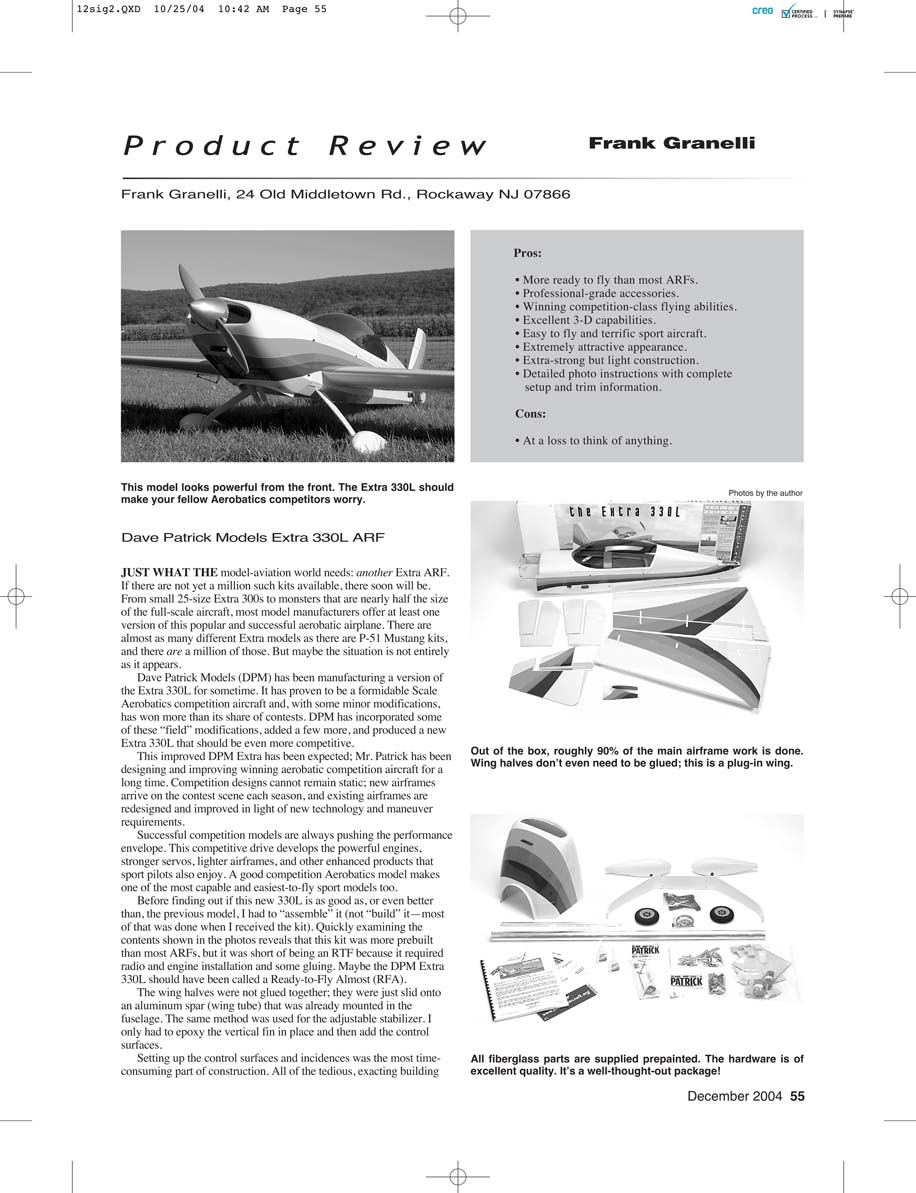
Dave Patrick Models Extra 330L ARF
Frank Granelli 24 Old Middletown Rd., Rockaway NJ 07866
Pros:
- More ready to fly than most ARFs.
- Professional-grade accessories.
- Winning competition-class flying abilities.
- Excellent 3-D capabilities.
- Easy to fly and terrific sport aircraft.
- Extremely attractive appearance.
- Extra-strong but light construction.
- Detailed photo instructions with complete setup and trim information.
Cons:
- At a loss to think of anything.
Just what the model-aviation world needs: another Extra ARF. If there are not yet a million such kits available, there soon will be. From small 25-size Extra 300s to monsters that are nearly half the size of the full-scale aircraft, most model manufacturers offer at least one version of this popular and successful aerobatic airplane. There are almost as many different Extra models as there are P-51 Mustang kits, and there are a million of those. But maybe the situation is not entirely as it appears.
Dave Patrick Models (DPM) has been manufacturing a version of the Extra 330L for some time. It has proven to be a formidable Scale Aerobatics competition aircraft and, with some minor modifications, has won more than its share of contests. DPM has incorporated some of these "field" modifications, added a few more, and produced a new Extra 330L that should be even more competitive.
This improved DPM Extra has been expected; Mr. Patrick has been designing and improving winning aerobatic competition aircraft for a long time. Competition designs cannot remain static; new airframes arrive on the contest scene each season, and existing airframes are redesigned and improved in light of new technology and maneuver requirements. Successful competition models are always pushing the performance envelope. This competitive drive develops the powerful engines, stronger servos, lighter airframes, and other enhanced products that sport pilots also enjoy. A good competition Aerobatics model makes one of the most capable and easiest-to-fly sport models too.
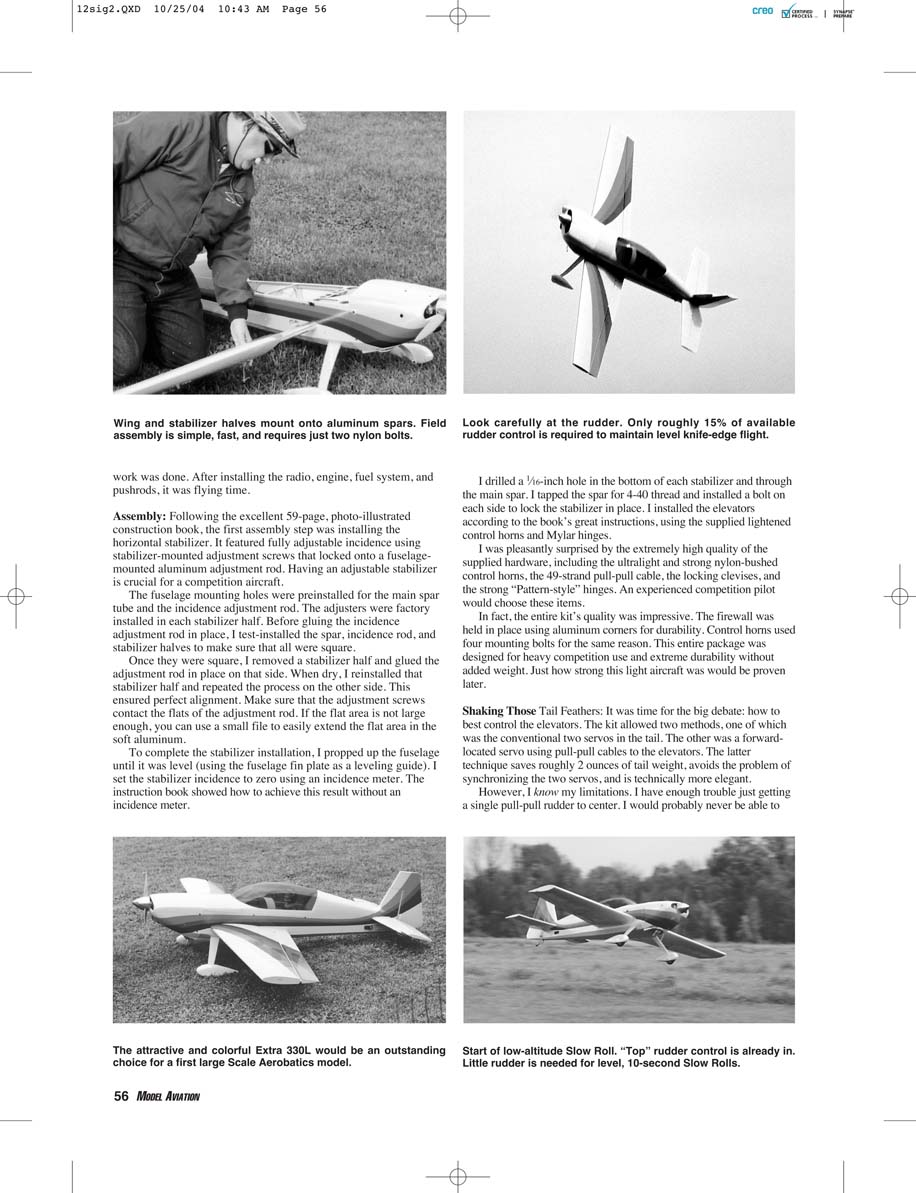
Before finding out if this new 330L is as good as, or even better than, the previous model, I had to "assemble" it (not "build" it—most of that was done when I received the kit). Quickly examining the contents reveals that this kit was more prebuilt than most ARFs, but it was short of being an RTF because it required radio and engine installation and some gluing. Maybe the DPM Extra 330L should have been called a Ready-to-Fly Almost (RFA).
The wing halves were not glued together; they were just slid onto an aluminum spar (wing tube) that was already mounted in the fuselage. The same method was used for the adjustable stabilizer. I only had to epoxy the vertical fin in place and then add the control surfaces. Setting up the control surfaces and incidences was the most time-consuming part of construction—all of the tedious, exacting building work was done.
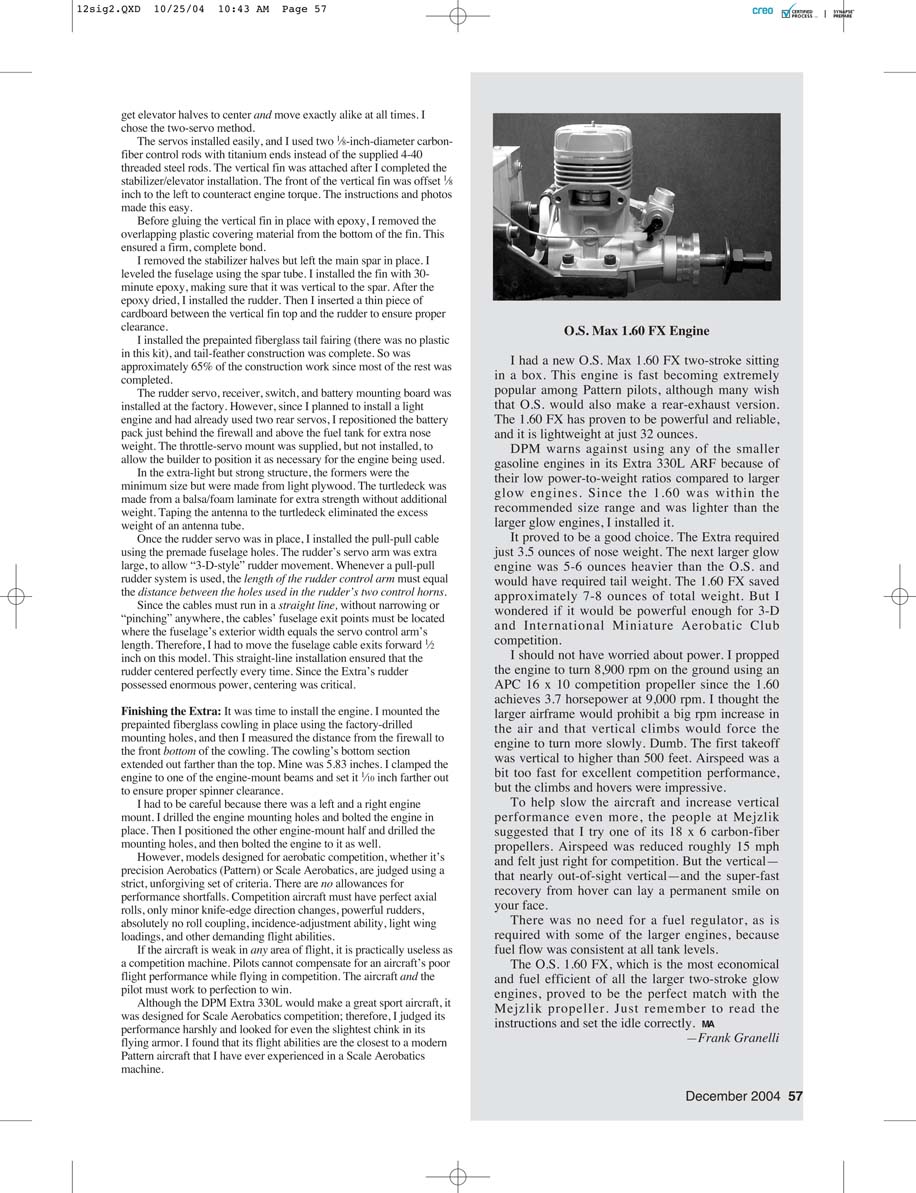
I drilled a 1/16-inch hole in the bottom of each stabilizer and through the main spar. I tapped the spar for 4-40 thread and installed a bolt on each side to lock the stabilizer in place. I installed the elevators according to the book's great instructions, using the supplied lightened control horns and Mylar hinges. I was pleasantly surprised by the extremely high quality of the supplied hardware, including the ultralight and strong nylon-bushed control horns, the 49-strand pull-pull cable, the locking clevises, and the strong "Pattern-style" hinges. An experienced competition pilot would choose these items.
In fact, the entire kit's quality was impressive. The firewall was held in place using aluminum corners for durability. Control horns used four mounting bolts for the same reason. This entire package was designed for heavy competition use and extreme durability without added weight. Just how strong this light aircraft was would be proven later.
Shaking Those Tail Feathers
It was time for the big debate: how to best control the elevators. The kit allowed two methods, one of which was the conventional two servos in the tail. The other was a forward-located servo using pull-pull cables to the elevators. The latter technique saves roughly 2 ounces of tail weight, avoids the problem of synchronizing the two servos, and is technically more elegant.
However, I know my limitations. I have enough trouble just getting a single pull-pull rudder to center. I would probably never be able to get elevator halves to center and move exactly alike at all times. I chose the two-servo method.
The servos installed easily, and I used two 1/8-inch-diameter carbon-fiber control rods with titanium ends instead of the supplied 4-40 threaded steel rods. The vertical fin was attached after I completed the stabilizer/elevator installation. The front of the vertical fin was offset 1/8 inch to the left to counteract engine torque. The instructions and photos made this easy.
Before gluing the vertical fin in place with epoxy, I removed the overlapping plastic covering material from the bottom of the fin. This ensured a firm, complete bond. I removed the stabilizer halves but left the main spar in place. I leveled the fuselage using the spar tube and installed the fin with 30-minute epoxy, making sure that it was vertical to the spar. After the epoxy dried, I installed the rudder and inserted a thin piece of cardboard between the vertical fin top and the rudder to ensure proper clearance.
I installed the prepainted fiberglass tail fairing (there was no plastic in this kit), and tail-feather construction was complete. This represented approximately 65% of the construction work since most of the rest was already completed at the factory.
The rudder servo, receiver, switch, and battery mounting board were installed at the factory. However, since I planned to install a light engine and had already used two rear servos, I repositioned the battery pack just behind the firewall and above the fuel tank for extra nose weight. The throttle-servo mount was supplied, but not installed, to allow the builder to position it as necessary for the engine being used.
In the extra-light but strong structure, the formers were the minimum size but were made from light plywood. The turtledeck was made from a balsa/foam laminate for extra strength without additional weight. Taping the antenna to the turtledeck eliminated the excess weight of an antenna tube.
Once the rudder servo was in place, I installed the pull-pull cable using the premade fuselage holes. The rudder's servo arm was extra large to allow "3-D-style" rudder movement. Whenever a pull-pull rudder system is used, the length of the rudder control arm must equal the distance between the holes used in the rudder's two control horns.
Since the cables must run in a straight line, without narrowing or "pinching" anywhere, the cables' fuselage exit points must be located where the fuselage's exterior width equals the servo control arm's length. Therefore, I had to move the fuselage cable exits forward 1/2 inch on this model. This straight-line installation ensured that the rudder centered perfectly every time. Since the Extra's rudder possessed enormous power, centering was critical.
Finishing the Extra
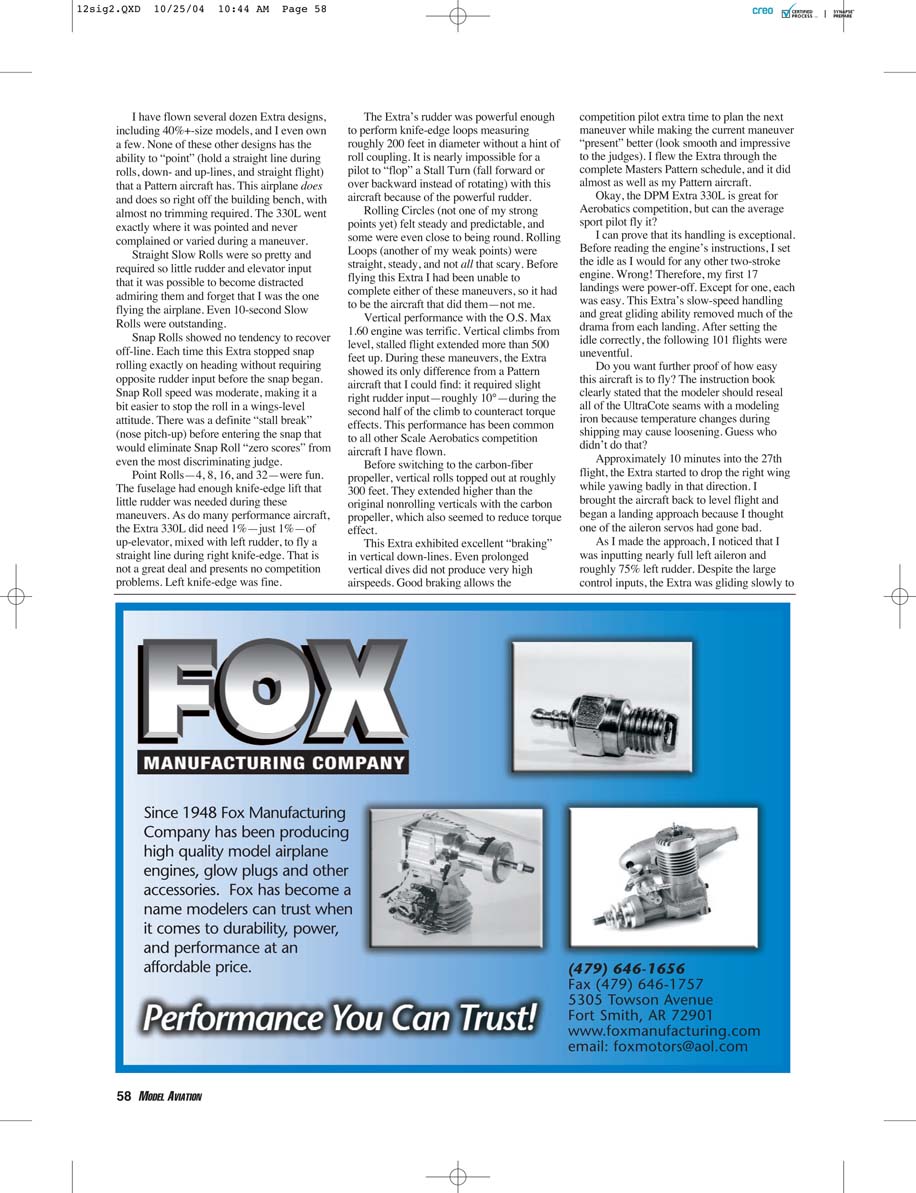
It was time to install the engine. I mounted the prepainted fiberglass cowling in place using the factory-drilled mounting holes, and then I measured the distance from the firewall to the front bottom of the cowling. The cowling's bottom section extended out farther than the top—mine measured 5.83 inches. I clamped the engine to one of the engine-mount beams and set it 3/16 inch farther out to ensure propeller spinner clearance.
I had to be careful because there was a left and a right engine mount. I drilled the engine-mounting holes and bolted the engine in place. Then I positioned the other engine-mount half, drilled the mounting holes, and bolted the engine to it as well.
However, models designed for aerobatic competition, whether it's Precision Aerobatics (Pattern) or Scale Aerobatics, are judged using a strict, unforgiving set of criteria. There are no allowances for performance shortfalls. Competition aircraft must have perfect axial rolls, only minor knife-edge direction changes, powerful rudders, absolute roll-to-roll coupling, incidence-adjustment ability, light wing loadings, and other demanding flight abilities.
If the aircraft is weak in any area of flight, it is practically useless as a competition machine. Pilots cannot compensate for an aircraft's poor flight performance while flying in competition. The aircraft and the pilot must work to perfection in unison.
Flight Performance
Although the DPM Extra 330L would make a great sport aircraft, it was designed for Scale Aerobatics competition; therefore, I judged its performance harshly and looked for even the slightest chink in its flying armor. I found that its flight abilities are the closest to a modern Pattern aircraft that I have ever experienced in a Scale Aerobatics machine.
I have flown several dozen Extra designs, including 40%-plus-size models, and I even own a few. None of these other designs has the ability to "point" (hold a straight line during rolls, down- and up-lines, and straight flight) that a Pattern aircraft has. This airplane does, and it does so right off the building bench, with almost no trimming required. The 330L went exactly where it was pointed and never complained or varied during a maneuver.
Straight slow rolls were so pretty and required so little rudder and elevator input that it was possible to become distracted admiring them and forget that I was the one flying the airplane. Even 10-second slow rolls were outstanding.
Snap rolls showed no tendency to recover off-line. Each time this Extra stopped snap rolling exactly on heading without requiring opposite rudder input before the snap began. Snap roll speed was moderate, making it a bit easier to stop the roll in a wings-level attitude. There was a definite "stall break" (nose pitch-up) before entering the snap that would eliminate snap roll "zero scores" from even the most discriminating judge.
Point rolls—4, 8, 16, and 32—were fun. The fuselage had enough knife-edge lift that little rudder was needed during these maneuvers. As do many performance aircraft, the Extra 330L did need 1°—just 1°—of up-elevator, mixed with left rudder, to fly a straight line during right knife-edge. That is not a great deal and presents no competition problems. Left knife-edge was fine.
The Extra's rudder was powerful enough to perform knife-edge loops measuring roughly 200 feet in diameter without a hint of roll coupling. It is nearly impossible for a pilot to "flop" a stall turn (fall forward or over backward instead of rotating) with this aircraft because of the powerful rudder.
Rolling circles felt steady and predictable, and some were even close to being round. Rolling loops were straight, steady, and not at all that scary. Before flying this Extra I had been unable to complete either of these maneuvers, so it had to be the aircraft that did them—not me.
Vertical performance with the O.S. Max 1.60 engine was terrific. Vertical climbs from level, stalled flight extended more than 500 feet up. During these maneuvers, the Extra showed its only difference from a Pattern aircraft that I could find: it required slight right rudder input—roughly 10°—during the second half of the climb to counteract torque effects. This performance has been common to all other Scale Aerobatics competition aircraft I have flown.
Before switching to the carbon-fiber propeller, vertical rolls topped out at roughly 300 feet. They extended higher with the carbon propeller, which also seemed to reduce torque effect.
This Extra exhibited excellent "braking" in vertical down-lines. Even prolonged vertical dives did not produce very high airspeeds. Good braking allows the competition pilot extra time to plan the next maneuver while making the current maneuver "present" better (look smooth and impressive to the judges). I flew the Extra through a complete Masters Pattern schedule, and it did almost as well as my Pattern aircraft.
Ease of Flying and Durability
Okay, the DPM Extra 330L is great for Aerobatics competition, but can the average sport pilot fly it? I can prove that its handling is exceptional.
Before reading the engine's instructions, I set the idle as I would for any other two-stroke engine. Wrong! Therefore, my first 17 landings were powerful. Except for one, each was easy. This Extra's slow-speed handling and great gliding ability removed much of the drama from each landing. After setting the idle correctly, the following 101 flights were uneventful.
Do you want further proof of how easy this aircraft is to fly? The instruction book clearly stated that the modeler should reseal all of the UltraCote seams with a modeling iron because temperature changes during shipping may cause loosening. Guess who didn't do that?
Approximately 10 minutes into the 27th flight, the Extra started to drop the right wing while yawing badly in that direction. I brought the aircraft back to level flight and began a landing approach because I thought one of the aileron servos had gone bad. As I made the approach, I noticed I was inputting nearly full left aileron and roughly 75% left rudder. Despite the large control inputs, the Extra was gliding slowly to the runway as if it were on rails. As it landed gently, it was easy to see that the entire top covering of the right wing had peeled away and was flapping behind the wing like a sail.
Despite the loose covering's drag and the airfoil loss on the right side, the Extra remained fully controllable and easy to land. UltraCote is strong; I reattached the covering, and it still looks new after 81 more flights.
Any competent sport flier can handle this aircraft and become a better pilot for the experience. Good competition aircraft are the easiest to fly well. The best competition airplanes make the pilot appear more skillful than he or she might be. This Extra is one of the latter.
What about that one of 17 power-off landings that did not go well? It is proof of this aircraft's strength. During an inverted photo pass just 10 feet over high corn, the misadjusted engine quit. There was no time, or altitude, to do anything but roll the aircraft level and stall it into the corn.
My world went dim for a moment as the bangs and crunches of the crash mixed with the sight of falling cornstalks. A 15-pound (with fuel), 27% Extra does not go quietly into a cornfield. I prayed that the photos already taken were good because this aircraft looked like it was history.
Dave must have had dumb, unlucky pilots such as myself in mind when he designed this thing. The only damage—and I have many witnesses—was one dent, not a hole, in the underside of the left wing where it landed on top of a cornstalk. After 10 seconds with a heat gun, all evidence of my idiocy was removed.
Competition aircraft are not supposed to crash well, but this one did. I do not suggest that you try this, but it is nice to know that the extra strength is there if you ever need it. After this experience I realized just how strong this aircraft is, and I started flinging it about the sky, doing all sorts of 3-D work.
Sudden cruise-speed stalls—called the Wall—were done without tip-stalling. Inverted cross-controlled spins—the Blender—remained level with a slow descent rate. Torque rolls and waterfalls were better than I can usually fly them. The aircraft made my flying look better than it was. More experienced 3-D pilots would have a ball.
My most daring 3-D maneuver was the Harrier landing. I had never tried this fully stalled, high-angle-of-attack landing before. My first attempt actually worked, although jamming the main landing gear extremely hard onto the ground this way is not one of my favorite things.
DPM provided many different levels of control movements in the excellent instruction book, from gentle sport flight to wild 3-D. How to set dual and triple rates was clearly explained. A complete competition trimming guide was included so that every pilot could get the best from the Extra.
Since the 330L had a fully adjustable stabilizer, it was possible to adjust the stabilizer's incidence to remove all elevator trim requirements, yet maintain level flight. Required for competition flight, this ability would also make sport flying much easier.
Now, after 108 flights, I still think DPM's Extra 330L is the most excellent Extra I have flown.
MA
Specifications:
- Wingspan: 76 inches
- Length: 74 inches
- Wing area: 1,220 square inches
- Weight: 14.2 pounds
- Engine used: O.S. Max 1.60 FX
- Wing loading: 26.8 ounces/square foot
- Radio used: JR 10SX transmitter / JR PR955 S-PCM receiver
Servos:
- JR 4131 elevator/ailerons
- JR DS8611 rudder
- JR 501 throttle
Battery:
- 2000 mA, six-volt NiMH
Manufacturers:
- Advanced Precision Composite Propeller (APC Prop)
Landing Products 1222 Harter Woodland, CA 95776 (530) 661-0399 www.apcprop.com
- Bisson Custom Mufflers
9 Moffat Rd. Parry Sound, Ontario P2A 2W7 (705) 389-1156 www.bissonmufflers.com
- Dave Patrick Models
1811 E. 400 N. Rd. Milford, IL 60953 (815) 457-3128 www.davepatrickmodels.com
- Mejzlik Modellbau
Borova 14 644 00 Brno Czech Republic (Europe) 011 420 5 42318888 www.mejzlikmodellbau.com
- Sonic-Tronics, Inc.
7865 Mill Rd. Elkins Park, PA 19027 (215) 635-6520 www.sonictronics.com
- Tru-Turn Spinner: Romeo Mfg., Inc.
100 W. 1st St. Deer Park, TX 77536 (281) 479-9600 www.tru-turn.com
Transcribed from original scans by AI. Minor OCR errors may remain.

