
DAYTON JR GOLD CUP RACE
Vern Smith
The Racing Environment
Only an experienced pylon racer, willing to sacrifice the time and money necessary to be competitive on a national level, would relish this environment.
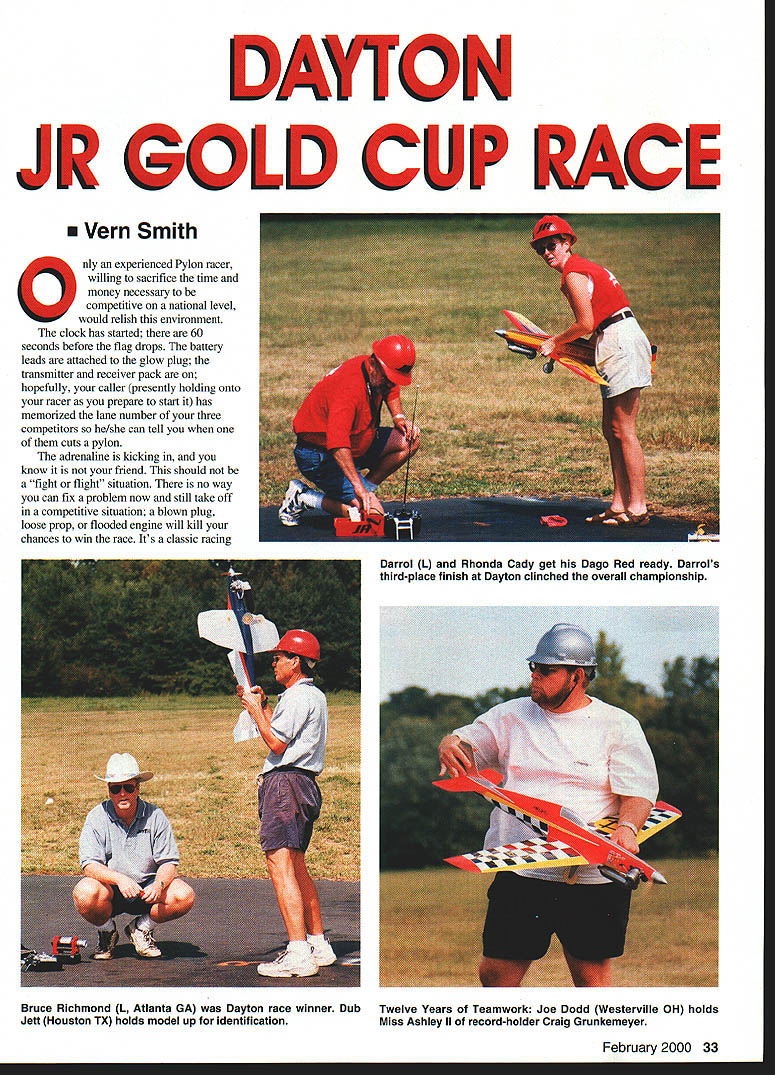
The clock has started; there are 60 seconds before the flag drops. The battery leads are attached to the glow plug; the transmitter and receiver pack are on; hopefully your caller (presently holding onto your racer as you prepare to start) has memorized the lane number of your three competitors so he/she can tell you when one of them cuts a pylon.
The adrenaline is kicking in, and you know it is not your friend. This should not be a "fight or flight" situation. There is no way you can fix a problem now and still take off in a competitive situation; a blown plug, loose prop, or flooded engine will kill your chances to win the race. It's a classic racing situation: lots of downsides but only one upside.
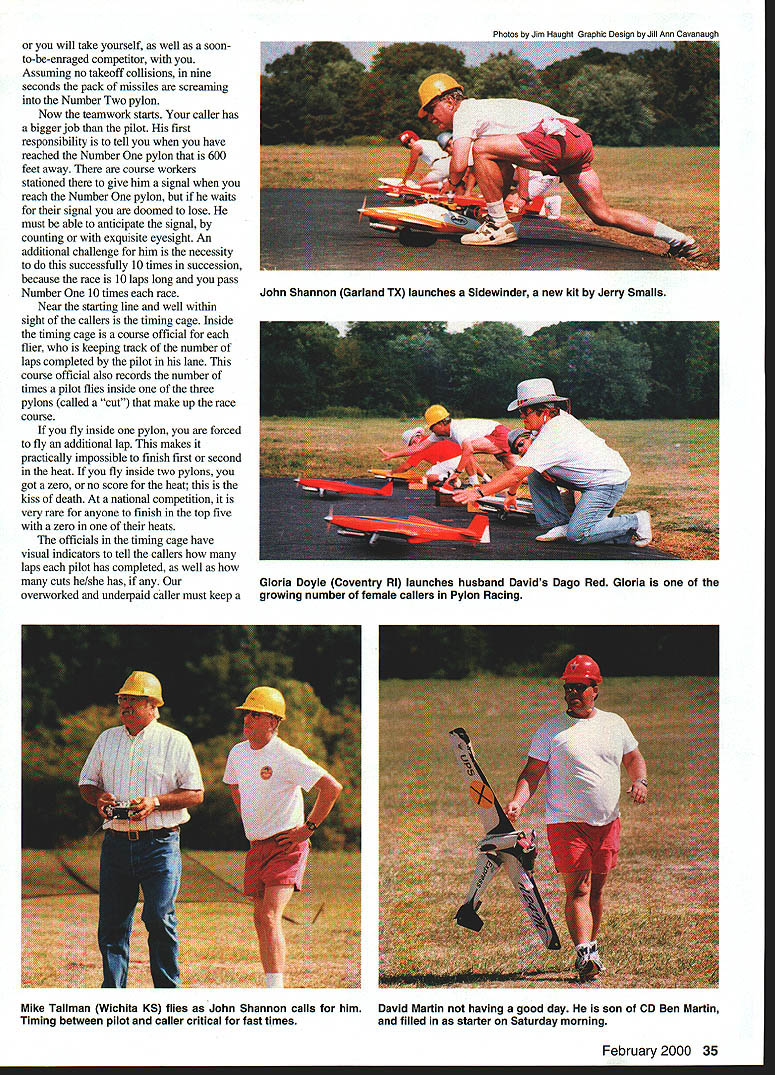
You put the electric starter against the spinner and pull the trigger. Four horsepower starts to gurgle. You start it rich so it won't self-destruct in the first 20 seconds. Your thumb and index finger are starting to lean on the needle valve. If you set the needle too rich, you go slow and lose. If you set the needle too lean, you go slow, lose, and trash a $120 piston and sleeve. The margin of error is about 10° of 360°.
There is no more time to mess with the needle valve with 20 seconds left on the clock. You throw your battery, tach, and starter in the field box and run to your favorite flying position. Hopefully, nobody has gotten there before you. The environment is chaotic. There is an acrid smell in the air: nitromethane, synthetic oil, and methanol have a very distinctive aroma.
Your hands are slippery from the oil in the fuel, and you are doing your best to hold onto your transmitter while seeing the starter out of the corner of your eye. Once again, adrenaline is not doing you any favors. You can never allow your complete attention to be diverted from your four-pound racer that is about to accelerate from zero to 170 mph in less than 10 seconds.
The flag drops, four racers are occupying airspace less than 40 feet wide, there is no room for error; you have to stay in your lane or you will take yourself, as well as a soon-to-be-enraged competitor, with you.
Assuming no takeoff collisions, in nine seconds the pack of missiles are screaming into the Number Two pylon.
Teamwork and Calling
Now the teamwork starts. Your caller has a bigger job than the pilot. His first responsibility is to tell you when you have reached the Number One pylon that is 600 feet away. There are course workers stationed there to give him a signal when you reach the Number One pylon, but if he waits for their signal you are doomed to lose. He must be able to anticipate the signal, by counting or with exquisite eyesight. An additional challenge for him is the necessity to do this successfully 10 times in succession, because the race is 10 laps long and you pass Number One 10 times each race.
Near the starting line and well within sight of the callers is the timing cage. Inside the timing cage is a course official for each flier, who is keeping track of the number of laps completed by the pilot in his lane. This course official also records the number of times a pilot flies inside one of the three pylons (called a "cut") that make up the race course.
If you fly inside one pylon, you are forced to fly an additional lap. This makes it practically impossible to finish first or second in the heat. If you fly inside two pylons, you get a zero, or no score for the heat; this is the kiss of death. At a national competition, it is very rare for anyone to finish in the top five with a zero in one of their heats.
The officials in the timing cage have visual indicators to tell the callers how many laps each pilot has completed, as well as how many cuts he/she has, if any. Our overworked and underpaid caller must keep a constant mental tab on your laps, cuts, remaining time, and the positions of the other three racers. He must also see the Number Two pylon and the exit from the timing cage to know when to tell you to bail out. If a rival takes a wide turn, you are expected to take your turn inside his lane to take advantage of his error. Of course, this often results in the other guy retaliating on the next lap.
Heats and Competition Structure
Races are usually run in heats of three or four aircraft. Each pilot flies three heats of 10 laps each. In club races, pilots are usually matched with others of like ability by the CD (contest director). At national events pilots are sorted by past scores and qualifying times. The top pilots fly each other in the later rounds and the winner is determined by who has the best finishes in each round.
There is a growing corps of very fast, very skilled pilots who are also superbly equipped mechanically. Their equipment is often a work of art, with attention paid to every detail from engine porting and piston fit to propeller selection and spinner aerodynamics. On race day these machines run almost flawlessly, and the pilots expect nothing less from themselves or their crews.
As a spectator sport, pylon racing is an adrenaline-filled spectacle that can be appreciated even by those who don't know the difference between a glow plug and a carburetor. The speed, the noise, the close-quarters flying, and the inevitable drama make it an exciting event to watch. For those who participate, it is a test of nerves, skill, and mechanical aptitude — a combination that keeps pilots coming back for more.
Dayton JR Gold Cup — Record and Equipment Notes
At the Dayton (OH) JR Gold Cup race, held September 1–12, Craig Crutchemeyer lowered the Quarter 40 record to 1:00.02. Craig had the following comments about the equipment he used to set the record, and some elements in his approach to pylon racing.
Craig and Joe Dodd teamed up in 1987—12 years' experience working together. If you look at the people who do well in pylon, there are almost always two or three people who consistently work together. The most important aspect seems to be having the same caller, race after race.
Craig and Joe do some serious practice in the spring, and also use this time to evaluate the propellers Craig has made during the previous winter. They set up a timing device (essentially a 100-foot speed trap) to get the numbers on their propellers. They take speed readings at the beginning and the end of the straights. Craig feels that the timing device is much more consistent than a hand-held radar gun.
The props are an interesting story in themselves. To the best of my knowledge, Craig is the only racer who makes his props from blocks of virgin wood. A friend made him a stylus tracing router to do the job. (Craig asked me to strongly emphasize that he is not in the propeller business.)
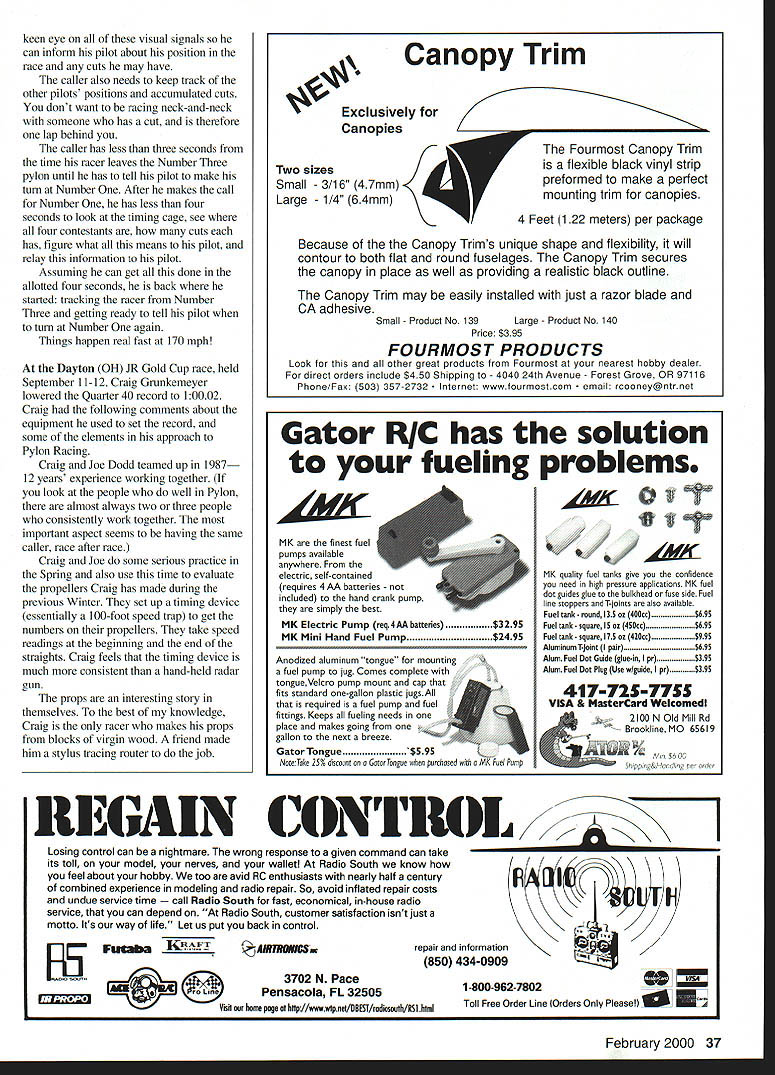
The prop Craig used to set the record at Dayton was 7½" long with progressively increasing pitch from the hub to the tip. At station seven the pitch was 7½° and at station eight it was 8½°. This is a lot of prop. Craig feels that the Rusty VanBuren Miss Ashley II he used to set the record likes to get up a head of steam and keep it. This means wider-radius turns and more pitch than one might ordinarily use.
Craig used Nelson engines and likes to set them up at the high end of the timing window as well as the compression window. The record engine was at 198 and 13. The conditions at Dayton were very good for engine performance and Craig’s Nelson was turning the big prop in the low-23,000-rpm area.
All pylon racers are quite center-of-gravity (CG) critical. Most of the guys who use the Miss Ashley II like the CG at .394, including the guy who sells it. Craig puts this farther back (3/8"), which most feel is the fastest, if you are good enough on the sticks to fly such a touchy setup.
Craig went fast all weekend, backing up his record time with a 1:01, and turning times below 1:04 in four of his heats. He admits to going down two points in one heat because he felt a sub-one-minute time coming. On the last lap he just missed the second pylon and turned a 1:05 for 11 laps. Had he made the percentage play and taken the win, he would have been tied for first place at the end of the competition. (By nature, racers would never take the percentage play if they felt there was a good chance to be the first to break the one-minute barrier.)
Results and Top Finishers
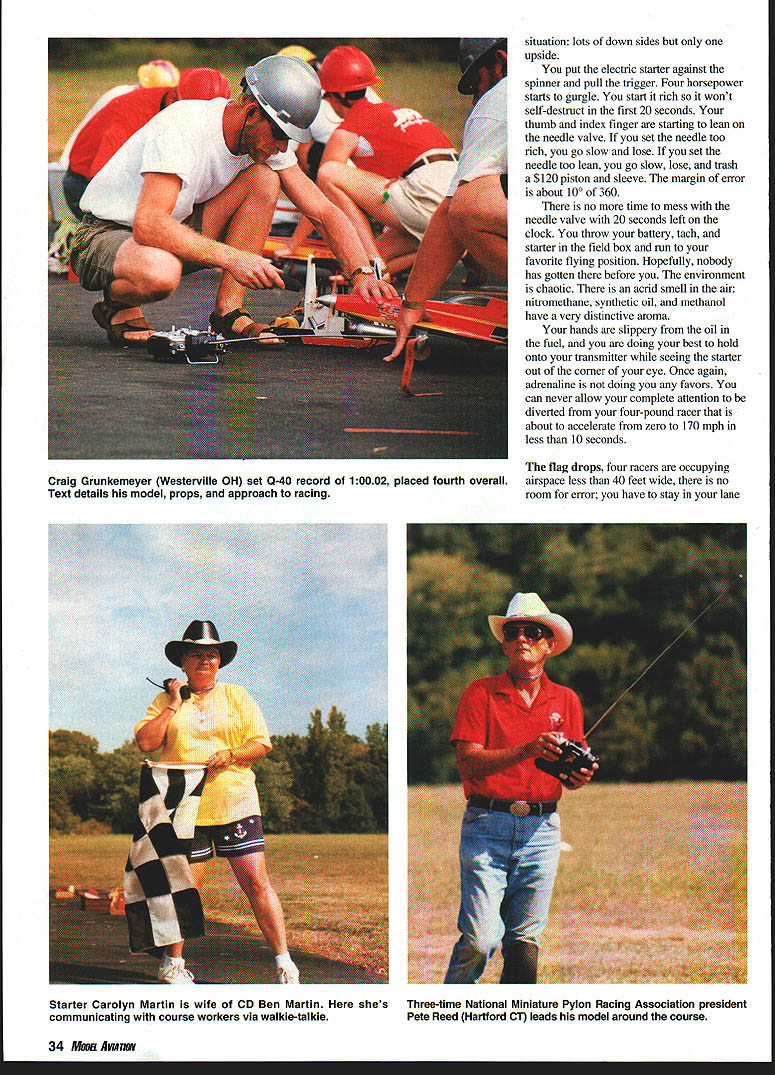
- Winner: Bruce Richmond, a pylon veteran of more than 20 years. He turned consistent 1:03s and 1:04s and stayed out of cut trouble.
- Second: Dub Jett, another seasoned competitor, finished for similar reasons as Bruce.
- Third: Darrol Cady, who locked up the JR Gold Cup series championship with his finish at Dayton. Darrol’s wife Rhonda is widely regarded as the best caller in the game and has made Darrol very tough to beat.
- Fourth: Craig Grunkemeyer, whose record time indicates how fast he was. It’s real tough to get into the top five with a zero (he cut out of a race), but Craig managed to do it.
- Fifth: Mike Helsel, who has probably been flying pylon longer than anyone currently competing. Mike’s always fast and rarely makes a big mistake.
Sponsorship and Support
The Gold Cup races are possible because of the financial support of JR, the hundreds of gallons of fuel supplied by PowerMaster, and the thousands of dollars in giveaway merchandise for the course workers. JR foots the bill for the trophies, the season point fund, advertising and promotional materials, and guarantees the organizations putting on the races at least $2,000 in cash for their efforts. PowerMaster supplies all fuel free of charge.
Worker sponsors for the Gold Cup Series:
- ACE Hobby Distributors
- Anchor Adhesives
- Carl Goldberg Models
- Du-Bro Products
- FMH Direct
- Futaba Corp.
- Great Planes
- K&B
- Performance Specialties
- Sig Manufacturing
- Sullivan Products
- Tower Hobbies
- ZAP
Interested in Racing?
Interested in racing Quarter Midgets? There’s help available through the NMPRA, America’s oldest special interest group dedicated solely to racing. Call Barry Leavengood at (818) 994-4364 and he’ll fill you in on people in your area who are active in racing.
MA
Vern Smith 180 Leaders Heights Rd. York, PA 17402
Transcribed from original scans by AI. Minor OCR errors may remain.

