
The Designs of Red Reinhardt
This design pioneer's models were years ahead of their time
Control Line (CL) Precision Aerobatics (Stunt) is a tradition-based event; its participants have a high regard for its history and its heroes, and Harold “Red” Reinhardt occupies one of the higher spots in that heritage.
In addition to being a top competitive flier in his time, Red designed a number of aircraft that live on even today; they are built for and flown in vintage competition. His designs are interesting and worthy of review and discussion because of their construction and overall approach.
This is a nostalgia trip for me. I was lucky enough to have seen Red in action at the flying fields, and that’s something I won’t forget.
As a youngster, I was a member of the Union Model Airplane Club in New Jersey during the early 1950s, and I spent a lot of time at its famed flying field behind the Elastic Spoffut Nut factory in Union. I saw Red there and at other area flying fields, and he made an impression.
Red had almost everything. His aircraft designs were the best; they performed well and looked great. He flew better than almost anyone, and he won or placed high at each contest he entered. Red had a car to drive to the fields and he had a girlfriend. I was in awe.
Red’s flying buddy Larry Scarcinzi was a Stunt hero in his own right. And Red was a close friend of the Hunt family; I’m sure he gave much inspiration to the then-young Bob Hunt, who went on to Nationals- and World Championships-winning fame.
During Red’s all-too-brief time in the hobby, he published six aircraft designs—three in Air Trails and three in Model Airplane News. Plans for all the models, or at least copies of the original construction articles, are available through the Precision Aerobatics Model Pilots Association (PAMPA) and other sources.
Early work and design approach
Red’s designs were smooth and clean, with graceful curves on the wingtips and tail surfaces. None of his built-up wing structures had leading-edge sheeting, but most had front-section partial ribs to improve the airfoil section. His structures were strong and light. His .049 designs used a lot of engine thrustline offset to ensure tight control lines with the minimum power available back then.
Many of Red’s models were done in the pre-flap era and none of them used coupled flaps. They all had large elevator areas and were built light to ensure good turning performance.
Red tried several different wing-construction techniques in his various models, all aimed at minimum weight with sufficient strength for the job.
Today's 1/2A engines provide even more power, allowing such aircraft to be built even larger and flown on longer lines; however, they still deliver the flying fun of Red's aircraft, which led the way.
Notable designs
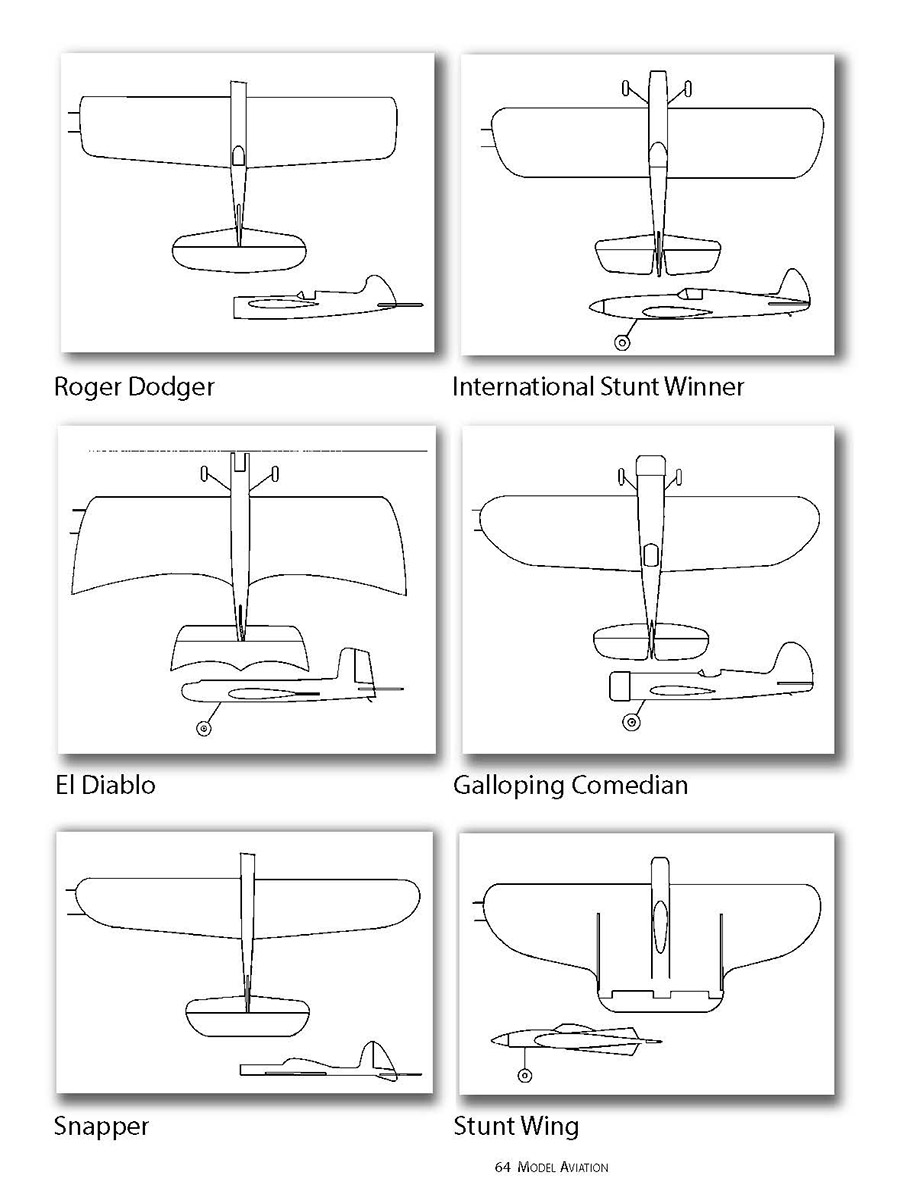
Roger Dodger (March 1950, Air Trails)
Red’s first published design was the Roger Dodger, in the March 1950 Air Trails. An .049-powered Stunt model for fun-flying rather than for serious competition, it combined lightweight construction with the right aerodynamic layout for top performance.
½A engines were new at the time, and serious fliers considered them a novelty. With this design, Red showed that the little engines were capable of full Stunt pattern performance—in the right aircraft.
The Roger Dodger had a 23-inch wingspan; the wing's leading edge and two spars were 1/16 square balsa. Rather than being enclosed in the built-up wing, the bellcrank and leadouts were positioned below the wing.
Power was an OK Cub .049, which put out very little power by today's standards. The airplane was flown on 15-foot thread lines.
Although the Roger Dodger is considered small by today's fliers, it would likely be a joy to fly if scaled up and beefed up a bit, and used with today's .049–.061 power plants.
International Stunt Winner (January 1951, Air Trails)
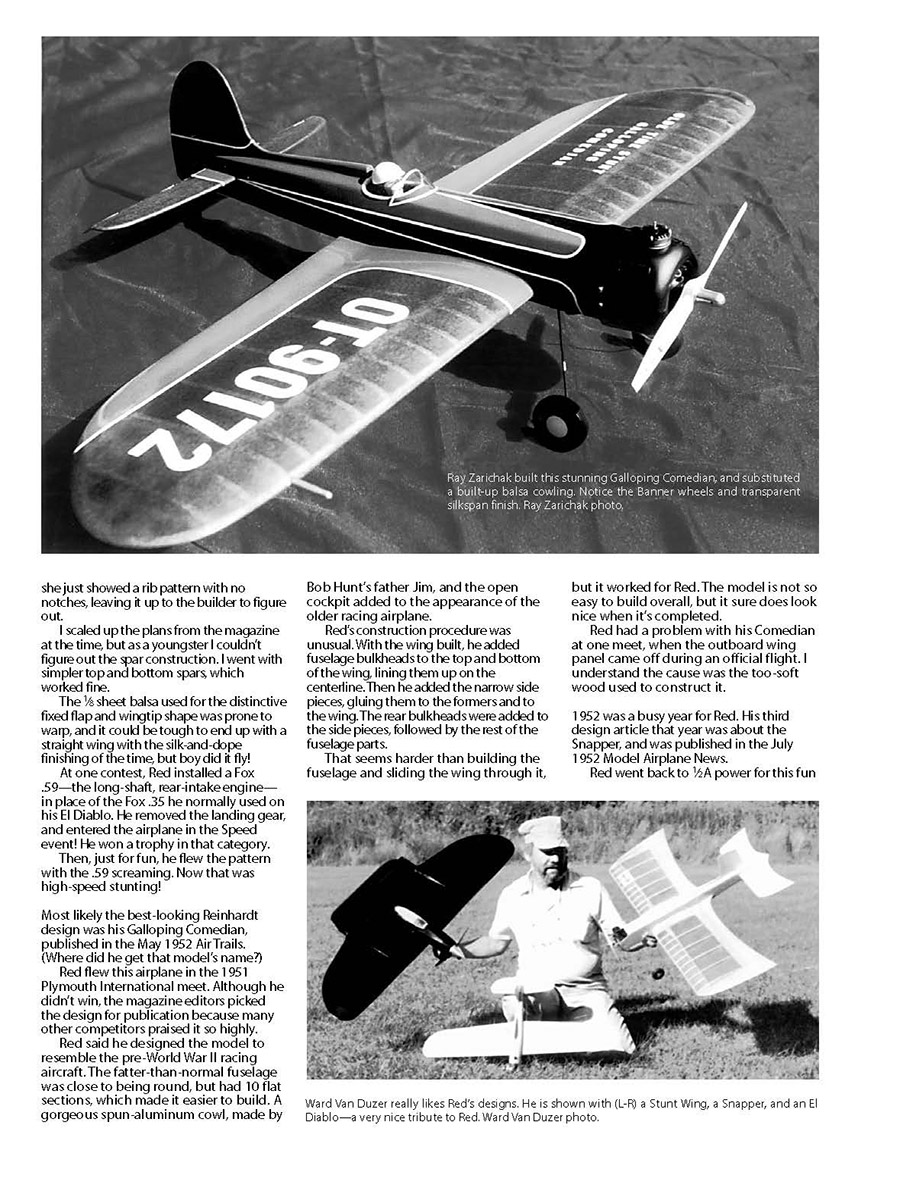
Red's next published design was the International Stunt Winner, in the January 1951 Air Trails. The airplane's name reflected what Red had done with it; he won the Stunt event at the Plymouth International Contest in Detroit in 1950.
Flying in the Senior division, Red had the highest points of all the classes, so he also won the Air Trails Perpetual Stunt Trophy. Although it wasn't a true international event with formal overseas entrants, it was one of the top meets of the day and certainly helped build Red's reputation.
Powered by a Fox .35—the highly regarded engine of the time for Stunt competition—the International Stunt Winner was aerodynamically right for the fast type of flying that was the norm.
The wing construction was unique, with a 1/16 sheet-balsa full-depth spar requiring each rib to be cut in two at a different spot. It looks as though it would be very tough to build accurately without some sort of fixture. Since it's a very clean, fairly small design, some of today's Old-Timer event competitors regard the International Stunt Winner as a particularly good choice for windy-weather use.
El Diablo (March 1952, Model Airplane News)
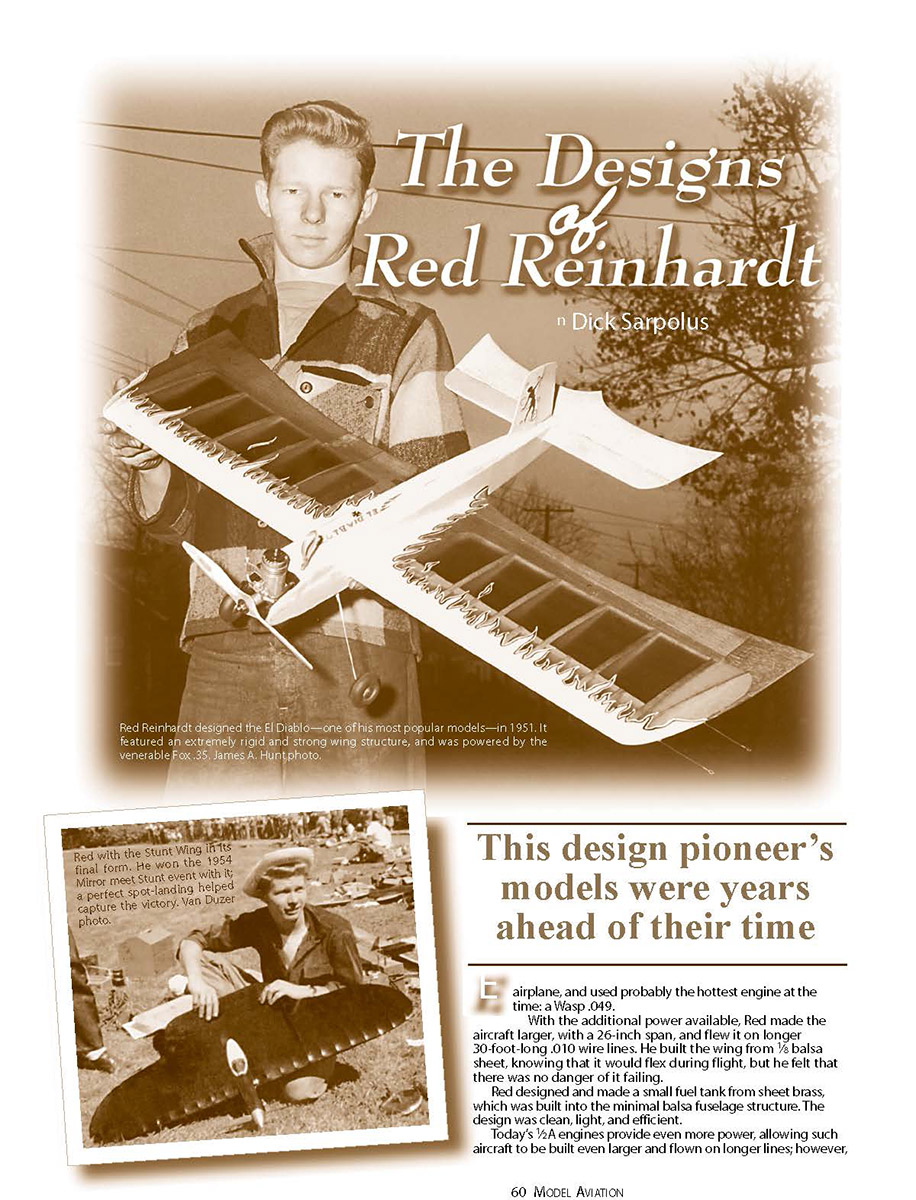
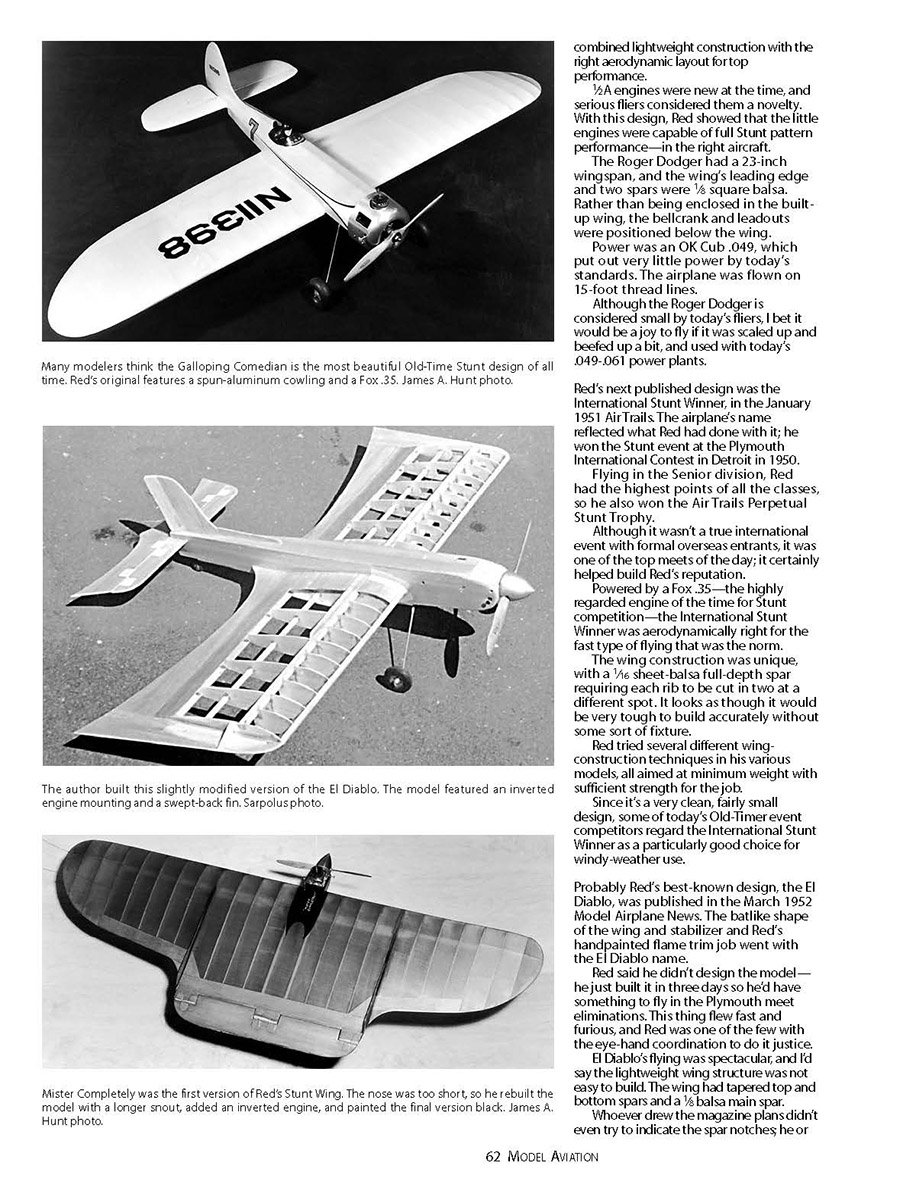
Probably Red's best-known design, the El Diablo, was published in the March 1952 Model Airplane News. The batlike shape of the wing and stabilizer and Red's handpainted flame trim job went with the El Diablo name.
Red said he didn't design the model—he just built it in three days so he'd have something to fly in the Plymouth meet eliminations. This thing flew fast and furious, and Red was one of the few with the eye-hand coordination to do it justice.
El Diablo's flying was spectacular, and the lightweight wing structure was not easy to build. The wing had tapered top and bottom spars and a 1/8 balsa main spar. Whoever drew the magazine plans didn't even try to indicate the spar notches; the plan just showed a rib pattern with no notches, leaving it up to the builder to figure out.
I scaled up the plans from the magazine at the time, but as a youngster I couldn't figure out the spar construction. I went with simpler top and bottom spars, which worked fine.
The 1/16 sheet balsa used for the distinctive fixed flaps and wingtip shape was prone to warp, and it could be tough to end up with a straight wing with the silk-and-dope finishing of the time, but it flew excellently.
At one contest, Red installed a Fox .59—the long-shaft, rear-intake engine—in place of the Fox .35 he normally used on his El Diablo. He removed the landing gear, and entered the airplane in the Speed event, winning a trophy in that category. Then, just for fun, he flew the pattern with the .59 screaming. That was high-speed stunting!
Galloping Comedian (May 1952, Air Trails)
Probably the best-looking Reinhardt design was his Galloping Comedian, published in the May 1952 Air Trails. Red flew this airplane in the 1951 Plymouth International meet. Although he didn't win, the magazine editors picked the design for publication because many other competitors praised it so highly.
Red said he designed the model to resemble the pre-World War II racing aircraft. The fatter-than-normal fuselage was close to being round but had 10 flat sections, which made it easier to build. A gorgeous spun-aluminum cowl, made by Bob Hunt's father Jim, and the open cockpit added to the appearance of the older racing airplane.
Red's construction procedure was unusual. With the wing built, he added fuselage bulkheads to the top and bottom of the wing, lining them up on the centerline. Then he added the narrow side pieces, gluing them to the formers and to the wing. The rear bulkheads were added to the side pieces, followed by the rest of the fuselage parts.
That seems harder than building the fuselage and sliding the wing through it, but it worked for Red. The model is not so easy to build overall, but it sure does look nice when it's completed.
Red had a problem with his Comedian at one meet, when the outboard wing panel came off during an official flight. The cause was the too-soft wood used to construct it.
Snapper (July 1952, Model Airplane News)
1952 was a busy year for Red. His third design article that year was about the Snapper, published in the July 1952 Model Airplane News. Red went back to 1/2A power for this fun design. The model was clean, light, and efficient.
Stunt Wing (March 1955, Model Airplane News)
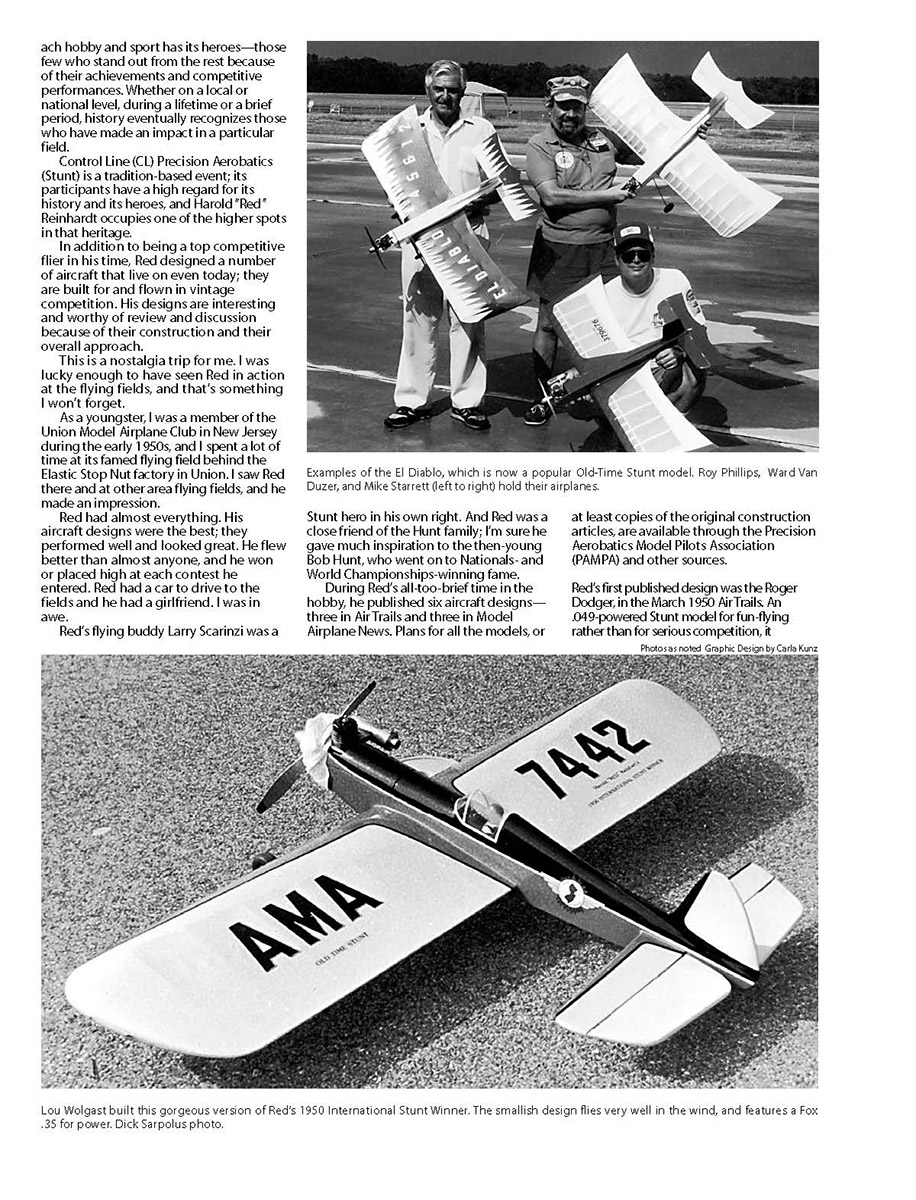
Red's last published design was his Stunt Wing, in the March 1955 Model Airplane News. Moving in a radical new design direction, he made this model to prove that flying wings could compete successfully in the precision Stunt event.
Red won the 1954 Mirror Model Flying Fair Stunt event with his Stunt Wing. As recalled by those at the Mirror meet, it flew a very wild pattern. Although Red won the event with this model, it didn't mean it was particularly suited for the AMA Stunt pattern. For its time, the Stunt Wing was innovative, unique, and interesting.
Red's design layout had an elongated center wing section and tapered tip sections. This was the only one of his aircraft to use a longer inboard wing panel. His model's elevator layout had some of the area ahead of the hinge line, so the total control area was quite large.
Red said that this aircraft was smooth and stable, and it flew well in the wind. Although he did well with the Stunt Wing at the time, the stunt fraternity in general was moving to coupled flaps, thicker airfoils, larger-size airplanes, and slower pattern flying.
One photo shows Red's first version of the Stunt Wing, actually named the Mister Comet, briefly. After the first flight, Red learned that the balance point was much too far to the rear, so he literally sawed the nose off the airplane and extended it forward. At the same time, he inverted the engine, added a bubble canopy, painted the airplane black, then renamed it the Stunt Wing.
Larry Scarcinzi told one story about Red's win at the Mirror meet, where points were given for spot landing. After the engine cut at the end of one flight, Red's Stunt Wing passed the landing spot at a five-foot height. Red had chosen an old wooden line reel as his spot.
Red pulled the nose straight up, and the airplane flopped over and dove straight down at the spot. The Froom needle-nose spinner hit dead center in the line reel, leaving a noticeable dent. The airplane bounced back into the air, Red worked the elevator rapidly up and down, and the model sort of fluttered softly down, coming to rest right over the designated line-reel landing spot.
The judges didn't even go over to measure; they just gave him full spot landing points. Red won the meet by a narrow margin. Larry still has that dented line reel in his collection of modeling memorabilia.
Achievements and legacy
The famous Mirror Model Flying Fair, sponsored by the Mirror newspaper, was a great model airplane contest held each year from 1946 through 1961. The wild CL Stunt patterns flown at this meet (the AMA pattern was not used) were perfectly suited for Red's style of flying.
He was the only triple winner in the 16-year history of this event, earning first place in 1949, 1952, and 1954. In 1949, he also won a Grumman aluminum canoe.
I believe Red only entered one AMA Nationals meet—in 1954 in Glenview, IL. He placed eighth with 320 points, finishing behind Don Stilt in first with 350 points, George Hurlin in third with 344 points, and Bob Palmer in fifth with 339 points.
Regardless of later CL Stunt trends, Red's advanced, innovative, and classic published designs, his unique and flamboyant flying ability, and his competitive performance ensure him a firm spot in modeling history.
Red's interest in competitive flying waned in the mid-1950s, and he wasn't seen much at the flying fields. He left the hobby and this earth much too soon; he passed away in the early 1970s.
I will continue to enjoy the memories of Red Reinhardt and his aircraft.
Acknowledgments
Thanks to Wynn Paul, Larry Scarcinzi, John Miske, Ward Dunzer, Ray Zarichak, and Bob Hunt for information and/or photographs assisting in the preparation of this article.
- Don Sprague
- 32 Longview Ave.
- Stamford, CT 06902
Transcribed from original scans by AI. Minor OCR errors may remain.

