
Digital Spread Spectrum: The Story So Far
by Dan Williams
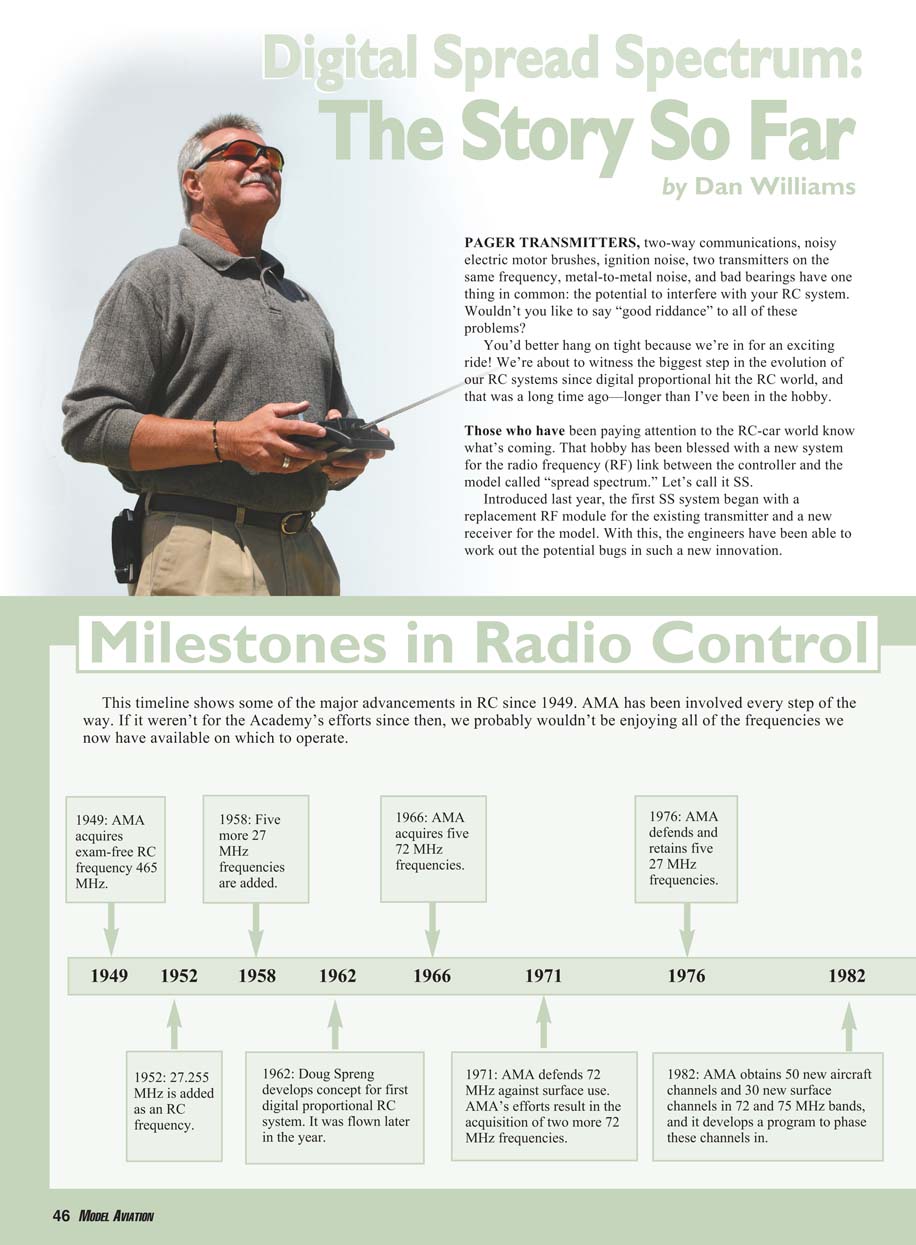
PAGER TRANSMITTERS, two-way communications, noisy electric motor brushes, ignition noise, two transmitters on the same frequency, metal-to-metal noise, and bad bearings have one thing in common: the potential to interfere with your RC system. Wouldn't you like to say "good riddance" to all of these problems?
You'd better hang on tight because we're in for an exciting ride! We're about to witness the biggest step in the evolution of our RC systems since digital proportional hit the RC world, and that was a long time ago—longer than I've been in the hobby.
Those who have been paying attention to the RC-car world know what's coming. That hobby has been blessed with a new system for the radio frequency (RF) link between the controller and the model called "spread spectrum." Let's call it SS.
Introduced last year, the first SS system began with a replacement RF module for the existing transmitter and a new receiver for the model. With this, the engineers have been able to work out the potential bugs in such a new innovation.
from the Federal Communications Commission (FCC).
Several authorized types of SS are available for our use. I won't get into the details here, but they must all work together to obtain certification. Systems that operate on that band must be "collision-proof"; when signals do happen to cross, they will ignore each other and keep working.
It really does work. That's why several people with wireless links from their laptops can sit together at the airport, surf the Internet, and not interfere with each other. The SS systems we will be using work on the same principle.
An SS system uses frequencies on 2.4 GHz and spreads the information across that broad band of frequencies instead of concentrating everything in a narrow bandwidth. The huge bandwidth available is advantageous; the same information can be repeated much more often (redundancies), and checks and balances (checksums) can be incorporated. Anything the receiver picks up that doesn't add up right gets tossed out. It happens so much more quickly than with our present systems that the occasional drop doesn't matter.
SS is immune to interference from traditional narrow-band sources that thrive in our 72 MHz RC band. The receiver is also locked electronically to that transmitter, so they won't glitch from signals from other transmitters, even if the signals happen to "collide" momentarily during operation. In addition, electrical noise from outside sources, such as motors, ignition systems, and metal-to-metal noise, only occur up to approximately 300 MHz; 2.4 GHz is a long way beyond that.
AMA is being proactive in this adventure for several reasons. Foremost is safety. We will test the systems as they become available.
Q: Will this new system affect systems on the current frequencies? A: The new systems work on 2.4 GHz, which is a long way from any of our current RC systems on 72 MHz, 50 MHz, and 27 MHz. There should be no interaction, but that is one of many things AMA will verify.
Q: Will our 72 MHz or 27 MHz RC frequencies go away? A: There are no plans for giving up our RC frequencies on 72 or 27 MHz. Your current equipment is safe!
Q: Will my current equipment become obsolete? A: No. This does not affect our current systems. However, it may be possible in the future to purchase SS RF modules for the transmitter and new receivers to convert your present system to SS.
Q: I like operating one transmitter with multiple models, which means that I will have multiple receivers. What will I do with this system? A: Each system has its own way of dealing with multiple receivers, but generally the receiver will be programmed one way or another to listen only to that transmitter signal. That way, in the event that “collisions” occur in the spreading signals, the receiver will listen solely to its transmitter. You should be able to use as many receivers as you want, as long as each is programmed to your transmitter only.
Q: Will the AMA Safety Code change, and when will I be able to fly my models at my AMA chartered club with SS? A: AMA’s goal with the system testing is to make changes to the Safety Code as necessary to accommodate the new systems. The Academy wants to encourage the technology—not hinder it.
The code reads, “I will operate my model aircraft using only radio-control frequencies currently allowed by the Federal Communications Commission ...” These frequencies are currently authorized, so there should be no problem as long as the club doesn’t have additional safety rules regarding the use only of our current frequencies.
Q: Will I be able to use my new SS system in competition? A: AMA will examine changes necessary to accommodate competition nationally and make recommendations and work internationally with the FAI. The 2.4 GHz frequencies are authorized internationally, and the same requirements apply in all countries for their operation. Modelers will be able to use the same SS systems globally!
Q: Will I be able to bury the antenna inside my model? A: This may depend on where the radio-system manufacturer recommends antenna placement inside the model. At 2.4 GHz, and with models at almost any orientation during flight, the receiver antenna is a critical element. This is the third dimension problem that RC cars do not have. It was definitely a design issue during development and may continue to be for a while as the systems evolve.
Q: How many transmitters will be able to operate simultaneously at my field? A: This must be worked out as part of the testing. Transmitters must operate together as part of the requirement in the standards. How many can operate reliably at one time is still to be determined and may depend on the types of SS technology that are in use.
There is a point where the band can “fill up” with all of these SS signals, and each type of system may start to degrade in performance—called “graceful degradation”—but no one will get locked out.
Depending on the SS system, each transmitter will listen before starting to transmit its SS signal so that it can cooperate with the other transmitters and not interfere. This is part of the “getting along” process and part of the “collision avoidance” process that is required by the FCC.
Q: Will my cell phone or pager cause interference with the new SS system? A: Cell phones and pagers, if using the same 2.4 GHz band as the new SS systems, must follow the same rules. To be certified, they must comply with the rules and get along so they won’t interfere with each other.
Q: Will cordless phones cause interference at the field? A: All equipment on the 2.4 GHz band we’re using must work together. Because of the SS characteristics and the rules, they will ignore each other.
Q: Will my servos respond slowly during any time with SS? A: The slowness of response is called “latency.” This is the time it takes between movements of the stick to movements in the servo. The SS manufacturers, as part of their design effort, are making sure that their systems will operate at least as well in terms of latency as our current systems.
As the band begins to fill up from many transmitters on the band doing SS, there may become a time when there are so many collisions that latency is compromised. This is part of what AMA will be looking at for safety reasons. Depending on the form of SS being used, this may never be a problem.
Q: Will my club be able to get rid of the frequency board at our field? A: Probably not as long as anyone flying at the field continues to use traditional RC systems. In reality, that will continue for a long time. If your club hosts contests or fly-ins of any kind, traditional systems will continue to show up during the registration process. You don’t want to turn these people away.
Q: Will our club still need a transmitter impound? A: If traditional systems are still being used at your club, the impound will be necessary. However, if you have one of the new SS systems and go to a fly-in or a contest, you may still be required to turn your transmitter in to the impound based on that club’s rules. Don’t give them grief; it will take some time for everyone to get used to the new ways of dealing with SS.
Q: Is this truly RC nirvana? A: Although it appears that way right now, everything eventually shows up with some compromises. Nothing is perfect. There may be issues; we just don’t know what they are yet. SS will continue to evolve, and it may come to a point where we can just worry about dumb thumbs again.
Q: Should we stop buying 72 MHz equipment in anticipation of SS coming on line? A: Nope. Right now SS isn’t even available for airborne models. It may take some time to finish development before introduction. This Q-and-A segment is intended to be a primer so that everyone can be educated before the first systems hit the market.
The first SS system has not been introduced for airborne models yet, but we are anticipating it at some point. Until that happens, we will stay at our current frequencies. The present technology is mature; we know how well it works and we know its shortcomings. SS is going to be a big unknown for a while, and we’ll have to wait and see what will be the good and the bad.
—Dan Williams
No additional text from the primary article "Digital Spread Spectrum: The Story So Far" appears on this scanned page.
Transcribed from original scans by AI. Minor OCR errors may remain.

