
Discus-Launch Gliders
by Mike Garton
THE DISCUS-THROW technique has caught on like wildfire in Radio Control (RC) hand-launch competitions. Dick Barker of the Seattle, WA area is credited with starting the discus-launch movement, and most of the top competitors have switched to this method in the last few months.
Many pilots are reporting that their launch heights have doubled with this technique, and all pilots are reporting less stress on their bodies than with the javelin throw.
Higher throws with less effort will help competitive and sport fliers.
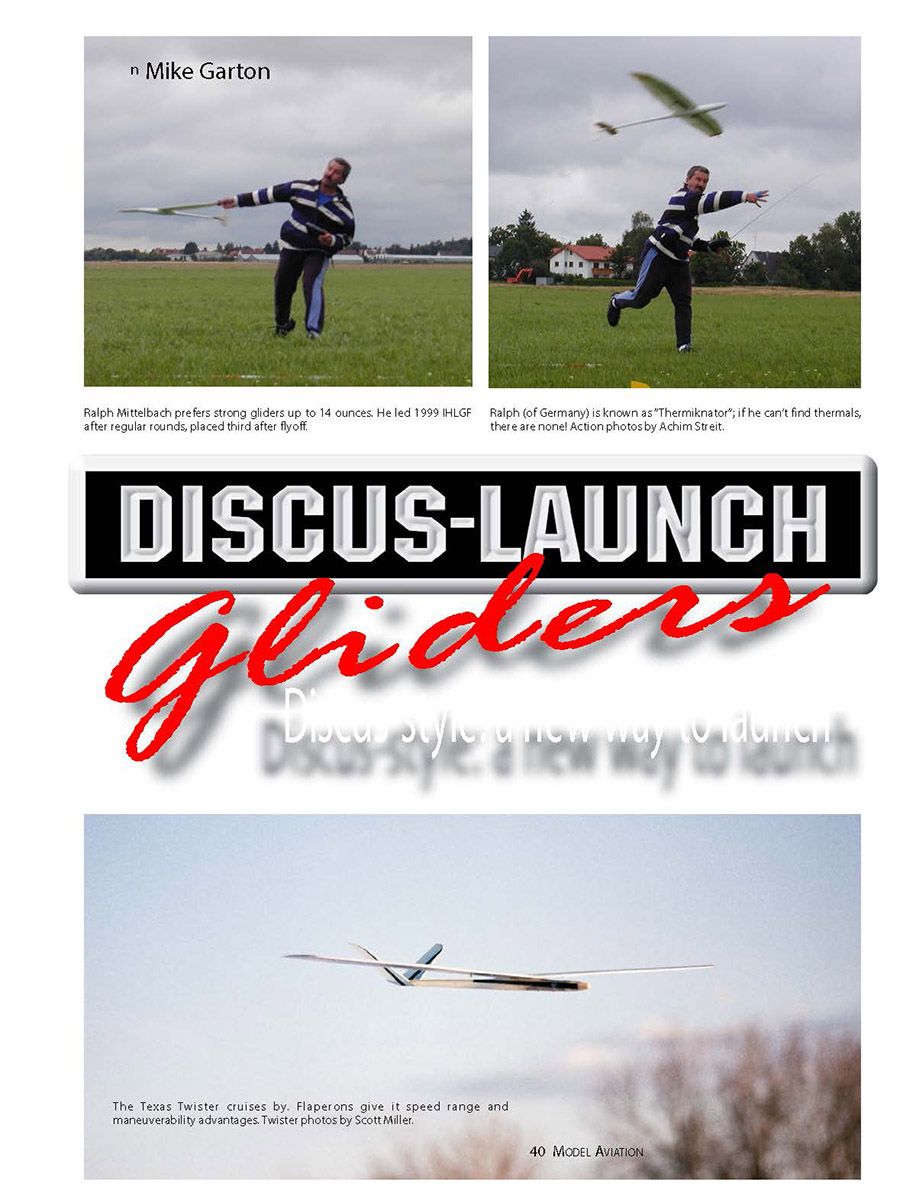
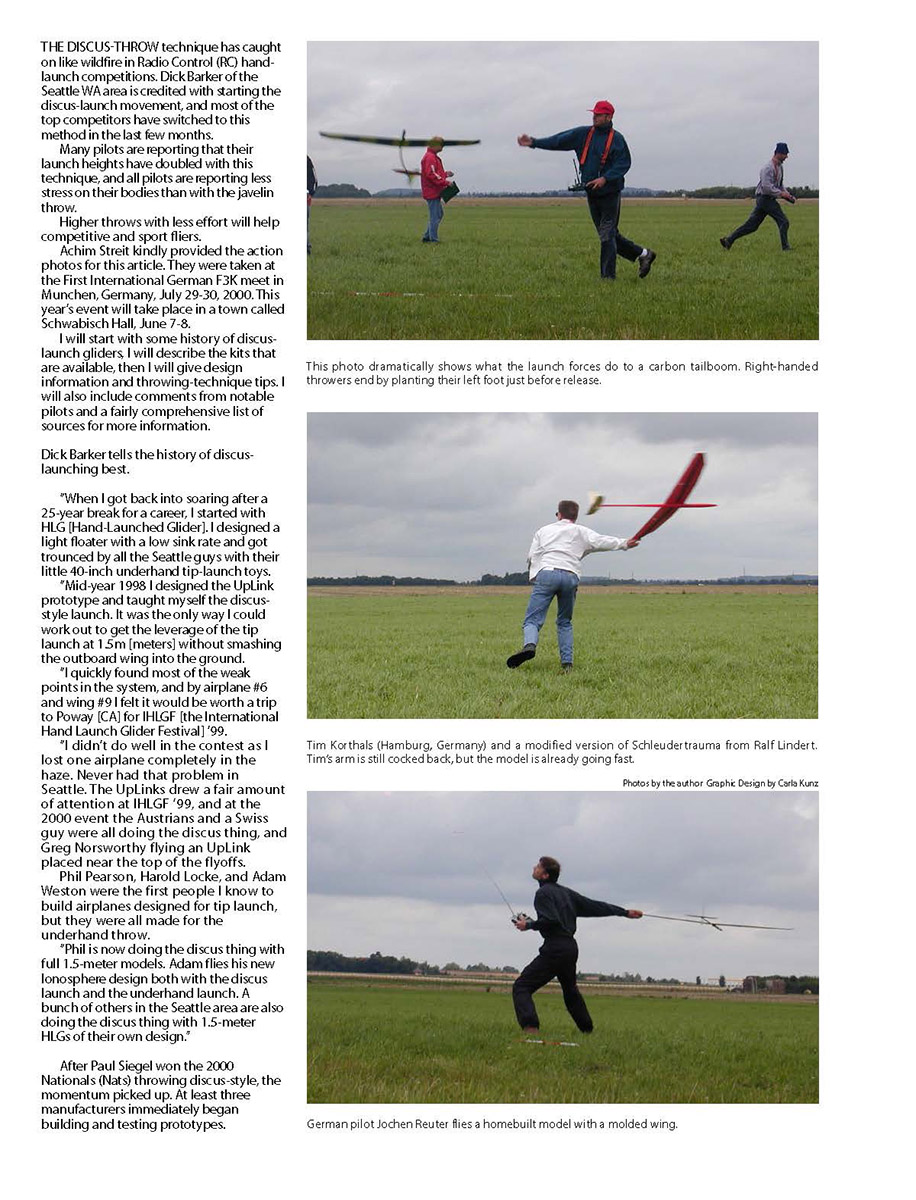
Achim Streit kindly provided the action photos for this article. They were taken at the First International German F3K meet in Munchen, Germany, July 29–30, 2000. This year's event will take place in a town called Schwabisch Hall, June 7–8.
I will start with some history of discus-launch gliders, describe the kits that are available, then give design information and throwing-technique tips. I will also include comments from notable pilots and a fairly comprehensive list of sources for more information.
History — Dick Barker
Dick Barker tells the history of discus-launching best:
"When I got back into soaring after a 25-year break for a career, I started with HLG (Hand-Launch Glider). I designed a light floater with a low sink rate and got trounced by all the Seattle guys with their little 40-inch underhand tip-launch toys.
"Mid-year 1998 I designed the UpLink prototype and taught myself the discus-style launch. It was the only way I could work out to get the leverage of the tip launch at 1.5 m [meters] without smashing the outboard wing into the ground.
"I quickly found most of the weak points in the system, and by airplane #6 and wing #9 I felt it would be worth a trip to Poway [CA] for IHLGF (the International Hand Launch Glider Festival) '99.
"I didn't do well in the contest as I lost one airplane completely in the haze. Never had that problem in Seattle. The UpLinks drew a fair amount of attention at IHLGF '99, and at the 2000 event the Austrians and a Swiss guy were all doing the discus thing, and Greg Norsworthy flying an UpLink placed near the top of the flyoffs. Phil Pearson, Harold Locke, and Adam Weston were the first people I know to build airplanes designed for tip launch, but they were all made for the underhand throw.
"Phil is now doing the discus thing with full 1.5-meter models. Adam flies his new Ionosphere design both with the discus launch and the underhand launch. A bunch of others in the Seattle area are also doing the discus thing with 1.5-meter HLGs of their own design."
After Paul Siegel won the 2000 Nationals (Nats) throwing discus-style, the movement picked up. At least three manufacturers immediately began building and testing prototypes.
What took so long?
Several technical challenges had to be overcome; the pioneers had to be persistent.
There are several structural issues.
- Doubling the release velocity makes the aerodynamic forces go up by a factor of four.
- Centrifugal forces try to pull the battery sideways.
- Polyhedral breaks become stress-risers.
- Huge initial yaw angles put severe forces on the vertical fin and tailboom.
Even minor stress concentrations will lead to a failure in a 90 mph discus launch. It takes many prototypes to get a workable design. The top (javelin-style) kits of last year would explode if given just one full-power discus launch.
Aerodynamically, these airplanes need thin, low-camber, low-drag airfoils to take best advantage of the high release velocity. The models cover roughly twice as much ground because of the higher launch and fast airfoils.
Polyhedral designs need very large vertical fins to quickly dampen the yawing upon release. Pod-and-boom designs need to have the rudder distributed almost equally above and below the tailboom, to minimize tailboom twisting while yawing.
An overly flexible tailboom will lead to inconsistent launches.
Another challenge to overcome was the configuration change between launch and flight. Most designs require outward rudder upon release. They may also need up-elevator. These launch presets are turned off as soon as the upward trajectory is stabilized—usually less than a half second after the model leaves the hand.
Gliders are extremely sensitive to trim changes at 90 mph. A computer radio with programmable presets is required.
The release-velocity numbers are obtained with a radar gun. Typical javelin throws can impart 40 mph on an HLG, and the elite throwers get approximately 55 mph. Top discus-throwers are roughly 90 mph.
Dick Barker's airplane was clocked at 74 mph on a discus launch. Dick will admit to being 63 years old.
You do not have to be young or athletic to throw high with this technique. Dick has won or placed in many contests in the last couple years. Dick's throw was measured at 100 feet with a laser rangefinder.
Kits
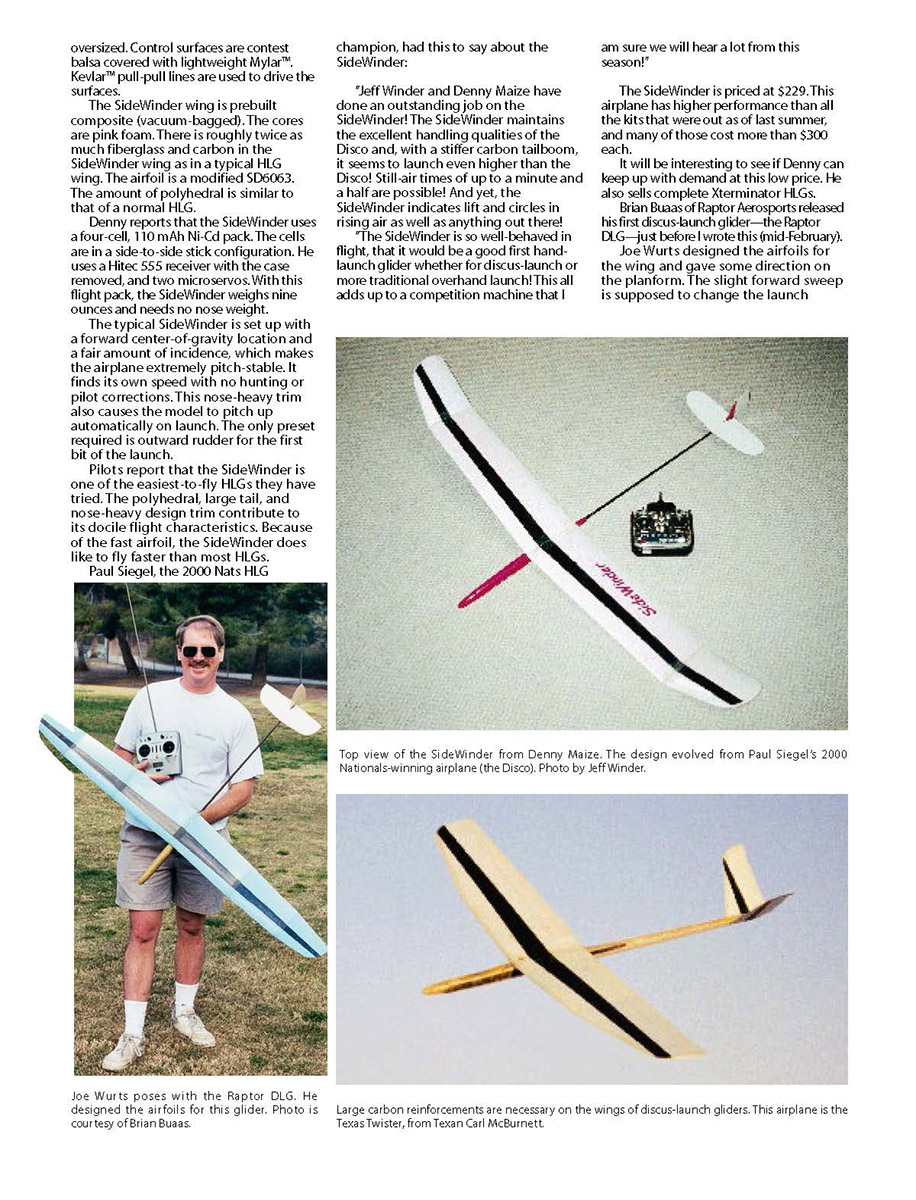
One of the airplanes I featured in the May Soaring column was Carl McBurnett's Texas Twister discus-launch glider. (See that column for detailed specifications.) It was released in December 2000.
Here is an update, now that I have another month of (winter) flying on the airplane.
I have not found a fault with the model. My discus launches have improved to the point where I can get dead-air flights in the 80- to 90-second range.
The Twister continues to hold up well; cartwheels on crusty snow have not broken it. This airplane is roughly 50% stronger than last year's Pro-Dartar and Blu Dartar HLGs, even though the weight is close.
I can work very light lift with appropriate flaperon camber. I have found workable lift each trip out. One January day there was some light lift over the Iowa snow; I had no flights less than two minutes. I can't wait to try it in summer air.
The flaperons should give this model a real advantage over other discus airplanes in turbulence or in small-diameter thermals.
This glider does not have a subfin and does not require a rudder preset for launch. A little more tail volume would suit my taste.
Mac recommends the Texas Twister for intermediate to advanced fliers. He has priced it at $275 including shipping and handling. It is well worth the money. If you prefer flaperon HLGs to polyhedral HLGs, this glider is the obvious choice.
SideWinder (Denny Maize, Polecat Aeroworks)
Denny Maize released the new SideWinder discus-launch airplane early this year. (Denny has begun Polecat Aeroworks as a full-time pursuit.) The model is an evolution of Paul Siegel's Disco HLG that won the 2000 Nats.
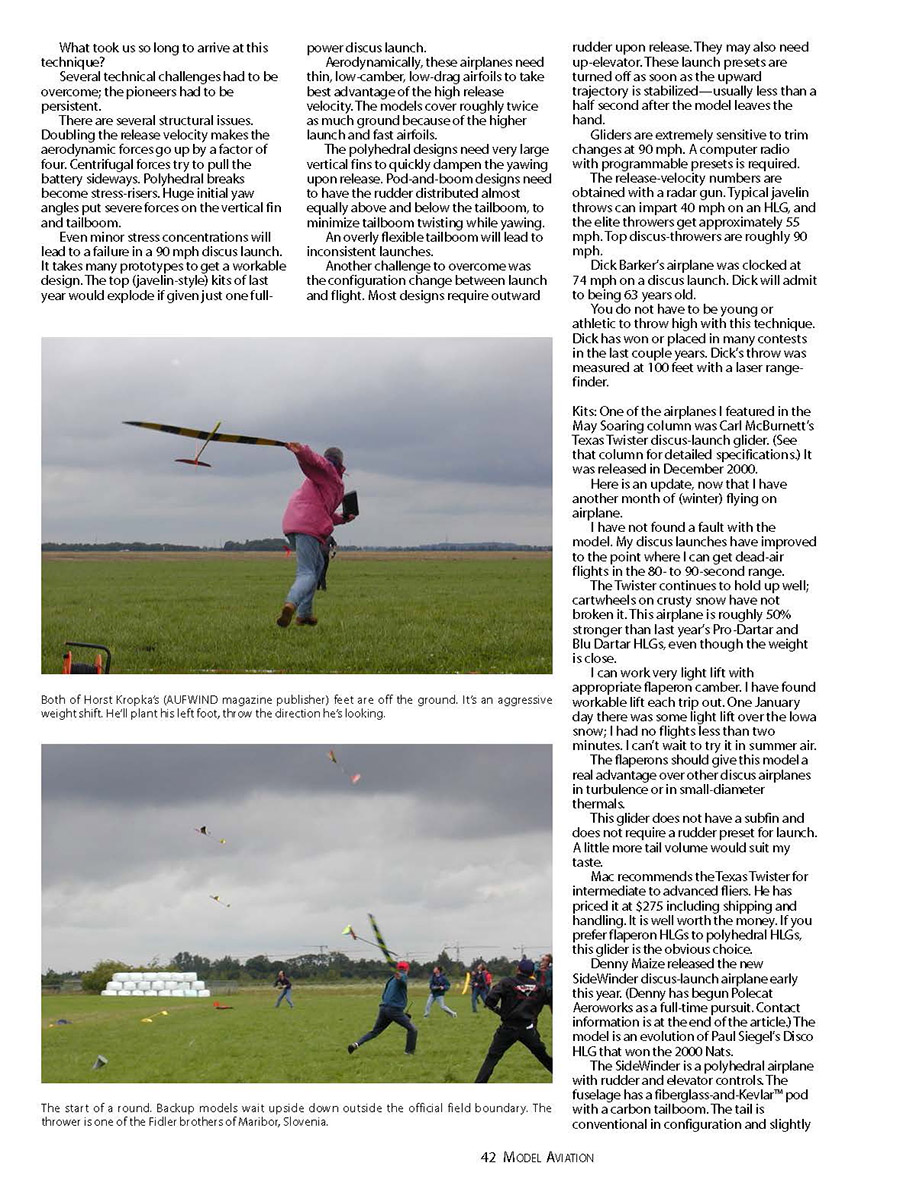
The SideWinder is a polyhedral airplane with rudder and elevator controls. The fuselage has a fiberglass-and-Kevlar pod with a carbon tailboom. The tail is conventional in configuration and slightly oversized. Control surfaces are contest balsa covered with lightweight Mylar™. Kevlar™ pull-pull lines are used to drive the surfaces.
The SideWinder wing is prebuilt composite (vacuum-bagged). The cores are pink foam. There is roughly twice as much fiberglass and carbon in the SideWinder wing as in a typical HLG wing. The airfoil is a modified SD6063. The amount of polyhedral is similar to that of a normal HLG.
Denny reports that the SideWinder uses a four-cell, 110 mAh Ni-Cd pack. The cells are in a side-to-side stick configuration. He uses a Hitec 555 receiver with the case removed, and two microservos. With this flight pack, the SideWinder weighs nine ounces and needs no nose weight.
The typical SideWinder is set up with a forward center-of-gravity location and a fair amount of incidence, which makes the airplane extremely pitch-stable. It finds its own speed with no hunting or pilot corrections. This nose-heavy trim also causes the model to pitch up automatically on launch. The only preset required is outward rudder for the first bit of the launch.
Pilots report that the SideWinder is one of the easiest-to-fly HLGs they have tried. The polyhedral, large tail, and nose-heavy design trim contribute to its docile flight characteristics. Because of the fast airfoil, the SideWinder does like to fly faster than most HLGs.
Paul Siegel, the 2000 Nats HLG champion, had this to say about the SideWinder:
"Jeff Winder and Denny Maize have done an outstanding job on the SideWinder! The SideWinder maintains the excellent handling qualities of the Disco and, with a stiffer carbon tailboom, it seems to launch even higher than the Disco! Still-air times of up to a minute and a half are possible! And yet, the SideWinder indicates lift and circles in rising air as well as anything out there!
"The SideWinder is so well-behaved in flight, that it would be a good first hand-launch glider whether for discus-launch or for more traditional overhand launch! This all adds up to a competition machine that I am sure we will hear a lot from this season!"
The SideWinder is priced at $229. This airplane has higher performance than all the kits that were out as of last summer, and many of those cost more than $300 each.
It will be interesting to see if Denny can keep up with demand at this low price. He also sells complete Xterminator HLGs.
Raptor DLG (Brian Buaas, Raptor Aerosports)
Brian Buaas of Raptor Aerosports released his first discus-launch glider—the Raptor DLG—just before I wrote this (mid-February). Joe Wurts designed the airfoils for the wing and gave some direction on the planform. The slight forward sweep is supposed to change the launch aerodynamics.
You may notice in the pictures that the Raptor has five polyhedral breaks, to minimize stress concentrations. It probably makes the wing much more difficult to produce. It should also be pretty in flight.
The Kevlar™ fuselage pod is from Brian's Feather Xl HLG. It uses a nose cone and has carbon reinforcement. The Raptor has a stiffer carbon tailboom than the Feather, and tail surfaces are sheet balsa. Brian reports that the all-up weight is typically 8.5 ounces.
Brian has a track record of producing high-quality airplanes. I have not seen a Raptor fly, but given the people involved in the design, it will be a winner.
The Raptor is priced at $325 plus shipping and handling.
The Throw
Throwing discus-style can be compared to swinging a golf club; a small man with good form can outdistance a large man with poor form. Also like a golf swing, smooth, fluid movements are most efficient.
If your body can take golfing, it can most likely take discus-launching.
Some pilots, such as Denny Maize and Chris Oster, can get flights of well above a minute discus-launching without spinning; track athletes call this the “standing throw.”
The footwork of the standing throw is nearly identical to that of a golf swing; it involves a weight shift, trunk twist, and whipping the arm around. Higher launches can be obtained with a full one-turn discus spin. Brian Buaas reports that he uses 1.5 turns in some conditions.
Right-handed throwers will start the one-turn spin facing 90° to the right of the wind. The right foot is swung around, turning the body 180°, and the left foot is swung around to the upwind direction and planted. The arm should start cocked back and stay there until approximately the 270° point of the turn.
Track-and-field discus throwers will tell you that all the power comes from the legs; arm muscles have relatively little impact. The key to a good throw is proper footwork, twisting of the trunk, and correct balance shifting as the feet move.
After watching collegiate discus throwers for a while, I developed an analogy.
Imagine that the trunk of your body is a vertically oriented coil spring. Your feet must turn your lower body around very quickly.
The body should turn 180° with each forward step; this loads the coil spring. By the time you are halfway through the spin, the airplane has some speed and your body is still twisted. Then the spring unloads; the legs turn first, then the waist, and finally, the arm whips around.
The throwing arm is the last part of the body to swing forward in track discus and when launching discus gliders. The function of the throwing arm is to hold the model as far out as possible.
The velocity imparted on the airplane is proportional to the speed of the body rotation and the distance from the center of rotation. The torsion-spring analogy helped me understand the rotating part of the throw.
For maximum launch, some linear forward momentum of the body is built up, then transferred into angular-momentum velocity at release. The transfer of linear to angular momentum takes place as the foot is planted on the last step (for right-handed throwers).
The discus-launch technique is best learned visually. There are "mpeg" video clips of launches on Carl McBurnett’s Web site, and the IHLGF 2000 video has footage of several discus-throwers, including Dick Barker.
Paul Naton, producer of the Endless Lift series of videos, promises to have discus-launch instructional footage in the future.
For the pilots who are really hungry for information, a source of a couple track-and-field instructional videos is at the end of the article. There appears to be roughly 80% overlap between track discus throwing and discus-glider throwing. The track video may be worth the $40 if you have no expert thrower nearby. It may also give competitive pilots an edge.
What to expect for HLG in the near future
- More flaperon discus gliders. After you get used to the speed control and maneuverability of flaperons, they are hard to live without. Mac and the Europeans are ahead in this area.
- Tooling for larger-diameter, thin-walled carbon tailbooms should be created now that the market exists.
- The wingtip grips are still evolving. The Europeans like the vertical dowel through the wingtip. Others make a flexible area that bounces back to shape after release.
- The easiest thing to do is make the skin thicker, then the wingtip is gripped with the thumb under the wing and four fingers on top of it.
- Some pilots use pine tar on the smooth wingtips for a better grip.
Reading this article, did you get the impression that most HLG designs just became obsolete?
You will need a discus glider if you want to compete with the best. The older gliders are still fun to sport-fly, and the discus gliders will be even more fun.
Catching thermals in the park is much easier with more than a minute to look around.
The new style of glider also puts much less stress on your body. This launch technique will allow a significant number of aging pilots to reconsider flying HLG.
Thanks to Dick Barker and Achim Streit for their contributions to this article.
RC Soaring Exchange postings (selected)
The following are E-mail postings from the RC Soaring Exchange (RCSE)—a computer newsgroup hosted by Air Age magazine and moderated by Michael Lachowski.
Joe Wurts (1/8/2001)
"Skypilot forwarded me some E-mail on the HLG throw technique thread. Not quite sure if I should be spilling the beans here ... But, if you're going to play HLG off in Phoenix, you'll be seeing me playing with a new technique. Okay, it's not really new, but it's for me.
"It involves grabbing the wingtip and whirling around and letting go on the wingtip. The average person should be able to double their launch altitude compared to their javelin throw in equivalent conditions. (This assumes that the airplane is designed for tip launch, which has a few quirks to it.)
"I got pushed into it via flying with Bill Watson at the end of the year. Last year, Bill got hooked (again) on HLG and came to Peoria to play. His javelin throw resulted in about a 25-second dead air.
"Over the last six months he has been working on the tip launch, and came to our locals to the field to play HLG. I was quickly humbled in that he was tip-launching at least 50% higher than I was getting my javelin throw. Even Jan told me to throw in the towel on the overhand throw.
"Last Saturday I took possession of a new TLS that was designed for tip launch, and started experimenting on just how one does it. Got a lot of advice, and promptly ignored it all and started evolving my own technique. After the first quick charge, I was launching well over 100 feet in dead air.
"My current goal, which looks eminently achievable, is 200 in nowind dead calm. I already over 3/4 of the way there, and I've a total of about 3 hours of tip-launch practice/experimentation. Still have a ways to go in refining the technique as well as the airframe design, as it is all in its infancy.
"The good news is that just about anyone can quickly learn how to get over a minute in dead air. Don't have to be in shape or athletic. And it sure is nice not abusing the knee, shoulder, elbow, etc. There's almost none of the hard impact loads on the body, which has been an issue for me with the javelin throw. I did tweak something in my hip the first day, but I've never been good at dancing.
"There is some fancy footwork too in high-power TLG, at least for me. Having at least another 50 feet of launch altitude sure changes the character of HLG flying, as well as the desired airframe design.
"The bad news is that the athletic folk are still going to be launching that much higher than the average person. Plan on over 90 mph launch speed with a reasonable athlete using good form. Over 100 mph is definitely possible.
"I suspect that I'm approaching 90 mph at present, although I've not thrown in at a radar yet. (I'll make sure that I have a current and valid certification before posting any data though ... ) For comparison, my best measured javelin throw was 56 mph.
"HLG will never be the same."
Werner Stark of Austria (2/4/2001)
"The basic idea of SAL (side-arm launching) has been taken over to Europe by German and Austrian participants of the 1999 IHLGF. Since then we honor the guys around Dick Barker at the new times of SAL. Today two different ideas are used at HLG/FSX contests:
- The German approach (mainly influenced by Uwe Peller and Achim Streit):
- Airfoil 6% thickness, camber 1.5%, almost no dihedral.
- 3 servos (flaperons, elevator, reinforced stab/rudder).
- Balance wings by bowing peg in the wingtip (various positions): feed fin, 1/2 above, 1/2 below boom.
- Distance between TE (trailing edge) and stab: +300 millimeter (+11.8 inches).
- Flying weight +320 grams (+11.2 oz).
- Almost no preset during launch required.
- Main acceleration during the first 20 degrees. The last 90 degrees are used for controlled release.
- Mainly used in Slovenia and Germany.
- Launching heights: +50 meters.
- The Austrian approach by Wolfgang Zach (placed 7th at the IHLGF 2000):
- Airfoil FL-150 or HD-5 (mainly used in FS & Electric competition).
- Four servos, molded wings, 5 degrees dihedral, all-carbon pod/boom.
- Stabilizer area: 15% above, 7% below boom.
- Distance between TE and stab: 500 millimeter (19.5 inches).
- Flying weight: +200 grams (+7 oz).
- Launching assist: Two shallow depressions for the forefinger and middle finger applied to the wingtip and some kind of carbon finger rest.
- No presets during launch required.
- Main acceleration during the last 90 degrees.
- Launching heights: +45 meters.
"Wolfgang Zach has won all major contests in Europe during 2000 ... You can find some information on: pws.prserv.net/stark/bobowzach.htm."
Dick Barker (12/9/2000) — Converting a conventional pod-and-boom HLG to discus
"It depends on what you have and how it is configured. You can give it a try. Just set up some punch preset in the rudder to make it go/stay at ailer release and some up-elevator to make it pitch up to the correct climb angle. The preset should be adjusted so it can be turned off about 1/2 to 3/4 second after release.
"If the following conditions are met it will be fine:
- The wing needs a very low pitching moment.
- The wing must be able to stand the quick transition to an 80-degree climb.
- The wing should not flutter at 130% of the old-fashioned launch method.
- The wing mount needs to tolerate a 50 G side (shear) load.
- The boom needs to stand up to any twisting caused by the offset rudder.
- The boom also must stand the bending stress caused by the offset rudder.
- The boom-to-pod joint must smoothly transfer the bending load to the pod.
- The tail feathers need to not get blown off at launch speed.
- The nose must be able to stand 50 G side loads as the battery wants out.
- The rudder pushrod must not flex during the launch preset.
- The wingtip needs to be solid enough to allow a good grip.
"Two #6 nylon screws will hold the wing on if there is no gap between the bottom of the wing and the wing mount. Boil the nylon screws for 20 minutes in water to properly hydrate them. Replace them every 1,000 launches and always slack them off after every flying session."
MA
Mike Garton 2733 NE 95th Ave. Ankeny IA 50021 [email protected]
Sources
If any of the following links or addresses change, I will post updates at http://eiss.cnde.iastate.edu/articles/GartonUpdates.shtml. These sources are also conveniently linked from that page.
- Translator for German Web sites: http://translator.go.com/
- Achim Streit’s photos from the DM F3K 2000: www.uni-paderborn.de/StaffWeb/streit/Bilder/DM_2000/index.html
- More information about glider contests in Europe: www.auwind-magazin.de/contest/
- International Hand Launch Glider Festival (IHLGF) information: www.torreypinesgulls.org/
- Dick Barker’s UpLink design: www.eskimo.com/~dickb/UpLink.html
- Ionosphere information: Thermal-Gromit Works — www.blarg.net/~awagner/wing_launch_technology.htm
- “A Conversation With the Pioneers of Discus Launching” (online article): http://eiss.cnde.iastate.edu/articles/discus.shtml
- Texas Twister: Carl McBurnett, 7506 Legend Point Dr., San Antonio TX 78244, (210) 662-9503 — www.bludartar.com/twister/twister.html
- SideWinder: Polecat Aeroworks (Denny Maize), (717) 503-9859 — www.polecataero.com/
- Raptor DLG: Raptor Aerosports, 9710 Zelzah Ave. #108, Northridge CA 91325, (818) 993-0570 — www.raptorrc.com/
- RC Soaring Exchange newsgroup, sponsored by Air Age magazine: www.eclipse.net/~mikel/rcse/rcse.htm
- Track-and-field discus videos (Mike Bunce’s video): 2730 Graham St., Ames IA 50010, (800) 873-2730 — http://champonline.com/
- Wolfgang Zach’s design online (in German): http://pws.prserv.net/stark/bobo/wzach.htm
- German manufacturer of discus-launch gliders: www.raf-lindert-flugmodelle.de
Transcribed from original scans by AI. Minor OCR errors may remain.

