
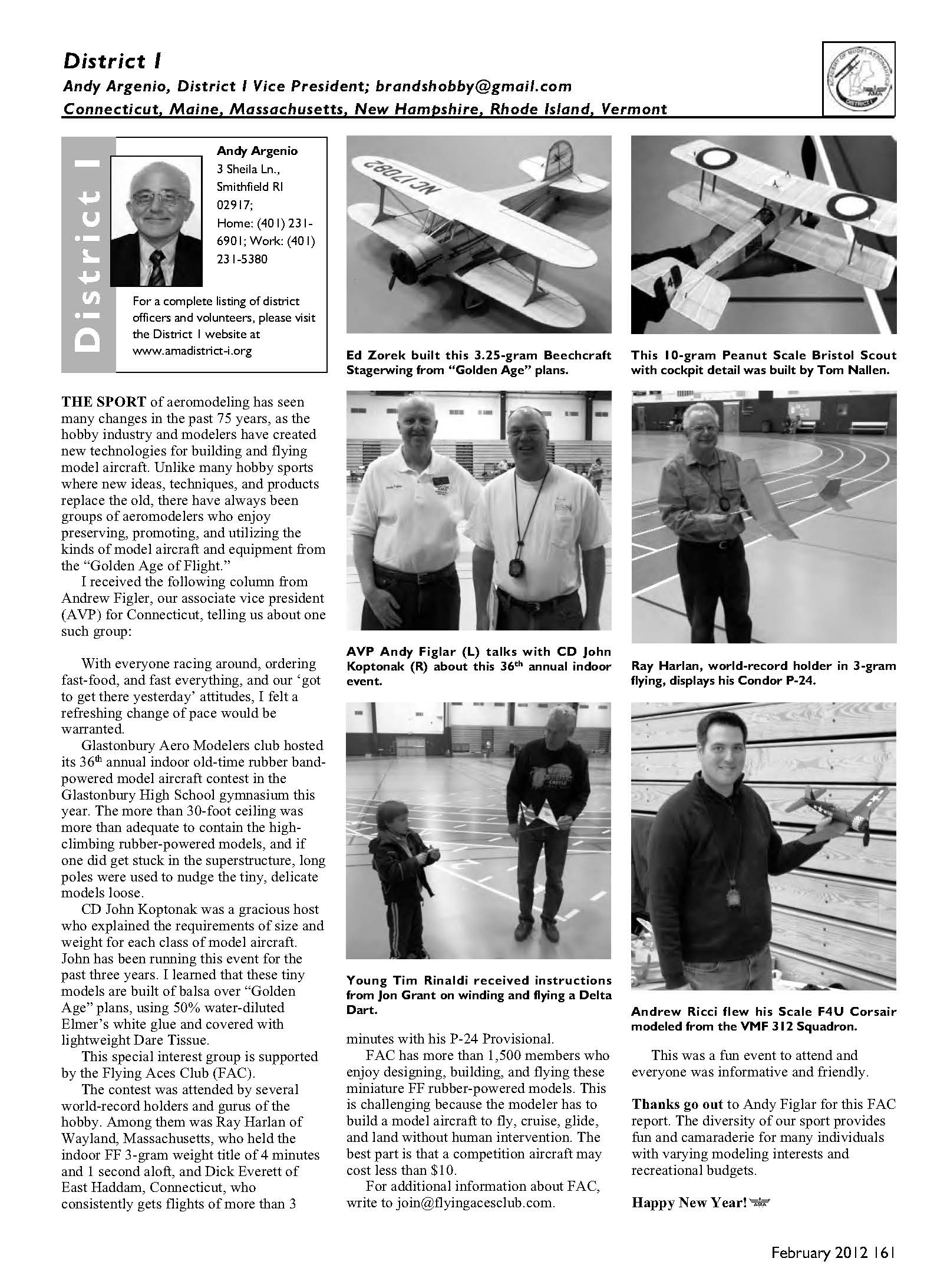
District I - 2012/02
THE SPORT of aeromodeling has seen many changes in the past 75 years, as the hobby industry and modelers have created new technologies for building and flying model aircraft. Unlike many hobby sports where new ideas, techniques, and products replace the old, there have always been groups of aeromodelers who enjoy preserving, promoting, and utilizing the kinds of model aircraft and equipment from the "Golden Age of Flight."
Andrew Figler, our Associate Vice President (AVP) for Connecticut, sent the following report on one such group.
Glastonbury Aeromodelers indoor contest
Glastonbury Aeromodelers Club hosted its 36th annual indoor old-time rubber band–powered model aircraft contest in the Glastonbury High School gymnasium. The gym’s more than 30-foot ceiling was more than adequate to contain the high-climbing rubber-powered models; if one did get stuck in the superstructure, long poles were used to nudge the tiny, delicate models loose.
Contest Director (CD) John Koptonak was a gracious host who explained the size and weight requirements for each class of model aircraft. John has been running this event for the past three years.
Models and construction
These tiny models are built of balsa using "Golden Age" plans, assembled with Elmer’s white glue diluted 50% with water, and covered with lightweight Dare Tissue. The models are free-flight (FF) rubber-powered and are designed to fly, cruise, glide, and land without human intervention.
Notable attendees
The contest was attended by several world-record holders and hobby gurus, including:
- Ray Harlan of Wayland, Massachusetts — holder of the indoor FF 3-gram weight title with a flight of 4 minutes 1 second.
- Dick Everett of East Haddam, Connecticut — who consistently gets flights of more than 3 minutes with his P-24 Provisional.
About the Flying Aces Club (FAC)
This special interest group is supported by the Flying Aces Club (FAC). FAC has more than 1,500 members who enjoy designing, building, and flying these miniature free-flight rubber-powered models. The competition aircraft can be very inexpensive to build — in some cases costing less than $10.
For additional information about FAC, write to [email protected].
This was a fun event to attend; everyone was informative and friendly. Thanks go out to Andrew (Andy) Figler for this FAC report. The diversity of our sport provides fun and camaraderie for many individuals with varying modeling interests and recreational budgets.
Happy New Year!
Transcribed from original scans by AI. Minor OCR errors may remain.

