
District I - 2015/06
Contact
- Andy Argenio
- Vice President
- [email protected]
- 3 Sheila Ln., Smithfield, RI 02917
- Tel.: (401) 231-6901
- www.amadistrict-i.org
We supported the FAA’s Notice of Proposed Rulemaking (NPRM) exempting recreational model aircraft from regulation; however, many of us expressed concerns about the FAA’s interpretation of Congress’ intent in Public Law 112-95, Section 336(c). We believe the FAA’s interpretation attempts to circumvent public law. As these issues are settled with the FAA or in court, we are seeing a proliferation of state legislation to address public safety, security, and privacy concerns.
After attending several legislative hearings and listening to testimony from a variety of stakeholders — human rights advocates, law enforcement, and lobbyists both for and against sUAS/drone bills — it became apparent that no single government agency, nor any one level of government, will resolve sUAS/drone issues. The FAA’s NPRM does not address privacy protections. We must continue to lobby at the federal, state, and municipal levels to protect the interests of AMA members flying in the National Airspace System.
Most individuals who testified on drone legislation favored state and municipal legislation over federal regulation. Federal legislation tends to be one-size-fits-all and does not account for geographic differences in risks and drone applications. For example:
- Precision agricultural uses in rural locations present different risks than drone operations in urban areas.
- Restrictions suitable for urban public-safety concerns would be unnecessarily burdensome for rural agricultural or research uses.
For this reason, Rhode Island’s HB5292, which sought exclusivity for the state to regulate over municipalities, did not move forward.
Those who testified on Rhode Island’s HB5454 (privacy protection and law-enforcement warrant requirements) argued that warrants are necessary because the Supreme Court has held there is no reasonable expectation of privacy above our homes. HB5454 was held for further study to include exemptions for:
- search and rescue,
- large-event monitoring,
- locating an active shooter,
- other legitimate public-safety operations.
The bill of greatest concern to aeromodeling is Rhode Island’s HB5453, which would:
- grant exclusive authority to the state to regulate,
- require registration and allow charging fees (stated as $15 per model aircraft),
- prohibit flying within 5 miles of large airports and within 2 miles of smaller state airports and emergency aircraft,
- prohibit flying within 0.5 miles of government buildings, schools, and colleges,
- prevent drones from capturing images within occupied dwellings.
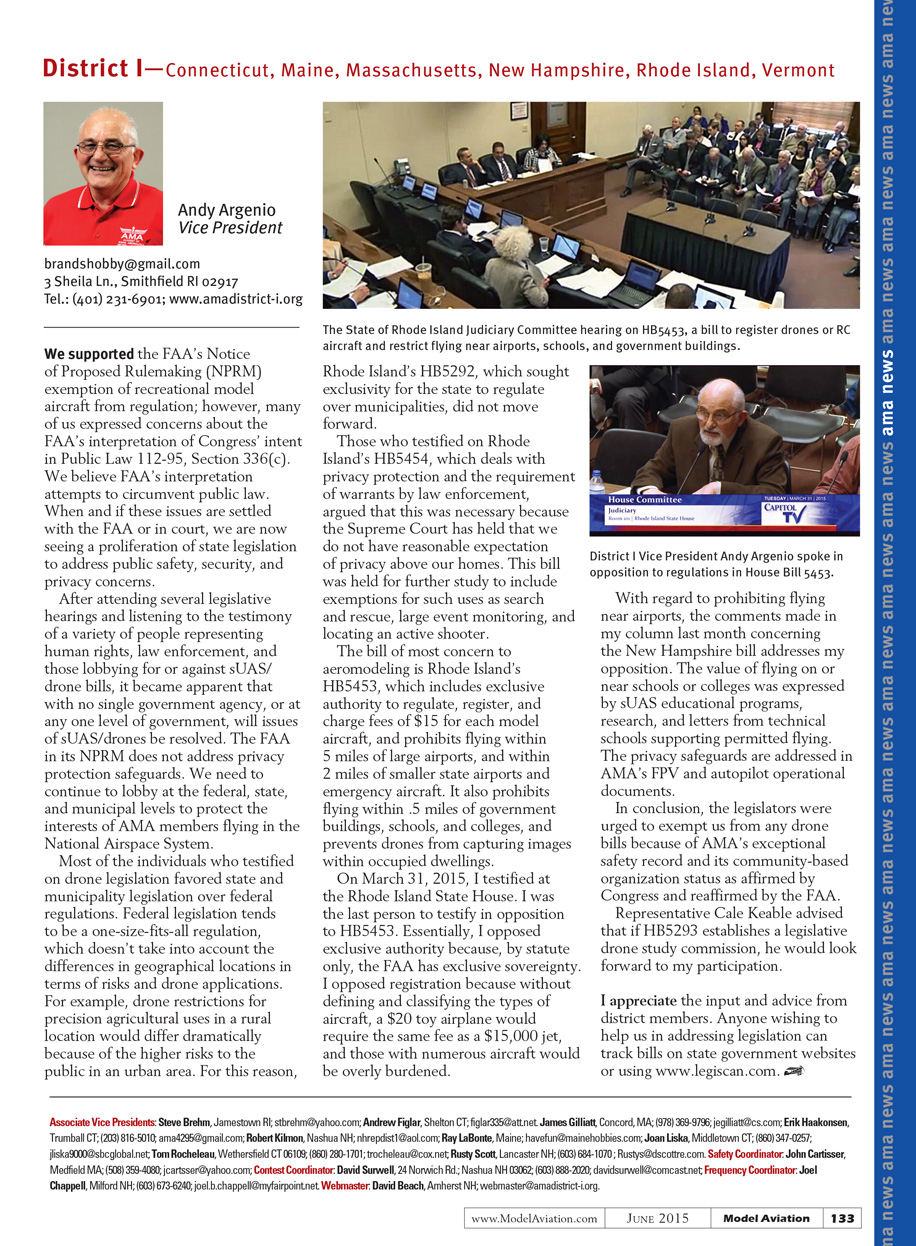
On March 31, 2015, I testified at the Rhode Island State House as the last person in opposition to HB5453. My opposition points included:
- Exclusive authority: by statute, the FAA has exclusive sovereignty over the national airspace.
- Registration: without clearer definitions and aircraft classifications, a $20 toy airplane could face the same fee or regulatory burden as a $15,000 jet; owners with numerous aircraft would be unduly burdened.
Regarding prohibitions on flying near airports, my previous comments (concerning a New Hampshire bill) address my opposition to overly broad distance restrictions. The value of flying at or near schools and colleges was emphasized by sUAS educational programs, research institutions, and letters from technical schools supporting permitted operations. Privacy safeguards for aeromodeling activities are addressed in the AMA’s FPV and autopilot operational documents.
In conclusion, legislators were urged to exempt AMA members from onerous drone bills because of AMA’s strong safety record and its community-based organization status, as affirmed by Congress and reaffirmed by the FAA. Representative Cale Keable advised that if HB5293 establishes a legislative drone study commission, he would welcome my participation. I appreciate the input and advice from district members.
How to help / Stay informed
- Track bills on your state government website.
- Use www.legiscan.com to monitor proposed legislation.
- Contact district leadership if you wish to assist in addressing legislation.
Transcribed from original scans by AI. Minor OCR errors may remain.

