
District I Report - 2009/09
Author
Andy Argenio, District I Vice President; [email protected]
CURRENT ECONOMIC and employment conditions are factors contributing to the decline of memberships in associations engaged in sports, hobbies, and recreational activities. The AMA recognizes that one way to combat membership decline and ensure the future of aeromodeling is to introduce young people to the sport and hobby of model aviation.
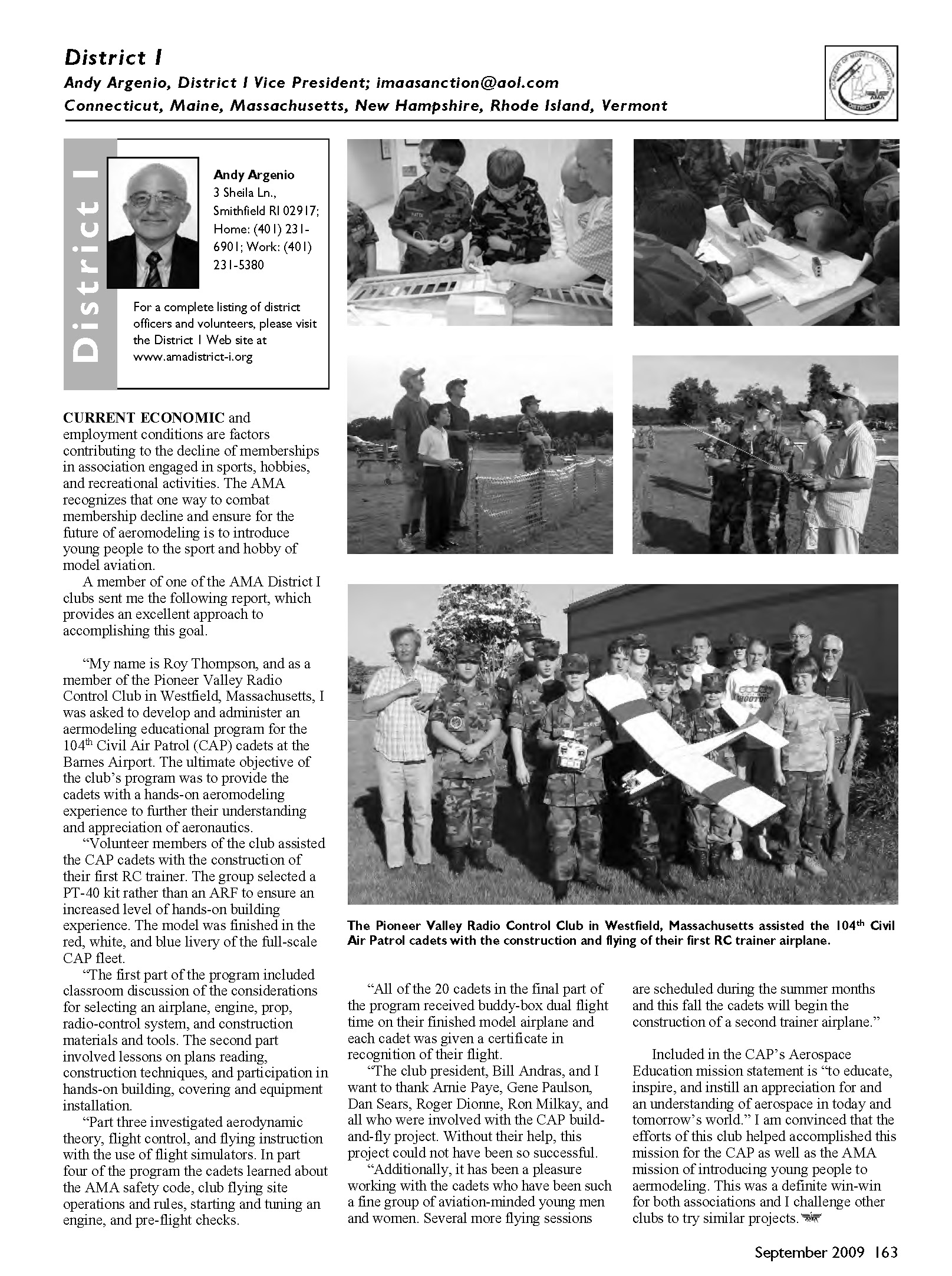
Pioneer Valley R/C Club — CAP Build-and-Fly Project
A member of one of the AMA District I clubs sent the following report, which provides an excellent approach to accomplishing this goal.
Report from Roy Thompson, Pioneer Valley Radio Control Club, Westfield, Massachusetts:
My name is Roy Thompson, and as a member of the Pioneer Valley Radio Control Club in Westfield, Massachusetts, I was asked to develop and administer an aeromodeling educational program for the 104th Civil Air Patrol (CAP) cadets at Barnes Airport. The ultimate objective of the club’s program was to provide the cadets with a hands-on aeromodeling experience to further their understanding and appreciation of aeronautics.
Volunteer members of the club assisted the CAP cadets with the construction of their first RC trainer. The group selected a PT-40 kit rather than an ARF to ensure an increased level of hands-on building experience. The model was finished in the red, white, and blue livery of the full-scale CAP fleet.
The program was organized into the following parts:
- Classroom discussion on considerations for selecting an airplane, engine, prop, radio-control system, and construction materials and tools.
- Lessons on plans reading, construction techniques, and participation in hands-on building, covering, and equipment installation.
- Aerodynamic theory, flight control, and flying instruction using flight simulators.
- Instruction on the AMA safety code, club flying site operations and rules, starting and tuning an engine, and pre-flight checks.
- Flight experience: all 20 cadets in the final part of the program received buddy-box dual flight time on their finished model airplane, and each cadet was given a certificate in recognition of their flight.
The club president, Bill Andras, and I want to thank the following volunteers for their help with the CAP build-and-fly project:
- Arnie Paye
- Gene Paulson
- Dan Sears
- Roger Dionne
- Ron Milkay
- and all others who were involved
Without their help, this project could not have been so successful.
Additionally, it has been a pleasure working with the cadets, who have been a fine group of aviation-minded young men and women. Several more flying sessions are scheduled during the summer months, and this fall the cadets will begin the construction of a second trainer airplane.
Included in the CAP’s Aerospace Education mission statement is “to educate, inspire, and instill an appreciation for and an understanding of aerospace in today and tomorrow’s world.” I am convinced that the efforts of this club helped accomplish this mission for the CAP as well as the AMA mission of introducing young people to aeromodeling. This was a definite win-win for both associations, and I challenge other clubs to try similar projects.
Transcribed from original scans by AI. Minor OCR errors may remain.

