
District II
Dave Mathewson, District II Vice President; [email protected]
- New Jersey
- New York
- Europe
Visiting Park-Flyer Pilots
I hope everyone's outdoor flying season is going well.
I had an interesting experience over the July 4th holiday. A member of the club I fly with—belonging to a virtual online "club" on one of the popular Internet forums—hosted two members who decided to travel during the summer vacation to meet and fly with some of their online peers. They passed through central New York and visited our field.
We spent most of a day flying in some rather difficult conditions, talking modeling, and just generally shooting the breeze as we would on any other day at the field. I even received a little advice from one of our guests on how to improve the setup on my electric T-Rex helicopter.
These visitors fly models commonly referred to as electric-powered park flyers—examples such as Strykers, Slo-Sticks, GWS Corsairs, and Accipiter models. As it turns out, one was an AMA member and the other wasn't. We discussed their perceptions of AMA and why one chose to join while the other did not, even though both could get along quite nicely without belonging. The answer was both eye-opening and a little concerning.
Cost wasn't the issue, nor was the fact that AMA offers several membership benefits they might not fully use. The difference came down to the reception each received when first visiting an AMA club where they live. The club that welcomed a visitor gained a new member. The club that did not only lost a potential member, but may also have given all of us a bit of a black eye.
The camaraderie, social aspects, and sharing of knowledge among people with a common interest made membership worthwhile to the individual who joined.
The visitors also told me about an active thread on an online forum discussing the definition of a modeler—some claiming that you're not a "real" modeler unless you grow your own balsa trees. After spending a day flying with these guys, I can tell you they are as much modelers as you and I. They're active, involved, and obviously successful. They can hold their own flying and would be an asset to any club they chose to join.
Please keep this in mind the next time a newcomer visits your field. We may have different definitions of what makes a true modeler, but the common denominator is our universal affection for model aviation. In the end, that makes us all the same.
Capitol Area Warbirds Over Schenectady Fly-In
In early June, I visited the first annual Capitol Area Warbirds Over Schenectady Fly-In, hosted by the Flying Knights Model Airplane Club of Troy and the Thundervolts RC Club. Frank Alvarez was the event director and Art Arro acted as contest director (CD).
Terrible weather had a dramatic impact on the event and kept entrants to a minimum. Saturday was a complete washout with the area receiving more than 1.2 inches of rain. The few brave pilots who flew on Sunday had to contend with threatening weather and standing water on the runway and in the pit area.
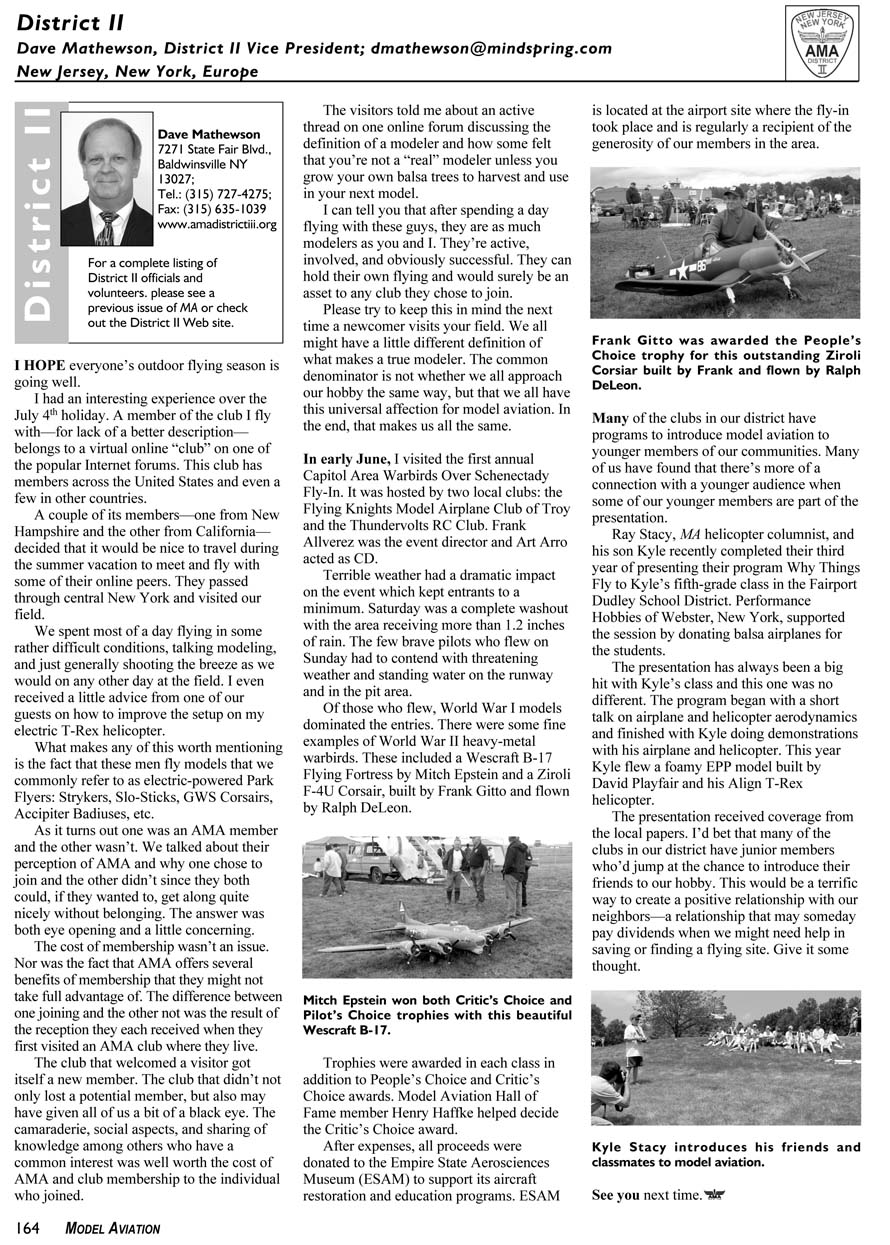
World War I models dominated the entries. There were also some fine examples of World War II heavy-metal warbirds, including a Wescraft B-17 Flying Fortress by Mitch Epstein and a Ziroli F4U Corsair built by Frank Gitto and flown by Ralph DeLeon.
Trophies were awarded in each class, in addition to People's Choice and Critic's Choice awards. Model Aviation Hall of Fame member Henry Haffke helped decide the Critic's Choice award.
After expenses, all proceeds were donated to the Empire State Aerosciences Museum (ESAM) to support aircraft restoration and education programs. ESAM is located at the airport site where the fly-in took place and is regularly a recipient of the generosity of our members in the area.
Youth Outreach — "Why Things Fly"
Many clubs in our district have programs to introduce model aviation to younger members of their communities. We've found there's often more of a connection with a younger audience when some of our junior members are part of the presentation.
Ray Stacy, Model Aviation helicopter columnist, and his son Kyle recently completed their third year presenting "Why Things Fly" to Kyle's fifth-grade class in the Fairport Dudley School District. Performance Hobbies of Webster, New York, supported the session by donating balsa airplanes for the students.
The presentation was a big hit. It began with a short talk on airplane and helicopter aerodynamics and finished with Kyle doing demonstrations with his airplane and helicopter. This year Kyle flew a foamy EPP model built by David Playfair and his Heli T-Rex helicopter.
The presentation received coverage in the local papers. Many clubs in our district have junior members who would jump at the chance to introduce their friends to our hobby. This is a terrific way to create a positive relationship with our neighbors—a relationship that may someday pay dividends when we need help saving or finding a flying site. Give it some thought.
See you next time.
Transcribed from original scans by AI. Minor OCR errors may remain.

