
District III Report - 2004/06
Sometimes I obtain interesting articles from various District III clubs. This month one of these articles highlights a very creative club activity. Greg Girard provided the following information.
Background
In April 2003, members of the Hamilton Wireless Kontrol Society (HAWKS) were discussing the declining number of fliers at their RC events. They noted dwindling participation at club meetings and a lack of interest among youth in the hobby. Having seen the decline for years, they agreed something needed to be done.
The Charity Flyer project
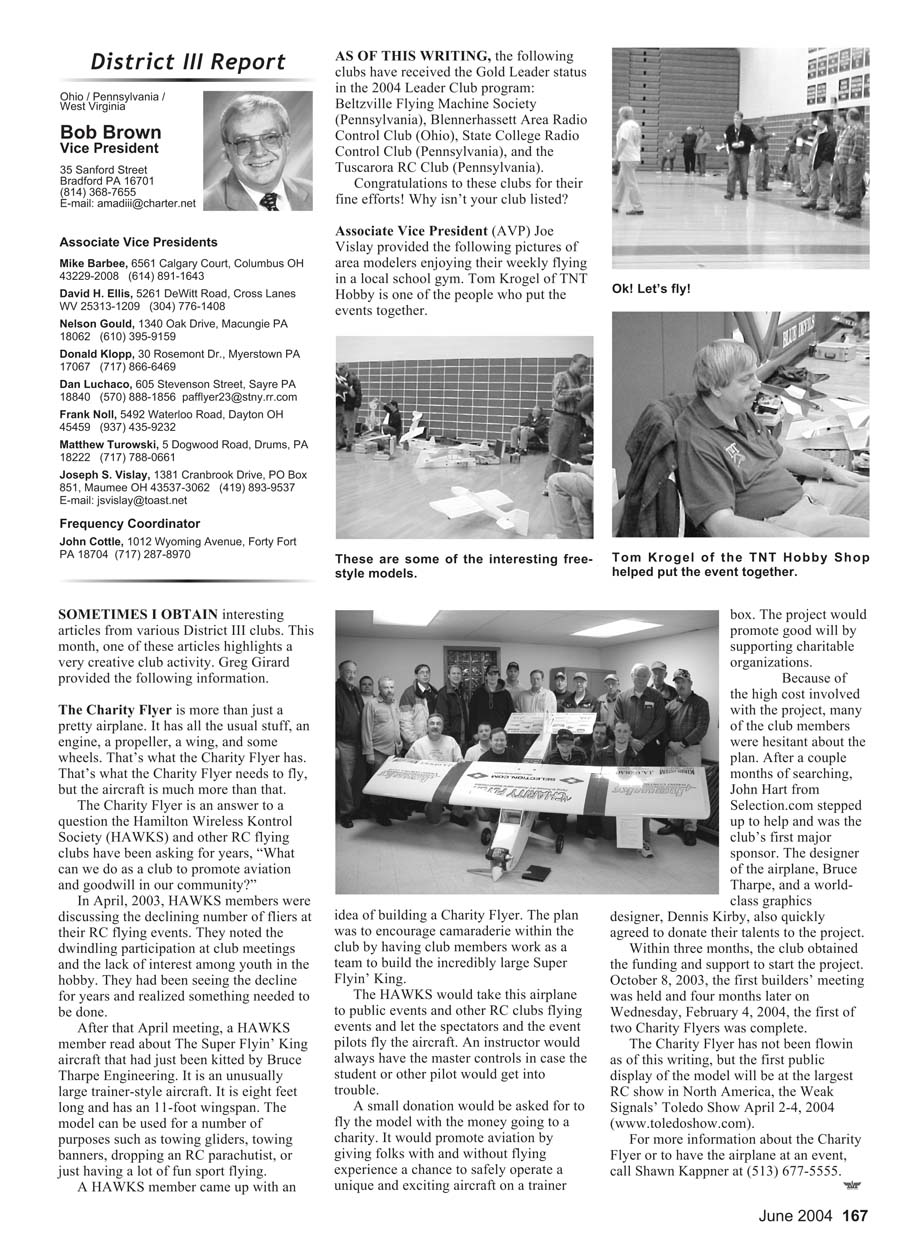
After that April meeting, a HAWKS member read about the Super Flyin' King aircraft recently kitted by Bruce Tharpe Engineering. It is an unusually large trainer-style model: eight feet long with an 11-foot wingspan. The model can be used for several purposes, including:
- towing gliders
- towing banners
- dropping an RC parachutist
- sport flying and general fun
A HAWKS member proposed building a Charity Flyer to promote camaraderie by having club members work together to build the large Super Flyin' King. The plan was to take the airplane to public events and other clubs' flying events and let spectators and visiting pilots fly the model under supervision. An instructor would always have the master controls in case a pilot got into trouble.
A small donation would be requested to fly the model, with proceeds going to charity. The project would promote aviation by giving people with and without flying experience a safe, supervised chance to operate a unique aircraft, and it would promote goodwill by supporting charitable organizations.
Sponsorship and construction
Because of the project's high cost, many club members were hesitant. After a couple of months of searching, John Hart from Selection.com stepped up as the club's first major sponsor. The aircraft designer, Bruce Tharpe, and world-class graphics designer Dennis Kirby also agreed to donate their talents. Within three months the club obtained the funding and support to start the project.
The first builders' meeting was held on October 8, 2003. Four months later, on Wednesday, February 4, 2004, the first of two Charity Flyers was complete.
Public display and contact
As of this writing the Charity Flyer had not yet been flown. Its first public display was scheduled for the Weak Signals' Toledo Show, April 2–4, 2004 (www.toledoshow.com).
For more information about the Charity Flyer or to have the airplane at an event, contact Shawn Kappner at (513) 677-5555.
Transcribed from original scans by AI. Minor OCR errors may remain.

