
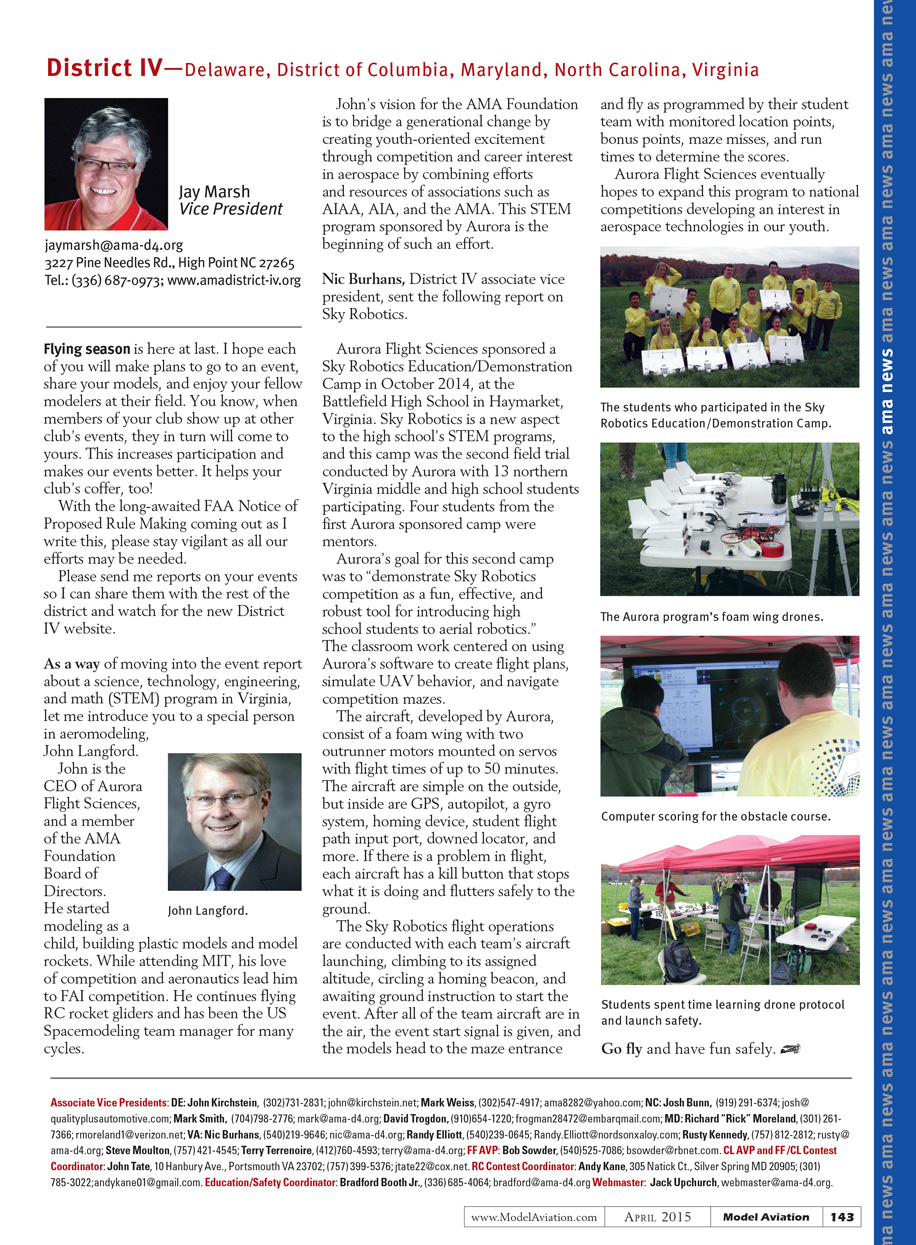
District IV - 2015/04
Jay Marsh Vice President
Flying season is here at last. I hope each of you will make plans to go to an event, share your models, and enjoy your fellow modelers at their field. When members of your club show up at other clubs’ events, those members in turn will come to yours. This increases participation, makes our events better, and helps your club’s coffers.
With the long-awaited FAA Notice of Proposed Rulemaking coming out as I write this, please stay vigilant as all our efforts may be needed.
Please send me reports on your events so I can share them with the rest of the district, and watch for the new District IV website.
John Langford
As a way of moving into the event report about a science, technology, engineering, and math (STEM) program in Virginia, let me introduce you to a special person in aeromodeling, John Langford.
John is the CEO of Aurora Flight Sciences and a member of the AMA Foundation Board of Directors. He started modeling as a child, building plastic models and model rockets. While attending MIT, his love of competition and aeronautics led him to FAI competition. He continues flying RC rocket gliders and has been the U.S. Spacemodeling team manager for many cycles.
John’s vision for the AMA Foundation is to bridge a generational change by creating youth-oriented excitement through competition and career interest in aerospace by combining efforts and resources of associations such as AIAA, AIA, and the AMA. The STEM program sponsored by Aurora is the beginning of that effort.
Nic Burhans, District IV associate vice president, sent the following report on Sky Robotics.
Sky Robotics Education/Demonstration Camp (October 2014)
Aurora Flight Sciences sponsored a Sky Robotics Education/Demonstration Camp in October 2014 at Battlefield High School in Haymarket, Virginia. Sky Robotics is a new component of the high school’s STEM programs, and this camp was the second field trial conducted by Aurora. Thirteen northern Virginia middle and high school students participated. Four students from the first Aurora-sponsored camp also participated as mentors.
Aurora’s goal for this second camp was to “demonstrate Sky Robotics Competition as a fun, effective, and robust tool for introducing high school students to aerial robotics.” The classroom work centered on using Aurora’s software to create flight plans, simulate UAV behavior, and navigate competition mazes.
The aircraft, developed by Aurora, consist of a foam wing with two outrunner motors mounted on servos, with flight times of up to 50 minutes. Externally the aircraft are simple, but internally they include:
- GPS
- Autopilot
- Gyro system
- Homing beacon
- Student flight-path input port
- Downed-aircraft locator
If there is a problem in flight, each aircraft has a kill button that stops what it is doing and allows it to flutter safely to the ground.
Sky Robotics flight operations are conducted as follows:
- Each team’s aircraft launches, climbs to its assigned altitude, circles a homing beacon, and awaits ground instruction to start the event.
- After all team aircraft are in the air, the event start signal is given.
- The models head to the maze entrance and fly as programmed by their student teams.
- Monitored location points, bonus points, maze misses, and run times determine the scores.
Aurora Flight Sciences hopes to expand this program to national competitions to develop interest in aerospace technologies among our youth.
Go fly and have fun safely.
Transcribed from original scans by AI. Minor OCR errors may remain.

