
District IX
Contact
Mark Smith, District IX Vice President [email protected]
States
- Colorado
- Kansas
- Nebraska
- North Dakota
- South Dakota
- Wyoming
I'm sure I'm like many of you in that I subscribe to many modeling magazines. One of my longtime favorites is RC Report. Stu Richmond is one of Gordon's contributing editors and wrote the following in his December 2005 column quoting Dave Platt:
"I reckon those of us who build and fly model airplanes are among the smartest 10% of the people in the world."
I agree with Mr. Platt and I would like to present evidence in support of his theory.
At a weekly breakfast get-together with some fellow RCers, longtime modeler bud Craig Williams brought a tool he had made to add detail to his latest project, a Giant P-47 from Top Flite. Craig is an accomplished scale modeler and has been a judge in the United States Scale Masters events.
Craig likes to experiment with various types of covering material and for this project, because of weight considerations, he elected to cover his fully sheeted airframe in aluminum MonoKote.
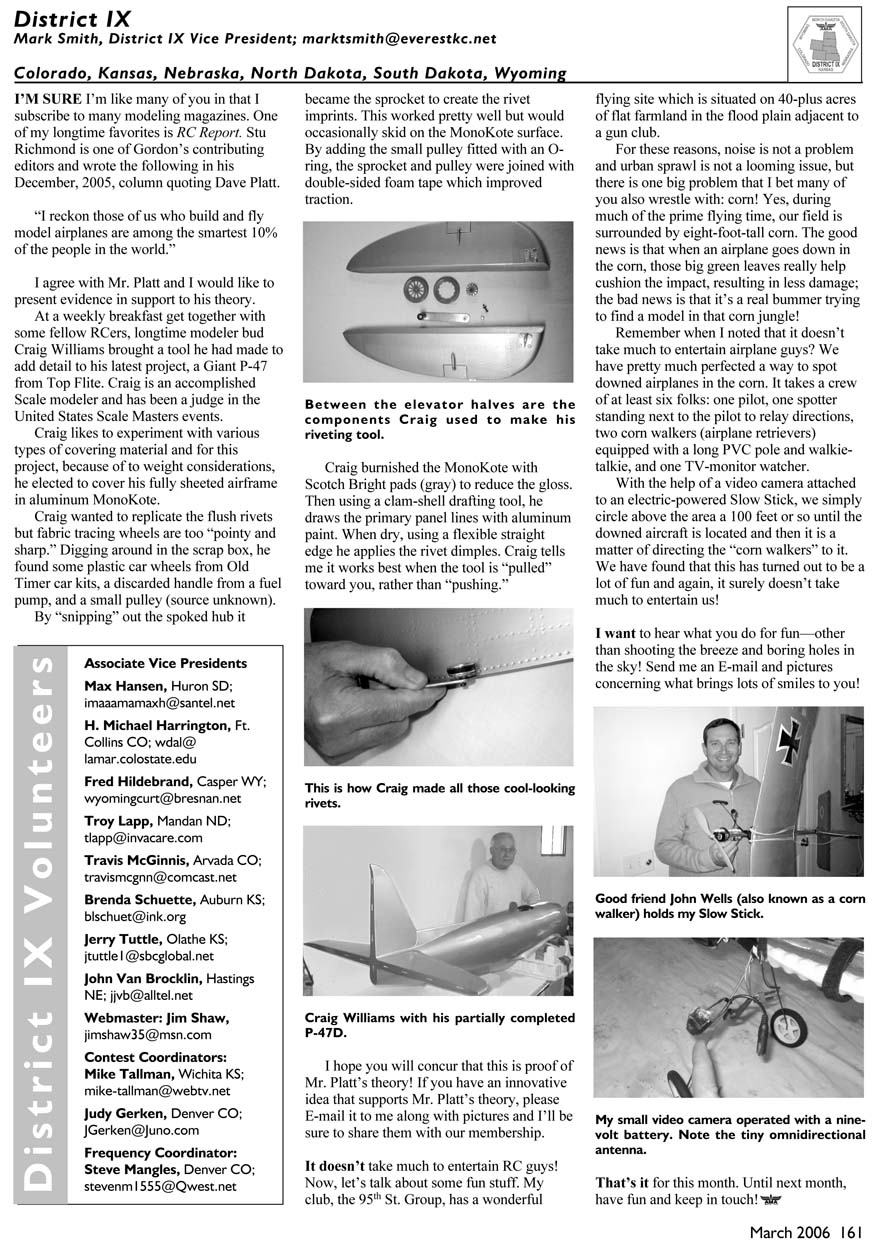
Craig wanted to replicate the flush rivets but fabric tracing wheels are too pointy and sharp. Digging around in the scrap box, he found some plastic car wheels from Old Timer car kits, a discarded handle from a fuel pump, and a small pulley (source unknown). By snipping out the spoked hub it became the sprocket to create the rivet imprints. This worked pretty well but would occasionally skid on the MonoKote surface. By adding the small pulley fitted with an O-ring, the sprocket and pulley were joined with double-sided foam tape which improved traction.
Craig burnished the MonoKote with Scotch-Brite pads (gray) to reduce the gloss. Then, using a clam-shell drafting tool, he draws the primary panel lines with aluminum paint. When dry, using a flexible straight edge he applies the rivet dimples. Craig tells me it works best when the tool is "pulled" toward you, rather than "pushing." This is how Craig made all those cool-looking rivets.
I hope you will concur that this is proof of Mr. Platt's theory! If you have an innovative idea that supports Mr. Platt's theory, please e-mail it to me along with pictures and I'll be sure to share them with our membership.
It doesn't take much to entertain RC guys!
Now, let's talk about some fun stuff. My club, the 95th St. Group, has a wonderful flying site which is situated on 40-plus acres of flat farmland in the flood plain adjacent to a gun club. For these reasons, noise is not a problem and urban sprawl is not a looming issue, but there is one big problem that I bet many of you also wrestle with: corn! Yes, during much of the prime flying time, our field is surrounded by eight-foot-tall corn. The good news is that when an airplane goes down in the corn, those big green leaves really help cushion the impact, resulting in less damage; the bad news is that it's a real bummer trying to find a model in that corn jungle!
Remember when I noted that it doesn't take much to entertain airplane guys? We have pretty much perfected a way to spot downed airplanes in the corn. It takes a crew of at least six folks:
- one pilot,
- one spotter standing next to the pilot to relay directions,
- two corn walkers (airplane retrievers) equipped with a long PVC pole and walkie-talkie,
- and one TV-monitor watcher.
With the help of a video camera attached to an electric-powered Slow Stick, we simply circle above the area at about 100 feet until the downed aircraft is located and then it is a matter of directing the "corn walkers" to it. We have found that this has turned out to be a lot of fun and again, it surely doesn't take much to entertain us!
I want to hear what you do for fun—other than shooting the breeze and boring holes in the sky! Send me an e-mail and pictures concerning what brings lots of smiles to you!
That's it for this month. Until next month, have fun and keep in touch! — MS
Transcribed from original scans by AI. Minor OCR errors may remain.

