
District I—Connecticut, Maine, Massachusetts, New Hampshire, Rhode Island, Vermont
Andy Argenio Vice President
[email protected] 3 Shelia Ln., Smithfield RI 02917 Tel.: (401) 231-6901; www.amadistrict-i.org
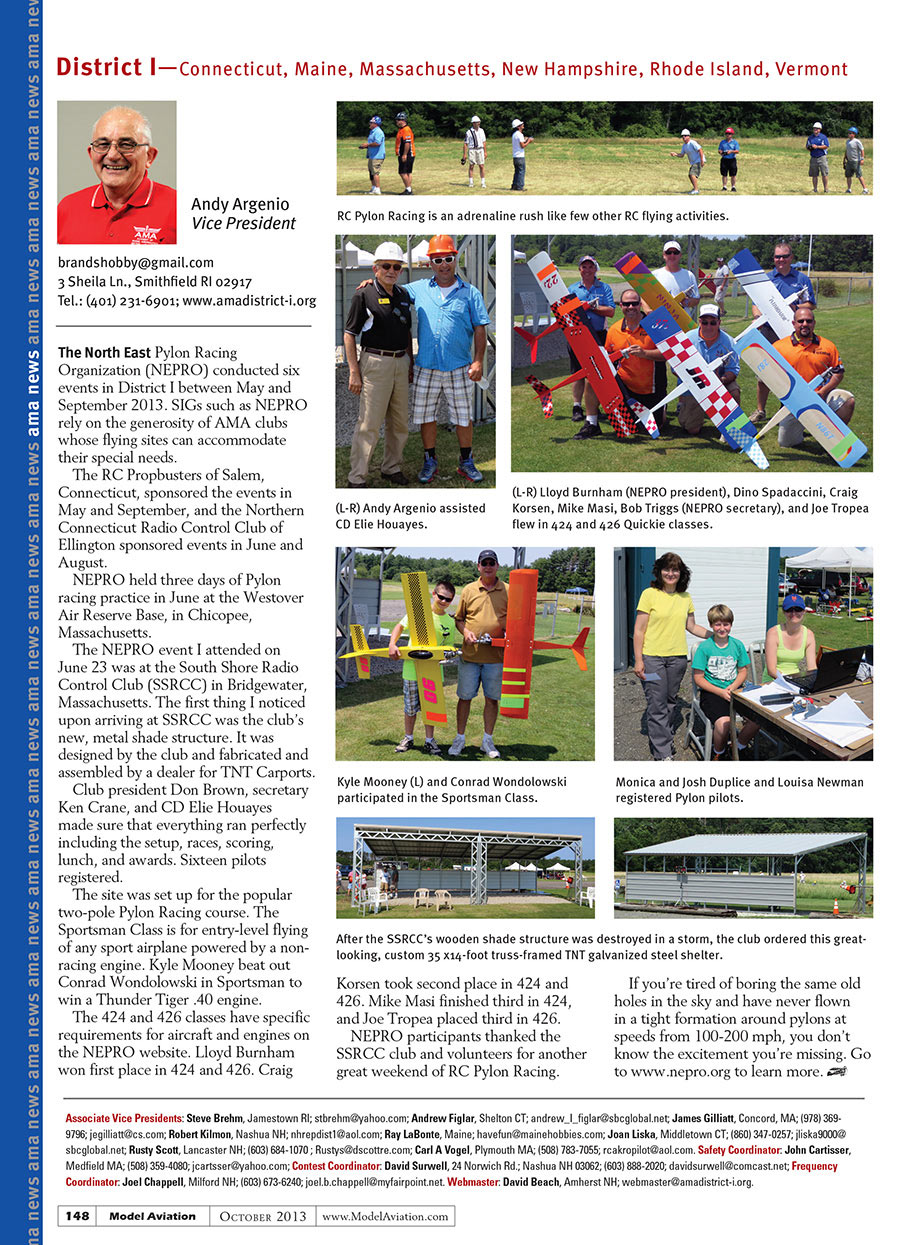
The North East Pylon Racing Organization (NEPRO) conducted six events in District I between May and September 2013. SIGs such as NEPRO rely on the generosity of AMA clubs whose flying sites can accommodate their special needs.
The RC Propbusters of Salem, Connecticut, sponsored the events in May and September, and the Northern Connecticut Radio Control Club of Ellington sponsored events in June and August.
NEPRO held three days of Pylon racing practice in June at the Westover Air Reserve Base, in Chicopee, Massachusetts.
The NEPRO event I attended on June 23 was at the South Shore Radio Control Club (SSRCC) in Bridgewater, Massachusetts. The first thing I noticed upon arriving at SSRCC was the club’s new, metal shade structure. It was designed by the club and fabricated and assembled by a dealer for TNT Carports.
Club president Don Brown, secretary Ken Crane, and CD Elie Houayes made sure that everything ran perfectly including the setup, races, scoring, lunch, and awards. Sixteen pilots registered.
The site was set up for the popular two-pole Pylon Racing course. The Sportsman Class is for entry-level flying of any sport airplane powered by a non-racing engine. Kyle Mooney beat out Conrad Wondolowski in Sportsman to win a Thunder Tiger .40 engine.
The 424 and 426 classes have specific requirements for aircraft and engines on the NEPRO website. Lloyd Burnham won first place in 424 and 426. Craig Korsen took second place in 424 and 426. Mike Masi finished third in 424, and Joe Tropea placed third in 426.
NEPRO participants thanked the SSRCC club and volunteers for another great weekend of RC Pylon Racing.
If you’re tired of boring the same old holes in the sky and have never flown in a tight formation around pylons at speeds from 100-200 mph, you don’t know the excitement you’re missing. Go to www.nepro.org to learn more.
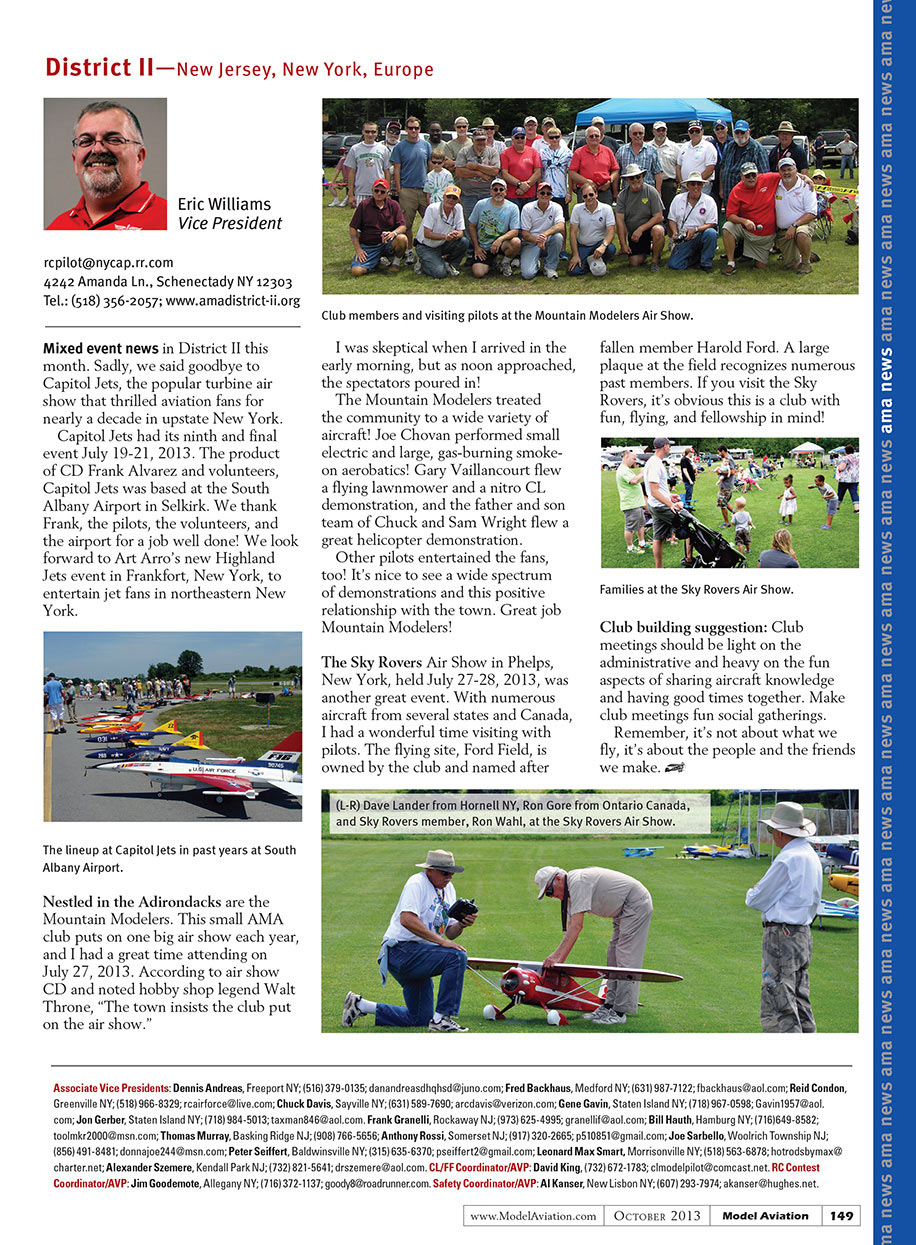
Nestled in the Adirondacks are the Mountain Modelers. This small AMA club puts on one big air show each year, and I had a great time attending on July 27, 2013. According to air show CD and noted hobby shop legend Walt Throne, “The town insists the club put on the air show.”
I was skeptical when I arrived in the early morning, but as noon approached, the spectators poured in!
The Mountain Modelers treated the community to a wide variety of aircraft! Joe Chovan performed small electric and large, gas-burning smoke-on aerobatics; Gary Vaillancourt flew a flying lawnmower and a nitro CL demonstration, and the father and son team of Chuck and Sam Wright flew a great helicopter demonstration.
Other pilots entertained the fans, too! It’s nice to see a wide spectrum of demonstrations and this positive relationship with the town. Great job Mountain Modelers!
The Sky Rovers Air Show in Phelps, New York, held July 27-28, 2013, was another great event. With numerous aircraft from several states and Canada, I had a wonderful time visiting with pilots. The flying site, Ford Field, is owned by the club and named after fallen member Harold Ford. A large plaque at the field recognizes numerous past members. If you visit the Sky Rovers, it’s obvious this is a club with fun, flying, and fellowship in mind!
Club building suggestion: Club meetings should be light on the administrative and heavy on the fun aspects of sharing aircraft knowledge and having good times together. Make club meetings fun social gatherings. Remember, it’s not about what we fly, it’s about the people and the friends we make.
District III — Ohio, Pennsylvania, West Virginia
When I learned that this issue of Model Aviation would feature building models from scratch, I thought it would be nice to include some District III modelers who are award-winning builders, feature their aircraft, and give some insight into how they construct their masterpieces.
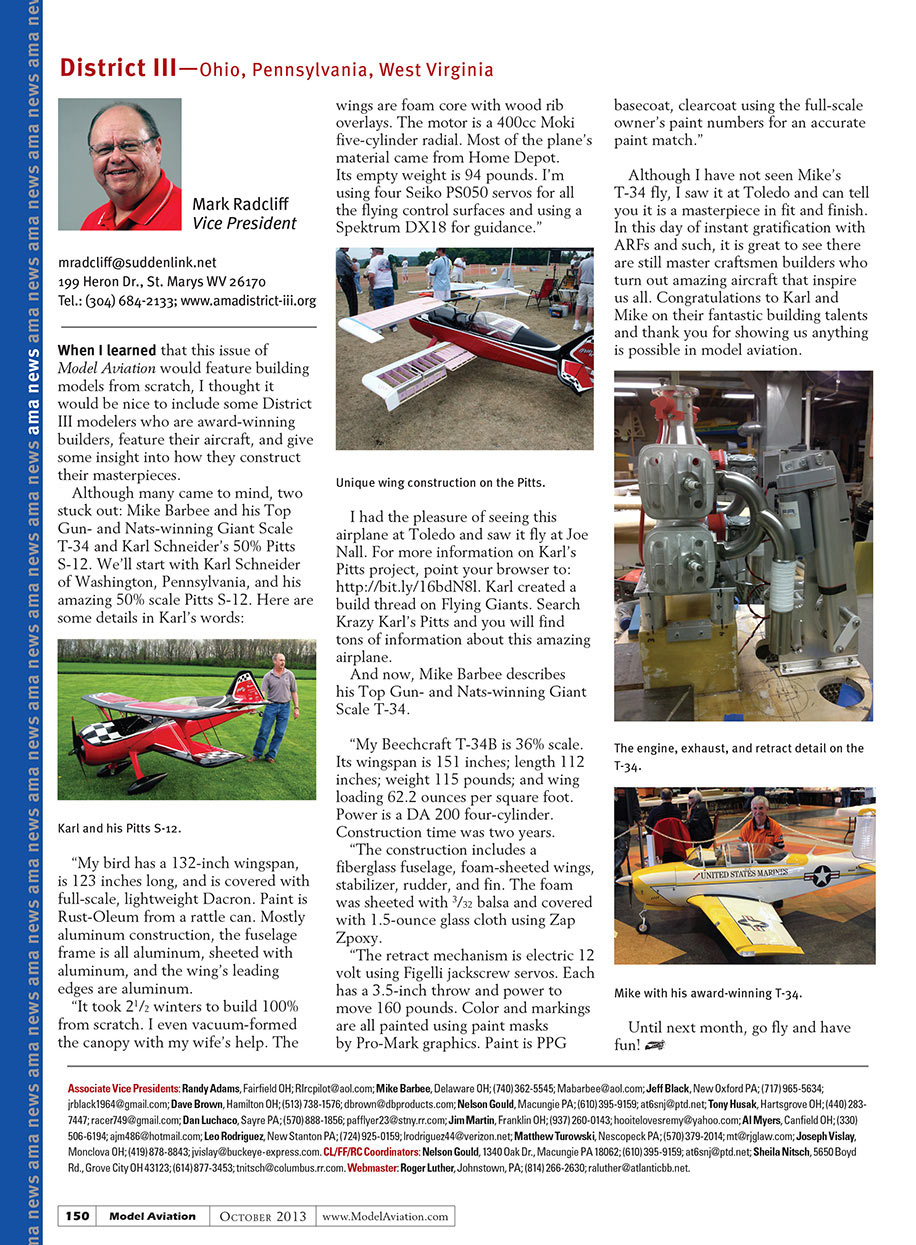
Although many came to mind, two stuck out: Mike Barbee and his Top Gun- and Nats-winning Giant Scale T-34 and Karl Schneider's 50% Pitts S-12. We'll start with Karl Schneider of Washington, Pennsylvania, and his amazing 50% scale Pitts S-12. Here are some details in Karl's words:
"My bird has a 132-inch wingspan, is 123 inches long, and is covered with full-scale, lightweight Dacron. Paint is Rust-Oleum from a rattle can. Mostly aluminum construction, the fuselage frame is all aluminum, sheeted with aluminum, and the wing's leading edges are aluminum.
It took 2½ winters to build 100% from scratch. I even vacuum-formed the canopy with my wife's help. The wings are foam core with wood rib overlays. The motor is a 400cc Moki five-cylinder radial. Most of the plane's material came from Home Depot. Its empty weight is 94 pounds. I'm using four Seiko PS050 servos for all the flying control surfaces and using a Spektrum DX18 for guidance."
I had the pleasure of seeing this airplane at Toledo and saw it fly at Joe Nall. For more information on Karl's Pitts project, point your browser to: http://bit.ly/16bdN8l. Karl created a build thread on Flying Giants. Search Krazy Karl's Pitts and you will find tons of information about this amazing airplane.
And now, Mike Barbee describes his Top Gun- and Nats-winning Giant Scale T-34.
"My Beechcraft T-34B is 36% scale. Its wingspan is 151 inches; length 112 inches; weight 115 pounds; and wing loading 62.2 ounces per square foot. Power is a DA 200 four-cylinder. Construction time was two years.
The construction includes a fiberglass fuselage, foam-sheeted wings, stabilizer, rudder, and fin. The foam was sheeted with 3/32 balsa and covered with 1.5-ounce glass cloth using Zap Epoxy.
The retract mechanism is electric 12 volt using Figelli jackscrew servos. Each has a 3.5-inch throw and power to move 160 pounds. Color and markings are all painted using paint masks by Pro-Mark graphics. Paint is PPG basecoat, clearcoat using the full-scale owner's paint numbers for an accurate paint match."
Although I have not seen Mike's T-34 fly, I saw it at Toledo and can tell you it is a masterpiece in fit and finish. In this day of instant gratification with ARFs and such, it is great to see there are still master craftsmen builders who turn out amazing aircraft that inspire us all. Congratulations to Karl and Mike on their fantastic building talents and thank you for showing us anything is possible in model aviation.
Until next month, go fly and have fun!
District IV—Delaware, District of Columbia, Maryland, North Carolina, Virginia
Bliss Teague Vice President
[email protected] 625 5th Ave. S.W., Hickory NC 28602 Tel.: (828) 324-2164; www.amadistrict-iv.org
Rusty Kennedy submitted a report on a Boy Scout event, held in Virginia.
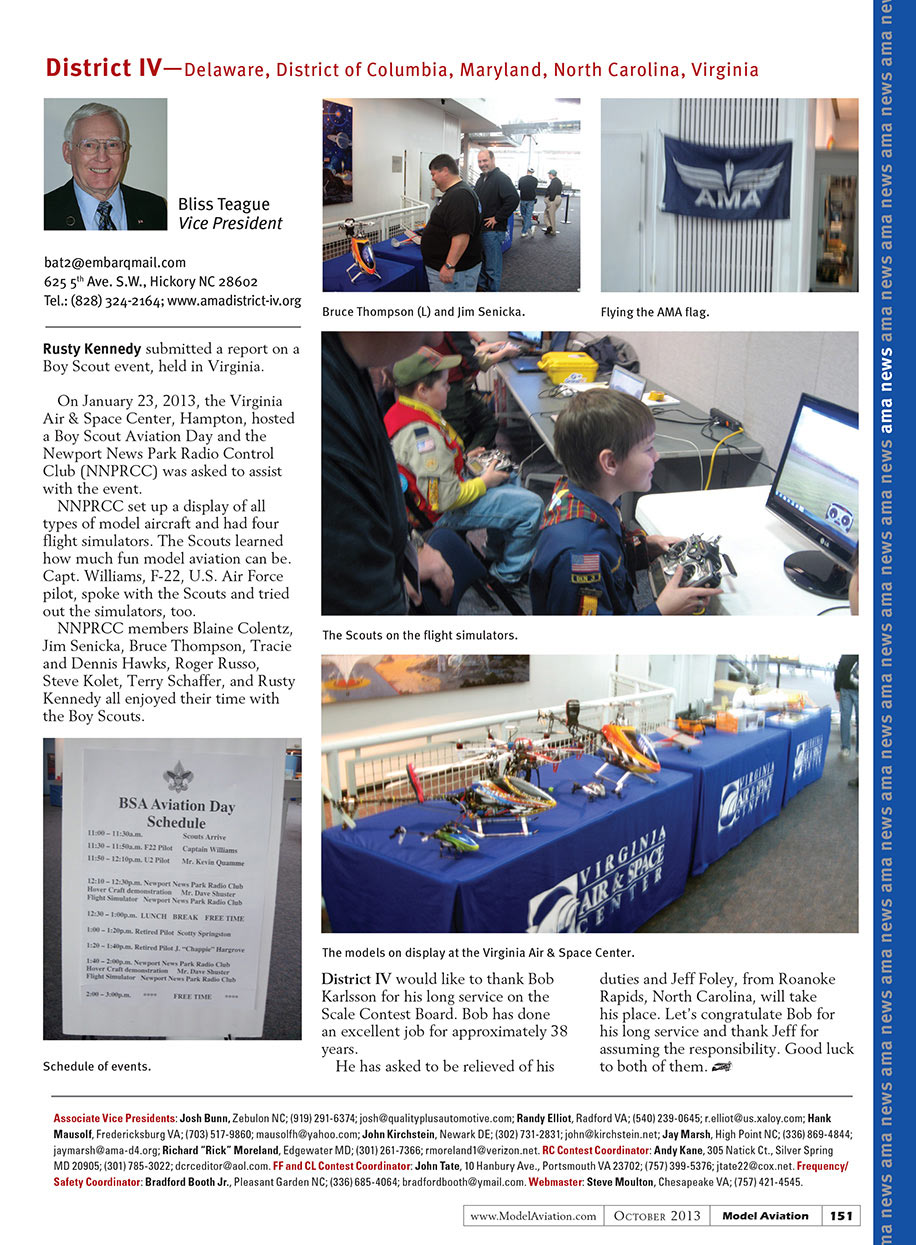
On January 23, 2013, the Virginia Air & Space Center, Hampton, hosted a Boy Scout Aviation Day and the Newport News Park Radio Control Club (NNPRCC) was asked to assist with the event.
NNPRCC set up a display of all types of model aircraft and had four flight simulators. The Scouts learned how much fun model aviation can be. Capt. Williams, F-22, U.S. Air Force pilot, spoke with the Scouts and tried out the simulators, too.
NNPRCC members Blaine Colentz, Jim Senicka, Bruce Thompson, Tracie and Dennis Hawks, Roger Russo, Steve Kolet, Terry Schaffer, and Rusty Kennedy all enjoyed their time with the Boy Scouts.
District IV would like to thank Bob Karlsson for his long service on the Scale Contest Board. Bob has done an excellent job for approximately 38 years.
He has asked to be relieved of his duties and Jeff Foley, from Roanoke Rapids, North Carolina, will take his place. Let's congratulate Bob for his long service and thank Jeff for assuming the responsibility. Good luck to both of them.
District V—Alabama, Florida, Georgia, Mississippi, Puerto Rico, South Carolina, Tennessee, US Virgin Islands
Jose Soto Vice President
[email protected] 1930 Deanna Dr., Apopka FL 32703 Tel.: (407) 409-4795; www.amadistrict-v.org
Hello District V!
This has been a busy month and you are all amazing! There is so much variety in what we in District V do that I would need a few more pages to bring you everything!
The 2nd Annual AMA District V Airfest is coming in November, so mark your calendars! Here are some of the reports sent in by your district associate vice presidents (AVPs)!
Andy Griffith sent in this report.
On July 27-28 I had the pleasure of attending the 13th annual Youth Masters, held at the Triple Tree Aerodrome in Woodruff, South Carolina. The event and its sponsors, including the International Miniature Aerobatic Club (IMAC) and the Triple Tree Aero Modelers, host this great gathering in the hopes of igniting a passion for IMAC competition in our young pilots.
The event is open to modelers up to age 16. There is no cost for pilots, and all they need is a desire to fly. Sponsors such as Chief Aircraft, Extreme Flight RC, and others ensure that IMAC-capable airplanes are available and that all of the kids fly their sequences with the aircraft provided by the event staff. Several meals are also provided for the pilots and volunteers and most camped on-site the entire weekend.
Two formal classes, Basic and Advanced, were run as well as a foamie freestyle competition that took place under the lights Saturday night.
Students were instructed, judged, and taught by IMAC notables such as the president, Wayne Mathews, Mark McClellan, and others who have competed and judged IMAC at the highest levels in the country.
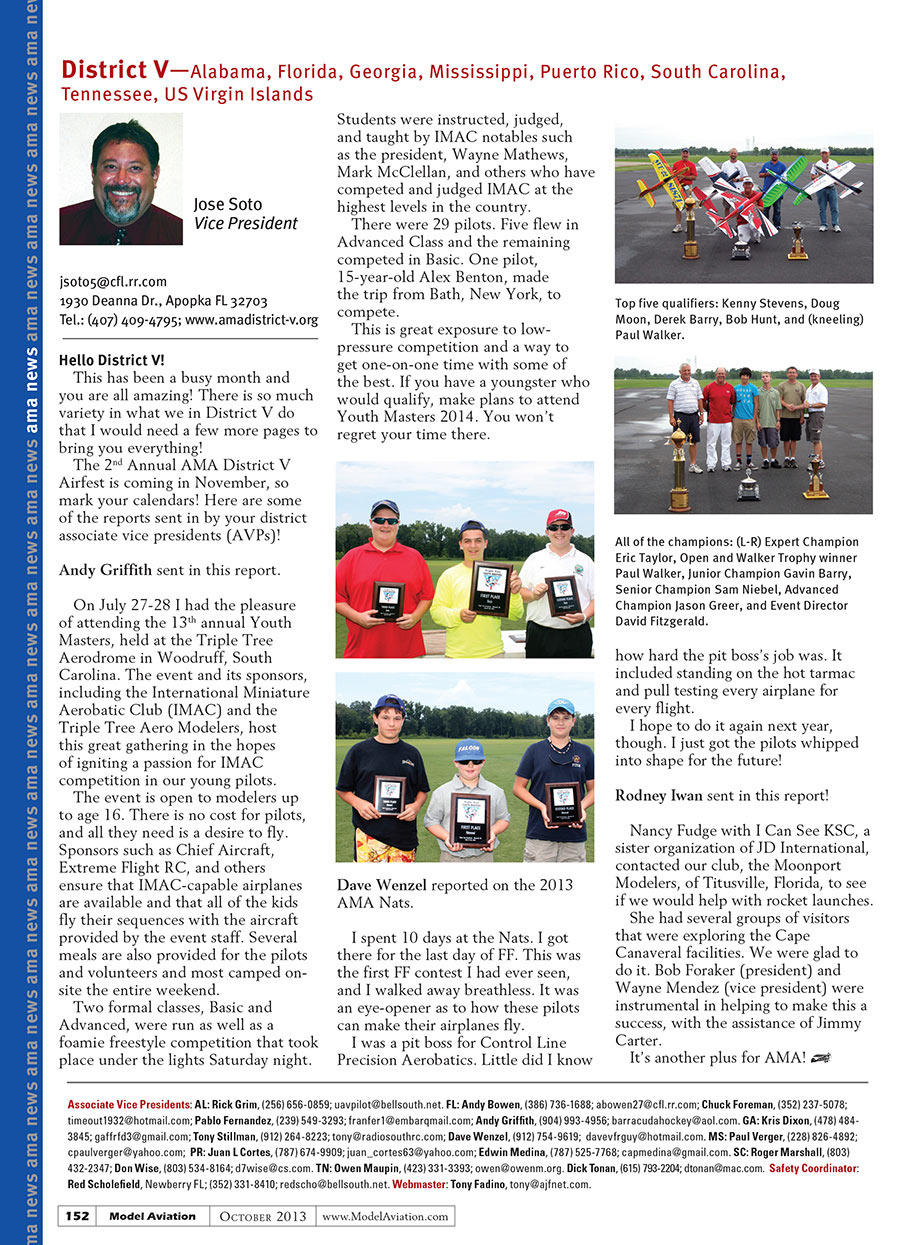
There were 29 pilots. Five flew in Advanced Class and the remaining competed in Basic. One pilot, 15-year-old Alex Benton, made the trip from Bath, New York, to compete.
This is great exposure to low-pressure competition and a way to get one-on-one time with some of the best. If you have a youngster who would qualify, make plans to attend Youth Masters 2014. You won't regret your time there.
Dave Wenzel reported on the 2013 AMA Nats.
I spent 10 days at the Nats. I got there for the last day of FF. This was the first FF contest I had ever seen, and I walked away breathless. It was an eye-opener as to how these pilots can make their airplanes fly.
I was a pit boss for Control Line Precision Aerobatics. Little did I know how hard the pit boss's job was. It included standing on the hot tarmac and pull testing every airplane for every flight.
I hope to do it again next year, though. I just got the pilots whipped into shape for the future!
Rodney Iwan sent in this report!
Nancy Fudge with I Can See KSC, a sister organization of JD International, contacted our club, the Moonport Modelers, of Titusville, Florida, to see if we would help with rocket launches.
She had several groups of visitors that were exploring the Cape Canaveral facilities. We were glad to do it. Bob Foraker (president) and Wayne Mendez (vice president) were instrumental in helping to make this a success, with the assistance of Jimmy Carter.
It's another plus for AMA!
District VI—Kentucky, Illinois, Indiana, Missouri
Randy Cameron Vice President
[email protected] 2134 S. Hillcrest Ave., Springfield MO 65807 Tel.: (417) 830-9211; www.amadistrict-vi.org
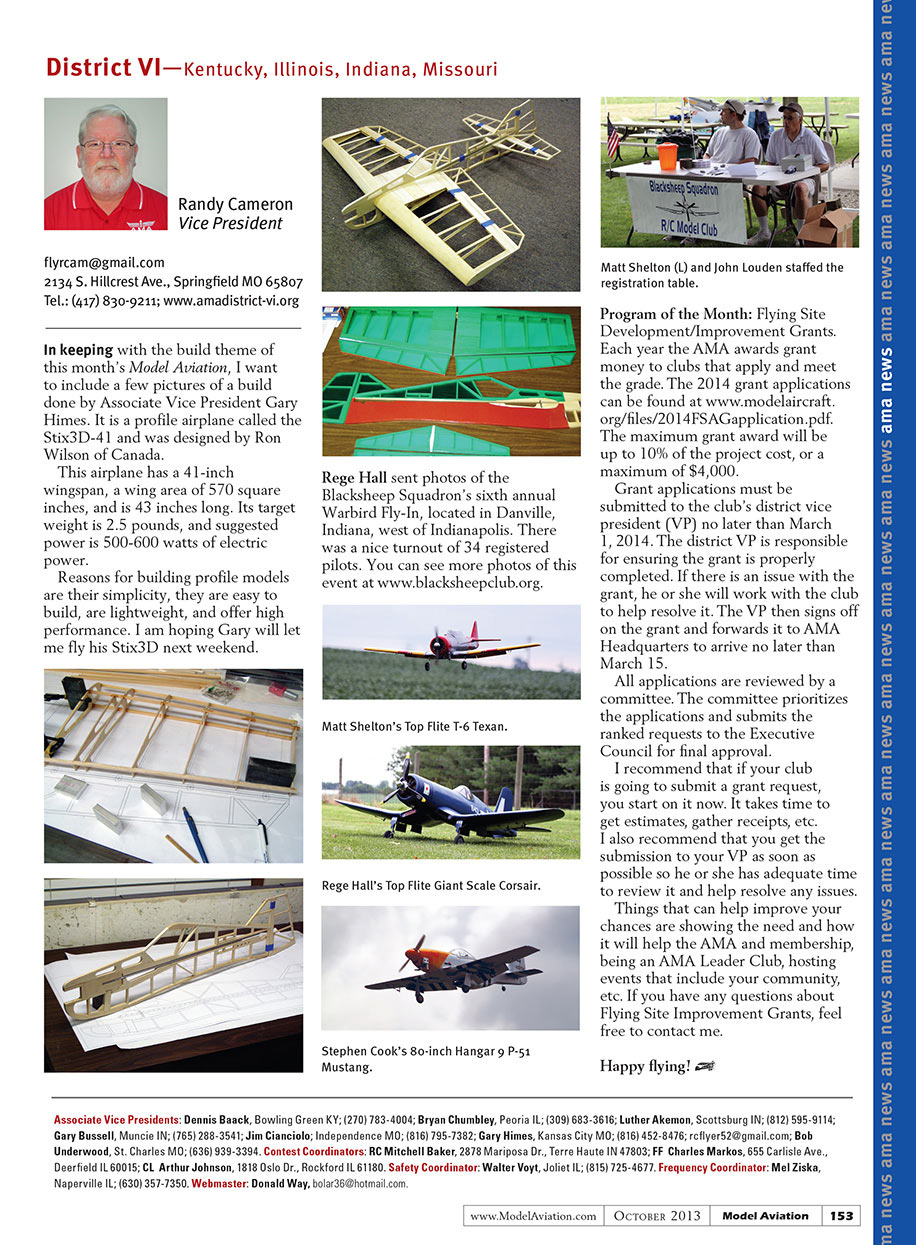
In keeping with the build theme of this month's Model Aviation, I want to include a few pictures of a build done by Associate Vice President Gary Himes. It is a profile airplane called the Stix3D-41 and was designed by Ron Wilson of Canada.
This airplane has a 41-inch wingspan, a wing area of 570 square inches, and is 43 inches long. Its target weight is 2.5 pounds, and suggested power is 500-600 watts of electric power.
Reasons for building profile models are their simplicity, they are easy to build, are lightweight, and offer high performance. I am hoping Gary will let me fly his Stix3D next weekend.
Rege Hall sent photos of the Blacksheep Squadron's sixth annual Warbird Fly-In, located in Danville, Indiana, west of Indianapolis. There was a nice turnout of 34 registered pilots. You can see more photos of this event at www.blacksheepclub.org.
Program of the Month: Flying Site Development/Improvement Grants. Each year the AMA awards grant money to clubs that apply and meet the grade. The 2014 grant applications can be found at www.modelaircraft.org/files/2014FSAGapplication.pdf. The maximum grant award will be up to 10% of the project cost, or a maximum of $4,000.
Grant applications must be submitted to the club's district vice president (VP) no later than March 1, 2014. The district VP is responsible for ensuring the grant is properly completed. If there is an issue with the grant, he or she will work with the club to help resolve it. The VP then signs off on the grant and forwards it to AMA Headquarters to arrive no later than March 15.
All applications are reviewed by a committee. The committee prioritizes the applications and submits the ranked requests to the Executive Council for final approval.
I recommend that if your club is going to submit a grant request, you start on it now. It takes time to get estimates, gather receipts, etc. I also recommend that you get the submission to your VP as soon as possible so he or she has adequate time to review it and help resolve any issues.
Things that can help improve your chances are showing the need and how it will help the AMA and membership, being an AMA Leader Club, hosting events that include your community, etc. If you have any questions about Flying Site Improvement Grants, feel free to contact me.
Happy flying!
Associate Vice Presidents: Dennis Baack, Bowling Green KY; (270) 783-4004; Bryan Chumbley, Peoria IL; (309) 683-3616; Luther Akemon, Scottsburg IN; (812) 595-9114; Gary Bussell, Muncie IN; (765) 288-3541; Jim Cianciolo, Independence MO; (816) 795-7382; Gary Himes, Kansas City MO; (816) 452-8476; [email protected]; Bob Underwood, St. Charles MO; (636) 393-3394. Contest Coordinators: RC Mitchell Baker, 2878 Mariposa Dr., Terre Haute IN 47803; FF Charles Marks, 655 Carlisle Ave., Deerfield IL 60015; CL Arthur Johnson, 1181 Oslo Dr., Rockford IL 61108. Safety Coordinator: Walter Voyt, Joliet IL; (815) 725-4677. Frequency Coordinator: Mel Ziska, Naperville IL; (630) 357-7350. Webmaster: Donald Way, [email protected].
Flying sites and neighbors—that can certainly be a touchy subject for all parties concerned. How clubs and members approach it can have a huge impact on the type of relationship that develops.
Our flying fields were originally located away from populated areas and often out in the middle of nowhere. The trouble today is that the middle of nowhere is disappearing in many parts of our district and remote locations are becoming difficult to find. I often hear about clubs located in remote areas suddenly finding a home or business being built near or adjacent to their fields.
I urge all of you to reach out to your neighbors—both new and old. Invite them over to the field, your events, or offer to teach them how to fly and get the chance to know each other. Of course that’s by no means a guarantee of a marriage-made-in-heaven relationship, but you’ll at least have a good idea where they stand.
Good reading for all on this subject can be found in the AMA documents section at www.modelaircraft.org/files/2012RevisedModelFliersandNeighborsDOC.pdf.
Before I turn the show over to Associate Vice President Bud Gorman to report on a project he worked on up in his neck of the woods, I want to give a huge shout out and thanks to all who participated in National Model Aviation Day. You helped us all stand tall.
Bud submitted a report about a CL model airplane build, held in July 2013. Here’s what he had to say:
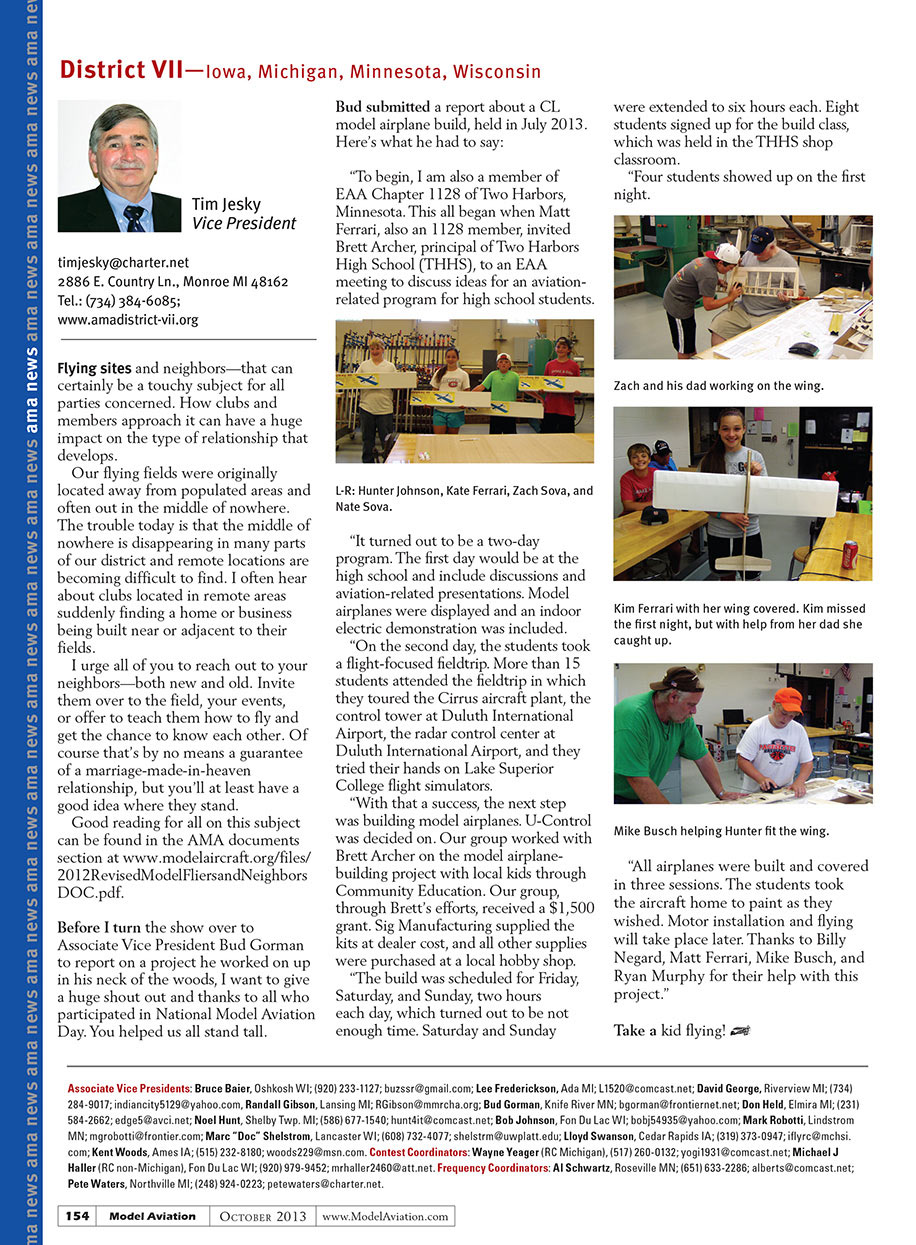
“To begin, I am also a member of EAA Chapter 1128 of Two Harbors, Minnesota. This all began when Matt Ferrari, also an 1128 member, invited Brett Archer, principal of Two Harbors High School (THHS), to an EAA meeting to discuss ideas for an aviation-related program for high school students.
“It turned out to be a two-day program. The first day would be at the high school and include discussions and aviation-related presentations. Model airplanes were displayed and an indoor electric demonstration was included.
“On the second day, the students took a flight-focused fieldtrip. More than 15 students attended the fieldtrip in which they toured the Cirrus aircraft plant, the control tower at Duluth International Airport, the radar control center at Duluth International Airport, and they tried their hands on Lake Superior College flight simulators.
“With that a success, the next step was building model airplanes. U-Control was decided on. Our group worked with Brett Archer on the model airplane-building project with local kids through Community Education. Our group, through Brett’s efforts, received a $1,500 grant. Sig Manufacturing supplied the kits at dealer cost, and all other supplies were purchased at a local hobby shop.
“The build was scheduled for Friday, Saturday, and Sunday, two hours each day, which turned out to be not enough time. Saturday and Sunday were extended to six hours each. Eight students signed up for the build class, which was held in the THHS shop classroom.
“Four students showed up on the first night.
“All airplanes were built and covered in three sessions. The students took the aircraft home to paint as they wished. Motor installation and flying will take place later. Thanks to Billy Negard, Matt Ferrari, Mike Busch, and Ryan Murphy for their help with this project.”
Take a kid flying!
District News
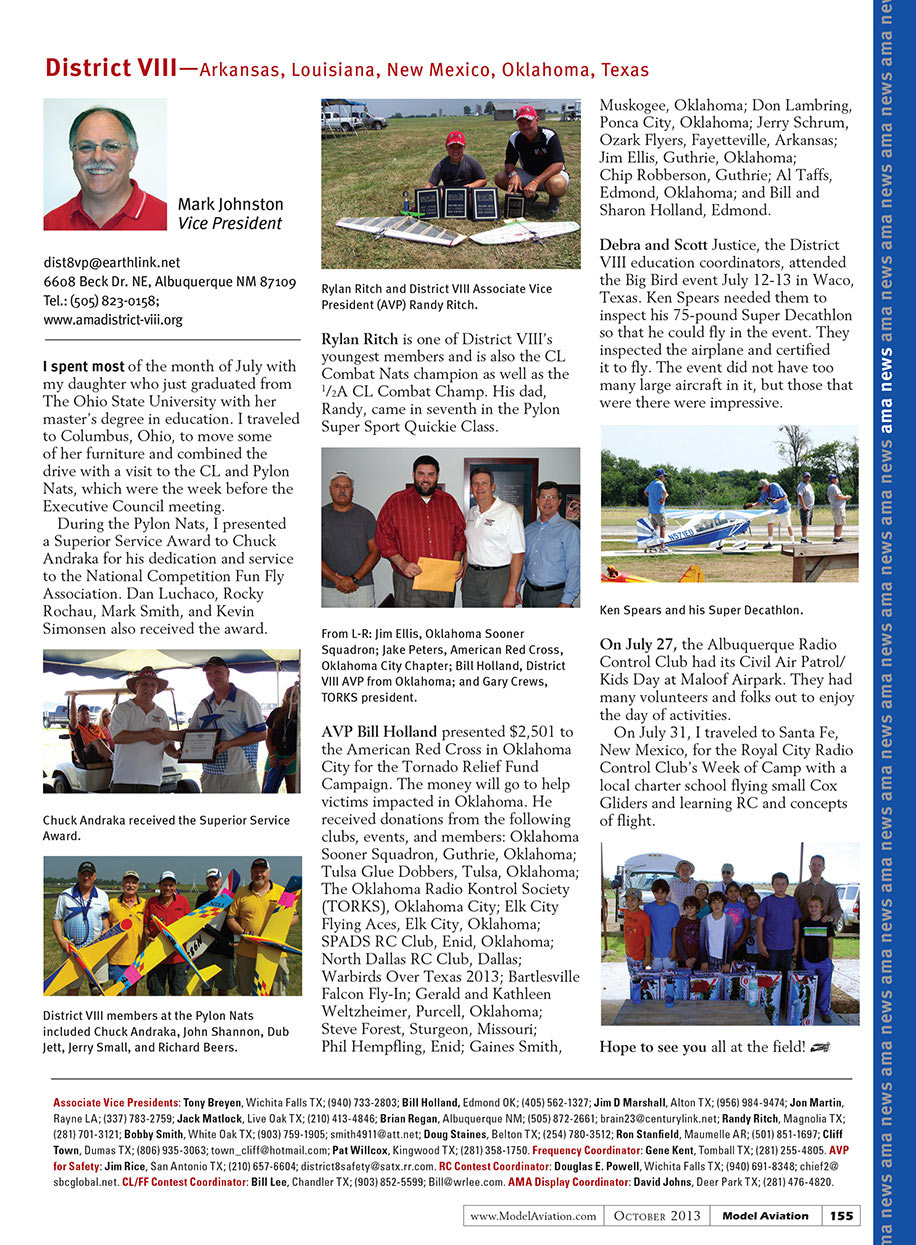
Rylan Ritch is one of District VIII’s youngest members and is also the CL Combat Nats champion as well as the 1/2A CL Combat Champ. His dad, Randy, came in seventh in the Pylon Super Sport Quickie Class.
AVP Bill Holland presented $2,501 to the American Red Cross in Oklahoma City for the Tornado Relief Fund Campaign. The money will go to help victims impacted in Oklahoma. He received donations from the following clubs, events, and members: Oklahoma Sooner Squadron, Guthrie, Oklahoma; Tulsa Glue Dobbers, Tulsa, Oklahoma; The Oklahoma Radio Kontrol Society (TORKS), Oklahoma City; Elk City Flying Aces, Elk City, Oklahoma; SPADS RC Club, Enid, Oklahoma; North Dallas RC Club, Dallas; Warbirds Over Texas 2013; Bartlesville Falcon Fly-In; Gerald and Kathleen Weltzheimer, Purcell, Oklahoma; Steve Forrest, Sturgeon, Missouri; Phil Hempfling, Enid; Gaines Smith, Muskogee, Oklahoma; Don Lambring, Ponca City, Oklahoma; Jerry Schrum, Ozark Flyers, Fayetteville, Arkansas; Jim Ellis, Guthrie, Oklahoma; Chip Robberson, Guthrie; Al Taffs, Edmond, Oklahoma; and Bill and Sharon Holland, Edmond.
Debra and Scott Justice, the District VIII education coordinators, attended the Big Bird event July 12-13 in Waco, Texas. Ken Spears needed them to inspect his 75-pound Super Decathlon so that he could fly in the event. They inspected the airplane and certified it to fly. The event did not have too many large aircraft in it, but those that were there were impressive.
On July 27, the Albuquerque Radio Control Club had its Civil Air Patrol/Kids Day at Maloof Airpark. They had many volunteers and folks out to enjoy the day of activities.
On July 31, I traveled to Santa Fe, New Mexico, for the Royal City Radio Control Club’s Week of Camp with a local charter school flying small Cox Gliders and learning RC and concepts of flight.
Hope to see you all at the field!
District IX—Colorado, Kansas, Nebraska, North Dakota, South Dakota, Wyoming
Jim Wallen Vice President
[email protected] 7322 W 82nd Way, Arvada CO 80003 Tel.: (303) 421-9061; www.amadistrict-ix.org
Occasionally we receive news that is difficult to pass along. Linda Kegel sent me a note that is in that category. Linda is a member of the F-Skylarks Control Line club from Fargo, North Dakota, and sent information about losing a founding member of the club.
The club has lost Mike Olson of Fargo who was a life-long aeromodeler, a club founder, and well-respected man in the Fargo area. The club has bought an AMA Walk of Fame brick in honor of Mike and will dedicate it at the annual contest.
Modeling is not always limited to aeromodeling. Other modeling endeavors have much in common and it seems to make sense to share the common ground.
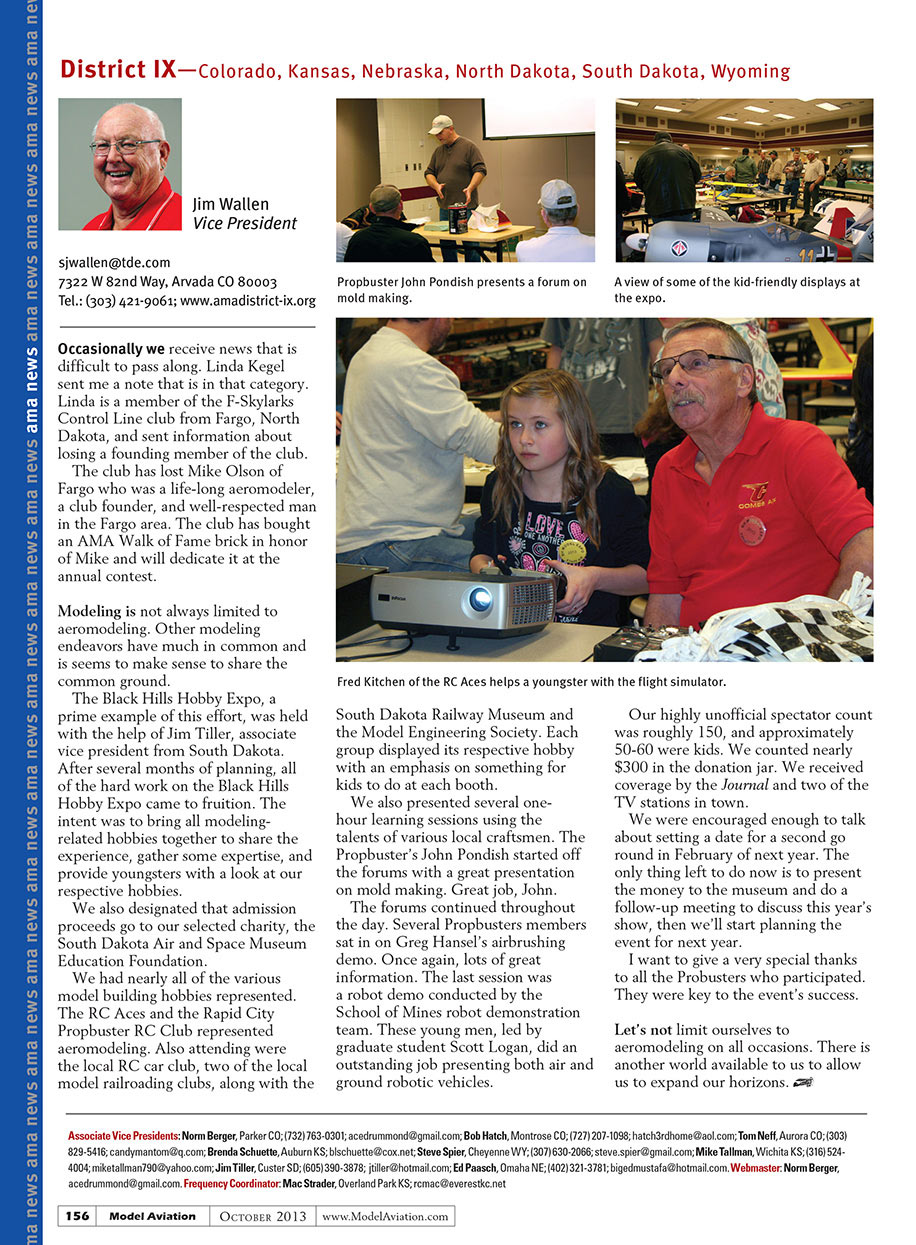
The Black Hills Hobby Expo, a prime example of this effort, was held with the help of Jim Tiller, associate vice president from South Dakota. After several months of planning, all of the hard work on the Black Hills Hobby Expo came to fruition. The intent was to bring all modeling-related hobbies together to share the experience, gather some expertise, and provide youngsters with a look at our respective hobbies.
We also designated that admission proceeds go to our selected charity, the South Dakota Air and Space Museum Education Foundation.
We had nearly all of the various model building hobbies represented. The RC Aces and the Rapid City Propbusters RC Club represented aeromodeling. Also attending were the local RC car club, two of the local model railroading clubs, along with the South Dakota Railway Museum and the Model Engineering Society. Each group displayed its respective hobby with an emphasis on something for kids to do at each booth.
We also presented several one-hour learning sessions using the talents of various local craftsmen. The Propbuster's John Pondish started off the forums with a great presentation on mold making. Great job, John.
The forums continued throughout the day. Several Propbusters members sat in on Greg Hansel’s airbrushing demo. Once again, lots of great information. The last session was a robot demo conducted by the School of Mines robot demonstration team. These young men, led by graduate student Scott Logan, did an outstanding job presenting both air and ground robotic vehicles.
Our highly unofficial spectator count was roughly 150, and approximately 50-60 were kids. We counted nearly $300 in the donation jar. We received coverage by the Journal and two of the TV stations in town.
We were encouraged enough to talk about setting a date for a second go round in February of next year. The only thing left to do now is to present the money to the museum and do a follow-up meeting to discuss this year's show, then we'll start planning the event for next year.
I want to give a very special thanks to all the Propbusters who participated. They were key to the event's success.
Let's not limit ourselves to aeromodeling on all occasions. There is another world available to us to allow us to expand our horizons.
District News
and get some great advice from past World Championships team member and current District III Vice President Mark Radcliff. Sunday evening was the pilots’ meeting and ice cream social, sponsored by F3A Unlimited.
The RC Aerobatics Nats competition includes the three-highest AMA classes: Intermediate, Advanced, and Masters, along with FAI. The Intermediate and Advanced contestants fly two rounds each on Monday, Tuesday, and Wednesday for a total of six rounds. Masters and FAI do the same, but then hold the finals on Thursday with the top-ranked pilots flying.
On Wednesday night, the results of Intermediate and Advanced were announced at a banquet. Also, the names of the pilots for the final rounds of Masters and FAI were announced and the FAI Unknown sequence was given to the pilots.
For my first Nats, I set a goal to finish in the top half of the field, which I accomplished. I had the best time, beyond my expectations. The camaraderie and cooperation between competitors was a pleasure to see.
Scott McNickel, a pilot whom I was flying against, volunteered to call for me. That meant telling me which maneuver to fly and how to optimize it for the best score. Scott did this for all six rounds although we were competing head to head. That’s the kind of sportsmanship.
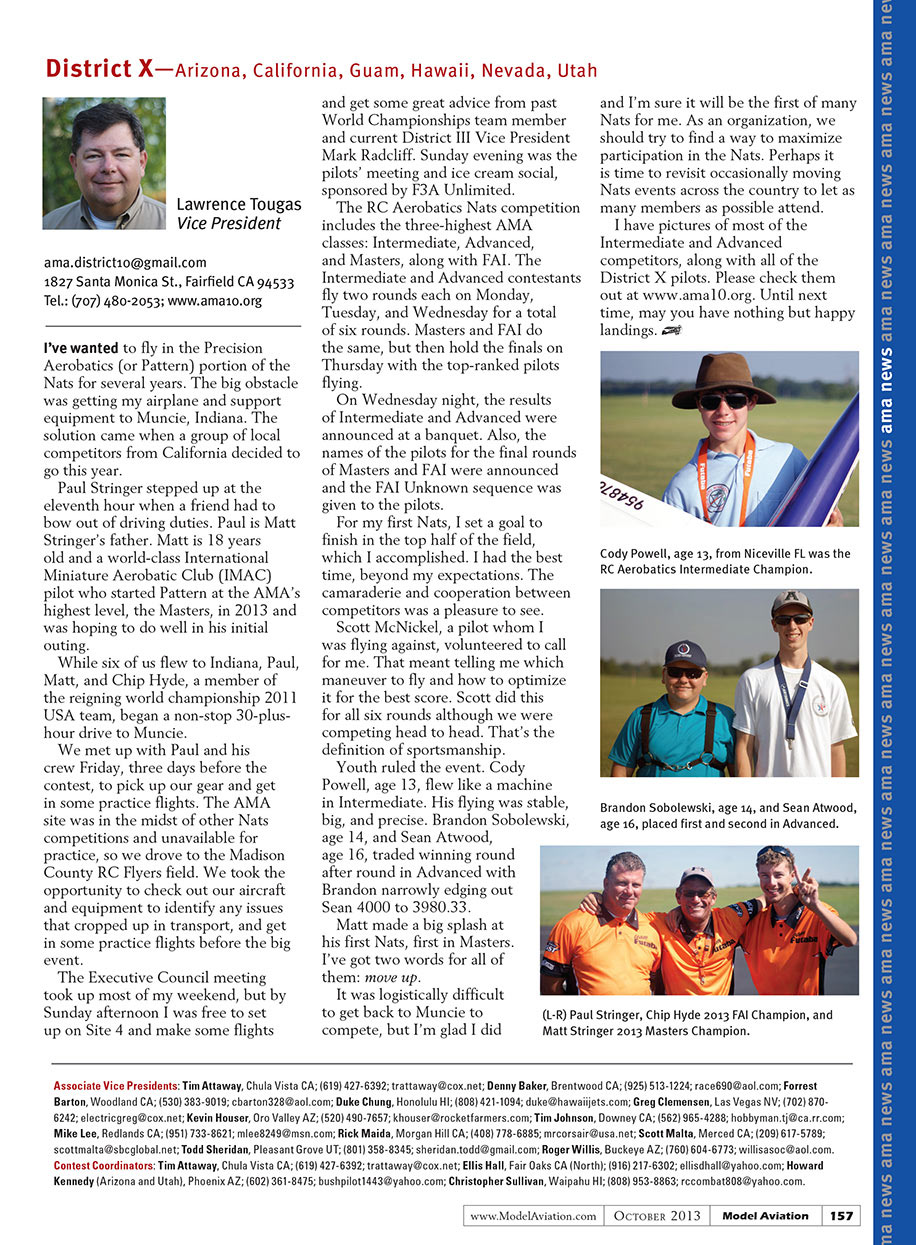
Youth ruled the event. Cody Powell, age 13, flew like a machine in Intermediate. His flying was stable, big, and precise. Brandon Sobolewski, age 14, and Sean Atwood, age 16, traded winning round after round in Advanced with Brandon narrowly edging out Sean 4000 to 3980.33.
Matt made a big splash at his first Nats, first in Masters. I’ve got two words for all of them: move up.
It was logistically difficult to get back to Muncie to compete, but I'm glad I did and I’m sure it will be the first of many Nats for me. As an organization, we should try to find a way to maximize participation in the Nats. Perhaps it is time to revisit occasionally moving Nats events across the country to let as many members as possible attend.
I have pictures of most of the Intermediate and Advanced competitors, along with all of the District X pilots. Please check them out at www.ama10.org. Until next time, may you have nothing but happy landings.
District XI—Alaska, Idaho, Montana, Oregon, Washington
Mike Mosbrooker Vice President
[email protected] 553 Birch St., Oak Harbor WA 98277 Tel.: (360) 679-9139; www.amadistrict-xi.org
I have a confession to make. I am a builder. I build plenty of stuff, but mostly model airplanes. According to my wife, I build too many model airplanes. I am addicted and I have no plans to change.
I was not born that way and it is not genetic—I think. It just happened. I built my first airplane when I was five or six with a lot of help from my mother. I learned that I do not like sanding and airplanes not meant to fly are not very interesting, although I built many.
My next effort was to scratch-build a rubber-powered airplane from pictures in an encyclopedia. It did not fly. I learned that typing paper is not a good match for a small model. I kept at it and eventually my schoolboy models did fly, and some actually flew well. I was hooked.
Why am I a builder? Because I enjoy the challenge of creating something that does what it was designed to do and, to be candid, I like the occasional praise that comes when something I created is good enough to merit such.
I also like to fly, so why not just buy something that is ready to fly? Well, I have a few and most of them are well constructed and perform well (this was not always the case), but what happens when the ground reaches up and smacks your airplane?
If you are a builder, you make an assessment and if it’s reasonable, you repair and rebuild. If you’re not, into the trash it goes and you go back to the hobby shop for a replacement.
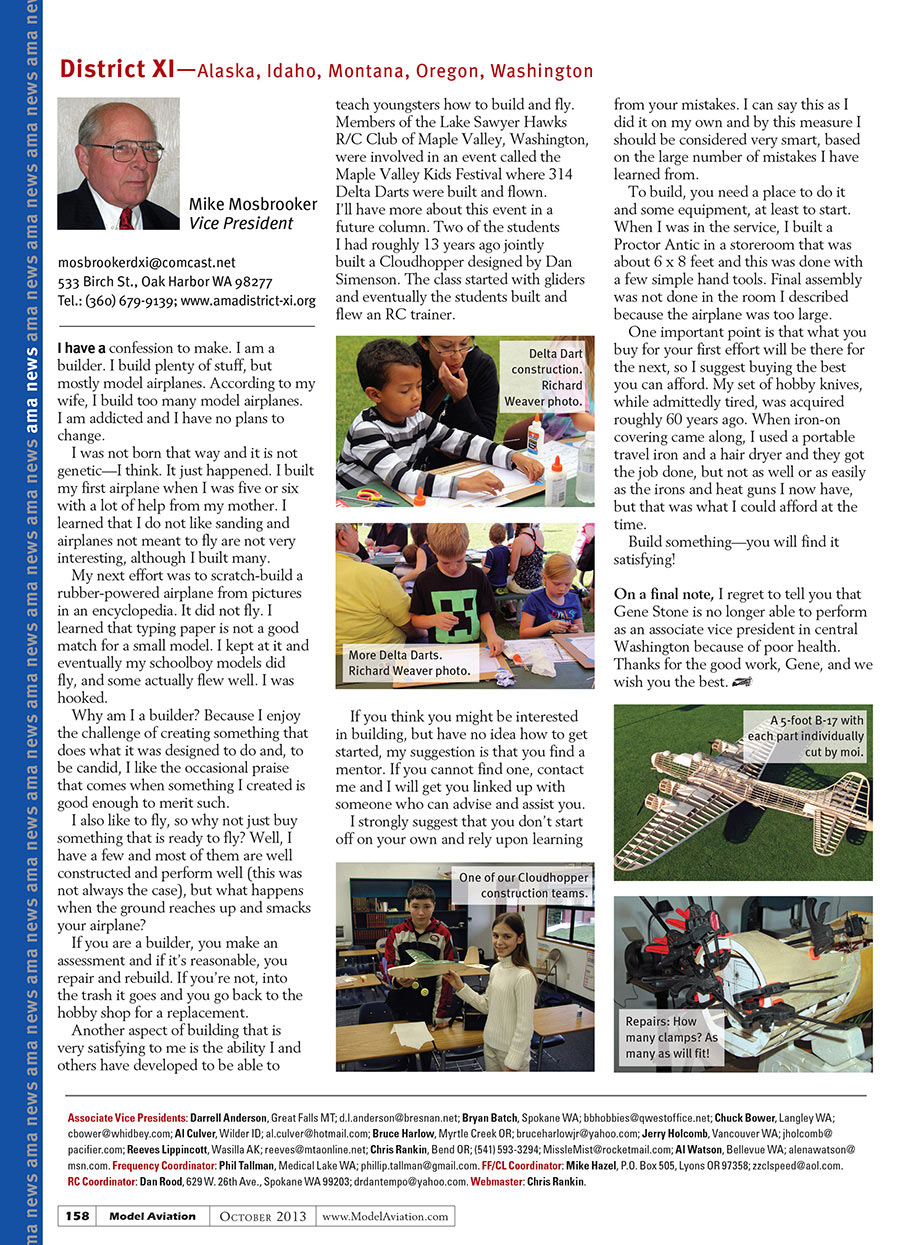
Another aspect of building that is very satisfying to me is the ability I and others have developed to be able to teach youngsters how to build and fly. Members of the Lake Sawyer Hawks R/C Club of Maple Valley, Washington, were involved in an event called the Maple Valley Kids Festival where 314 Delta Darts were built and flown.
I’ll have more about this event in a future column. Two of the students I had roughly 13 years ago jointly built a Cloudhopper designed by Dan Simenson. The class started with gliders and eventually the students built and flew an RC trainer.
Delta Dart construction. Richard Weaver photo.
More Delta Darts. Richard Weaver photo.
If you think you might be interested in building, but have no idea how to get started, my suggestion is that you find a mentor. If you cannot find one, contact me and I will get you linked up with someone who can advise and assist you.
I strongly suggest that you don’t start off on your own and rely upon learning from your mistakes. I can say this as I did it on my own and by this measure I should be considered very smart, based on the large number of mistakes I have learned from.
To build, you need a place to do it and some equipment, at least to start. When I was in the service, I built a Proctor Antic in a storeroom that was about 6 x 8 feet and this was done with a few simple hand tools. Final assembly was not done in the room I described because the airplane was too large.
One important point is that what you buy for your first effort will be there for the next, so I suggest buying the best you can afford. My set of hobby knives, while admittedly tired, was acquired roughly 60 years ago. When iron-on covering came along, I used a portable travel iron and a hair dryer and they got the job done, but not as well or as easily as the irons and heat guns I now have, but that was what I could afford at the time.
Build something—you will find it satisfying!
On a final note, I regret to tell you that Gene Stone is no longer able to perform as an associate vice president in central Washington because of poor health. Thanks for the good work, Gene, and we wish you the best.
Transcribed from original scans by AI. Minor OCR errors may remain.

