
District X Report - 2009/11
Li-Poly Fires and Safety
It's 9:30 a.m. and you're at your favorite flying site. You want to fly, so you hook up your lithium battery and charger to your car's battery, then step away for a moment to chat with a friend. All of a sudden the lithium battery explodes.
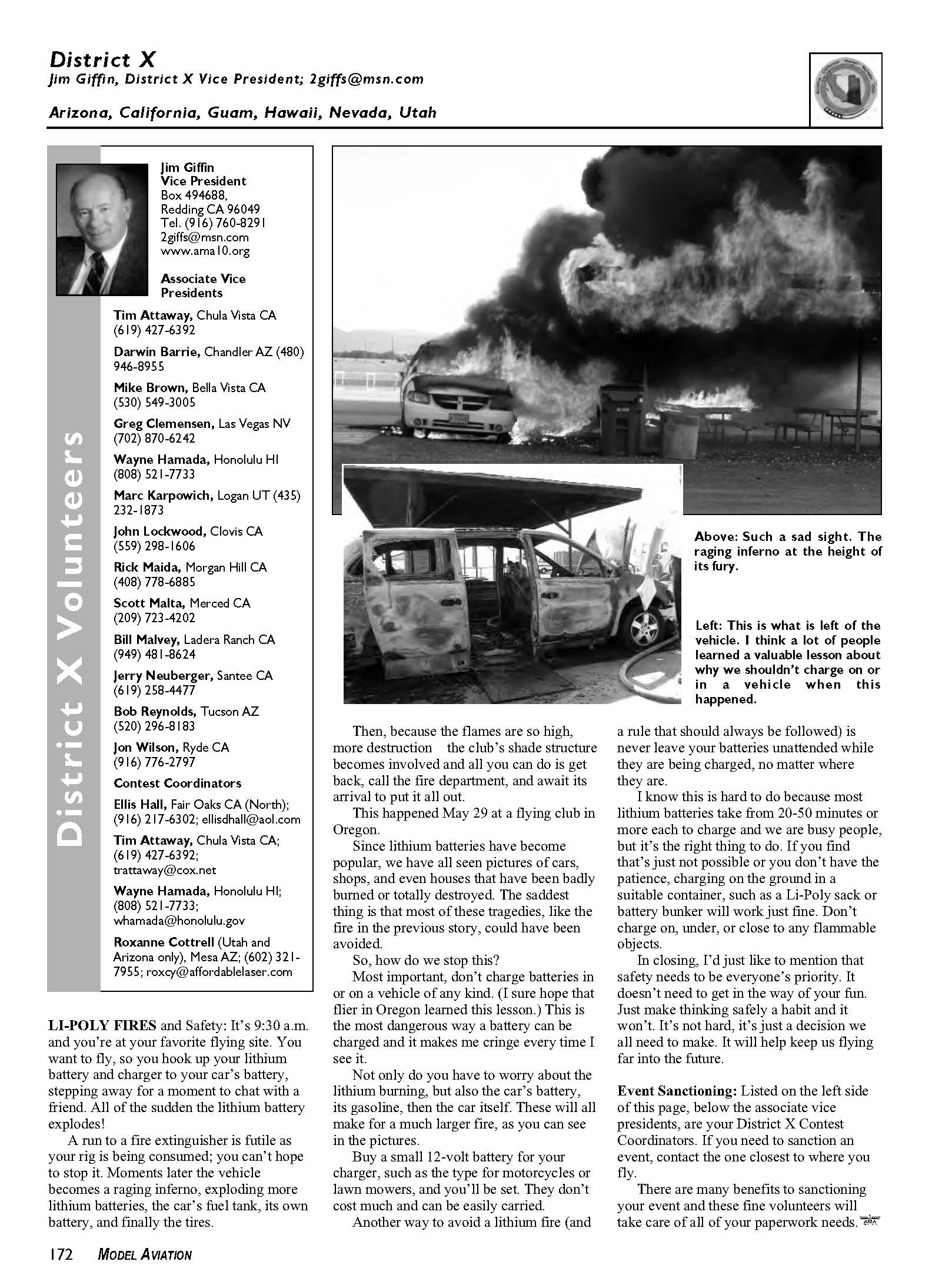
A run to a fire extinguisher is futile as your rig is consumed; you can't hope to stop it. Moments later the vehicle becomes a raging inferno, exploding more lithium batteries, the car's fuel tank, its own battery, and finally the tires. Because the flames are so high, more destruction follows — the club's shade structure becomes involved and all you can do is get back, call the fire department, and await its arrival to put it all out. This happened May 29 at a flying club in Oregon.
Since lithium batteries have become popular, we've all seen pictures of cars, shops, and even houses that have been badly burned or totally destroyed. The saddest thing is that most of these tragedies, like the fire in the previous story, could have been avoided.
So, how do we stop this? The most important rule: don't charge batteries in or on a vehicle of any kind. This is the most dangerous way a battery can be charged and it makes me cringe every time I see it. Not only do you have to worry about the lithium burning, but also the car's battery, its gasoline, and the car itself — all of which make for a much larger fire.
Safety recommendations:
- Do not charge batteries in or on a vehicle. Buy a small 12-volt battery for your charger (such as the type for motorcycles or lawn mowers); they don't cost much and are easy to carry.
- Never leave batteries unattended while charging, no matter where you are. Most lithium batteries take 20–50 minutes or more to charge, and staying with them is the right thing to do.
- If you cannot reasonably supervise charging, charge on the ground in a suitable container, such as a Li-Poly sack or a battery bunker.
- Do not charge on, under, or near any flammable objects.
In closing, safety needs to be everyone's priority. It doesn't need to get in the way of your fun — just make thinking safely a habit. It's not hard; it's a decision we all need to make. Doing so will help keep us flying far into the future.
Event Sanctioning
Listed on the left side of this page, below the Associate Vice Presidents, are your District X Contest Coordinators. If you need to sanction an event, contact the coordinator closest to where you fly.
There are many benefits to sanctioning your event, and these volunteers will take care of all your paperwork needs.
Transcribed from original scans by AI. Minor OCR errors may remain.

