
District XI—Alaska, Idaho, Montana, Oregon, Washington
Mike Mosbrooker
Vice President
- [email protected]
- 533 Birch St., Oak Harbor, WA 98277
- Tel.: (360) 679-9139
- www.amadistrict11.org
Flying Sites
One of the chief reasons for belonging to a club is to have a place to fly. After you have a place to fly, the trick is to keep it. This applies to all sites, whether they are privately owned or public land with authorized flying.
There are many ways to lose a site, as I am sure you know or can imagine. I suggest you look at the possibilities and then attempt to cultivate good relationships with those who might one day pass judgment on your use of a field. Put on and publicize a day of introductory flying for youngsters, or contribute to the cleanup of an adjacent sports field, and make sure the community knows that the local model club did this.
When something bad happens, perhaps people will remember that the same modelers do a lot of good things for the community too. Even if nothing ever happens, you will have done a worthwhile community service and will be regarded positively.
A Local Example
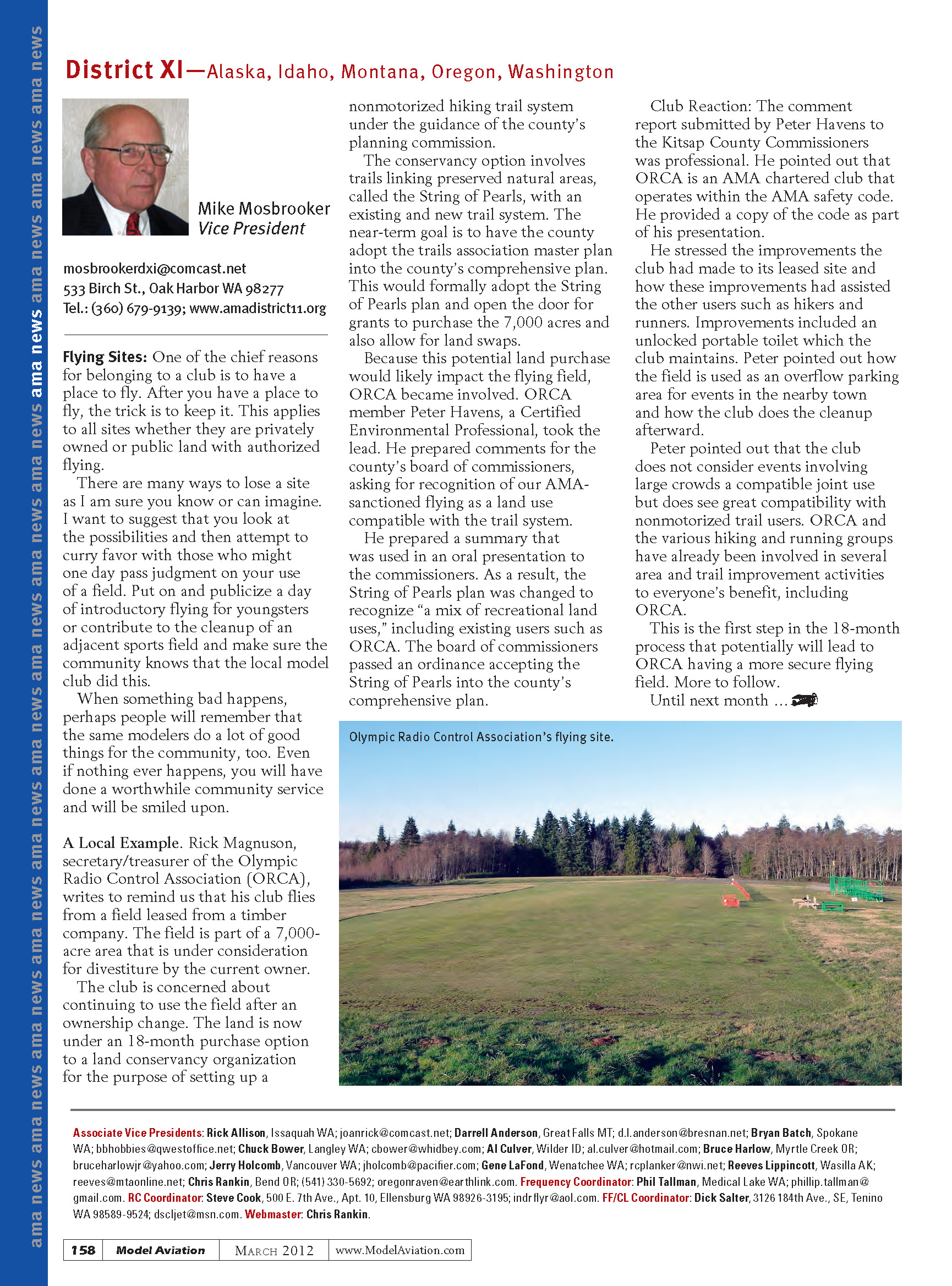
Rick Magnuson, secretary/treasurer of the Olympic Radio Control Association (ORCA), writes to remind us that his club flies from a field leased from a timber company. The field is part of a 7,000-acre area that is under consideration for divestiture by the current owner. The club is concerned about continuing to use the field after an ownership change. The land is now under an 18-month purchase option to a land conservancy organization for the purpose of setting up a nonmotorized hiking trail system under the guidance of the county’s planning commission.
The conservancy option involves trails linking preserved natural areas, called the String of Pearls, with an existing and new trail system. The near-term goal is to have the county adopt the trails association master plan into the county’s comprehensive plan. This would formally adopt the String of Pearls plan and open the door for grants to purchase the 7,000 acres and also allow for land swaps.
Because this potential land purchase would likely impact the flying field, ORCA became involved. ORCA member Peter Havens, a Certified Environmental Professional, took the lead. He prepared comments for the county’s board of commissioners, asking for recognition of AMA-sanctioned flying as a land use compatible with the trail system.
He prepared a summary that was used in an oral presentation to the commissioners. As a result, the String of Pearls plan was changed to recognize "a mix of recreational land uses," including existing users such as ORCA. The board of commissioners passed an ordinance accepting the String of Pearls into the county’s comprehensive plan.
Club Reaction
The comment report submitted by Peter Havens to the Kitsap County Commissioners was professional. He pointed out that ORCA is an AMA-chartered club that operates within the AMA safety code, and he provided a copy of the code as part of his presentation.
He stressed the improvements the club had made to its leased site and how these improvements had assisted other users such as hikers and runners. Improvements included an unlocked portable toilet which the club maintains. Peter pointed out how the field is used as overflow parking for events in the nearby town and how the club does the cleanup afterward.
Peter noted that the club does not consider events involving large crowds a compatible joint use but does see great compatibility with nonmotorized trail users. ORCA and the various hiking and running groups have already been involved in several area and trail improvement activities to everyone’s benefit, including ORCA.
This is the first step in the 18-month process that potentially will lead to ORCA having a more secure flying field. More to follow.
Until next month …
Transcribed from original scans by AI. Minor OCR errors may remain.

