
Dornier Falke
by Dave Linstrum
Free Flight Scale modelers (and scale fliers in general) may be attracted to a full-scale subject on an aesthetic basis, as with a Spitfire or a Mustang, or on a practical basis, as with a Fike or a Lacey homebuilt. Others may look for an obscure subject that has not been modeled by others.
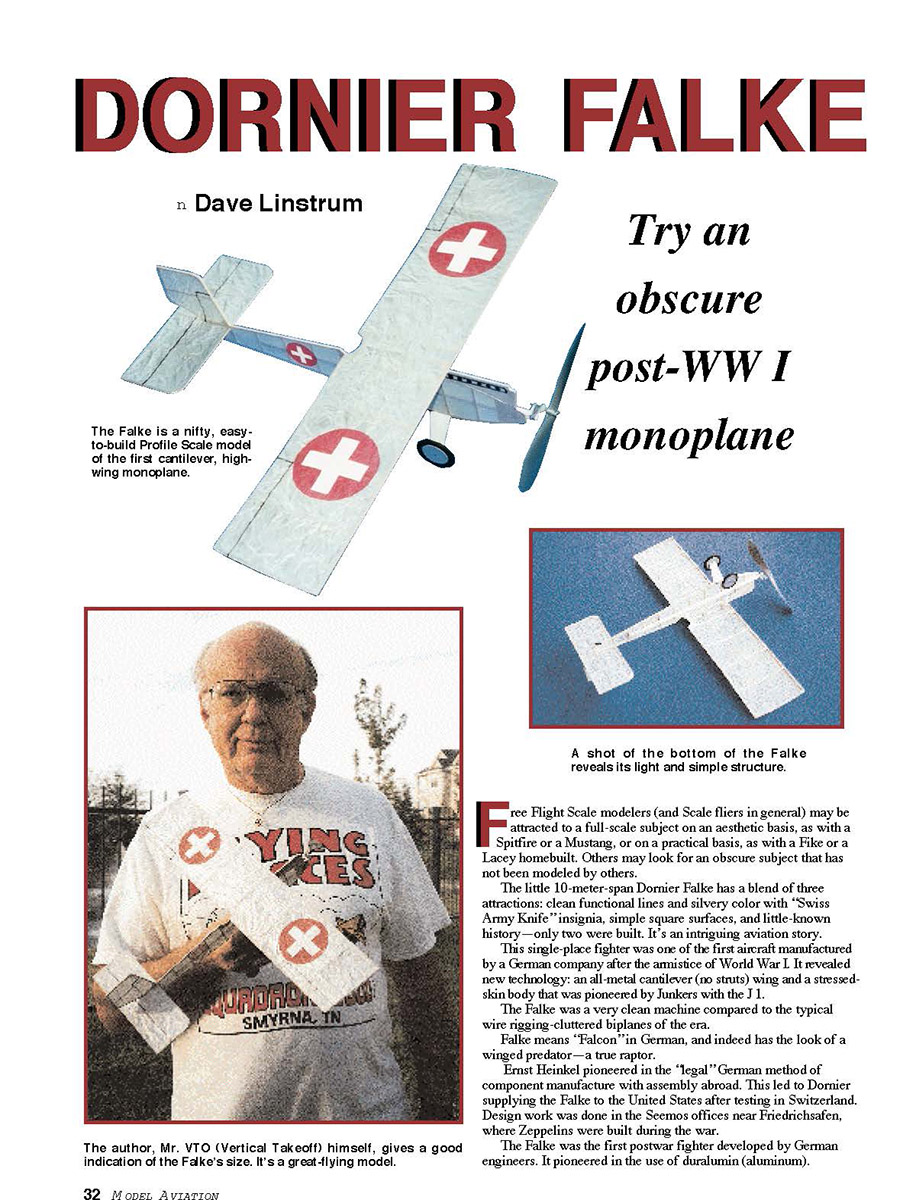
The little 10‑meter‑span Dornier Falke has a blend of three attractions: clean functional lines and silvery color with "Swiss Army Knife" insignia, simple square surfaces, and little‑known history—only two were built. It's an intriguing aviation story.
This single‑place fighter was one of the first aircraft manufactured by a German company after the armistice of World War I. It revealed new technology: an all‑metal cantilever (no struts) wing and stressed‑skin body that was pioneered by Junkers with the J 1.
The Falke was a very clean machine compared to the typical wire‑rigging‑cluttered biplanes of the era.
Falke means "falcon" in German, and indeed has the look of a winged predator — a true raptor.
Ernst Heinkel pioneered in the "legal" German method of component manufacture with assembly abroad. This led to Dornier supplying the Falke to the United States after testing in Switzerland. Design work was done in the Seemoos offices near Friedrichshafen, where Zeppelins were built during the war.
The Falke was the first postwar fighter developed by German engineers. It pioneered in the use of duralumin (aluminum). Claudius Dornier's design colleagues included Richard Vogt, of Hamburg Flugzeugbau, and Alexander Lippisch, noted for his flying wings. Lippisch later designed the 1942 rocket‑powered Messerschmitt Me 163 Komet.
The Falke's creators were innovators and aviation pioneers.
The prototype Falke was assembled in Switzerland. The first test flight took place at Dübendorf, November 1, 1922. It was powered by a 330‑horsepower Hispano‑Suiza engine.
For proposed U.S. Navy versions, this aircraft was manufactured under license by Wright Aeronautical Corporation in Ohio. The first U.S. Falke was shipped there to be fitted with the Wright engine, then it took part in a U.S. Navy competition at McCook Field in April 1923.
The time between the first test flight and the demonstration in America was only six months—an amazing feat at the time!
The Navy took possession of the aircraft, but the expected Wright Hispano‑Suiza HP‑3 engine contract did not materialize. Therefore, the Falke was never placed in service by the Navy and remained in obscurity at a time when many were flying fabric‑covered biplanes.
The Falke represented a major advance in aircraft design.
---
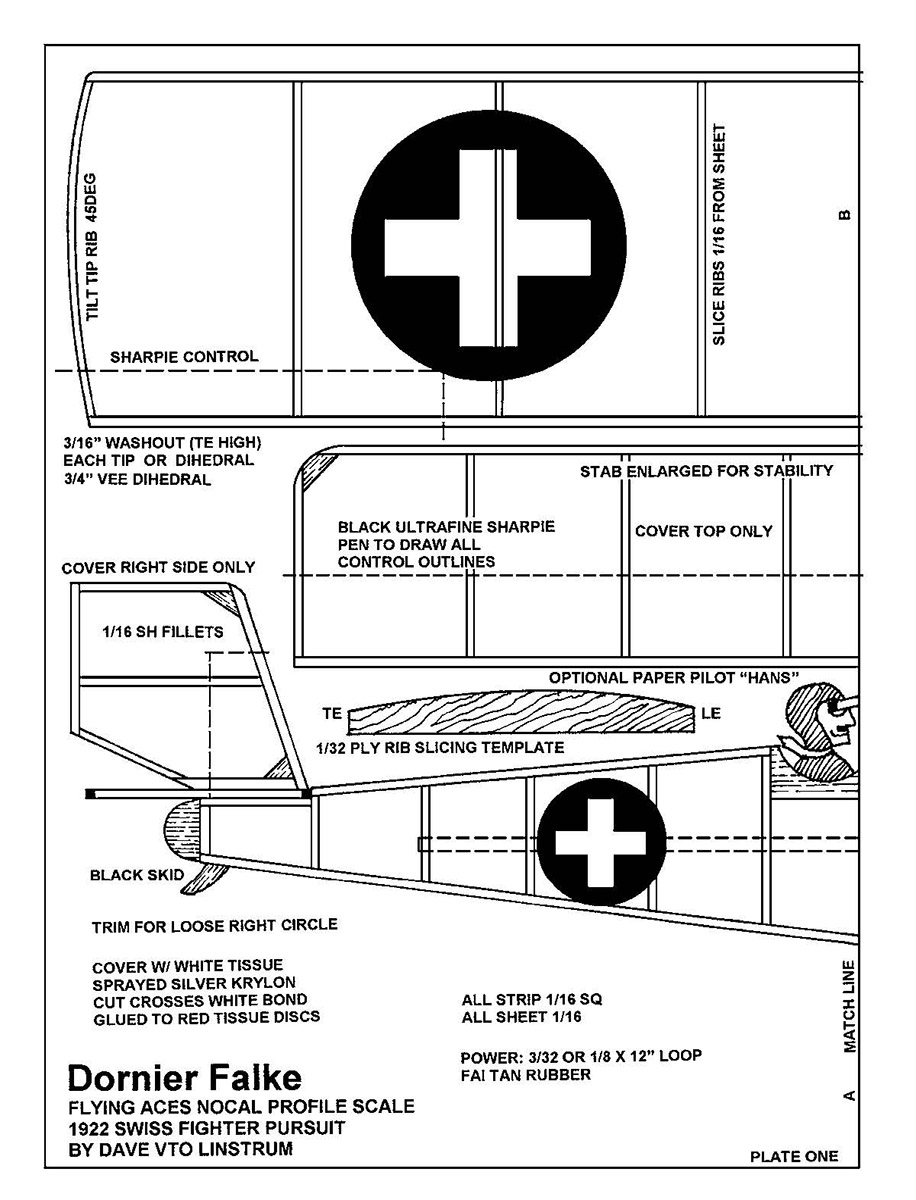
Dornier Falke — Flying Aces Local Profile (Scale)
1922 Swiss Fighter Pursuit by Dave Linstrum
PLATE ONE
- 3/16" washout (TE high)
- Each tip or dihedral 3/4" vee dihedral
- Tilt tip rib 45°
- Sharpie control
- Slice ribs 1/16" from sheet
- Stab enlarged for stability
- Black ultrafine Sharpie pen to draw all control outlines
- Cover top only
- Cover right side only
- 1/16" sh fillets
- Optional paper pilot "Hans"
- 1/32" ply rib slicing template
- Trim for loose right circle
- Black skid
- Cover with white tissue sprayed silver Krylon
- Cut crosses from white bond glued to red tissue discs
- All strip 1/16" square
- All sheet 1/16"
- Power: 3/32" or 1/8" x 12" loop FAI tan rubber
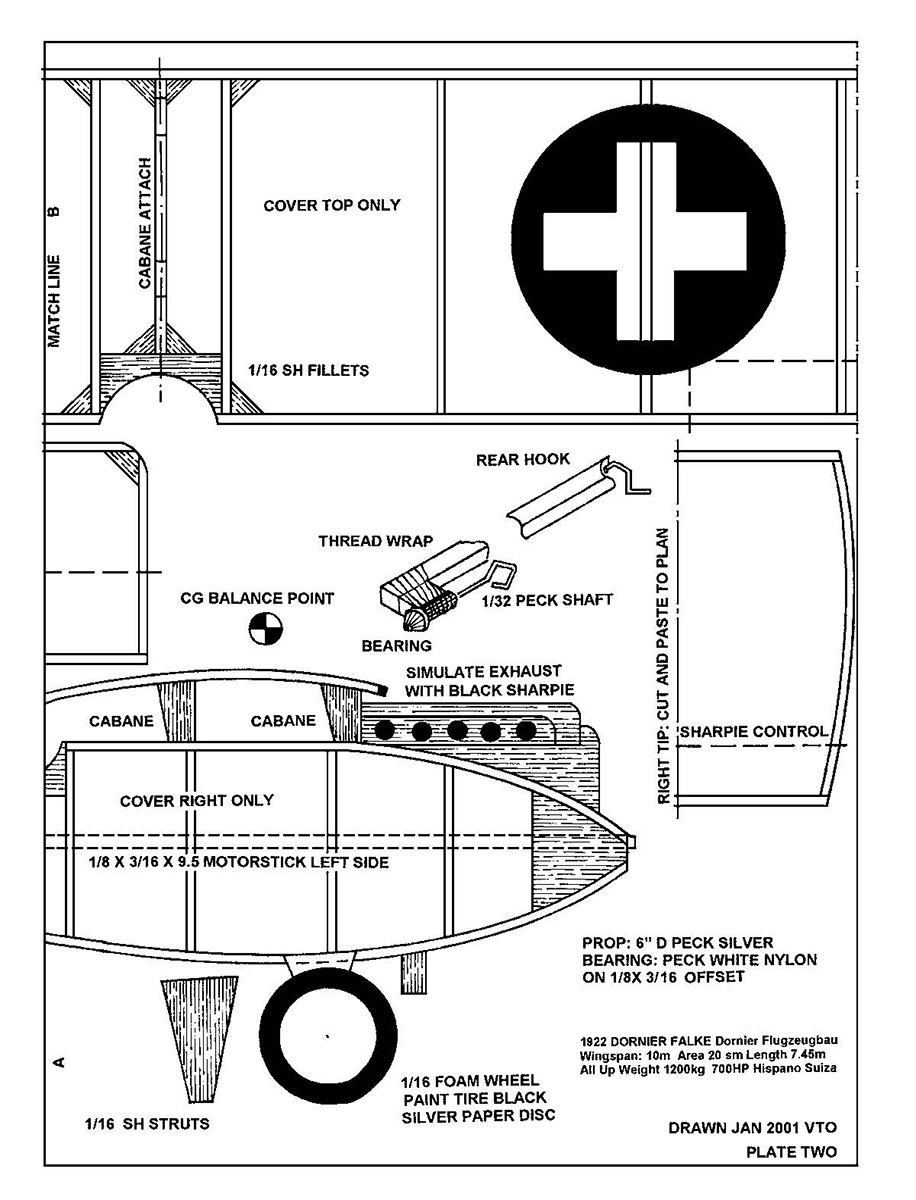
Match line
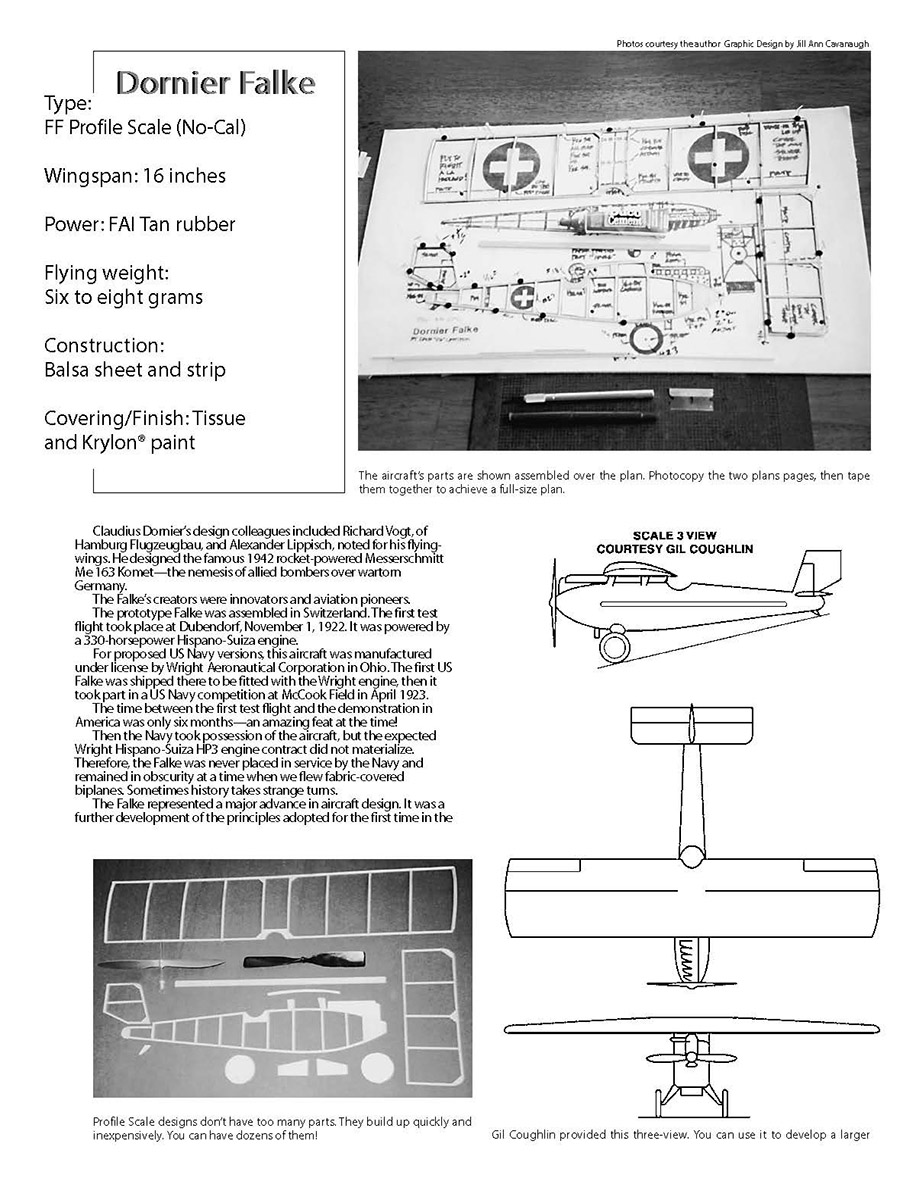
1922 Dornier Falke — Dornier Flugzeugbau Wingspan: 10 m Area: 20 m² Length: 7.45 m All‑up weight: 1200 kg Engine: 700 HP Hispano‑Suiza
Construction
Materials and Tools:
- Stick‑and‑tissue construction and flying require special tools and materials. At the least, these items include an X‑Acto® or other pointed model knife, a dust or pressboard marker, pins, a self‑healing cutting board (or scrap of thick mat board), glue (use Duco or cement or thick gel cyanoacrylate), a glue stick for paper, and needle‑nose pliers.
- A flat, pin‑sticking building board is essential; the author uses a scrap of Rome‑Core®.
- Make a couple photocopies of plan plates—one to tape together for building (put waxed paper over it to prevent glue adhesion) and the other for templates and insignia tracing on tissue.
- You will need to make your own silver tissue, because it is not commonly available. Obtain some white Japanese tissue and either shrink it on a frame or an old picture frame will do, then mist on a light coat of Krylon® silver aerosol; do not apply a heavy coat.
- Red tissue is needed for insignia and the crosses need to be cut from white bond paper. Use glue stick to attach the members and to cover the entire model top and right sides only.
- Be careful when applying the glue to the fragile bass sticks. Trim the tissue with an X‑Acto™ knife.
Building:
- Build in a well‑lit, uncluttered area. You can use precut balsa strips or strip from sheet balsa using a steel straightedge, but be careful. The whole model is built from 1/16" balsa.
- If you have no stick‑and‑tissue experience, get some by building a simple kit such as an M.A.M. Delta Dart, a Peck ROG (rise‑off‑ground), or a Peck Peanut kit.
- You can order everything you need to build this model from Peck‑Polymers. Get the latest catalog for SA: Peck, Box 27099, Santa Fe, CA 92701, or call (619) 468‑1818. Peck Polymers specializes in stick‑and‑tissue and has books on the subject.
- Another catalog supplier is FAI Model Supply, Box 266, Sayre, PA 18840‑0366; Tel.: (570) 888‑9873. A catalog is $2. Both are good mail‑order shops.
The author will not detail basic gluing techniques—books and kit instructions cover that. This Falke is not an Almost Ready‑to‑Fly (ARF) with an instruction book—it is a simple craftsman's project.
Assembly:
- After all parts have been covered (apply decoration first), attach the motor stick without the propeller to the left side of the body, gluing to each upright and nose.
- Attach the stabilizer; then the fin to the body. Tilt the stabilizer slightly, with the right tip up roughly 1/8" as seen from the rear. This will induce a natural right turn.
- Attach splayed gear struts and wheels.
- Attach the wing to the cabane struts, gluing solidly to the center rib. Pin it while the glue dries. Check alignment from the top and the front, then add more glue to this critical joint.
- Add the prop shaft and the prop, bending and clipping the shaft in front of the hub. The author prefers the six‑inch Peckisher plastic prop but you can use an old AME, Beta Dart, or plastic prop.
- Make a 12‑inch‑long boompom: 3/8" FaltaM rubber by tying in a square knot. Hang the loop from the shaft and the rear hook; try winding in some hand turns. Turn the prop clockwise as seen from the front.
- Check the balance with the motor on the stick and add a bit of lead to the nose if necessary.
- Lube the motor with Reck rubber lube or Johnson's® Baby Shampoo, and wipe off the excess.
- Obtain a box in which to store and transport the model—gratis boxes from a hobby shop used to ship letter‑size copy paper are ideal. Do not use grocery‑store boxes; the lids implode.
Flying
- It is pointless to test‑glide such a small model in cover all areas.
- If you’re outdoors, handwind approximately 200 turns and launch the Falke straight ahead into the wind (do not fly into a strong wind, do not throw it). The model should climb slightly to the right in a nose circle.
- Adjust using the nose bearing (add a right thrust or add a 1/8" x 2" tab to the right‑wing trailing edge, with the rear drooping—like a little aileron). This helps keep the wing up in a turn.
- Progress to powered winding using a Reck S1 winder (from the catalog). You will need a handle to pinch the prop hub while you attach the winder to the rear of the motor, stretching it out approximately a foot to the rear and side of the model.
- Put in roughly 100 turns to turn the winder once, then remove the rubber from the winder to attach to the rear hook. Take the model from your body and launch carefully.
I hope you enjoy your simple version of the 1922 Falke. Happy landings, Flying Aces, Inc.
Dave Linstrum 4016 Maguire Blvd., Apt. 313-14 Orlando, FL 32803
Transcribed from original scans by AI. Minor OCR errors may remain.

