
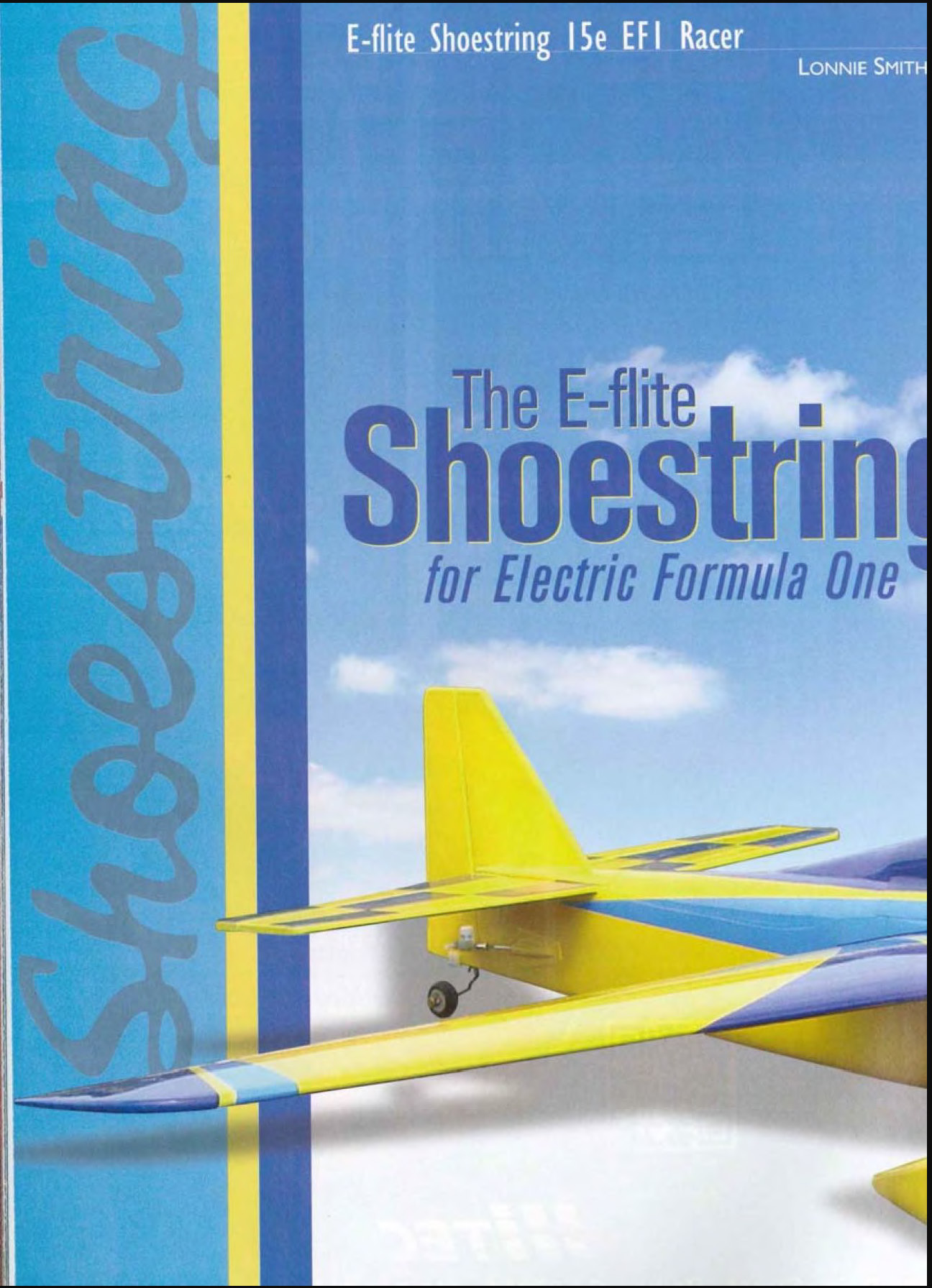
The E-flite Shoestring for Electric Formula One
Lonnie Smith
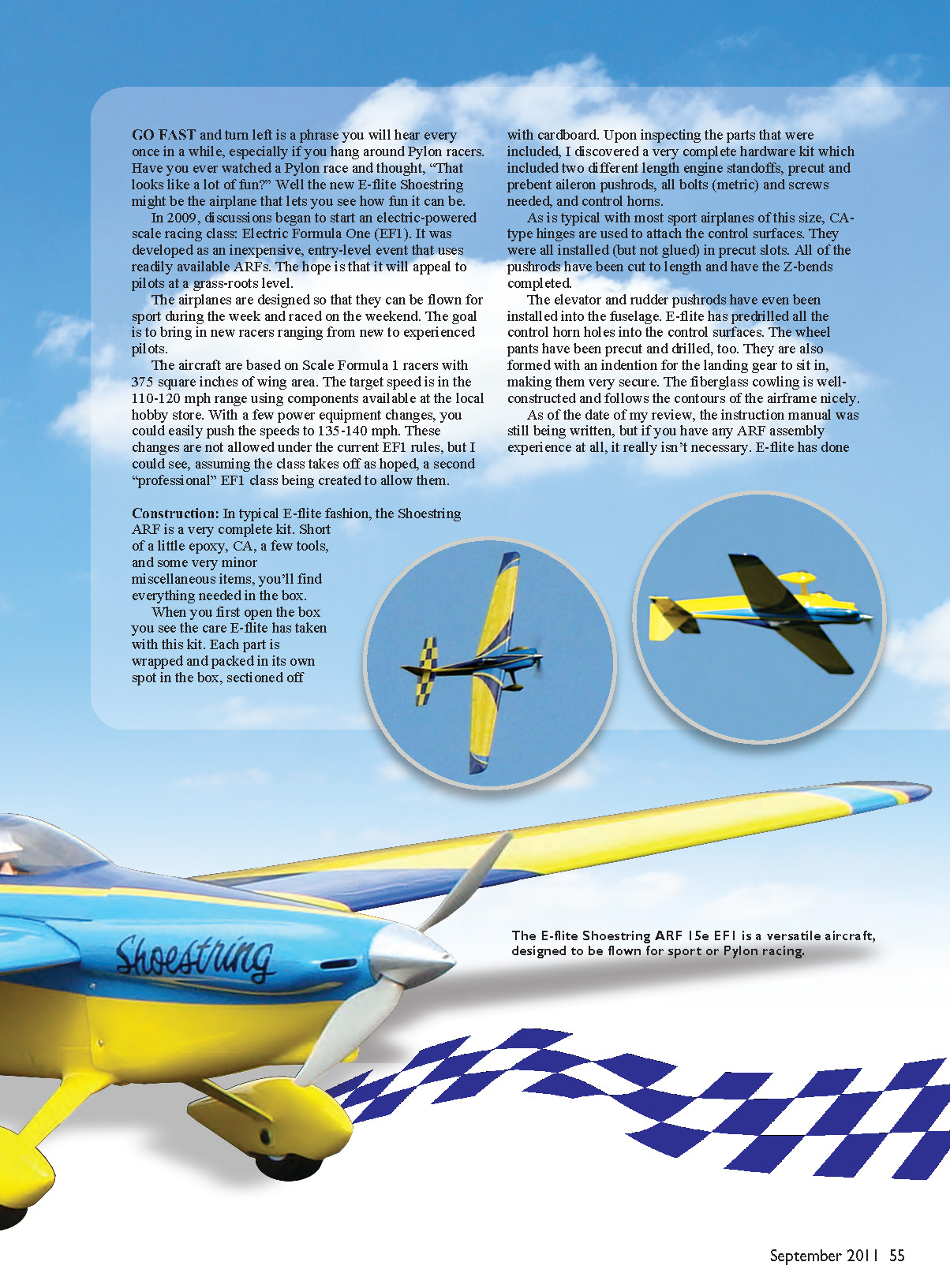
GO FAST and turn left is a phrase you will hear every once in a while, especially if you hang around pylon racers. Have you ever watched a pylon race and thought, "That looks like a lot of fun?" The new E-flite Shoestring might be the airplane that lets you see how fun it can be.
In 2009, discussions began to start an electric-powered scale racing class: Electric Formula One (EF1). EF1 was developed as an inexpensive, entry-level event that uses readily available ARFs. The hope is that it will appeal to pilots at a grass-roots level. The airplanes are designed so that they can be flown for sport during the week and raced on the weekend. The goal is to bring in new racers ranging from novice to experienced pilots.
The aircraft are based on Scale Formula 1 racers with 375 square inches of wing area. The target speed is in the 110–120 mph range using components available at the local hobby store. With a few power equipment changes you could easily push speeds to 135–140 mph. Those changes are not allowed under the current EF1 rules, but I could see, assuming the class takes off as hoped, a second "professional" EF1 class being created to allow them.
Construction
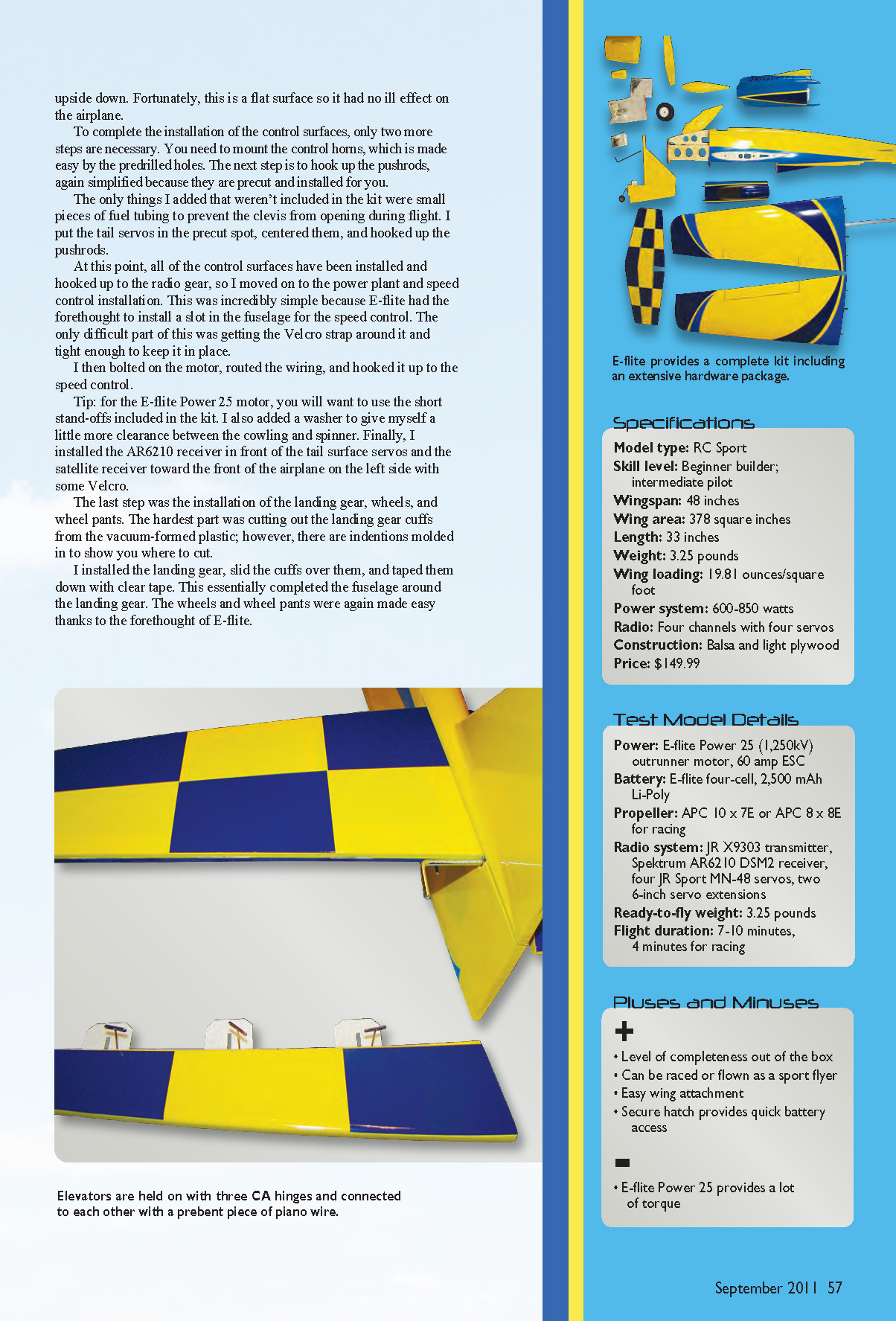
In typical E-flite fashion, the Shoestring ARF is a very complete kit. Short of a little epoxy, CA, a few tools, and some minor miscellaneous items, you'll find everything needed in the box. Each part is wrapped and packed in its own spot, sectioned off with cardboard. The hardware kit is comprehensive and includes two different length engine standoffs, precut and prebent aileron pushrods, all bolts (metric) and screws needed, and control horns.
CA-type hinges are used to attach the control surfaces; they are installed (but not glued) in precut slots. All pushrods have been cut to length and have the Z-bends completed. The elevator and rudder pushrods are even installed into the fuselage, and E-flite has predrilled all the control-horn holes into the control surfaces. The wheel pants are precut and drilled and include an indentation for the landing gear to sit in, making them secure. The fiberglass cowling is well constructed and follows the airframe contours nicely.
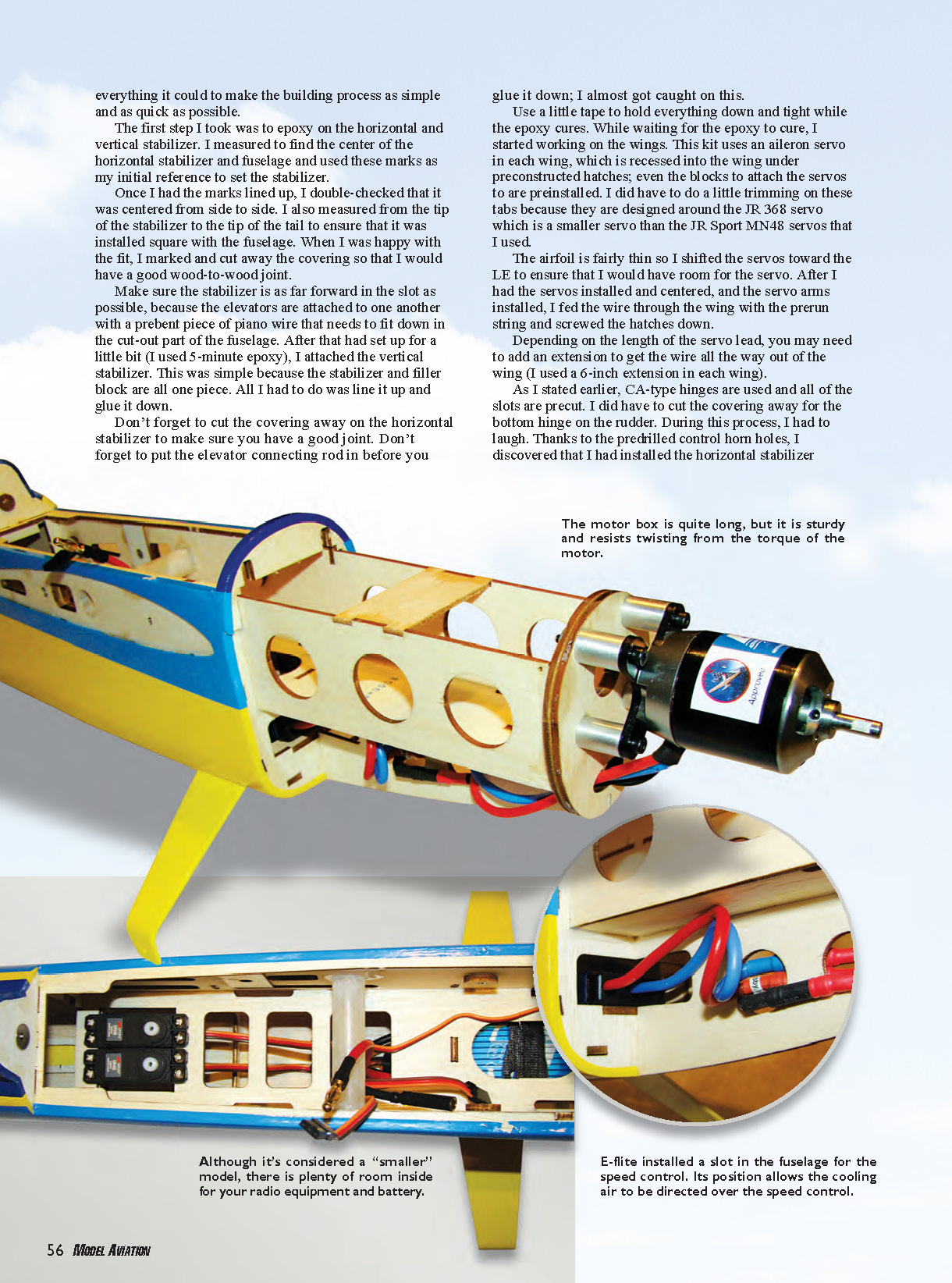
As of this review the instruction manual was still being written, but if you have any ARF assembly experience it isn't necessary. E-flite has done everything possible to make the building process simple and quick. They also installed a slot in the fuselage for the speed control so cooling air can be directed over it. Although it's considered a "smaller" model, there's plenty of room inside for radio equipment and the battery. The motor box is quite long, but it is sturdy and resists twisting from motor torque.
My assembly steps and tips:
- Epoxy the horizontal stabilizer first. Measure to find the center of the horizontal stabilizer and the fuselage and use these marks as your initial reference. Double-check that it is centered side-to-side and square with the fuselage by measuring from stabilizer tip to tail tip. Mark and cut away the covering so you have a good wood-to-wood joint.
- Make sure the stabilizer is as far forward in the slot as possible because the elevators are connected by a prebent piece of piano wire that needs to fit down in the fuselage cut-out. I used 5-minute epoxy and held parts with tape while curing.
- Attach the vertical stabilizer after the horizontal has set. The stabilizer and filler block are one piece, so line it up and glue.
Tip: Don't forget to put the elevator connecting rod in place before gluing the horizontal stabilizer — I almost forgot.
Wings and servos:
- Each wing uses an aileron servo recessed under preconstructed hatches; the servo blocks are preinstalled. I had to trim the tabs because they were designed around the JR 368 (a smaller servo) and I used JR Sport MN48 servos.
- The airfoil is fairly thin, so I shifted the servos toward the leading edge to ensure room. After centering the servos and installing the arms, feed the wires through the wing with the prerun string and screw the hatches down.
- Depending on servo-lead length, you may need extensions (I used a 6-inch extension in each wing).
- All hinge slots are precut; I did have to cut covering away for the bottom hinge on the rudder.
- Thanks to the predrilled control-horn holes, mounting the control horns and hooking up the pushrods is straightforward. I added small pieces of fuel tubing to prevent the clevis from opening in flight.
Power installation and radio:
- The fuselage slot for the speed control makes installation very simple; the only tricky part is getting the Velcro strap around it tight enough.
- Bolt on the motor, route wiring, and connect to the speed control. For the E-flite Power 25 motor, use the short standoffs included in the kit; I also added a washer for a bit more clearance between the cowling and spinner.
- I installed the AR6210 receiver in front of the tail-surface servos and the satellite receiver toward the front left side of the airplane with Velcro.
Landing gear and wheel pants:
- Cut out the landing-gear cuffs from the vacuum-formed plastic using the molded indentations as guides.
- Install the landing gear, slide the cuffs over them, and tape them down with clear tape. Wheels and wheel pants installation is straightforward thanks to the kit's preparation.
Flying
The Shoestring was designed to be a nice, easy sport flyer that can be turned into a pylon racer by adjusting control rates and changing the propeller. E-flite has done an exceptional job meeting that objective.
I began with pylon testing. EF1 is a new class being developed to entice additional pilots into racing. It is designed as an entry-level class and is flown on either a 375-foot, three-pylon course or a 400-foot, two-pylon course, which allows it to be flown almost anywhere, including at some tight fields. Model type, motor, and batteries are limited and must go through an approval process to keep the playing field level. For rules and approved components see RCGroups (forum "Electric Formula One: List of Recommended and Approved Components") and the National Miniature Pylon Racing Association (NMPRA) website.
Flight characteristics:
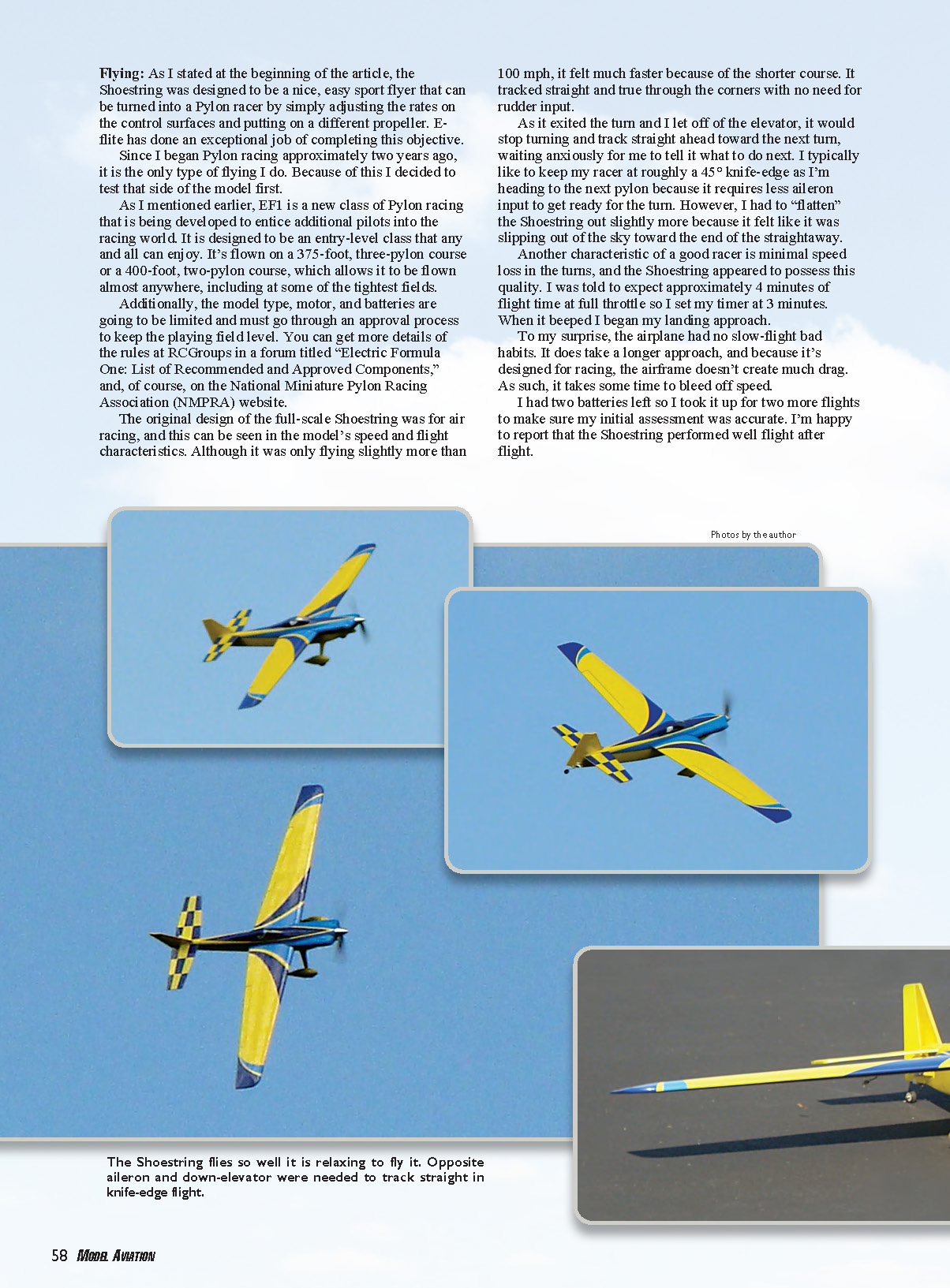
- Although the model was flying slightly more than 100 mph, it felt faster because of the shorter course.
- It tracked straight and true through corners with no need for rudder input.
- Exiting the turn and reducing elevator would stop the turn and it would track straight toward the next pylon.
- I usually keep a racer at roughly a 45° knife-edge toward the next pylon, but with the Shoestring I had to flatten out slightly because it felt like it was slipping toward the end of the straightaway.
- A good racer loses minimal speed in the turns; the Shoestring showed this quality.
I was told to expect approximately 4 minutes of flight time at full throttle, so I set my timer to 3 minutes. At that point I began the landing approach. The airplane had no slow-flight bad habits, though it requires a longer approach and takes time to bleed off speed because it is designed for racing and produces little drag. I flew two more flights and the Shoestring performed well each time.
Sport Flying
I tested the sport-flying ability on a windy day (10–15 mph). The Shoestring handled the wind confidently; it got bumped around but was easy to keep on track. I felt comfortable flying it a few feet off the deck, even inverted. With the control rates turned up it handled scale aerobatics with ease. Although I didn't try full 3-D before writing the review, the control surfaces appear large enough for basic 3-D maneuvers.
Conclusion
If you've thought, "I'd like to get into pylon racing but I don't want to buy an airplane just for that," the Shoestring and the new EF1 class are for you. Although the Shoestring was designed for racing, E-flite has done a great job making it a sport model that can be raced, or a racing airplane that can be sport flown.
Manufacturer/Distributor
- E-flite / Horizon Hobby
4105 Fieldstone Rd. Champaign, IL 61822 (800) 338-4639 www.e-flite.com www.horizonhobby.com
Sources
- JR Radio
(877) 504-0233 www.jrradios.com
- Spektrum RC
(800) 338-4639 www.spektrumrc.com
- APC Propellers
(530) 661-0399 www.apcprop.com
- RCGroups
- NMPRA
Transcribed from original scans by AI. Minor OCR errors may remain.

