
Electric CL Skyraider
By Dick Sarpolus
WILL ELECTRIC POWER introduce CL flying to a new generation of model-airplane enthusiasts? Maybe. There are no noisy engines or oil to wipe off. High-tech electric power, sophisticated electronics, new-chemistry batteries, and the direct-connection way to fly may produce a new era for CL flight. This isn't the CL airplane your father and grandfather flew!
Will electric power be of interest to the longtime CL flier who likes the smell of nitromethane and castor oil, who enjoys adjusting the needle valve for a good engine run, and who considers the sound an important part of the CL flying experience? Probably not, unless that flier wants an electric or two in the hangar for flying at that nearby park with a noise restriction.
The October 2001 MA featured my sheet-balsa, profile, 1/2A Skyraider for CL Aerobatics (Stunt). To try electric power, I got that balsa Skyraider from the workshop, removed the Norvel .061 engine, and put an electric motor in its place.
After trying many different motors and propellers, shorter lines, and whatever else I could think of, I gave up. I couldn't come up with an electric power system that would directly replace the Norvel .061 and provide the same performance; the electrics were heavier.
I also wanted the model to be "Stuntable" and fly with no problems on 35-foot-long lines. I figured that in this small size, the airframe would have to be lighter and the wing area would have to be larger for electric power.
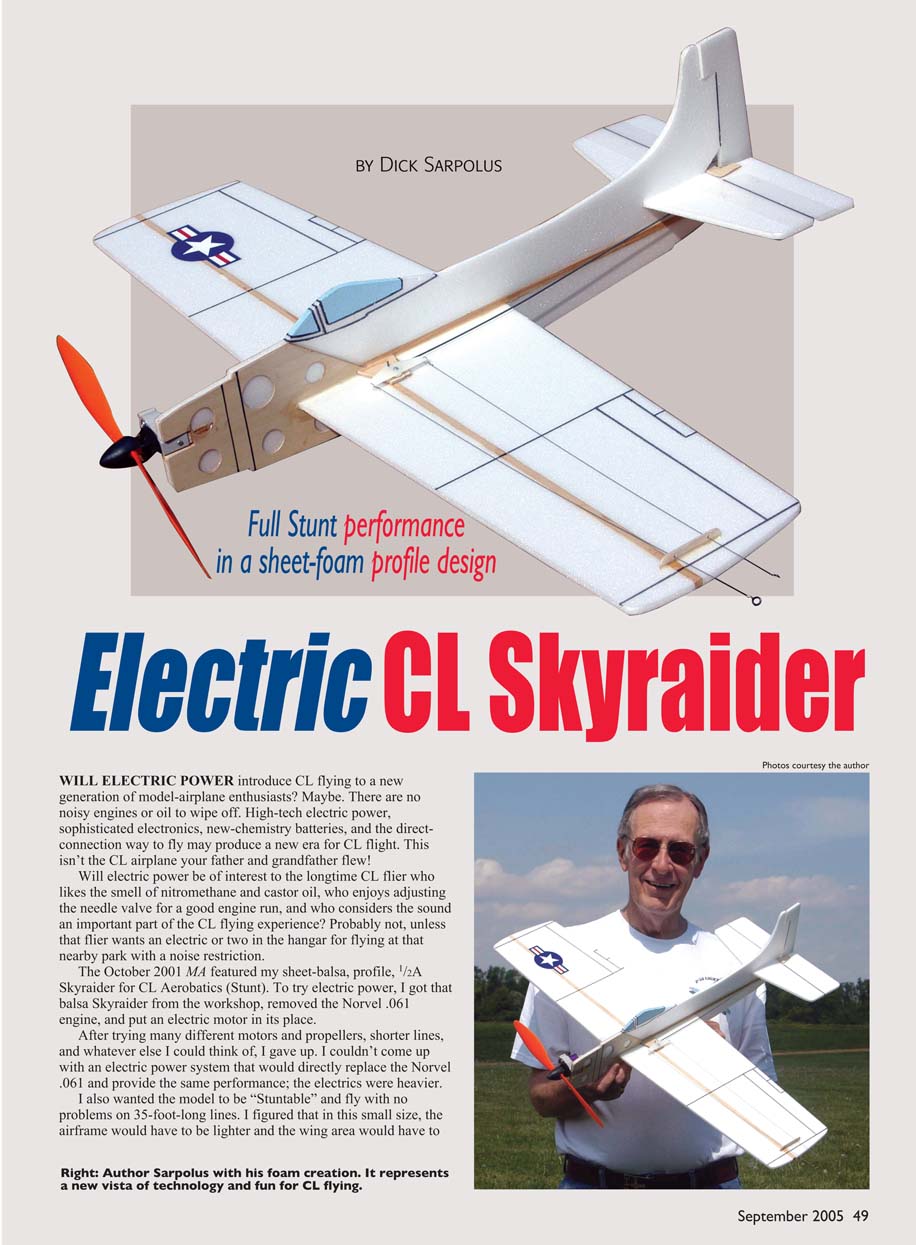
Therefore, I redesigned the Skyraider, enlarged it a bit overall and for more wing area, and made the airframe from sheet foam — in this case Depron — to save weight. It's been well proven in small RC aircraft, so why wouldn't it work for CL? It does.
The electric version doesn't quite equal the power and performance of the glow-engine-powered airplane, but it does fly well, it stays out on the end of the lines, and it performs aerobatics. All with no noise and no mess.
This flat-plate foam profile construction isn't the greatest aerodynamically. It does have some drawbacks, but it's easy to build and it does provide noiseless CL fun in a small area. It's a CL park flyer.
This quiet CL stuff is easy and fun! You don't have to fly RC to get a challenge and have real flying excitement. In larger sizes, larger airframes and more powerful motors and batteries provide performance that is equal to the glow-powered equipment. Look into CL!
You have a number of choices for construction material. I built the prototype Skyraider from 6mm Depron, which is an imported sheet foam. Alternatives are Balsa Products' smooth-skinned construction foam or Dow Bluecor sheet insulation foam.
I used spruce or basswood spars for reinforcement since they're easy to get and low in cost; you could use carbon-fiber tubing if you wanted. The nylon bellcrank is a standard hobby item. Obtain plywood of different thicknesses, music wire, epoxy glue, and you're ready to go.
There are more choices to make in the electronics. I powered my Skyraider with a Feigao 1308422 brushless motor in a GWS 350 gearbox with D, 6.6:1 gearing. That combination turns an 11 x 8 GWS propeller at approximately 4,700 rpm while drawing roughly 8 amps.
An 11-inch-diameter propeller seems too large for this size of airplane, but flying results are what counts; I tried many propellers, and this one works. I'm using a three-cell, 1250 mAh Li-Poly battery pack and a Phoenix-25 ESC.
I've powered a similar airframe with a Motor Max 400T brushless outrunner motor, direct drive, turning an 8 x 6 GWS propeller at approximately 7,800 rpm while drawing roughly 12 amps.
The preceding power-plant setups give nearly equal flight performance. A setup my friend Ray has on his electric CL model that is the same size and weight is an AXI 2212/20 motor with a Jeti ESC that turns an APC 9 x 5 propeller at 8,600 rpm while drawing approximately 12 amps. That may be the best setup we've used so far.
There are many motors and gearboxes on the market and many combinations that I'm sure could deliver similar or better performance than the setups I've used. You could use the preceding performance numbers as a rough guide to select other power-plant arrangements.
I don't think any brush-type motor and any type of battery other than Li-Poly would deliver enough power and be light enough for decent performance, but there are a great deal of components to be tried. Special chargers are required for Li-Poly batteries, and you have to be careful with them for safety. As even lighter and higher-current-drain batteries become available, performance will improve. There is a variety of Li-Poly batteries to try.
There is another electronic component needed for CL flying: a timer control. You can't just let the batteries die to end the flight; Li-Polys would be ruined, and it's no fun flying with less than full power.
The Z-Tron CL timer designed by Sergio Ziguras is available from Windy Urtnowski at www.windyurnt... It's lightweight and easy to use. The time is adjustable from 30 seconds to eight minutes in half-minute steps, and the device includes several other handy features. Another timer on the market is the JMP programmable unit, available from Bob Selman Designs at www.bsdmicrocrc.com.
I've been flying on 35-foot .008 or .012 stranded cable lines. The Skyraider has performed mainly short flights, and I have gotten at least four 1-1/2-minute attempts from one charge on the battery pack. The battery pack is easy to remove from the airframe so it can be changed.
CONSTRUCTION
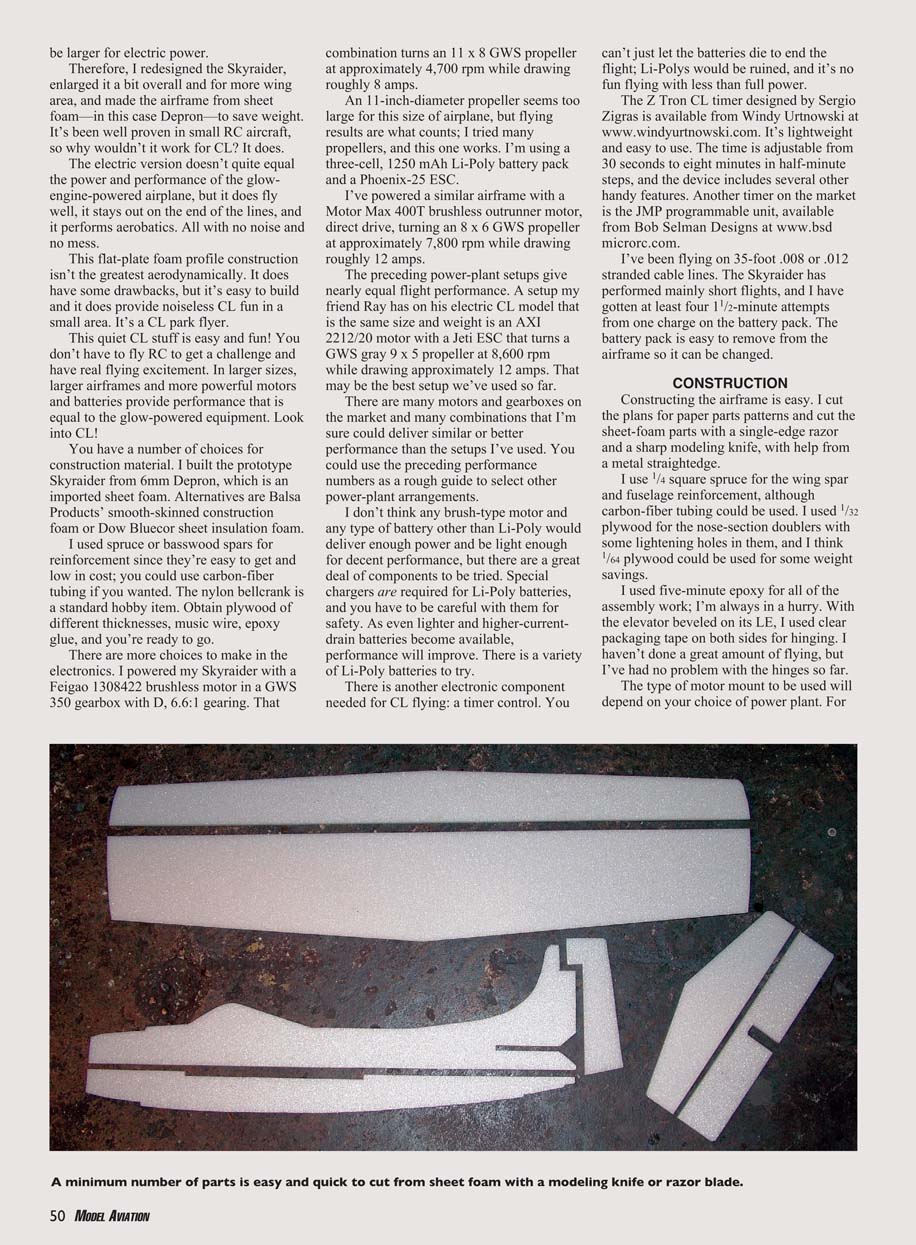
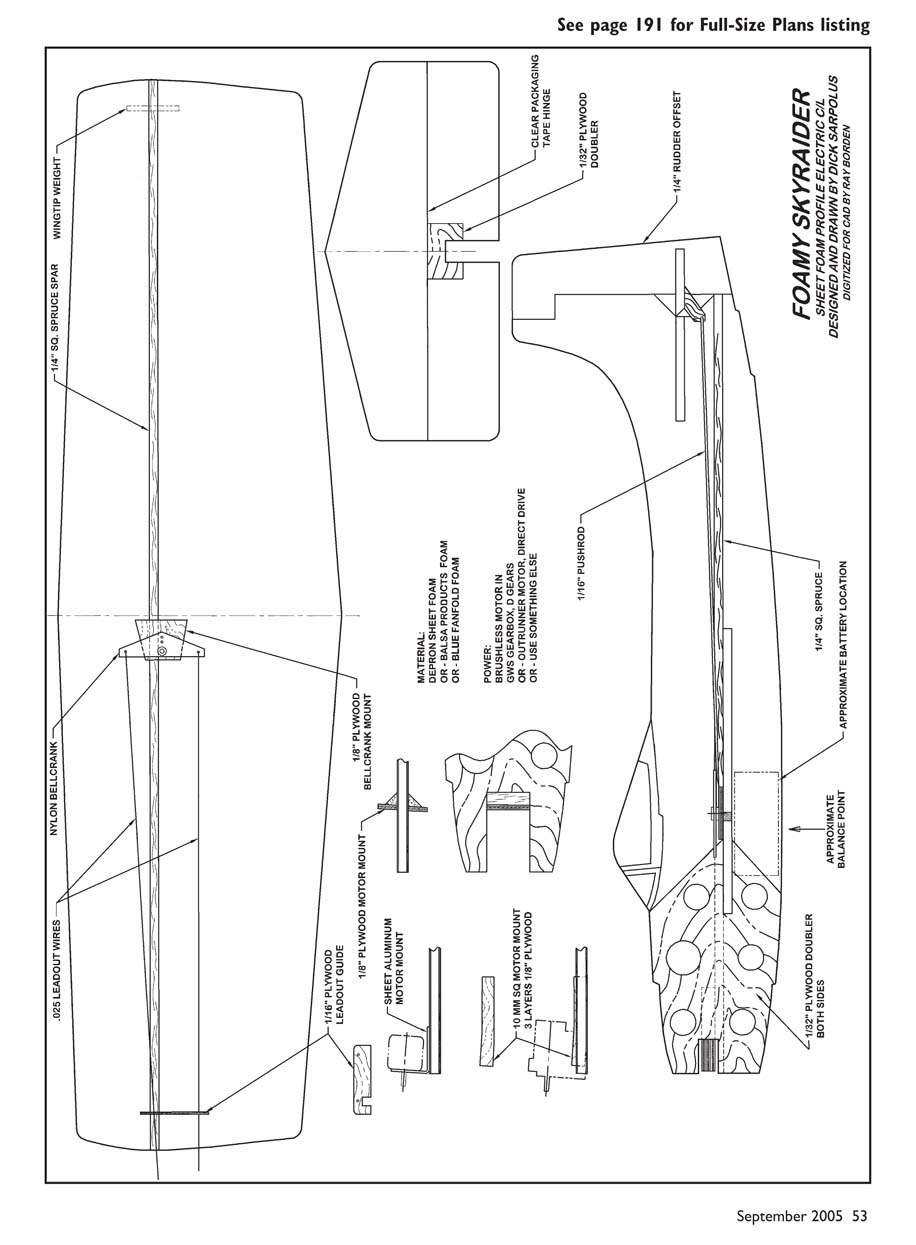
Constructing the airframe is easy. I cut the plans for paper parts patterns and cut the sheet-foam parts with a single-edge razor and a sharp modeling knife, with help from a metal straightedge.
I use 1/4 square spruce for the wing spar and fuselage reinforcement, although carbon-fiber tubing could be used. I used 1/32 plywood for the nose-section doublers with some lightening holes in them, and I think 1/64 plywood could be used for some weight savings.
I used five-minute epoxy for all of the assembly work; I'm always in a hurry. With the elevator beveled on its LE, I used clear packaging tape on both sides for hinging. I haven't done a great amount of flying, but I've had no problem with the hinges so far.
The type of motor mount to be used will depend on your choice of power plant. For the 10mm square stick-type mount, I made a "bent stick," for thrustline offset, from several layers of plywood. Then I cut into the plywood doubler on the outboard side and epoxied the motor-mount stick in place.
An outrunner type of motor could be mounted with a bent piece of sheet aluminum; I've done that and it worked fine. Or with a cutout in the fuselage to clear the motor, a plywood firewall could be installed at the rear or front of the cutout, depending on the type of motor mounting. Some bracing behind the firewall would reinforce it. This will have to be worked out to suit the motor you use.
The foam could have been painted with water-based acrylic craft paints. However, since I was worried about weight I went with some inked lines only, made with a Sharpie marking pen.
I did use a bit of plywood to reinforce the fuselage where the battery is held in place with Velcro fastening tape and a Velcro retaining strap.
Weight is obviously important. My sheet-balsa-and-plywood, painted Skyraider weighed roughly 6 ounces — 8 ounces with the glow engine in place. My larger sheet-foam Skyraider airframe weighs 4 ounces and approximately 10 ounces with the electric power equipment in place.
I didn't use a landing gear because I prefer to fly over grass fields, launching the aircraft by hand. A light wire landing gear and light wheels could probably be used if you really wanted, with little penalty.
The battery pack can be positioned fore or aft to adjust the balance point, depending on the equipment used. The length of the control horn, the balance point, and spacing of the lines at the handle should be adjusted to suit your preferences for control sensitivity.
Flying: The foam, electric Skyraider is fun to fly! CL flying with no noise is a different experience for sure. Although this is not a "serious" Stunter, it's capable of most of the stunt maneuvers, done in a fun way. Best of all, it can be flown almost anywhere without concern for the noise bothering nonmodeling citizens.
As I mentioned, the model stays out well on 35-foot lines. It can handle a light breeze. I can't write much about the crash resistance; I've been lucky so far with only minor incidents that were easy to repair with a bit of five-minute epoxy or foam-friendly cyanoacrylate. This is certainly a low-cost airframe, but the electrics are not low in cost.
Electric CL technology is fairly new, it's coming along quickly as more modelers experiment, and this little Skyraider is one of the first steps to show what's possible. MA
Dick Sarpolus 32 Alameda Ct. Shrewsbury NJ 07702 [email protected]
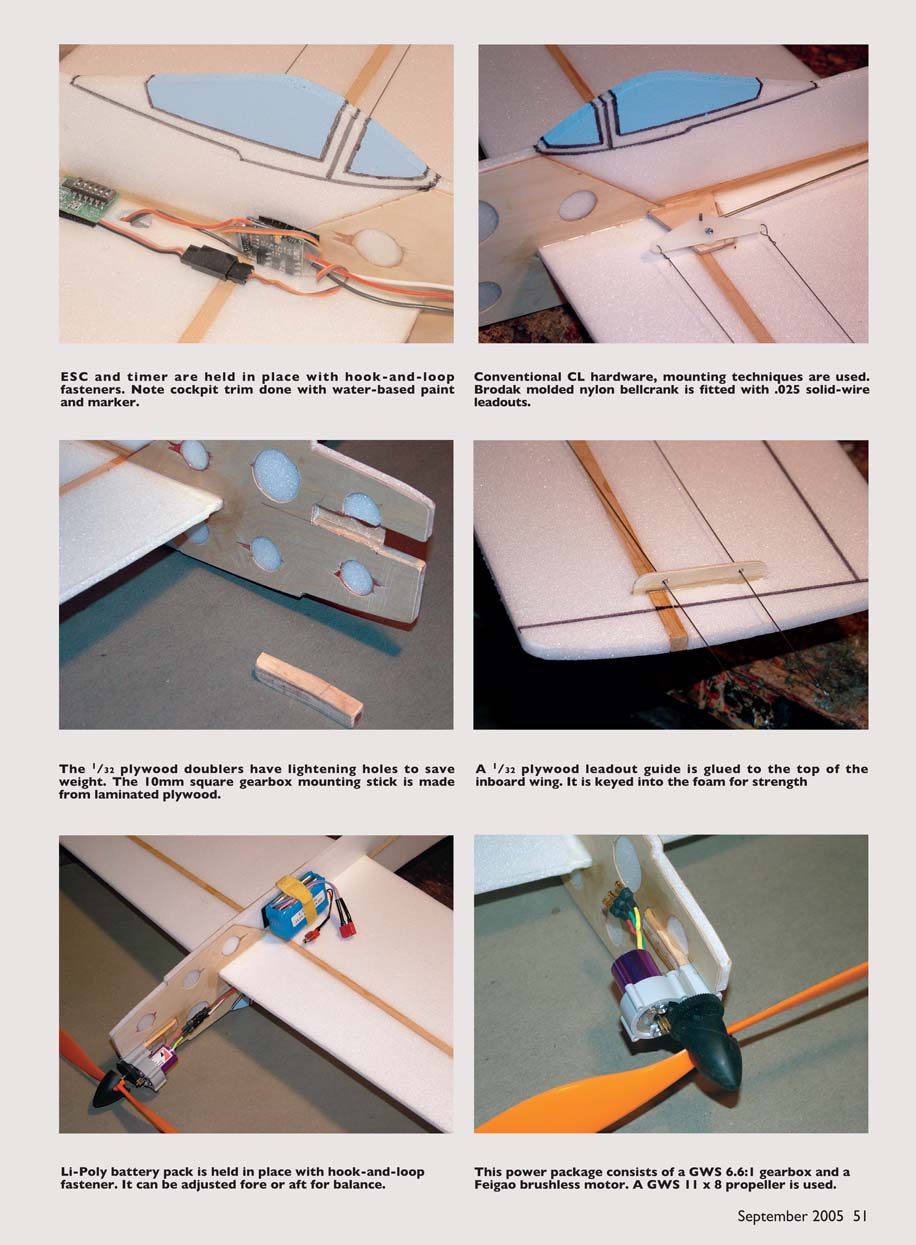
the ESC and timer are held in place with hook-and-loop fasteners. Note cockpit trim done with water-based paint and marker.
Conventional CL hardware, mounting techniques are used. Brodak molded nylon bellcrank is fitted with .025 solid-wire leadouts.
The 1/32 plywood doublers have lightening holes to save weight. The 10mm square gearbox mounting stick is made from laminated plywood.
A 1/32 plywood leadout guide is glued to the top of the inboard wing. It is keyed into the foam for strength.
Li-Poly battery pack is held in place with hook-and-loop fastener. It can be adjusted fore or aft for balance.
This power package consists of a GWS 6.6:1 gearbox and a Feigao brushless motor. A GWS 11 x 8 propeller is used.
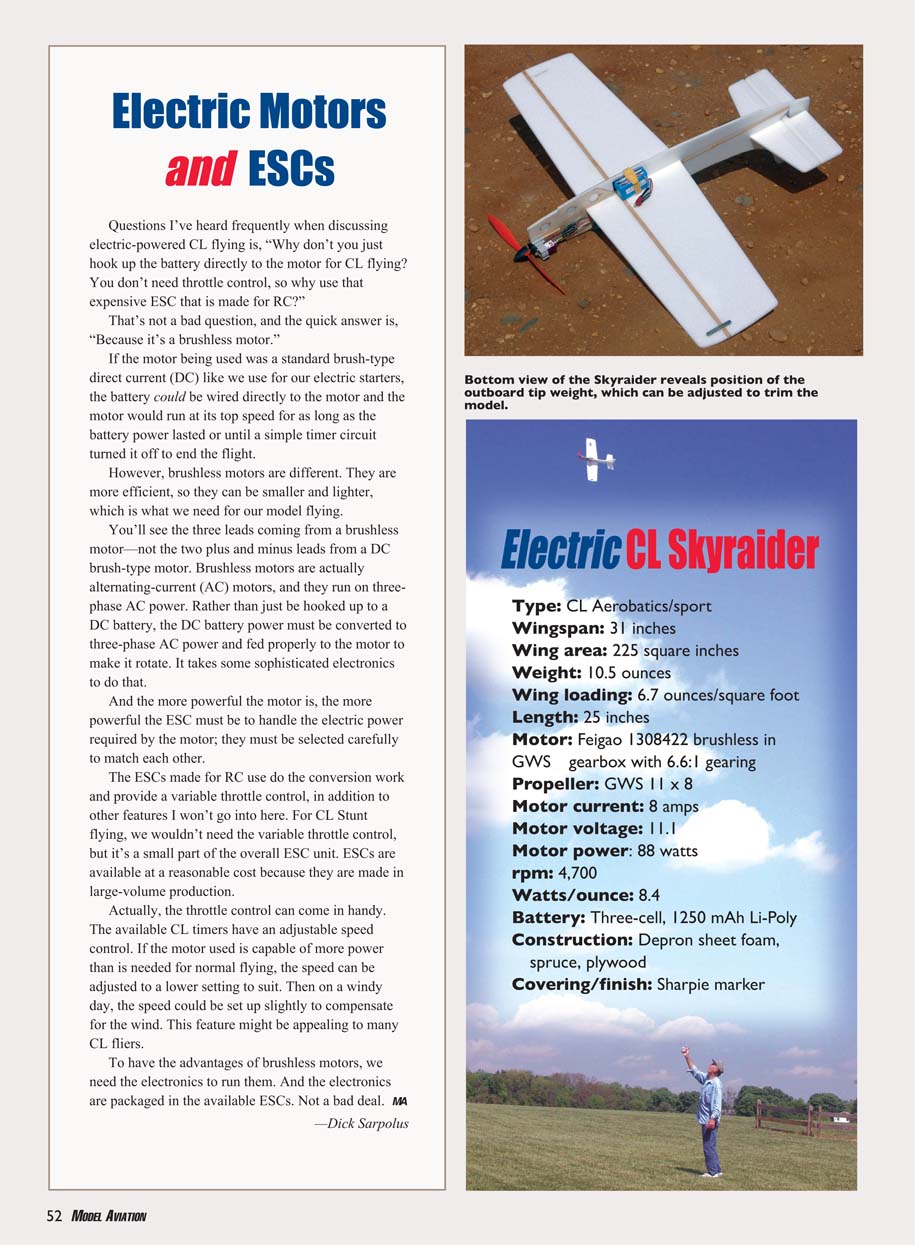
Electric CL Skyraider
Type: CL Aerobatics/sport
Wingspan: 31 inches
Wing area: 225 square inches
Weight: 10.5 ounces
Wing loading: 6.7 ounces/square foot
Length: 25 inches
Motor: Feigao 1308422 brushless in GWS gearbox with 6.6:1 gearing
Propeller: GWS 11 x 8
Motor current: 8 amps
Motor voltage: 11.1
Motor power: 88 watts
rpm: 4,700
Watts/ounce: 8.4
Battery: Three-cell, 1250 mAh Li-Poly
Construction: Depron sheet foam, spruce, plywood
Covering/finish: Sharpie marker
Transcribed from original scans by AI. Minor OCR errors may remain.

