
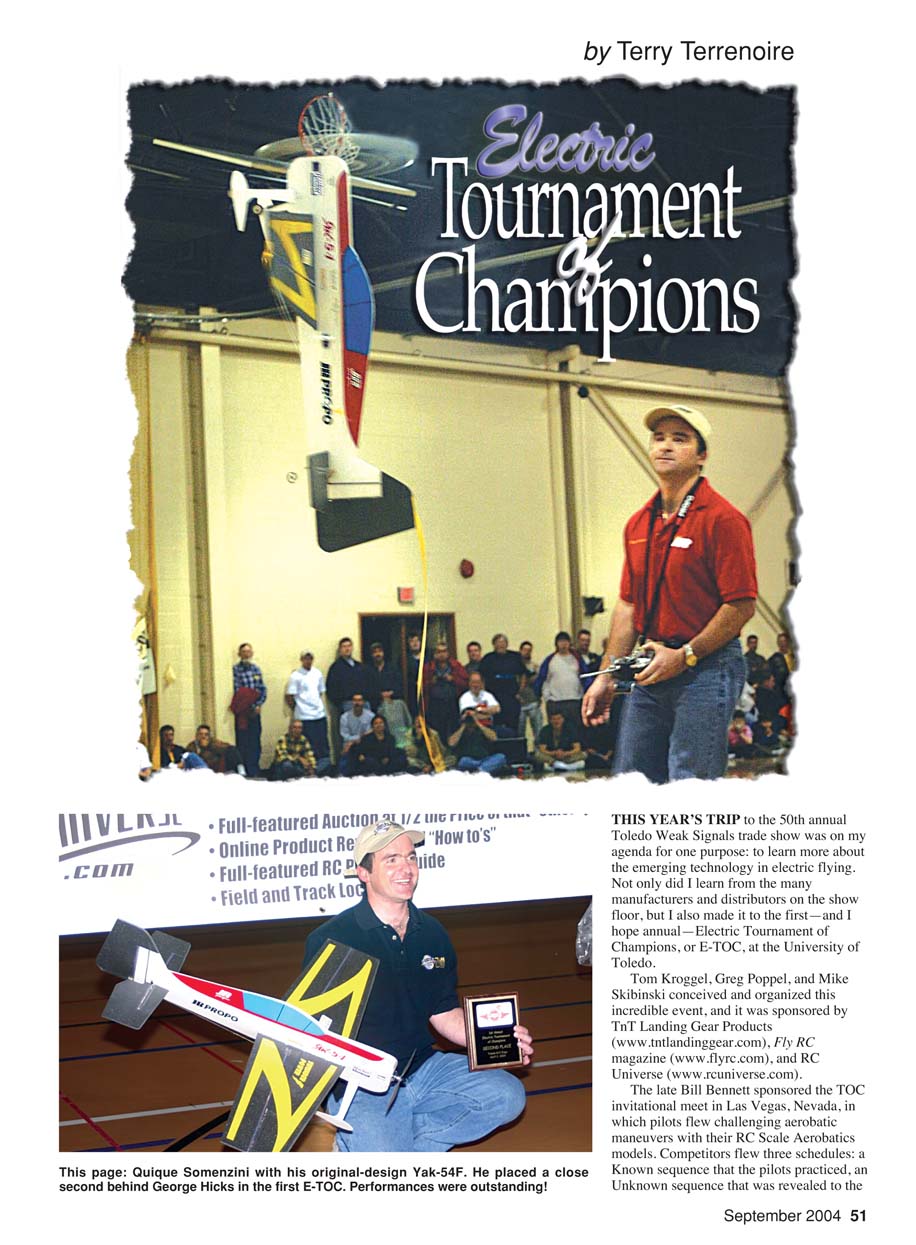
Electric Tournament of Champions
by Terry Terrenoire
Event overview
This year’s trip to the 50th annual Toledo Weak Signals trade show had one purpose: to learn more about the emerging technology in electric flying. In addition to visiting manufacturers and distributors on the show floor, I attended the first— and hopefully annual—Electric Tournament of Champions (E-TOC) at the University of Toledo.
E-TOC was conceived and organized by Tom Kroggel, Greg Poppel, and Mike Skibinski. The event was sponsored by:
- TnT Landing Gear Products (www.tntlandinggear.com)
- Fly RC magazine (www.flyrc.com)
- RC Universe (www.rcuniverse.com)
Background and format
The late Bill Bennett sponsored the TOC invitational meet in Las Vegas, where pilots flew RC scale aerobatics with three schedules: a Known sequence, an Unknown sequence revealed the night before, and a Freestyle sequence (often set to music). Using Bill Bennett’s TOC as a basis, Tom, Greg, and Mike challenged top pilots to present Freestyle programs using only electric-powered airplanes in a low-ceiling gymnasium.
The contest took place on a Friday evening during the Toledo trade show (first weekend in April). Eleven invitees attended the 2004 E-TOC:
- George Hicks
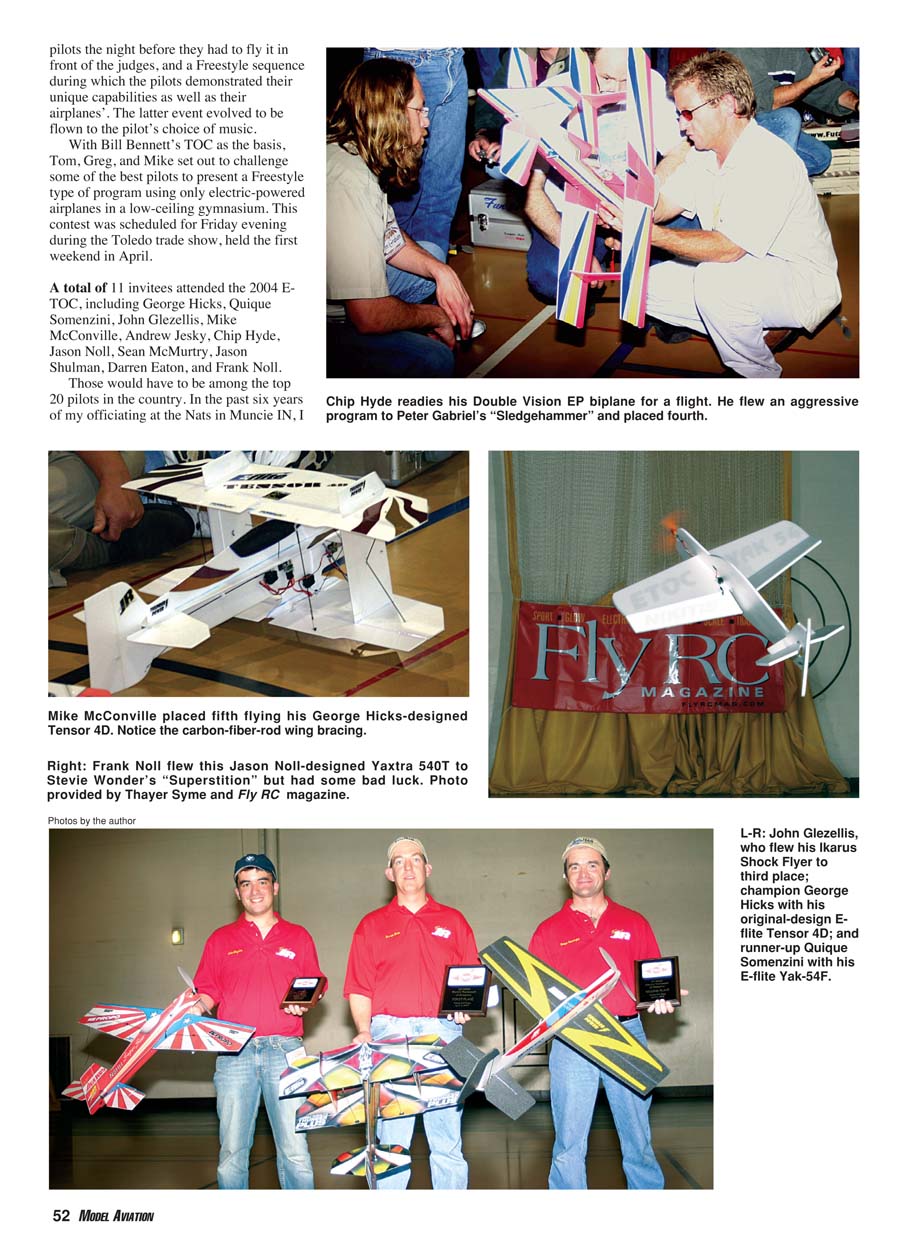
- Quique Somenzini
- John Glezellis
- Mike McConville
- Andrew Jesky
- Chip Hyde
- Jason Noll
- Sean McMurtry
- Jason Shulman
- Darren Eaton
- Frank Noll
The participants flew two qualifying rounds. The top six combined scores from those rounds advanced to the finals, where each finalist flew one additional round to determine the winner. The venue at the University of Toledo had only a 23-foot ceiling. Despite that constraint, pilots presented outstanding two-minute routines choreographed to loud, exciting music that integrated pitching and rolling maneuvers with spectacular hovering and torque-rolling elements.
Results and highlights
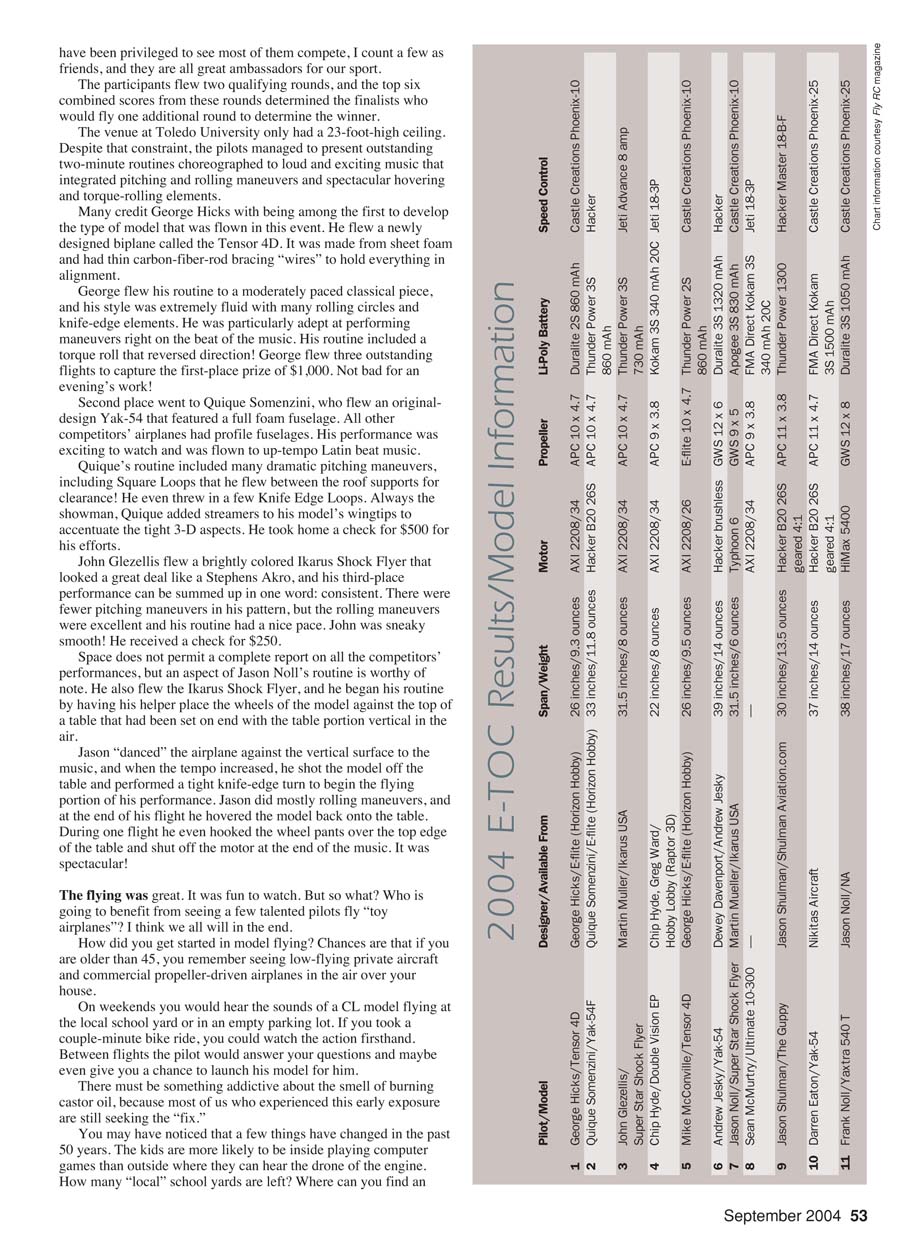
- First place — George Hicks (Tensor 4D) — $1,000
George flew a newly designed biplane called the Tensor 4D, built from sheet foam with thin carbon-fiber-rod bracing “wires.” His routine, set to a moderately paced classical piece, was extremely fluid with many rolling circles, knife-edge elements, and a torque roll that reversed direction. He performed three outstanding flights to capture first place.
- Second place — Quique Somenzini (Yak-54F) — $500
Quique flew an original-design Yak-54 with a full foam fuselage (most other competitors used profile fuselages). He flew to up-tempo Latin-beat music and included dramatic pitching and rolling maneuvers, Square Loops between roof supports, and Knife-Edge Loops. Quique added streamers to his wing tips to accentuate the tight 3-D aspects.
- Third place — John Glezellis (Ikarus Shock Flyer) — $250
John flew a brightly colored Ikarus Shock Flyer that resembled a Stephens Akro. His performance was best described as consistent: fewer pitching maneuvers but excellent rolling maneuvers and a nicely paced, smooth routine.
Other placements:
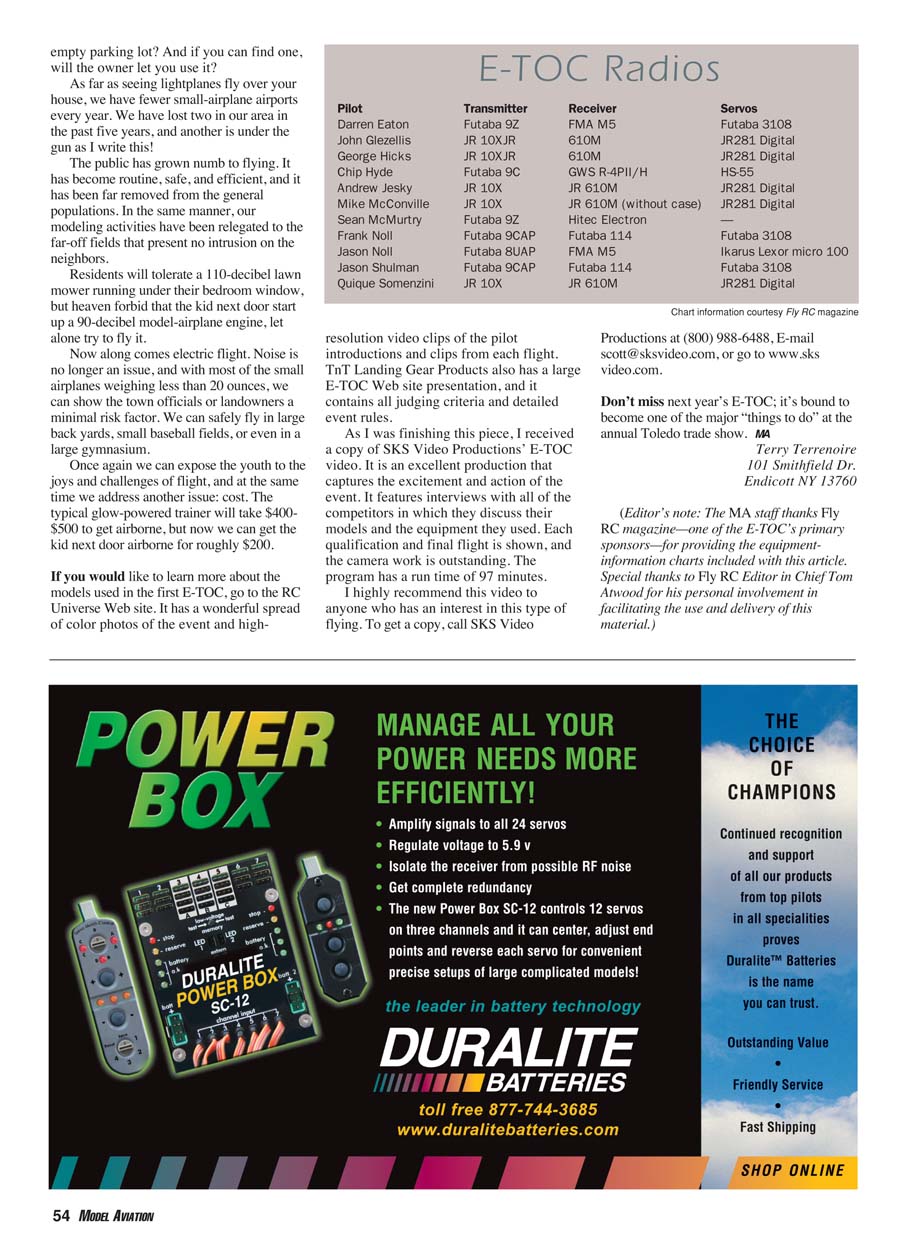
- Fourth — Chip Hyde (flew an aggressive program to Peter Gabriel’s “Sledgehammer”)
- Fifth — Mike McConville (flew a George Hicks–designed Tensor 4D)
Notable performances:
- Jason Noll (Ikarus Shock Flyer) began his routine by having his helper place the model’s wheels against the top of a vertically oriented table. He “danced” the airplane against the vertical surface to the music, then shot the model off the table into a tight knife-edge turn to begin flying. He performed mostly rolling maneuvers and finished by hovering the model back onto the table. In one flight he hooked the wheel pants over the top edge of the table and shut off the motor at the end of the music — a spectacular finish.
Why electric flight matters
The flying was great and fun to watch, but more important is who will benefit from increased exposure to electric flight.
- Accessibility and noise: Electric flight removes the noise barrier that often prevents public demonstrations. Small electric airplanes (many under 20 ounces) permit safe flying in large back yards, small baseball fields, or even gymnasiums.
- Youth exposure: Kids today are more likely to be inside playing computer games than outside watching model aircraft. Electric models make it easier to reintroduce youth to flight because they’re quieter, lower-risk, and can be shown to landowners and town officials as minimal risk activities.
- Cost: Typical glow-powered trainers can cost $400–$500 to get airborne, while electric setups can put a newcomer in the air for roughly $200.
These factors help make the hobby more visible and available to a new generation.
Resources and media
- RC Universe: photo galleries and high-resolution video clips of the event (pilot introductions and flight clips) — www.rcuniverse.com
- TnT Landing Gear Products: E-TOC site with judging criteria and detailed event rules — www.tntlandinggear.com
SKS Video Productions produced an excellent E-TOC video capturing the excitement and action of the event. It features interviews with all competitors discussing their models and equipment, shows each qualification and final flight, and includes outstanding camera work. Runtime: 97 minutes.
To purchase the video:
- Phone: (800) 988-6488
- E-mail: [email protected]
- Web: www.sksvideo.com
Conclusion
Don’t miss next year’s E-TOC; it’s bound to become one of the major “things to do” at the annual Toledo trade show.
Terry Terrenoire 101 Smithfield Dr. Endicott, NY 13760
Editor’s note
The MA staff thanks Fly RC magazine—one of the E-TOC’s primary sponsors—for providing the equipment-information charts included with this article. Special thanks to Fly RC Editor in Chief Tom Atwood for his personal involvement in facilitating the use and delivery of this material.
Transcribed from original scans by AI. Minor OCR errors may remain.

