
Electrics
Greg Gimlick | [email protected]
FAUX PAS — MEA CULPA
Fixing errors that have been published in recent columns.
Going back a couple issues I find that I’ve been errant in a couple of my statements. Some of it is my fault and some of the blame lies elsewhere, but I’d never blame an editor; after all, they are the bosses.
I referenced John Worth’s e-zine and Bob Aberle’s article about the indoor fly at the NEAT (Northeast Electric Aircraft Technology) Fair that was covered extensively. I gave the wrong title to the e-zine, and as a subscriber I knew better. The title of the publication is RC Micro World and the address is www.cloud9rc.com. Subscriptions are available online for AMA members for $20 a year and $30 for nonmembers. You had better join AMA if you haven’t already.
The AstroFlight 120 motor I unashamedly admit to loving in my big WACO is a conventional inrunner. Through some miscommunication between me and MA it was referred to incorrectly in one of my columns. It is an inrunner and an exceptional one! Check it out at www.astroflight.com.
Where Do We Go From Here?
Back to school! I’m going to step back this month and address some basic aspects of getting into electrics. This is a basic primer, not intended as the be-all and end-all of electric flight, but I hope to address some questions I get on a monthly basis.
We have achieved a plug-and-play world in electrics, but you still need to know where to go, what to buy, and why. The key is to help you not waste your money. As the electrics master Keith Shaw has said, “Buy cheap, buy twice.” Don’t confuse inexpensive with cheap, but be smart about your purchases and you’ll thank us for it later.
Where do I learn stuff?
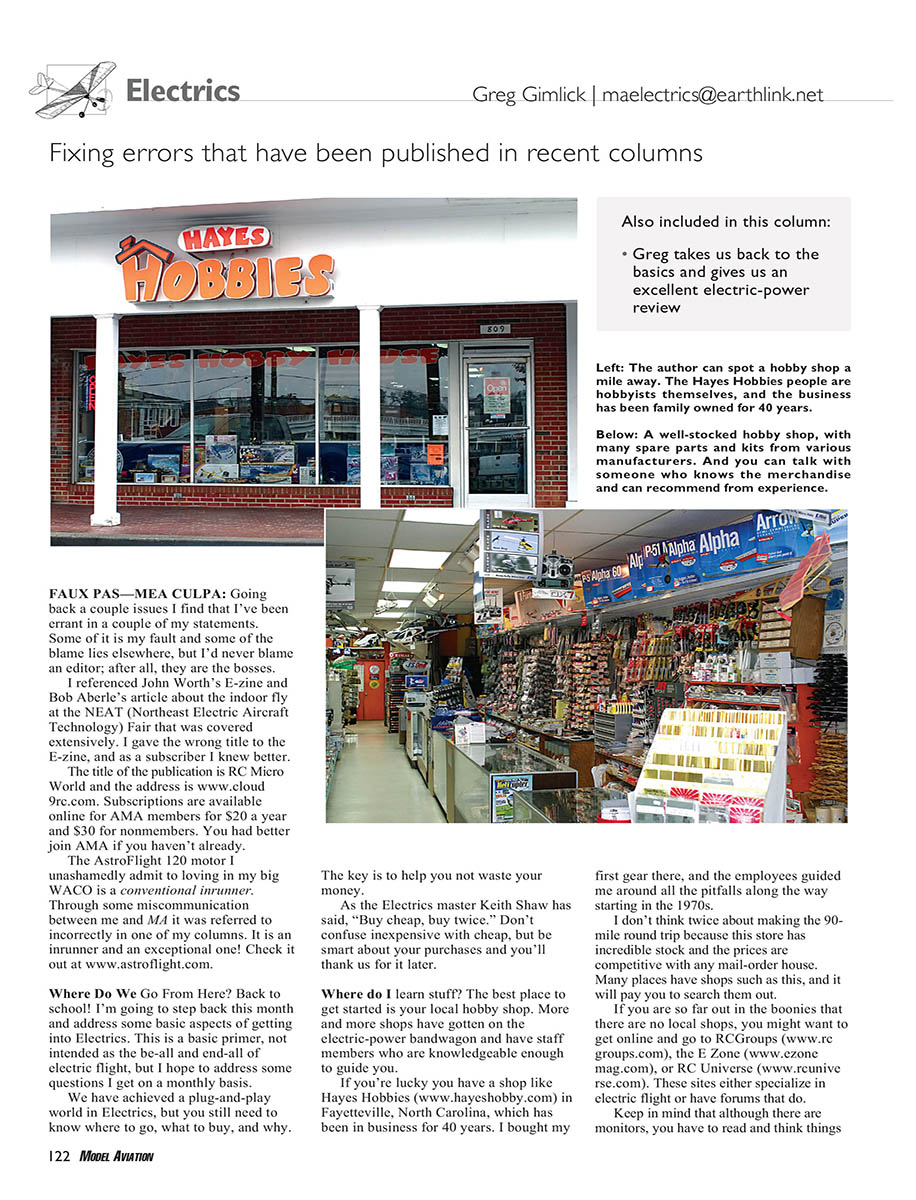
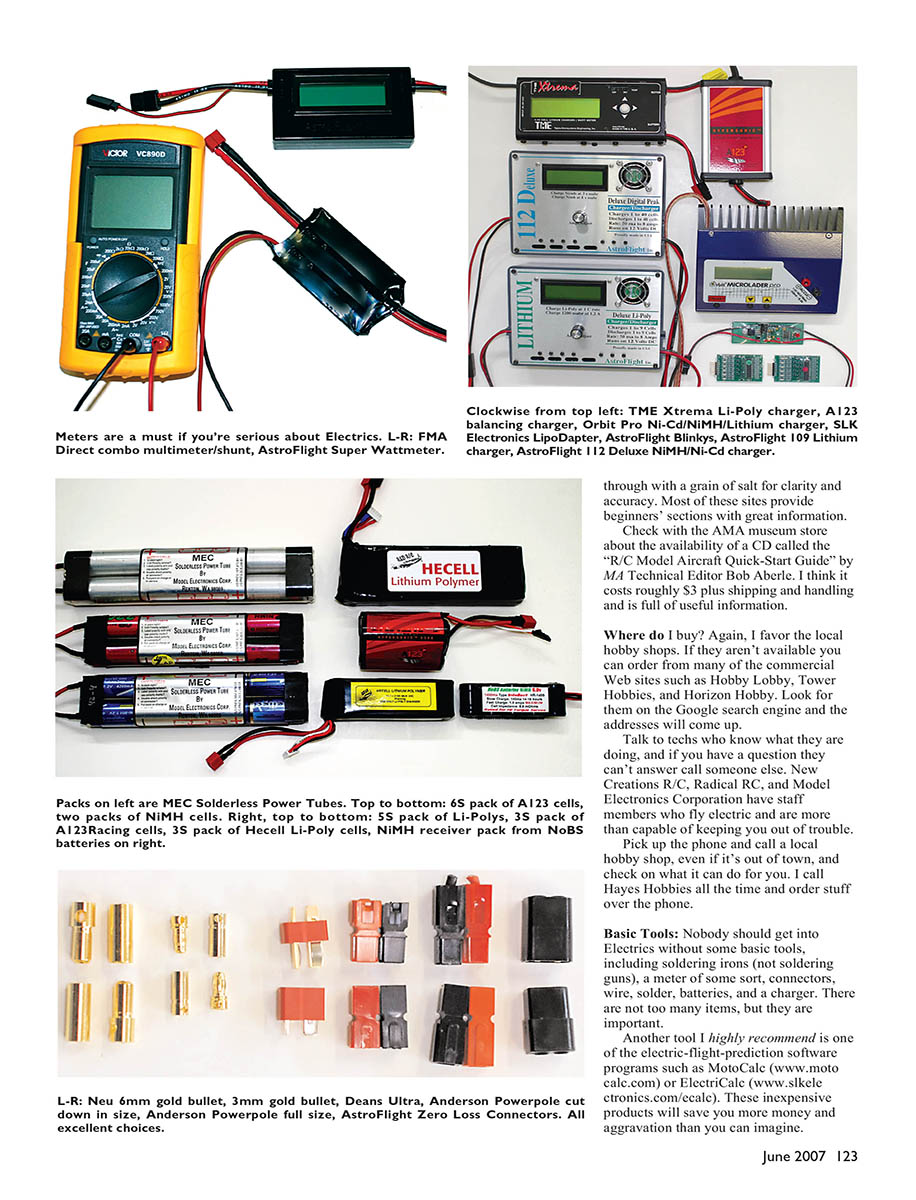
The best place to get started is your local hobby shop. More and more shops have gotten on the electric-power bandwagon and have staff members who are knowledgeable enough to guide you. If you’re lucky you have a shop like Hayes Hobbies (www.hayeshobby.com) in Fayetteville, North Carolina, which has been in business for 40 years. I bought my first gear there, and the employees guided me around all the pitfalls along the way starting in the 1970s. I don’t think twice about making the 90-mile round trip because this store has incredible stock and the prices are competitive with any mail-order house. Many places have shops such as this, and it will pay you to search them out.
If you are so far out in the boonies that there are no local shops, you might want to get online and go to:
- RCGroups — www.rcgroups.com
- E Zone — www.ezonemag.com
- RC Universe — www.rcuniverse.com
These sites either specialize in electric flight or have forums that do. Keep in mind that although there are monitors, you have to read and think things through with a grain of salt for clarity and accuracy. Most of these sites provide beginners' sections with great information.
Check with the AMA museum store about the availability of a CD called the "R/C Model Aircraft Quick-Start Guide" by MA Technical Editor Bob Aberle. I think it costs roughly $3 plus shipping and handling and is full of useful information.
Where do I buy?
Again, I favor the local hobby shops. If they aren't available you can order from many of the commercial web sites such as Hobby Lobby, Tower Hobbies, and Horizon Hobby. Look for them on the Google search engine and the addresses will come up.
Talk to techs who know what they are doing, and if you have a question they can't answer call someone else. New Creations R/C, Radical RC, and Model Electronics Corporation have staff members who fly electric and are more than capable of keeping you out of trouble.
Pick up the phone and call a local hobby shop, even if it's out of town, and check on what it can do for you. I call Hayes Hobbies all the time and order stuff over the phone.
Basic Tools
Nobody should get into electrics without some basic tools, including:
- Soldering irons (not soldering guns)
- A meter of some sort
- Connectors
- Wire
- Solder
- Batteries
- A charger
There are not too many items, but they are important.
Another tool I highly recommend is one of the electric-flight-prediction software programs such as MotoCalc (www.motocalc.com) or ElectriCalc (www.slelectronics.com/ecalc). These inexpensive products will save you more money and aggravation than you can imagine. They have tutorial/help sections that are worth way more than the cost of the programs. I use them when readers write to me and ask for projections because they do all the math and contain more information in their databases of motors and batteries than I could ever hope to assemble. Take my word for it; you will not regret spending the $40.
Meters
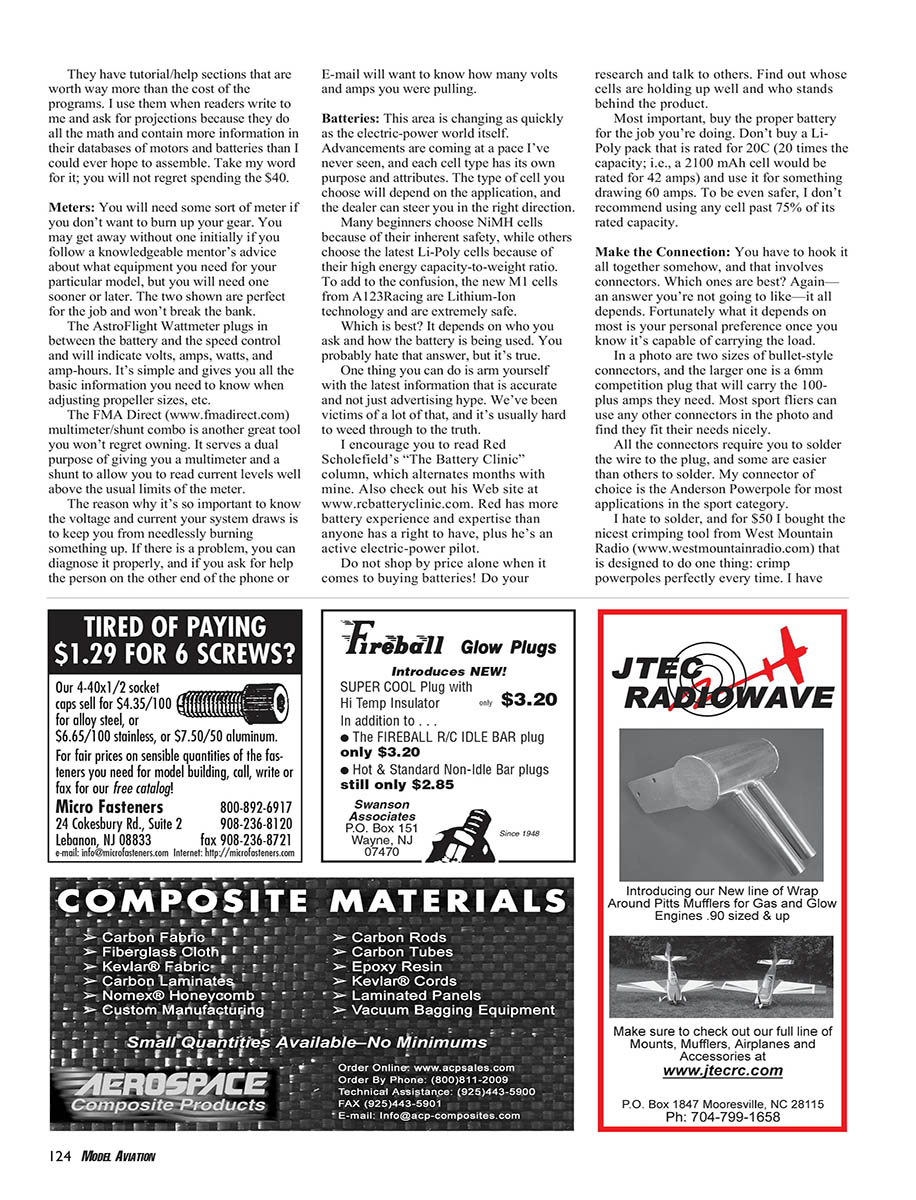
You will need some sort of meter if you don't want to burn up your gear. You may get away without one initially if you follow a knowledgeable mentor's advice about what equipment you need for your particular model, but you will need one sooner or later. The two shown are perfect for the job and won't break the bank.
The AstroFlight Wattmeter plugs in between the battery and the speed control and will indicate volts, amps, watts, and amp-hours. It's simple and gives you all the basic information you need to know when adjusting propeller sizes, etc.
The FMA Direct (www.fmadrirect.com) multimeter/shunt combo is another great tool you won't regret owning. It serves a dual purpose of giving you a multimeter and a shunt to allow you to read current levels well above the usual limits of the meter.
The reason why it's so important to know the voltage and current your system draws is to keep you from needlessly burning something up. If there is a problem, you can diagnose it properly, and if you ask for help the person on the other end of the phone or email will want to know how many volts and amps you were pulling.
Batteries
This area is changing as quickly as the electric-power world itself. Advancements are coming at a pace I've never seen, and each cell type has its own purpose and attributes. The type of cell you choose will depend on the application, and the dealer can steer you in the right direction.
Many beginners choose NiMH cells because of their inherent safety, while others choose the latest Li-Poly cells because of their high energy capacity-to-weight ratio. To add to the confusion, the new M1 cells from A123Racing are Lithium-Ion technology and are extremely safe.
Which is best? It depends on who you ask and how the battery is being used.
One thing you can do is arm yourself with the latest information that is accurate and not just advertising hype. We've been victims of a lot of that, and it's usually hard to weed through to the truth.
I encourage you to read Red Scholefield's "The Battery Clinic" column, which alternates months with mine. Also check out his web site at www.rcbatteryclinic.com. Red has more battery experience and expertise than anyone has a right to have, plus he's an active electric-power pilot.
Do not shop by price alone when it comes to buying batteries! Do your research and talk to others. Find out whose cells are holding up well and who stands behind the product.
Most important, buy the proper battery for the job you're doing. Don't buy a Li-Poly pack that is rated for 20C (20 times the capacity; i.e., a 2100 mAh cell would be rated for 42 amps) and use it for something drawing 60 amps. To be even safer, I don't recommend using any cell past 75% of its rated capacity.
Make the Connection
You have to hook it all together somehow, and that involves connectors. Which ones are best? Again—an answer you're not going to like—it all depends. Fortunately what it depends on most is your personal preference once you know it's capable of carrying the load.
All the connectors require you to solder the wire to the plug, and some are easier than others to solder. My connector of choice is the Anderson Powerpole for most applications in the sport category.
I hate to solder, and for $50 I bought the nicest crimping tool from West Mountain Radio (www.westmountainradio.com) that is designed to do one thing: crimp Powerpoles perfectly every time. I have found them to be extremely reliable.
As far as the actual wire itself, don't use tiny little servo wire even if the connectors will accept it. Buy proper battery wire. For most sport models, 14-gauge wire is fine; for larger models go to 12- or even 10-gauge. Keep the leads short and neat to minimize resistance and clutter.
I have nothing against soldered connectors, and I use a lot of them, but crimping is quick, easy, and avoids any problems associated with poor soldering skills.
Between my motor and controller I prefer either the AstroFlight Astro 3-Pin Zero-Loss Connector or 3mm bullet plugs. It makes it easy to swap a wire or flip the Zero-Loss connector around to fix any problem with motor direction.
Choose the connector you're happy with, and try to standardize your usage to reduce the number of adapters you'll need. I have a box full of adapters because I test so many things that have various plugs on them. All my batteries have Anderson Powerpoles, as do my chargers, but I have adapters to convert them to all the others "just in case."
I'm working on an article that will go much deeper into the various connectors and their relative resistance, etc., that will be published at a later date.
Charge It Up!
So now you've decided on your batteries and connectors; what next? You have to charge those batteries, and the market is exploding with chargers. There are chargers that will do only Li-Polys and chargers that will do only NiCd or NiMH cells. There are chargers that will do them all, log the data onto your computer, and allow you to program any charge rate or cutoff voltage.
How do you choose? What do you want to pay, and what are your long-range goals for electrics?
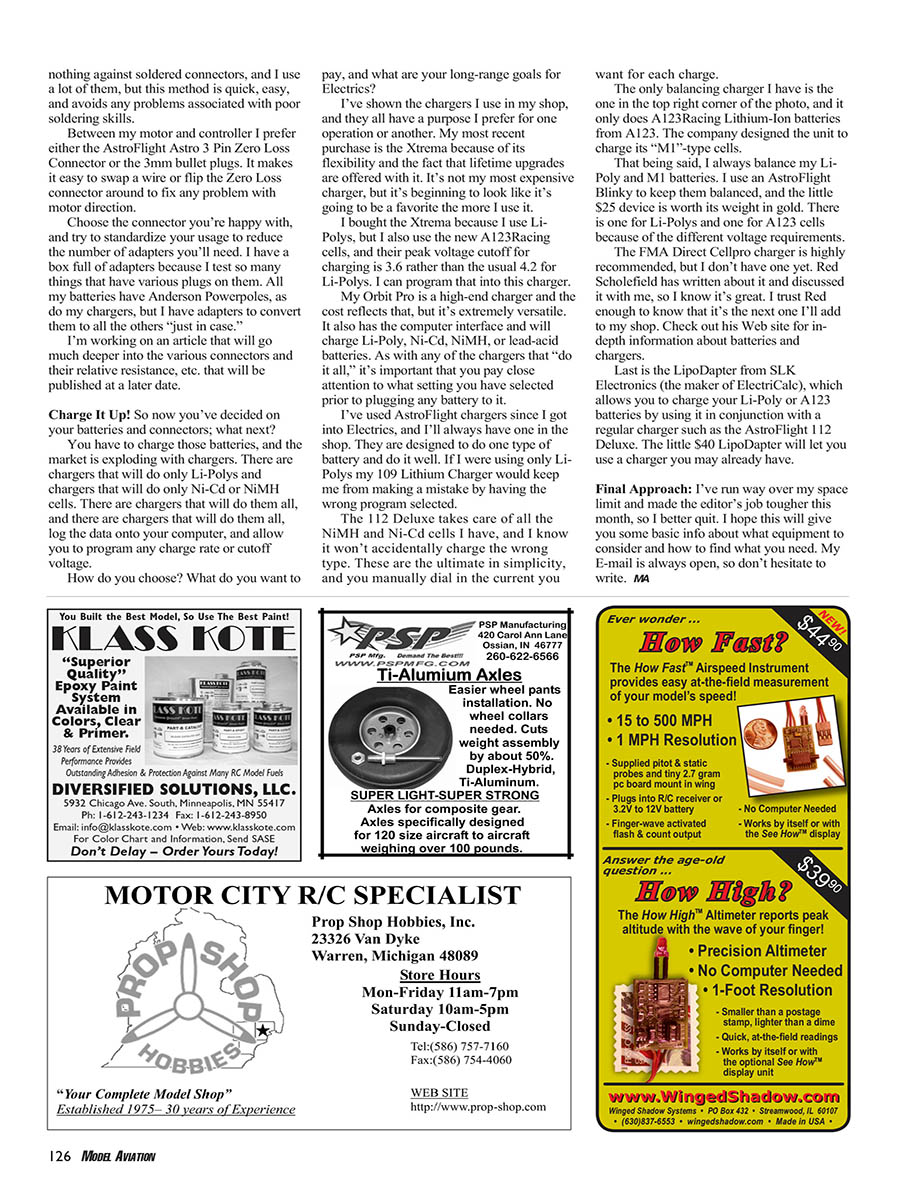
I've shown the chargers I use in my shop, and they all have a purpose I prefer for one operation or another. My most recent purchase is the Xtrema because of its flexibility and the fact that lifetime upgrades are offered with it. It's not my most expensive charger, but it's beginning to look like it's going to be a favorite the more I use it.
I bought the Xtrema because I use Li-Polys, but I also use the new A123Racing cells, and their peak voltage cutoff for charging is 3.6V rather than the usual 4.2V for Li-Polys. I can program that into this charger.
My Orbit Pro is a high-end charger and the cost reflects that, but it's extremely versatile. It also has the computer interface and will charge Li-Poly, NiCd, NiMH, or lead-acid batteries. As with any of the chargers that "do it all," it's important that you pay close attention to what setting you have selected prior to plugging any battery to it.
I've used AstroFlight chargers since I got into electrics, and I'll always have one in the shop. They are designed to do one type of battery and do it well. If I were using only Li-Polys my 109 Lithium Charger would keep me from making a mistake by having the wrong program selected.
The 112 Deluxe takes care of all the NiMH and NiCd cells I have, and I know it won't accidentally charge the wrong type. These are the ultimate in simplicity, and you manually dial in the current you want for each charge.
The only balancing charger I have is the one that only does A123Racing M1 cells. The company designed the unit to charge its M1-type cells.
That being said, I always balance my Li-Poly and NiMH batteries. I use an AstroFlight Blinky to keep them balanced, and the little $25 device is worth its weight in gold. There is one for Li-Polys and one for A123 cells because of the different voltage requirements.
The FMA Direct Cellpro charger is highly recommended, but I don't have one yet. Red Scholefield has written about it and discussed it with me, so I know it's great. I trust Red enough to know that it's the next one I'll add to my shop. Check out his web site for in-depth information about batteries and chargers.
Lastly, the LipoDapter from SLK Electronics (the maker of ElectricCalc) allows you to charge your Li-Poly or A123 batteries by using it in conjunction with a regular charger such as the AstroFlight 112 Deluxe. The little $40 LipoDapter will let you use a charger you may already have.
Final Approach
I've run way over my space limit and made the editor's job tougher this month, so I better quit. I hope this will give you some basic info about what equipment to consider and how to find what you need. My email is always open, so don't hesitate to write.
MA
Transcribed from original scans by AI. Minor OCR errors may remain.

